Chinese
 français
 Deutsch
 italiano
 español
 português
 Nederlands
 日本語
日本語 한국의
한국의




Categories
Hot Products

How to prevent lithium battery explosion
Feb 14,2017
How to prevent lithium battery
explosion
Researchers at Stanford University have recently created a new
"smart" electrospinning separator with a thermal triggering
mechanism that contains a flame retardant that can be used to prevent lithium-ion
battery combustion.
In
such a structure, the flame retardant is packaged in the inside of the polymer
protection shell to prevent the flame retardant from directly dissolving into
the electrolyte, thereby adversely affecting the battery performance.
When the heat inside the lithium battery is too high, the polymer
protective shell will be dissolved because of high temperature, the release of
flame retardants, which effectively inhibit the highly flammable electrolyte
combustion.
The
structure and function of this new electrospinning ultrafine fiber separator
are as follows:
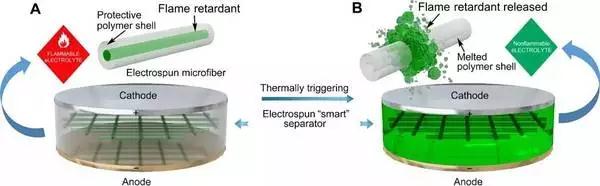
The
description of the graph is as follows:
(A)This
separate separator consists of ultra-fine fibers, with a "core-shell"
structure, flame retardant in the core, the polymer is the shell. Flame
retardants are packaged in the interior of the polymer protection shell to
prevent direct dissolution in the electrolyte and cause side effects on
the electrochemical performance of the cell.
(B)When the
heat is too high after the trigger, the polymer protective shell dissolved, and
then packaged in the internal release of the flame retardant into the
electrolyte, effectively preventing the electrolyte ignition and combustion.
In
addition, the scientists also mentioned in the paper of the ultra-fine fiber separator material and the manufacture of microscopic diagram:
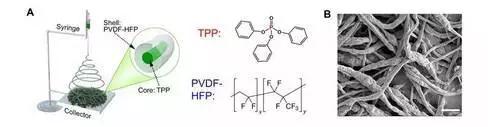
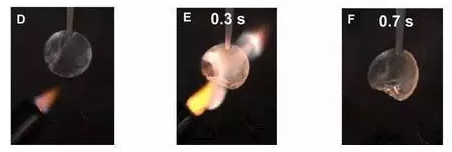
Flame retardants use a cheap, powerful, commonly used material "triphenyl phosphate." During normal operation of the cell, the flame retardant is well contained within the polymeric protective shell, which dissolves when the temperature of the separator is above a certain temperature. In the experiment, the flame retardant completely extinguished the electrolyte fire only 0.4 seconds, as shown below 0.3 seconds when the lithium battery on fire, 0.7 seconds when the fire was extinguished.
 subscribe to us