Chinese
 français
 Deutsch
 italiano
 español
 português
 Nederlands
 日本語
 한국의




- Home
- >
- Electrode Preparation
- >
- Battery Slurry Mixer
- >
- 20L Vacuum Planetary Mixing Machine
Categories
Hot Products
Loading...
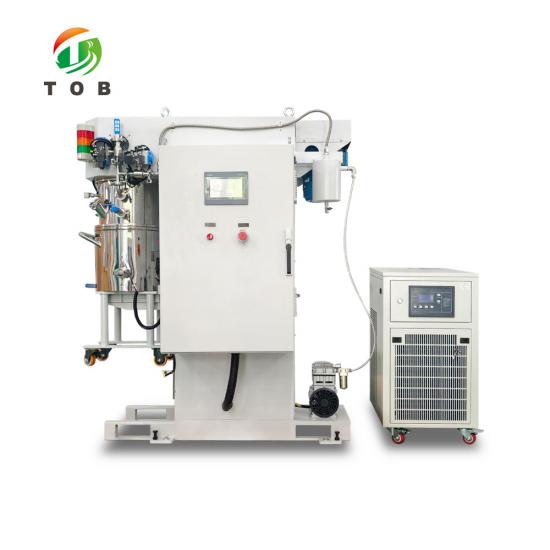
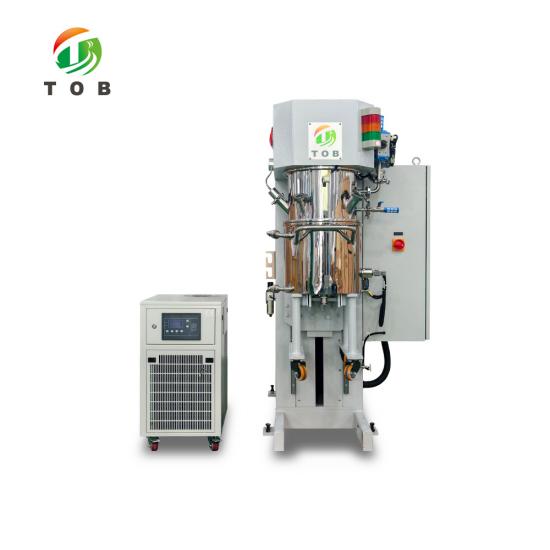
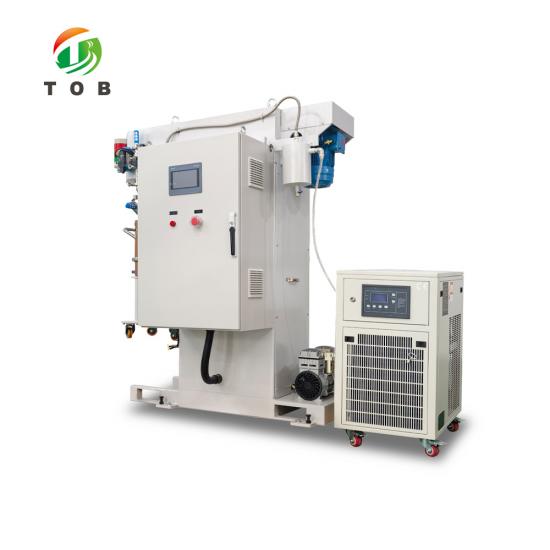
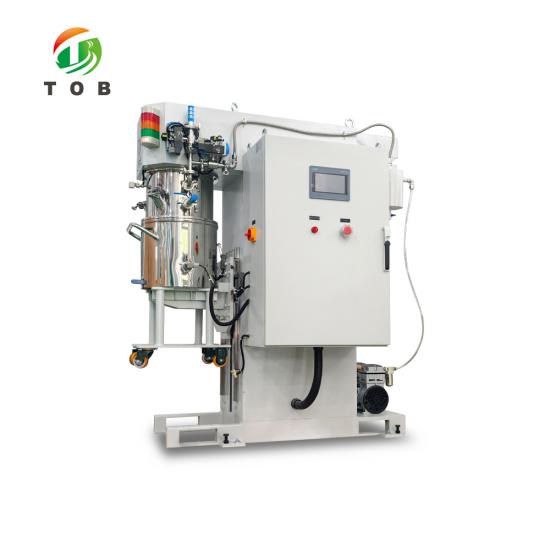

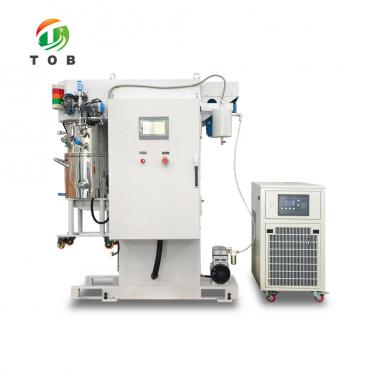
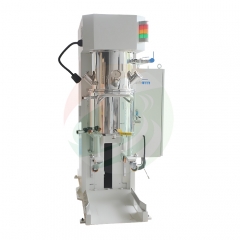
20L Vacuum Planetary Mixing Machine
Brand:
TOB NEW ENERGYitem no.:
TOB-XFZH20order(moq):
1setPayment:
L/C,T/Tproduct origin:
Chinashipping port:
XIAMEN
20L Vacuum Planetary Mixing Machine - TOB-XFZH20
Product Overview and Ideal Applications
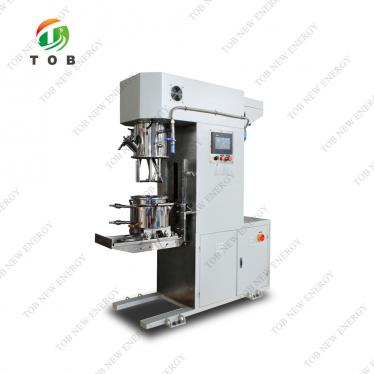
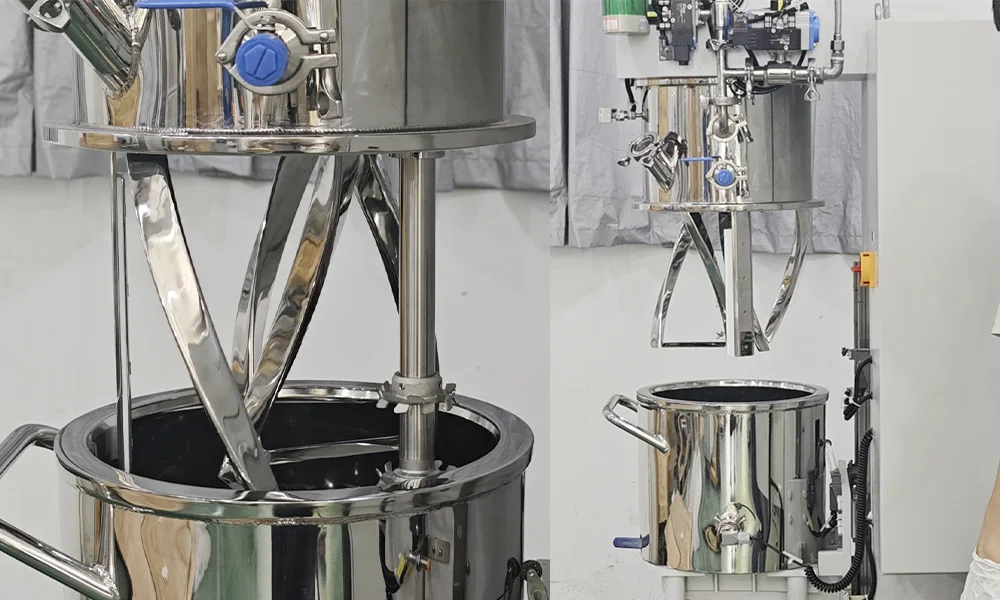
The TOB-XFZH20 is a 20L vacuum planetary mixing machine for battery slurry. It combines planetary stirring with high-speed dispersion in a single jacketed barrel, so that powder and liquid are wetted, dispersed and degassed without being transferred between vessels. The barrel is designed for a 28L total volume with a working volume of 8-20L, driven by a 2.2kw mixing motor at 8-86rpm and a 3kw dispersing motor at 600-6000rpm.
The machine is built for high-viscosity duty rather than for low-viscosity blending: the planetary box rotates at 5-53rpm and the mixing blade tip runs at 0.09-0.9m/s, which keeps a heavy paste moving instead of leaving a dead zone at the barrel wall. The wall scraping arm, the jacketed barrel and the vacuum ports on the upper barrel are what allow the same batch to be mixed, dispersed and de-aerated under one process window.
Ideal for:
- Battery electrode slurry where powders and liquids have to be brought to a uniform slurry in one vessel
- High-viscosity processes, up to an operating viscosity of ≤ 1.2 million cP
- Batches of 8-20L, which covers laboratory confirmation and small pilot runs
- Processes that need mixing and dispersion in the same step, rather than in two separate machines
- Not for: free-flowing dry powders or thin liquids. The mixing blade is a variable cross-section spiral twist type with a 2pcs blade set in a 350mm barrel, and the wall scraping arm is the part that removes material from the barrel wall. For those duties, choose a machine built for that material form instead.
Where the 20L Mixer Fits in Battery Slurry Preparation
The mixing step sits between powder and liquid handling and the coating step. Vacuum mixing is used at the point where the slurry has to be brought to its final solids content and de-aerated before it leaves for the coater, which is why the barrel is jacketed, sealable and fitted with evacuation and exhaust ports rather than being an open tank:
- Powder and liquid are charged through the upper barrel ports, with the powder feed port being a quick opening interface DN50 and the liquid feed port shared with it
- The barrel is raised on the electric lifting column and locked, with the mixing barrel able to rise only after it is in place
- Mixing and dispersion take place here, with the planetary blade turning at 8-86rpm and the serrated dispersing plate at 600-6000rpm in the same barrel
- The jacketed wall and bottom carry the cooling or heating medium so that the batch temperature is held during dispersion, and the digital temperature display gauge shows the material temperature
- The vacuum buffer tank prevents vacuum pump oil from flowing back into the drum, and the slurry is discharged through the 1" Three-piece discharge ball valve at the barrel bottom
- The mixed slurry leaves for coating, for example on a slot die coater electrode coating machine
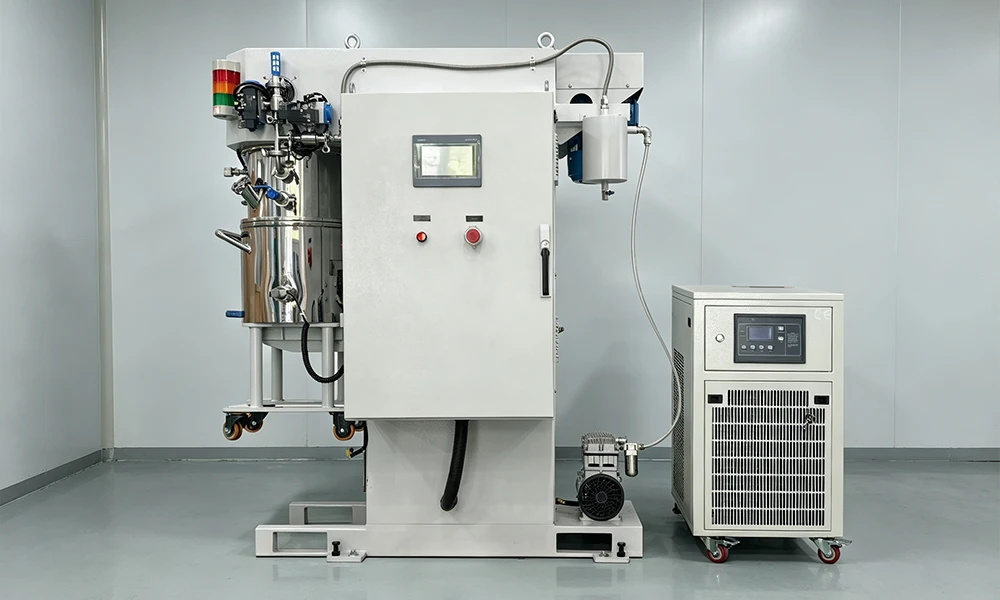
Key Engineering Characteristics of TOB-XFZH20
1. Jacketed Barrel and Discharge
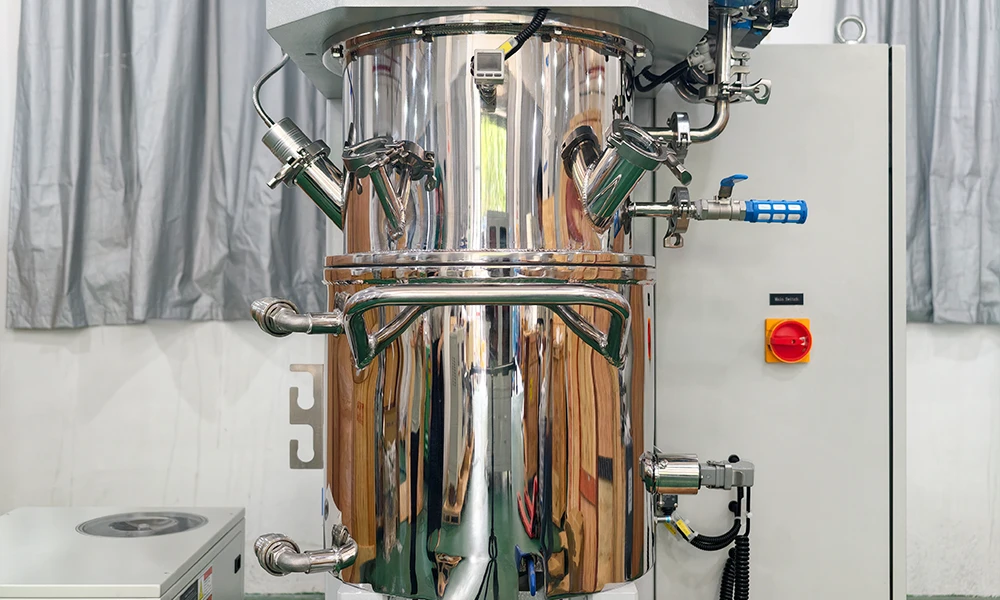
- 28L total volume with an 8-20L working volume: the barrel is sized so that a batch can be mixed, dispersed and degassed without the material climbing above the working range. A 350mm inner diameter and 300mm inside depth give the blade and the dispersing plate room to turn without crowding the wall.
- Single jacketed wall and bottom: both the barrel wall and the barrel bottom carry the tempering medium, so heat from a high-speed dispersion step is removed from the side and from the base rather than from one surface only.
- Discharge from the bottom: a 1" three-piece discharge ball valve at the barrel bottom lets a high-viscosity batch leave under gravity after the vacuum is released, without lifting the barrel contents out by hand.
2. Mixing System
- 2.2kw at 8-86rpm, planetary box at 5-53rpm: the low blade speed is what makes a heavy paste workable. The blade travels the barrel rather than staying in one place, which is the difference between a planetary mixer and a simple stirrer.
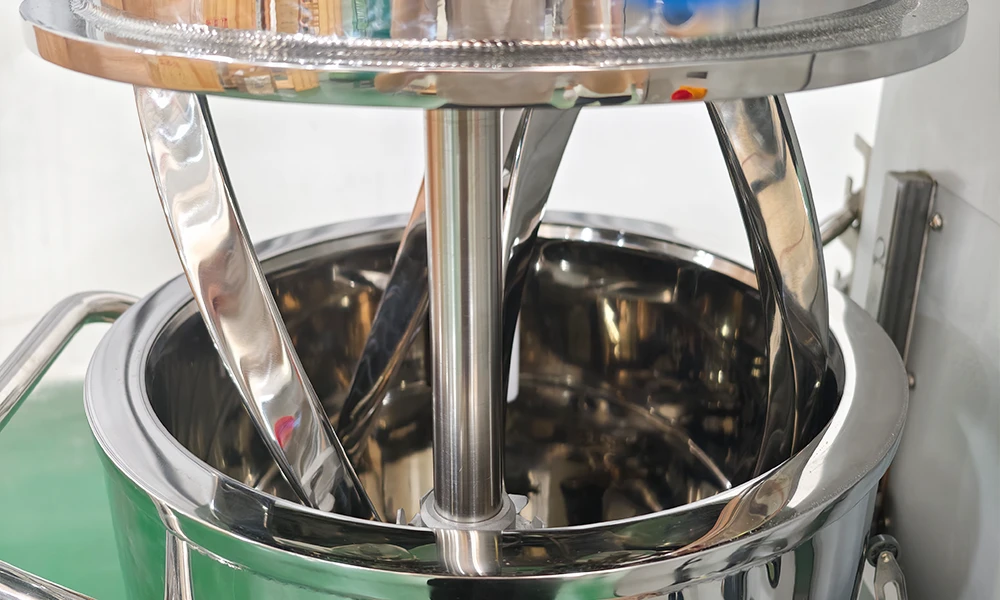
- Blade geometry and clearance: two variable cross-section spiral twist blades with a 90 ° helix, 194mm in diameter, set 7±2.5mm apart, 3+1.5mm from the barrel wall and 3+1mm from the barrel bottom. These clearances are the practical numbers behind a uniform batch, because material that sits beyond the blade path is not being mixed.
- Blade tip speed of 0.09-0.9m/s: reported as line speed rather than only as rpm, which is the figure that can be compared against a different machine size when a process is scaled.
3. Dispersing System and Wall Scraping
- 3kw at 600-6000rpm: the dispersing shaft runs an order of magnitude faster than the mixing blade, with a tip speed of 2.1-21m/s. It is the step that breaks agglomerates that planetary stirring alone leaves intact.
- Serrated 70mm dispersing plate, 2pcs: a serrated plate creates local high shear at the tooth edge, which is where de-agglomeration happens.
- Removable Teflon wall scraper: the scraping arm turns at the planetary box speed and holds the material off the barrel wall. It is a removable design, and has to be removed when scraping the wall on a high viscosity process, so the working clearance changes with the duty rather than being fixed.
4. Sealing, Lifting and Process Control
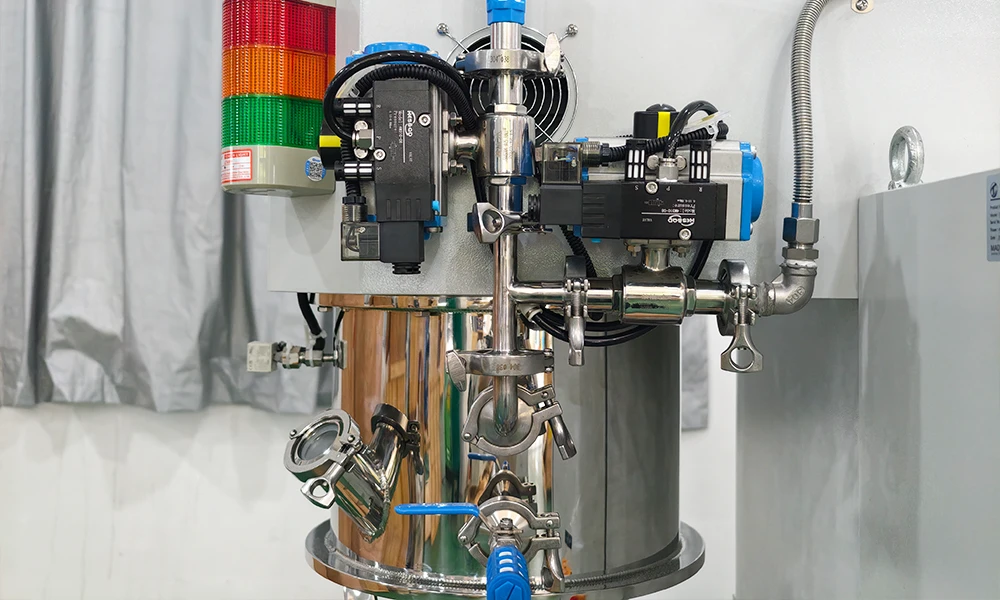
- Ports for a closed process: the upper barrel carries a quick opening DN50 powder feed port shared with the liquid feed, evacuation and exhaust ports at G1/2" inner wire, a spare ISO quick opening 3/4" port, a DN50 spotlight port and an M14×1.5 digital vacuum gauge port. A closed barrel with a vacuum gauge port is what makes degassing a controlled step rather than an assumption.
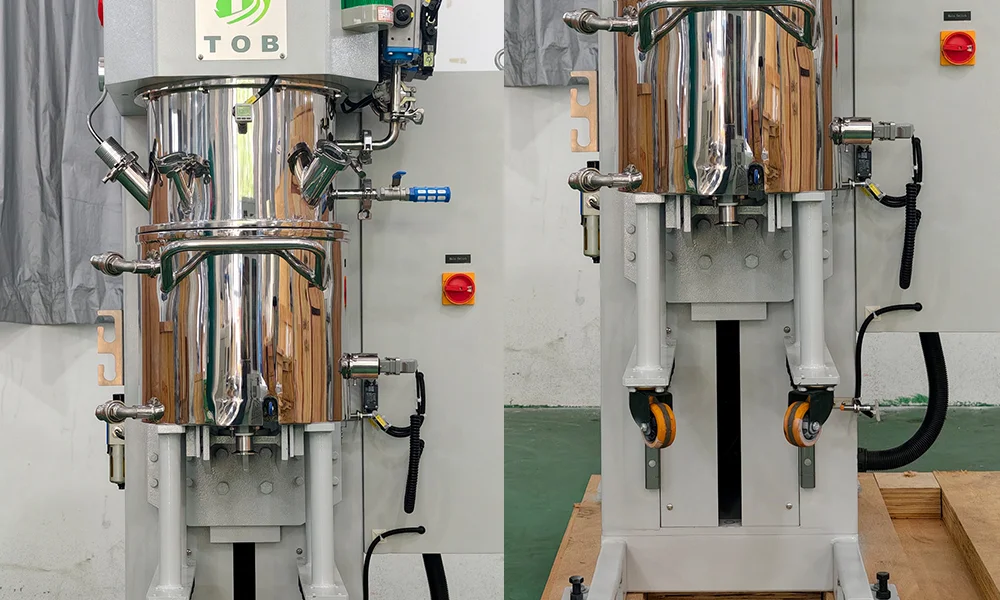
- Electric lifting on a linear guide, ≤450mm: the base is high rigidity structural carbon steel and the barrel is raised electrically along a high-precision linear guide, which keeps the barrel aligned with the mixing head over repeated cycles.
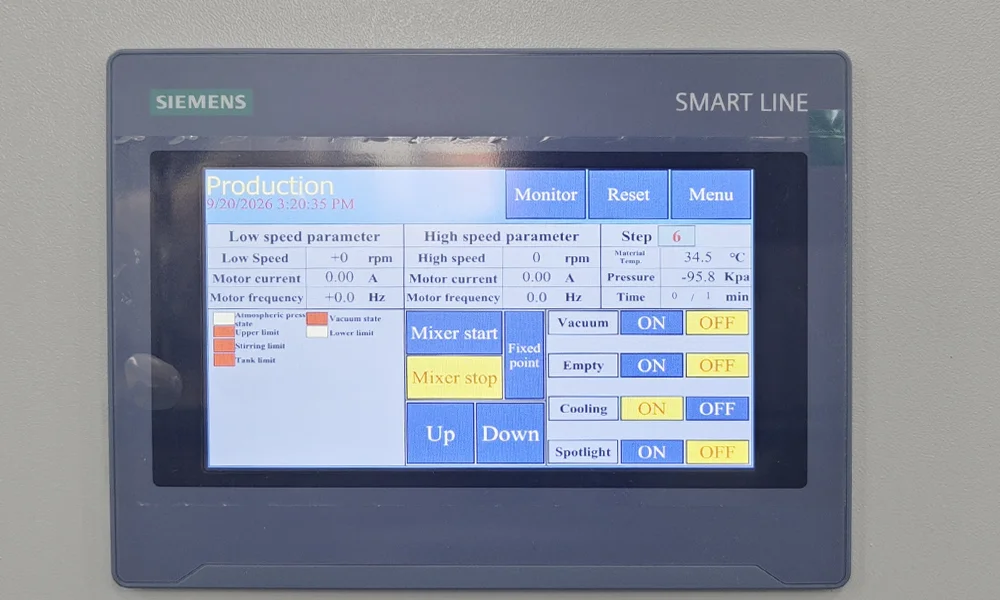
- Inverter control with a touch screen speed display: power control and speed adjustment are by inverter start and control, the speed is shown on a touch screen, and the timer controls both dispersion and stirring. A 1pcs emergency stop button and an over-temperature alarm with alarm shutdown are part of the same panel.
- Safety chain, not a single interlock: the barrel can be turned only when it is in place, cannot be lowered or opened while mixing, high-speed dispersion can only start after the barrel is in place, and the barrel cannot be lowered until the vacuum is released. The list below sets out each condition.
Complete Technical Specifications
Product pictures are for reference only, please refer to the actual machine
1. Lower Barrel Parts
| Parameter | Value |
|---|---|
| Design total volume | 28L |
| Elective volume | 8-20L |
| Container inner diameter | 350mm |
| Container inside depth | 300mm |
| Container material | The parts in connect with materials is 304 stainless steel |
| Tempering jacket form | Single jacketed barrel wall for cooling or heating; single jacketed barrel bottom for cooling or heating |
| Tempering jacket port | G1/2",with quick opening movable joint |
| Jacket withstand pressure | ≤0.4MPa |
| Tempering jacket circulation system | prepared by customer |
| Jacket water inlet temperature | ≤8℃ |
| Cooling water flow | >10L/min |
| Discharge materials form | bottom of a 1" Three-piece discharge ball valve |
| Design environment temperature | -10~+120°C |
| Move mode | Casters move |
2. Mixing Parts
| Parameter | Value |
|---|---|
| Working frequency | 5-50hz |
| Mixing power | 2.2kw |
| Mixing blade speed | 8-86rpm |
| Planetary box rotate speed | 5-53rpm |
| Mixing blade diameter | 194mm |
| Mixing blade model | Variable cross-section spiral twist type, 90 ° helix |
| Mixing blade material | 304 stainless steel |
| Mixing blade line speed | 0.09-0.9m/s |
| Mixing blade number | 2pcs |
| Distance between blade and blade | 7±2.5mm |
| Distance between blade and barrel wall | 3+1.5mm |
| Distance between blade and barrel bottom | 3+1mm |
3. Dispersing Parts
| Parameter | Value |
|---|---|
| Working frequency | 5-50hz |
| Dispersing power | 3kw |
| Dispersing rotate speed | 600-6000rpm |
| Dispersing plate diameter | 70mm |
| Dispersing model | Serrated |
| Dispersing plate material | 304 stainless steel |
| Dispersing line speed | 2.1-21m/s |
| Dispersing number | 2pcs |
| Dispersing shaft number | 1pcs |
4. Scratch the Wall Parts
| Parameter | Value |
|---|---|
| Scratch wall bracket material | 304 stainless steel |
| Scratch wall material | Teflon |
| Scratch wall rotate speed | Consistent with planetary box rotate speed |
| Removable or not | Removable design (Need to remove when scraping the wall on high viscosity process) |
5. Base and Lifting Parts
| Parameter | Value |
|---|---|
| Parts materials | High rigidity structural carbon steel |
| Lifting way | electric |
| Lifting guide | High-precision linear guide |
| Lifting itinerary | ≤450mm |
6. Upper Barrel Parts
| Parameter | Value |
|---|---|
| Upper barrel material | 304 stainless steel |
| Powder feed port | quick opening interface DN50 1pcs |
| Liquid feed port | Shared with powder feed port |
| Spotlight port | DN50 1pcs |
| Evacuation port | G1/2" inner wire 1pcs |
| Exhaust port | G1/2" inner wire 1pcs |
| Spare port | ISO quick opening 3/4" 1pcs |
| Digital vacuum gauge port | M14×1.5 Internal thread metric tooth interface 1pcs |
7. Control System
| Parameter | Value |
|---|---|
| Electrical cabinet | Used to install low-voltage electrical components such as inverter |
| Manual operation panel | For placement buttons, knobs, gauges etc |
| Power supply | AC 3×380V±5﹪,50Hz |
| Control mode | Electric control + liquid control |
| Power control and speed adjustment mode | Inverter start and control |
| Cooling mode | Air-cooled (wind cooling)and liquid-cooled |
| Operation mode | The panel on the electric cabinet operates the corresponding button + knob |
| Digital temperature display gauge | material temperature |
| Emergency stop button | 1pcs |
| Alarm system | Over-temperature alarm, over-temperature alarm shutdown, alarm shutdown |
| Speed display | Touch screen shows the speed |
| Power instructions | 1pcs |
| Timer | 1pcs, control both dispersion and stirring |
Note: If you choose the human-machine interface system configuration, the relevant content of the control system is integrated into the touch screen control
8. Safety Chain System
| Condition | Behaviour |
|---|---|
| Emergency stop | Press the emergency stop switch, the equipment will stop immediately and no operation can be performed |
| Start low speed stirring and mixing | you can turn the barrel while it is rising |
| High-speed dispersion | the barrel can be turned only when it is in place |
| Safety lock during operation | when the machine is running and mixing, the mixing barrel cannot be lowered and cannot be opened |
| Prevent vacuum pipeline backflow | special vacuum buffer tank design can effectively prevent vacuum pump oil from flowing back into the mixing drum |
| Operation fault stop | the inverter is protected by overload, overcurrent, overvoltage, leakage, lack of equal etc. |
| Mixing barrel lifting | the mixing barrel can rise only after it is in place; cannot be lowered until the vacuum is discharged from the mixing barrel (normal pressure is not restored) |
- High-speed dispersion can only be started after the mixing barrel is in place
- The mixing drum is equipped with a locking protection system after it is raised to a high position to prevent the drum from falling abnormally during work
- The dry mixing stage requires the mixing paddle to rotate and raise the barrel at the same time
Selection Guide: Choosing Between the 20L Model and Other Capacities
The three models below share the same mixing principle and the same stated operating viscosity, so the choice is made on batch size and on how much dispersing power the formulation needs. The values are those published for each model.
| Decision point | TOB-XFZH20 (this model) | 10L model | 150L model |
|---|---|---|---|
| Working volume | 8-20L | 5-10L | 95-150L |
| Design volume | 28L | 16L | 216L |
| Mixing power | 2.2kw | 2.2kw | 15kw |
| Dispersing power | 3kw | 3kw | 18.5kw |
| Dispersing rotate speed | 600-6000rpm | 600-6100rpm | 216-2850rpm |
| Dispersing plate diameter | 70mm | 70mm | 155mm |
| Operating viscosity | ≤ 1.2 million cP | ≤ 1.2 million cP | ≤ 1.2 million cP |
| Choose it when | A batch of 8-20L has to be mixed, dispersed and degassed in one barrel | Formulation work is still at the 5-10L stage, see the 10L Vacuum Planetary Mixing Machine | The batch has moved past pilot size, see the 150L Planetary Vacuum Mixing and Dispersing Machine |
For an intermediate step, the 30L Vacuum Planetary Mixer for Battery Slurry sits between this model and the 150L machine.
Practical Operating Recommendations
- Confirm the utility supply before installation: the tempering jacket circulation system is prepared by customer, and the stated requirements are a jacket water inlet temperature of ≤8℃ and a cooling water flow of >10L/min, with a jacket withstand pressure of ≤0.4MPa. Power supply is AC 3×380V±5﹪,50Hz. Both are site responsibilities, not machine functions.
- Plan the batch around the working volume: 8-20L against a 28L design volume. Charging below the lower figure leaves the mixing blade without enough material to work against; charging above the upper figure leaves no headspace for the dispersion step to fold material back down.
- Match the wall scraper to the duty: the scraper is a removable design and has to be removed when scraping the wall on a high viscosity process. Decide this before the batch starts rather than after material has built up on the wall.
- Release the vacuum before lowering the barrel: the barrel cannot be lowered until the vacuum is discharged (normal pressure is not restored), so build the venting step into the batch procedure.
- Use the line speeds when transferring a process: the mixing blade is rated at 0.09-0.9m/s and the dispersing plate at 2.1-21m/s. Comparing a new formulation across machines on rpm alone will not reproduce the shear it saw in the previous barrel.
Engineering FAQ
Q1: Why does this machine carry a 2.2kw mixing drive and a separate 3kw dispersing drive instead of one motor?
Because the two duties need opposite conditions. Keeping a heavy paste in motion needs torque at low speed, which is why the blade turns at 8-86rpm. Breaking agglomerates needs a high shear rate, which is why the dispersing plate turns at 600-6000rpm. One drive cannot sit at both ends of that range, and a single shaft run fast enough to disperse would not move a 1 million cP paste. Providing them as two systems in one barrel is what removes the transfer step between a mixer and a separate disperser.
Q2: How do I decide whether my formulation belongs on this 20L model or on a different capacity?
By the batch size you intend to run repeatedly, not by the largest batch you can imagine. This model works from 8-20L. If the formulation is still being settled, smaller capacities let you change the recipe with less material at risk; if the batch has already been fixed at pilot scale, the next size up avoids running the same recipe several times to fill one production batch. All three capacities in the comparison above share the same stated viscosity range, so viscosity alone does not decide the size.
Q3: What has to be ready on site before the machine can run?
Three things. The tempering jacket circulation system is prepared by customer, and has to deliver a jacket water inlet temperature of ≤8℃ at a cooling water flow of >10L/min with the jacket held at ≤0.4MPa. The power supply is AC 3×380V±5﹪,50Hz. And because the machine is cooled by air-cooled (wind cooling)and liquid-cooled means, the surrounding area has to allow both the cabinet airflow and the cooling circuit. None of the three is supplied as part of the machine.
Q4: Why is the wall scraper described as removable rather than permanently fitted?
Because on a high viscosity process it has to be removed. The scraper is a Teflon arm on a 304 stainless steel bracket that turns at the planetary box speed, and on a heavy paste it works against a much higher load than on a thin one. The published note is that it is a removable design and needs to be removed when scraping the wall on high viscosity process, which means the working configuration changes with the duty rather than staying fixed.
Q5: What happens if the barrel is lowered while the vacuum is still held?
The machine will not allow it. The barrel can rise only after it is in place and cannot be lowered until the vacuum is discharged and normal pressure is restored. This is part of the safety chain rather than a procedure the operator has to remember, and it is the same chain that prevents the barrel being opened or lowered while mixing is running.
Q6: When does it make sense to move to a larger machine instead of adding a second run on this one?
When the batch size is genuinely fixed and repeatable. The dispersing power per litre falls as capacity rises, which is why a 150L machine carries 15kw mixing and 18.5kw dispersing against 2.2kw and 3kw here. A larger machine is the right answer when the formulation and the batch size are settled; running the recipe twice at 20L is usually the better answer while the formulation is still moving.
Q7: What is not part of the machine as supplied?
The tempering jacket circulation system is prepared by customer. The vacuum pump and the cooling circuit are similarly site-side items, connected through the evacuation port at G1/2" inner wire and the jacket port at G1/2",with quick opening movable joint. The machine itself provides the sealed barrel, the mixing and dispersing systems, the lifting column and the control cabinet.
Planning a high viscosity slurry batch between 8L and 20L? Send us the powder, the liquid, the target solids content and your batch size, and we will go through the parameters with you.
tob.amy@tobmachine.com | +86 181 2071 5609
Reviewed by: Pinery Gong, Principal Engineer - battery assembly process and yield engineering, XIAMEN TOB NEW ENERGY TECHNOLOGY Co., Ltd. | Last updated: 2026-10-15
You May Also Need
-
10L Vacuum Planetary Mixing Machine - the smaller model in the same range, with a 16L design volume and a 5-10L working volume. Choose it when the formulation is still being settled and you would rather test with less material.
-
30L Vacuum Planetary Mixer for Battery Slurry - the next step up. Relevant when the 8-20L batch has stopped being enough but the volume does not yet justify a production-scale machine.
-
2L Laboratory Planetary Vacuum Mixer for Li-ion Battery Slurry Mixing - the smallest unit in the range. Use it to screen formulations before committing an 8-20L batch, rather than to produce the batch itself.
-
150L Planetary Vacuum Mixing and Dispersing Machine - the scale-up unit, with a 216L design volume, 15kw mixing and 18.5kw dispersing. Choose it once the recipe and the batch size are both fixed.
-
4680 Tabless Battery Cells Slot Die Coater Electrode Coating Machine - the downstream step. The slurry that leaves this mixer is coated there, so the two have to be specified against the same solids content and viscosity.
If you are interested in our products and want to know more details,please leave a message here,we will reply you as soon as we can.




 subscribe to us