Chinese
 français
 Deutsch
 italiano
 español
 português
 Nederlands
 日本語
日本語 한국의
한국의




- Home
- >
- Coin Cell Equipment
- >
- Lab Mixer
- >
- 500ml Compact Dual-Shaft Lab Scale Planetary Vacuum Mixer
Categories
Hot Products
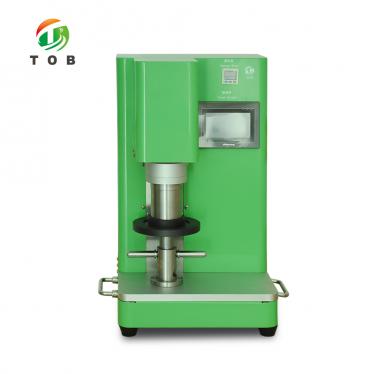
Loading...
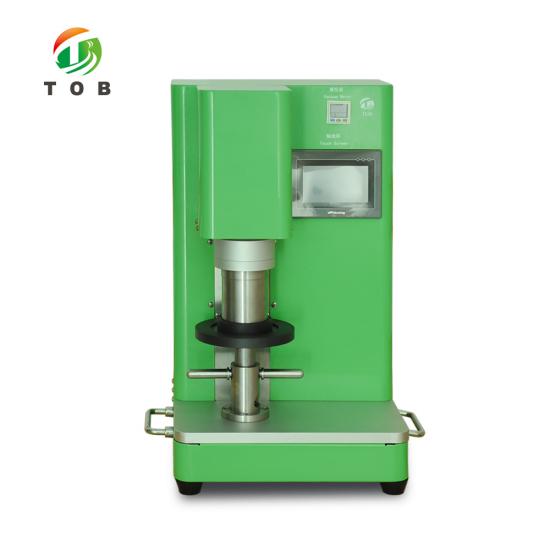
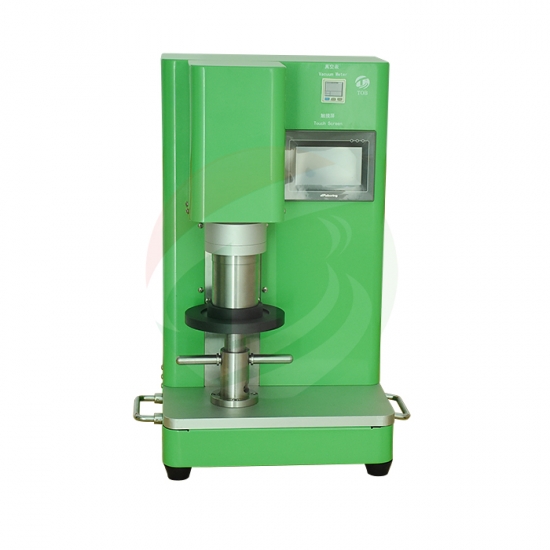
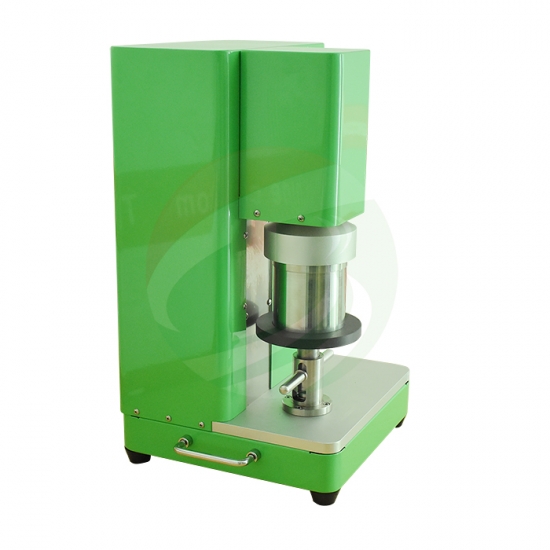
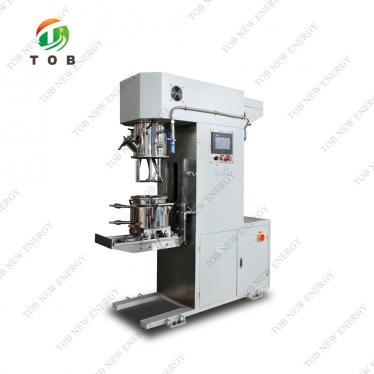
500ml Compact Dual-Shaft Lab Scale Planetary Vacuum Mixer
Brand:
TOB NEW ENERGYitem no.:
TOB-XJB-500order(moq):
1setPayment:
L/C,T/Tproduct origin:
Chinashipping port:
XIAMEN
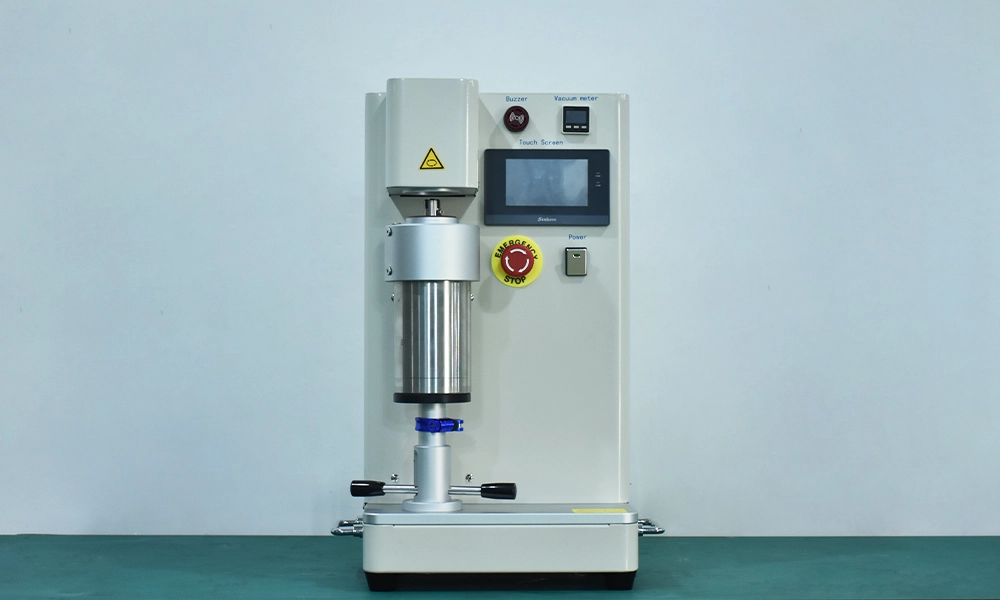
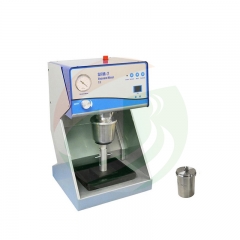
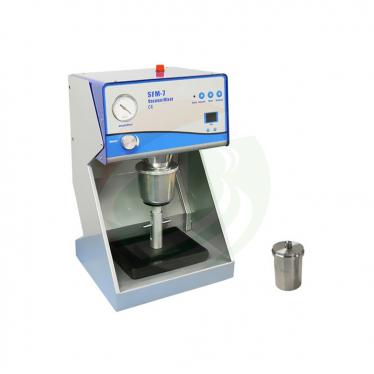
TOB-XJB-500 500ml Dual-Shaft Planetary Vacuum Mixer for Electrode Slurry Preparation
1. Product Overview and Ideal Applications
The TOB-XJB-500 is a benchtop dual‑shaft planetary vacuum mixer designed specifically for small‑batch electrode slurry preparation in battery R&D. Unlike a generic overhead stirrer or a simple magnetic mixer, this machine combines high‑speed dual‑axis agitation with a built‑in vacuum system, achieving both thorough dispersion of active materials and elimination of air bubbles within a single enclosed cycle.
In a typical battery lab, you weigh out cathode powder (NMC, LFP, LCO), carbon black, and PVDF binder, load them into the 500 ml stainless‑steel tank, and after 20 to 60 minutes of programmed mixing under vacuum, you get a smooth, bubble‑free slurry ready for coating. Because the tank is sealed and vacuum is pulled to –0.08 MPa, there’s no need to transfer the slurry to a separate degassing unit—the mixer handles it all. This saves a step and reduces the risk of moisture pickup, which is critical when processing moisture‑sensitive high‑nickel cathode materials.
Ideal for:
● University and corporate battery R&D labs that need to prepare 10–100 g batches of electrode slurry with high repeatability.
● Process engineers developing new slurry formulations and seeking to mimic large‑scale planetary mixing on a bench scale.
● Pilot lines that require quick turnaround of small test batches without investing in a full‑size production mixer.
● Any researcher who has ever scraped a half‑gelled, air‑entrained mixture out of a beaker and wishes for a more robust solution.
2. Where the Mixer Fits in Battery Electrode Manufacturing
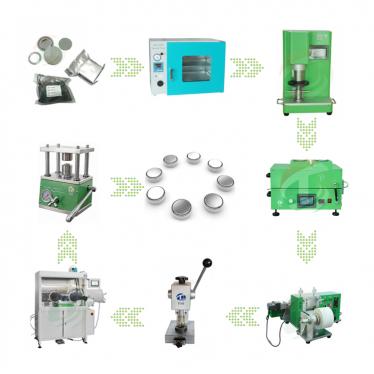
The TOB-XJB-500 operates at the very front of the electrode manufacturing chain—it sits right after the weighing and dry‑blending of active material, conductive carbon, and binder. Its output is a homogeneous slurry that is directly fed to a film coater (such as a doctor blade or slot‑die coater) to produce cathode or anode sheets. After coating, the sheets are dried, calendared, and slit before cell assembly.
The quality of the mixing stage heavily determines the final electrode’s microstructure and, ultimately, the cell’s capacity and cycling stability. Poor mixing leads to agglomerates that cause coating streaks, uneven binder distribution that results in electrode delamination, and entrapped air that forms micro‑voids in the dried film. The vacuum environment in the TOB-XJB-500 addresses the air‑entrapment problem directly, while the dual‑shaft planetary motion ensures that even high‑viscosity slurries (such as those with high solid content or nano‑silicon anodes) are thoroughly sheared and dispersed.
Process Optimisation Best Practices (drawn from real electrode R&D):
● Staged mixing: Don’t just set one speed and walk away. Use the multi‑segment function: a low‑speed pre‑mixing (100–150 rpm) for 5–10 minutes to homogenize dry powders under vacuum, then ramp to 1000 rpm for high‑shear dispersion, and finally a low‑speed degassing stage for 5 minutes. This sequence significantly reduces air re‑entrapment.
● Fill ratio: Do not fill the 500 ml tank to the brim. Aim for 40–60% loading (200–300 g of slurry) to give the dual shafts enough free space for the planetary motion to develop the required vortex.
● Binder addition timing: For NMP‑based PVDF systems, dissolve PVDF in NMP first, then add carbon black and mix until fully dispersed, and only then add the active material. This “solution‑first” method prevents binder swelling in local spots.
● Vacuum monitoring: Keep an eye on the vacuum gauge. If the vacuum drops (pressure rises) during mixing, it could indicate a leak or that volatile moisture is being drawn out of the powder. Re‑tighten the lid clamp or extend the vacuum pump‑down time at the start.
3. How the Planetary Vacuum Mixer Actually Works
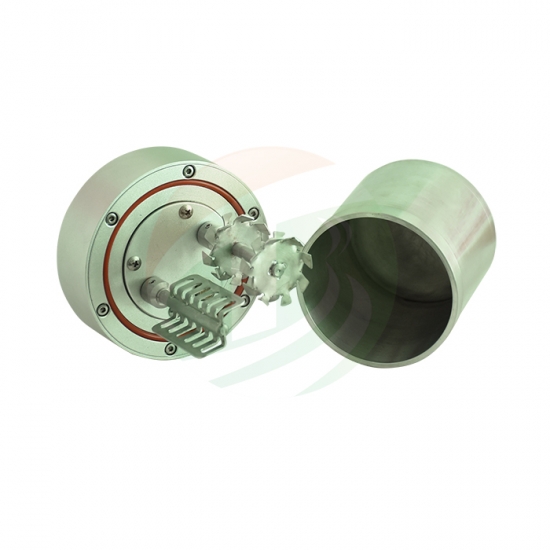
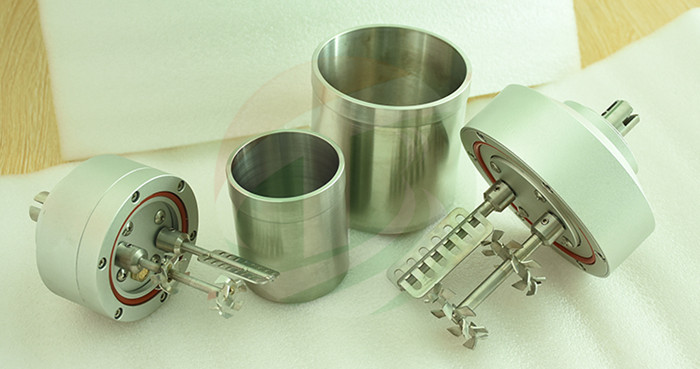
The TOB-XJB-500 uses a dual‑shaft planetary mechanism: two helical impellers rotate on their own axes while simultaneously revolving around the tank center. This creates a complex three‑dimensional flow pattern that constantly scrapes material from the tank walls and bottom, directing it into the high‑shear zone between the impellers. The result is that every particle, regardless of its density, gets repeatedly exposed to intense shear stress. For a 500 ml batch, you can see the dry powder and binder transform into a uniform slurry within 15–20 minutes, with a visibly smooth surface and no dry clumps.
The vacuum pump (built‑in, reaching –0.08 MPa) is connected directly to the mixing chamber. As it evacuates air, bubbles trapped inside agglomerates or generated during the wetting of powders are drawn out through the slurry surface. Because the tank is completely sealed, the degassing happens in parallel with mixing, not afterwards. This parallel action is what gives the slurry its dense, bubble‑free consistency—something that’s immediately noticed when you apply it onto the current collector with a doctor blade and see a flawless coating line.
Control logic that matters for the user:
The mixer allows you to program up to several speed‑time segments. For example, you might set:
- Segment 1: 120 rpm for 5 min (initial wetting),
- Segment 2: 500 rpm for 20 min (high‑shear dispersion),
- Segment 3: 200 rpm for 5 min (final homogenisation).
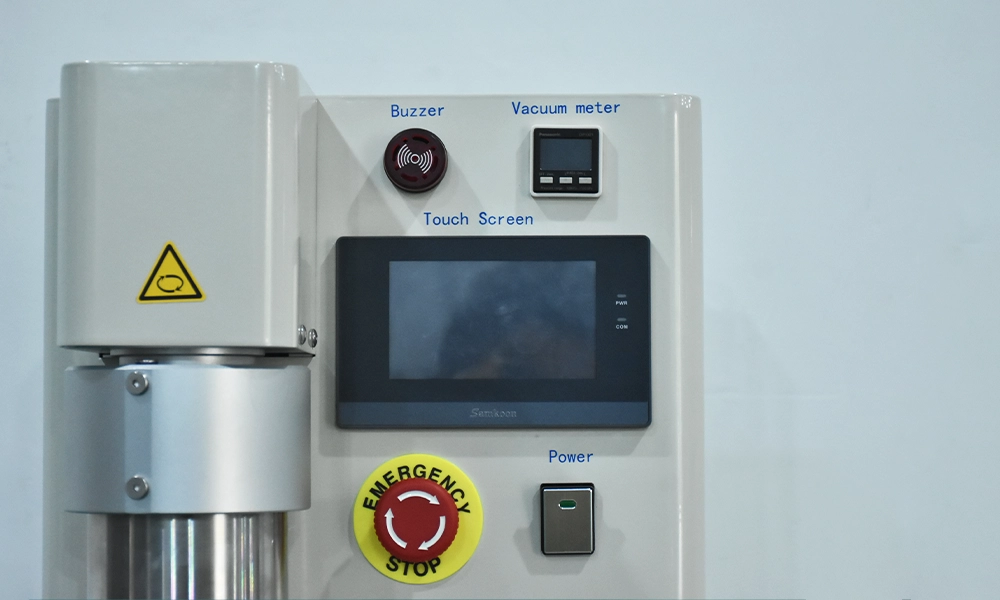
A digital timer (up to 600 minutes) automatically stops the process when the program ends. Because the speed is continuously adjustable up to 1000 rpm, you can dial in the exact shear rate needed to break down carbon agglomerates without damaging fragile active material particles—a common concern when mixing delicate silicon anode powders or nano‑sized LFP.
4. Key Engineering Advantages for Battery Slurry Mixing
● -0.08 MPa Built‑In Vacuum: Bubble‑Free Slurry, Every Time
Many lab‑scale mixers leave vacuum generation to an external pump that must be connected and monitored separately. The TOB-XJB-500 integrates its own vacuum pump and achieves a vacuum level of –0.08 MPa. In practice, this means you can pull a vacuum on the powder mix to remove moisture and surface‑adsorbed gases before adding solvent, then maintain vacuum during mixing to eliminate the microscopic air bubbles that would otherwise expand during coating and drying. The result is a denser electrode with fewer pinhole defects.
● Dual‑Shaft Planetary Agitation for High‑Viscosity Slurry
A single central impeller often leaves a “dead zone” near the tank wall where unmixed powder accumulates. The two off‑axis helical impellers continuously scrape the inner surface while creating a vigorous vortex. Even with high‑viscosity slurries (8′000–15′000 mPa·s), the mixer achieves a visually uniform dispersion without the need for a separate high‑shear disperser. The corotation and counter‑rotation function can be selected to further optimise the flow pattern for different material combinations.
● Programmable Multi‑Segment Speed for Process Development
Not all powders respond the same way to a constant high speed. The ability to set multiple speed‑time segments lets you design a custom mixing profile that mimics the step‑wise dispersion used in large‑scale production. This is invaluable when transferring a process from a Ph.D.’s beaker to a 500 ml pilot batch: you can systematically study the effect of each stage and build a scalable recipe.
● 500 ml Stainless‑Steel Tank — Small Footprint, Realistic Results
The 500 ml capacity is ideal for standard lab‑scale electrode trials. You can mix enough slurry for 10–20 small‑format electrode sheets or a few pouch cells. The stainless‑steel tank is easy to clean, durable, and resistant to NMP and other common battery solvents. Its removable design means you can weigh components directly into the tank, minimising material loss.
● Robust Bracket and Safety Design
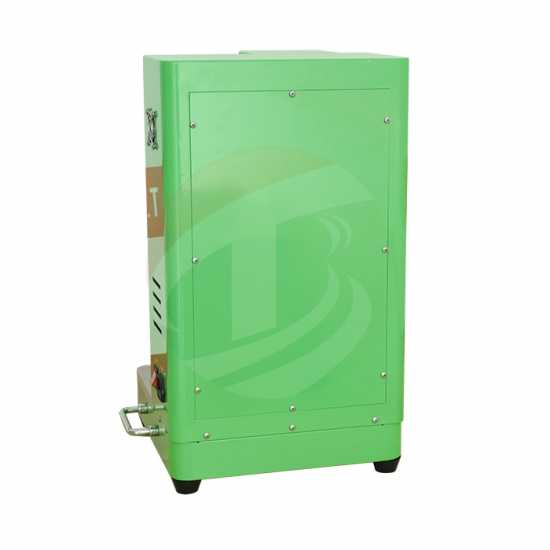
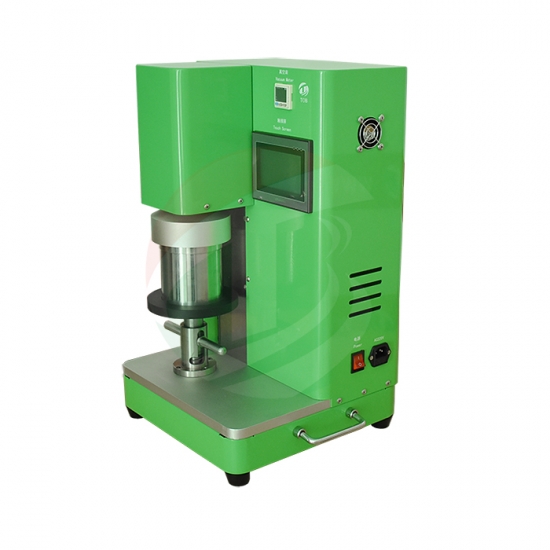
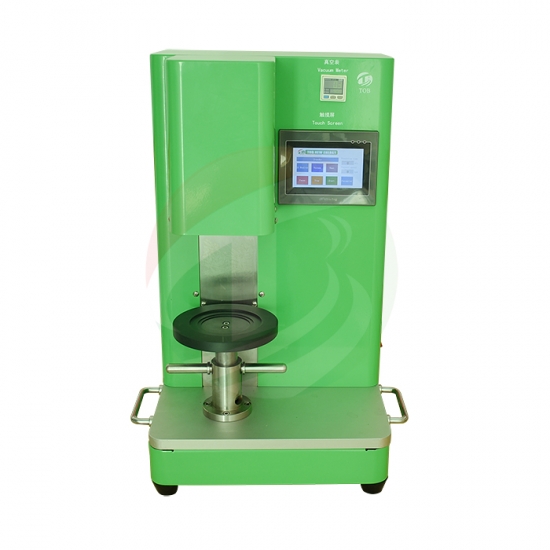
The mixing head is supported by a sturdy bracket that keeps the impellers aligned and prevents vibration during high‑speed operation. The transparent enclosure (or lid interlock) protects the user from any accidental splashing, and the machine will not start unless the lid is securely clamped—a detail that busy labs quickly appreciate. Its compact footprint (330 × 320 × 570 mm) and 35 kg weight mean it can be placed on a standard laboratory bench without reinforcement.
5. Complete Technical Specifications
| Parameter | Specification |
| Model | TOB-XJB-500 |
| Voltage | AC 220 V, 50 Hz (optional 110 V, 60 Hz) |
| Power | 200 W |
| Max. stirring speed | 1000 rpm |
| Speed control | Continuous adjustable, with multi‑segment programmable function |
| Mixing tank capacity | 500 ml stainless steel vacuum mixing tank |
| Stirring time | 0–600 min, programmable |
| Vacuum pump | Built‑in, ultimate vacuum –0.08 MPa |
| Impeller type | Standard dual helical impellers (custom configurations available according to tank design) |
| Overall dimensions (L×W×H) | Approx. 330 mm × 320 mm × 570 mm |
| Net weight | Approx. 35 kg |
| Warranty | One year limited, lifetime technical support |
Notes:
- The mixer is designed for battery electrode slurry and can handle solvents such as NMP and water.
- For use with aqueous slurries (e.g., graphite‑water‑CMC‑SBR), ensure thorough cleaning to avoid corrosion.
6. Common Mixing Issues and How the TOB-XJB-500 Resolves Them
The following table lists typical problems encountered during lab‑scale electrode slurry preparation and explains how the TOB-XJB-500’s features directly mitigate them.
| Mixing Problem | Typical Cause in General Lab Mixers | Solution with TOB-XJB-500 |
| Persistent bubbles in coated film | Air entrapment during mixing; no degassing step. | Integrated vacuum (–0.08 MPa) continuously removes bubbles during mixing. The vacuum seal ensures no air re‑enters. |
| Agglomerates (dry powder specks) in slurry | Insufficient shear or dead zones in single‑shaft mixers. | Dual‑shaft planetary motion scrapes the entire tank and subjects material to high shear. Multi‑segment programming breaks agglomerates stepwise. |
| Binder gelation and slurry viscosity spike | Local high temperature or uneven binder distribution. | The controlled, staged mixing prevents hot spots. The vacuum also removes moisture that can accelerate binder gelation in PVDF systems. |
| Material sticking to tank walls and impellers | Poor geometry; material not recirculated effectively. | The helical impellers and planetary action constantly push material away from walls and towards the centre. A slight increase in speed at the end helps scrape the tank clean. |
| Inconsistent batch‑to‑batch coating quality | Manual control with no repeatable program. | Programmable speed/time profiles can be saved as preset recipes, guaranteeing the same mechanical energy input every batch. |
| Difficult cleaning between different cathode materials | Tank not easily removable or impellers hard to access. | The stainless‑steel tank lifts off easily, and the impellers can be removed for thorough cleaning with NMP or water. Cross‑contamination is virtually eliminated. |
If you face a mixing challenge not addressed here, contact TOB’s application engineers—we work with battery slurries every day and can often diagnose the issue from a simple description of the symptoms.
7. Recommended Starting Mixing Parameters for Common Electrode Formulations
These recipes are starting points developed from TOB’s in‑house battery lab and customer feedback. They assume a total slurry mass of 200–300 g in the 500 ml tank. Always adjust to your specific material properties and target rheology.
| Electrode Formulation | Stage 1 (Low Speed) | Stage 2 (High Shear) | Stage 3 (Degas) | Notes |
| NMC622 cathode (PVDF/NMP) | 120 rpm, 5 min | 500 rpm, 20 min | 200 rpm, 5 min | Add NMP gradually during Stage 1 to avoid powder dust. |
| LFP cathode (PVDF/NMP or aqueous) | 150 rpm, 5 min | 450 rpm, 15 min (aqueous: 30 min) | 200 rpm, 5 min | For aqueous, use the vacuum to degas thoroughly; replace water‑cooled jacket if available (not on this model). |
| Graphite anode (CMC/SBR aqueous) | 100 rpm, 10 min (dry blend) | 400 rpm, 25 min | 150 rpm, 5 min | Dry‑blend graphite and carbon first, then add CMC solution. Vacuum helps remove foam from SBR. |
| Silicon‑graphite composite anode | 100 rpm, 5 min | 350 rpm, 30 min | 150 rpm, 5 min | Keep speed moderate to avoid breaking silicon particles. Vacuum is essential for this high‑surface‑area system. |
Important: Pre‑treatment of moisture‑sensitive powders
If you are mixing high‑nickel cathode materials (NMC811, NCA) or sulfide solid electrolytes, consider placing the powder in a vacuum oven for 1 h at 120°C before loading it into the mixer. This reduces residual moisture, which can negatively affect slurry stability and final cell performance.
8. Why Choose TOB-XJB-500 Over a Generic Bench‑Top Stirrer: A Comparison
| Feature | TOB-XJB-500 | Typical Benchtop Stirrer / Simple Mixer |
| Mixing mechanism | Dual‑shaft planetary with high shear | Single impeller or magnetic stirring bar |
| Vacuum degassing | Built‑in –0.08 MPa vacuum system | Not available; external degassing needed |
| Programmability | Multi‑segment speed/time profiles | Manual speed control only |
| Tank capacity | 500 ml stainless steel, with sealed lid | Usually open beaker or jar |
| Suitable slurry viscosity | Up to 15′000 mPa·s or higher | Typically less than 3′000 mPa·s |
| Uniformity within batch | High, due to 3D flow and scraping | Often poor near walls, requires manual scraping |
| Footprint | 330×320×570 mm, self‑contained | Varies; often requires stand and external pump |
Why labs upgrade to the TOB-XJB-500:
If you’ve ever spent a morning coating electrodes only to find every strip riddled with micro‑bubbles, or had to throw away a batch because the NMC slurry turned into a lumpy gel, you know that a “decent” stirrer isn’t enough. The TOB-XJB-500 is purpose‑built to tackle these exact frustrations. Its vacuum system and dual‑shaft planetary motion turn slurry preparation from a gamble into a predictable, repeatable step—and that predictability is what lets you focus on the cell performance rather than troubleshooting the mixing.
9. Engineering FAQ — Mixing Electrode Slurries with the TOB-XJB-500
Q1: Can the TOB-XJB-500 mix high‑solid‑content slurries (e.g., 60% solid content) used in advanced battery research?
Yes. Because of the dual‑shaft planetary drive, the mixer can handle slurries with very high viscosity. For solid contents above 55%, we recommend starting at a slightly lower speed (300–600 rpm) for a longer time and using a staged solvent addition strategy: first make a thick paste, then gradually add the remaining solvent while the vacuum is on. This avoids over‑loading the motor at the initial dry‑blend stage. The 200 W motor and precise speed control give you enough torque for the job.
Q2: How do I clean the tank and impellers after mixing an NMP‑based cathode slurry?
Immediately after emptying the slurry, fill the tank partially with fresh NMP and run the mixer at 300 rpm for 5 minutes under vacuum (no powder). The NMP will dissolve residual PVDF and suspend carbon particles. Drain the NMP and repeat with a clean solvent rinse if needed. For the impellers, simply remove them from the shaft (they are friction‑fit or screw‑on) and wash with NMP or acetone. Never use water to clean an NMP system—the residual water can cause binder precipitation and corrosion.
Q3: Is it possible to use this mixer inside a glovebox for air‑sensitive materials?
The TOB-XJB-500 is a standalone benchtop machine, but its small footprint and vacuum‑sealed tank make it suitable for use in a controlled environment. You can place the entire mixer in a large glovebox or dry room. The tank lid seals with an O‑ring, so moisture ingress during mixing is minimal. For extreme moisture‑sensitive materials (e.g., sulfide solid electrolytes), we can advise on adapting the vacuum pump exhaust path. Contact us for details.
Q4: What maintenance does the vacuum pump require?
The built‑in oil‑free diaphragm pump (or piston pump) requires very little maintenance. Occasionally, check the vacuum line for solvent condensation, especially if you frequently mix high‑vapor‑pressure solvents. A simple inline cold trap can be added (optional) to prevent solvent vapor from reaching the pump. The pump is designed for continuous use within the duty cycle of the mixer. TOB provides one year of warranty and lifetime technical support if any pump issue arises.
Related Product
◉ TOB-NMC-622 Cathode Material — High‑nickel cathode powder optimised for high energy density; pairs directly with this mixer.
◉ TOB-JYCM-800 Lab Slot Die Coater — After mixing, apply your slurry onto aluminium or copper foil with precise thickness control.
◉ TOB-JS-200L Heat Electrode Calendering Machine — Compact calendering rolls to densify your coated electrode to the target compaction density.
Ready to turn your slurry preparation into a reproducible process? Request a demo recipe for your specific electrode material or get the full specification sheet and warranty details.
tob.amy@tobmachine.com | +86 181 2071 5609
If you are interested in our products and want to know more details,please leave a message here,we will reply you as soon as we can.

 subscribe to us