Chinese
 français
 Deutsch
 italiano
 español
 português
 Nederlands
 日本語
日本語 한국의
한국의




- Home
- >
- Lab Furnace
- >
- Tube Furnace
- >
- 1200℃ Three-Zone Tube Furnace for Battery Materials
Categories
Hot Products
Loading...
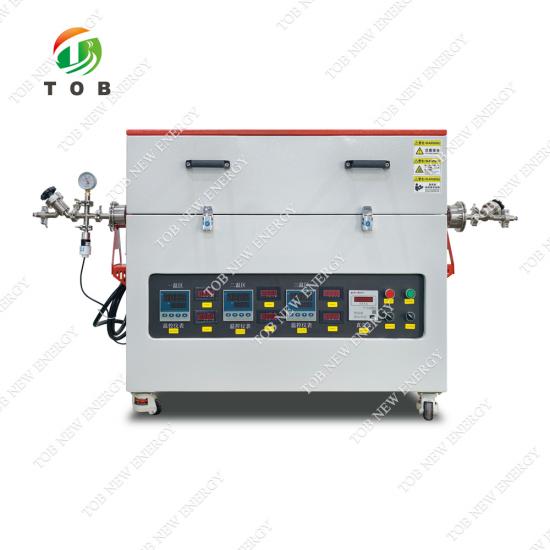
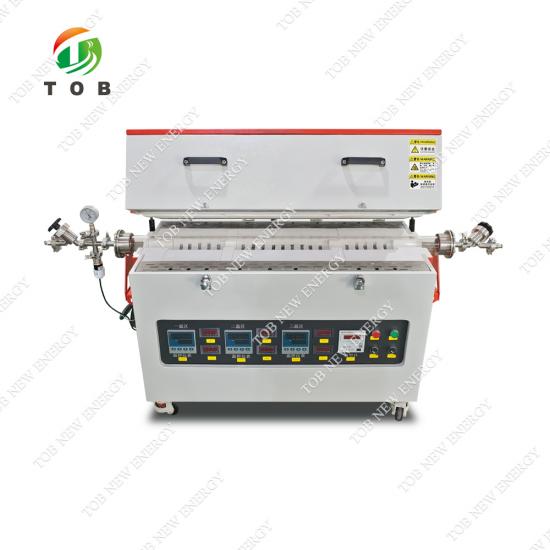
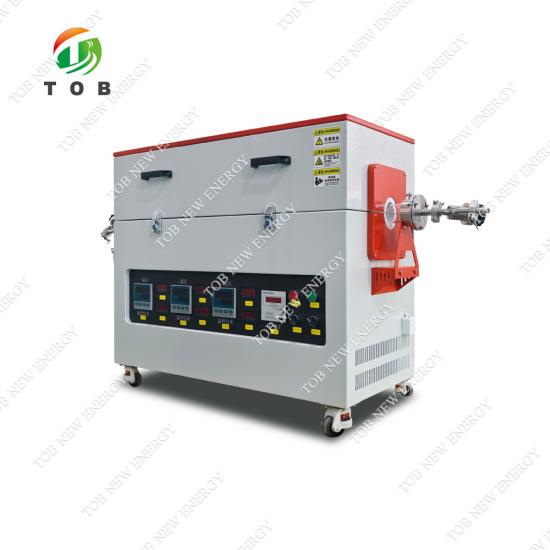
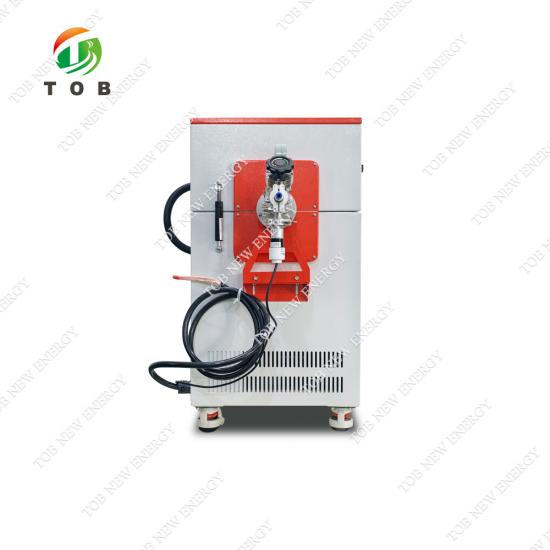
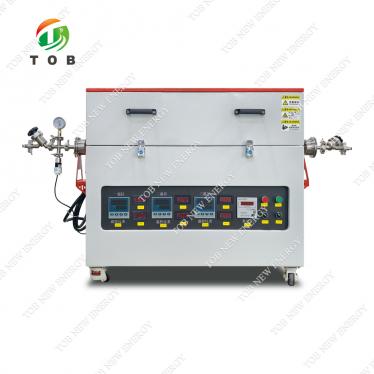
1200℃ Three-Zone Tube Furnace for Battery Materials
Brand:
TOB NEW ENERGYitem no.:
TOB-G1200-60-IIIorder(moq):
1setPayment:
L/C,T/Tproduct origin:
Chinashipping port:
XIAMEN
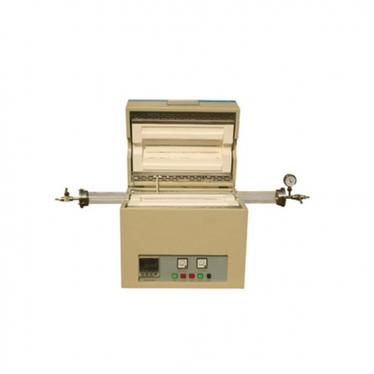
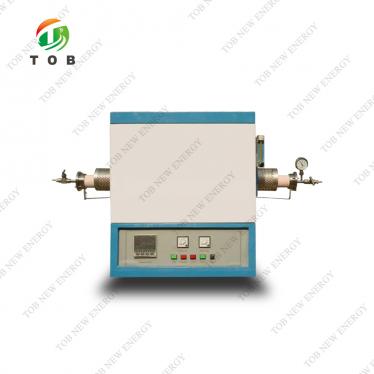
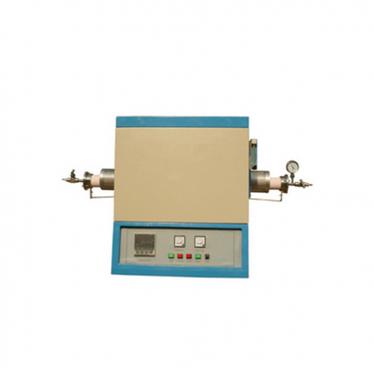
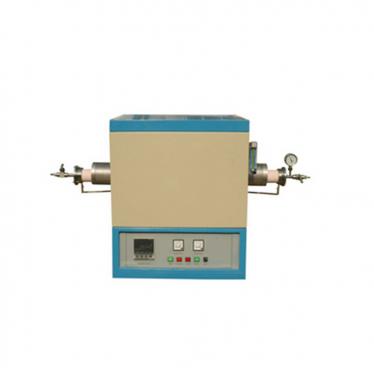
TOB-G1200-60-III Three-Zone Tube Furnace (1200℃) for Battery Material Synthesis and CVD Processing
Product Overview and Ideal Applications
A three-zone tube furnace is a precision thermal processing tool that splits a long cylindrical heating chamber into three independently controlled temperature zones. The TOB-G1200-60-III uses this architecture to create an exceptionally long uniform-temperature region—≥ 450 mm—inside a 60 mm diameter quartz tube, making it possible to heat larger samples, multiple small samples, or continuous processes without the hot‑end/cold‑end gradient that frustrates single‑zone furnace users.
In battery R&D, this furnace is the workhorse behind cathode powder calcination, anode carbonisation, solid‑state electrolyte synthesis, and chemical vapour deposition (CVD) of electrode coatings. The quartz tube accepts oxygen, nitrogen, argon, and other process gases under positive pressure or rough vacuum (optional pump, 0.5 Pa), so you can run oxidation, inert‑atmosphere, or vacuum‑assisted experiments in the same system. The 31‑segment programmable controller lets you define a complete thermal profile—ramp, dwell, cool—while the furnace independently manages each zone to exactly track the setpoint. When you open the furnace after a run, the double‑shell forced‑air cooling keeps the outer casing below 60 ℃, and the high‑purity alumina fiber insulation has already paid for itself in energy saved.
Ideal for:
- Battery material researchers calcining LFP, NMC, LCO, or LMFP cathode precursors under controlled atmospheres.
- Solid‑state electrolyte developers synthesising LLZO, LATP, or sulfide‑based electrolytes that require precise temperature ramps and long dwells.
- Any lab performing CVD growth of carbon coatings on anode particles or thin‑film electrode layers.
- Quality assurance teams that need to reproduce heat‑treatment conditions across multiple batches of powder or small components.
- University labs that previously struggled with single‑zone furnaces producing inconsistent sample quality along the tube.
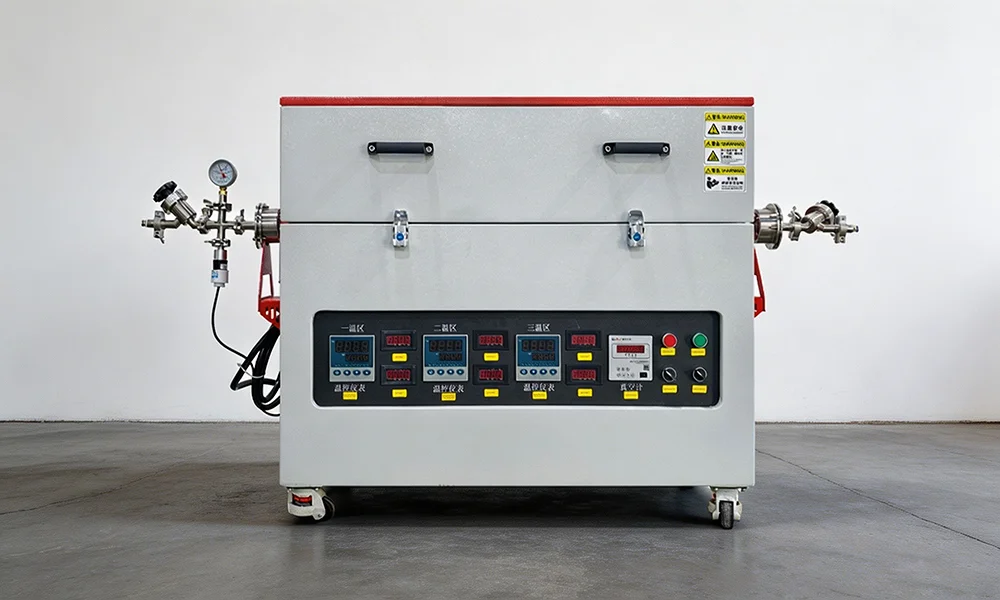
Where This Tube Furnace Fits in Battery Material Processing
The TOB-G1200-60-III sits at the powder synthesis and heat‑treatment stage of battery material production—before electrode slurry mixing and coating. For cathode active materials, the metal hydroxide or carbonate precursors are mixed with a lithium source and calcined in this furnace at temperatures between 700 ℃ and 1000 ℃ under flowing oxygen or dry air. The three‑zone design ensures the entire boat of powder sees the same temperature history, which directly translates into uniform particle size, consistent lithium stoichiometry, and repeatable electrochemical performance batch after batch.
Similarly, for carbon‑coated anode materials, the furnace can perform carbonisation of the coating layer under nitrogen or argon. The CVD capability comes into play when you need to deposit a conformal carbon or ceramic layer onto powder or a pre‑formed electrode strip.
Process optimisation best practices (derived from real battery material synthesis):
- Profile pre‑test: Before committing a full batch of expensive precursor, run a 31‑segment profile with an empty sample boat and a dummy thermocouple inside the tube. Verify that the centre of the boat actually reaches the setpoint and that the cooling rate is as expected. The GP518P controller’s auto‑tune PID function can be invoked during this test to optimise zone balancing.
- Gas flow direction matters: For powder calcination in a boat, direct the gas flow from the gas inlet towards the vacuum pump or exhaust. This carries away evolved moisture and CO₂ without re‑depositing them on the downstream powder. A flow rate of 100–200 sccm is usually sufficient for a 60 mm tube; higher flow may cool the centre zone slightly.
- Minimise contamination: Before loading battery‑grade precursors, pre‑bake the empty quartz tube at 1100 ℃ for 2 hours under oxygen to burn off any organic residues from previous runs. Always handle the tube and boats with clean, powder‑free gloves—trace sodium from skin contact can permanently degrade cathode performance.
- Quenching control: The furnace allows a controlled cooling rate. For materials that require a specific crystallographic phase, program a slow cooling segment (2–5 ℃/min) through the critical temperature range rather than simply turning off the power and letting the furnace cool naturally. This is particularly important for ordered‑rock‑salt cathodes and certain oxide solid electrolytes.
How the Three‑Zone System Works in Real Operation
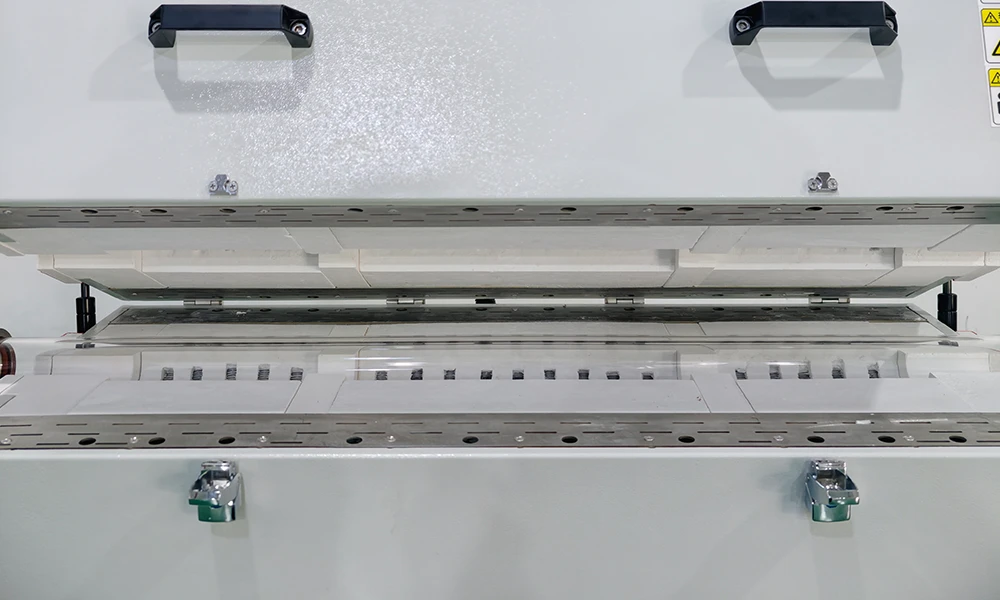
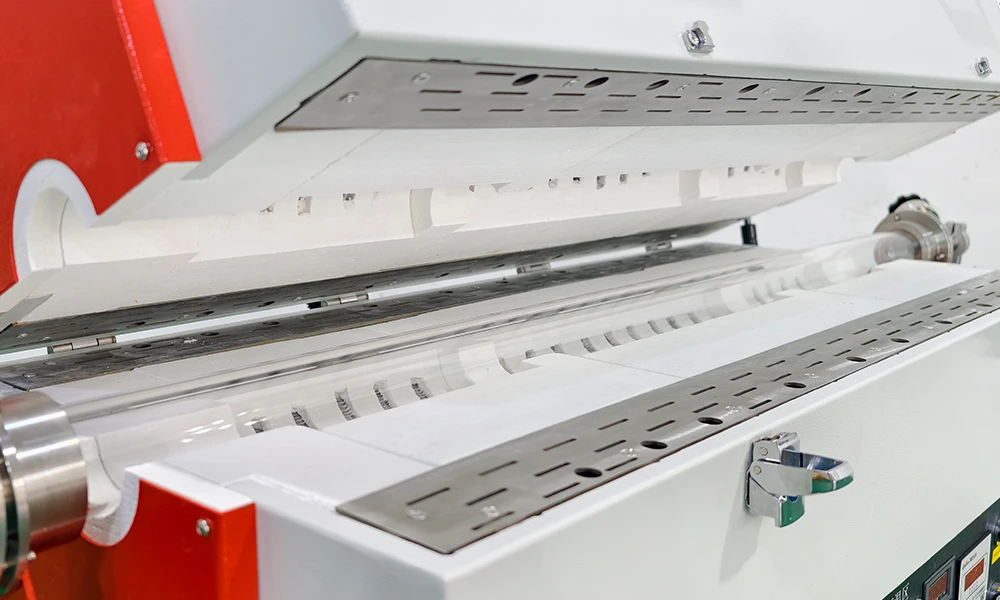
Conventional tube furnaces with a single heating element inevitably develop a temperature profile that peaks in the middle and drops off toward both ends. This limits the usable uniform zone to a fraction of the total heated length. The TOB-G1200-60-III overcomes this by splitting the 750 mm heated length into three independently controlled zones, each with its own Ni‑Cr alloy heating coil and K‑type thermocouple placed near the tube wall.
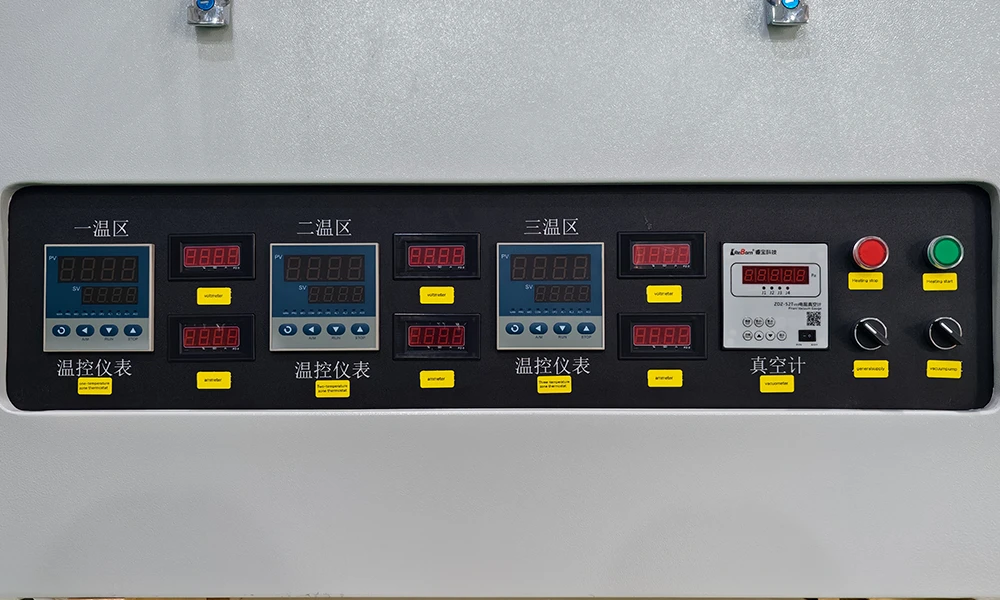
A Yudian GP518P multi‑channel controller regulates each zone using phase‑angle‑fired SCR (silicon‑controlled rectifier) modules. During ramp‑up, the two outer zones are typically driven slightly harder to compensate for the higher heat loss at the ends. As the furnace approaches the setpoint, the built‑in multi‑group PID auto‑tune function adjusts the power output to all three zones to flatten the temperature gradient. The result is a stable uniform zone of at least 450 mm—long enough for a full‑size alumina boat holding tens of grams of cathode precursor, or several smaller boats placed side‑by‑side for a combinatorial study.
From the operator’s perspective, you define one program on the touch‑panel or digital display: 31 segments of ramp rate, target temperature, and dwell time. The controller then automatically coordinates the three zones to follow that profile, displaying both the setpoint and the real‑time measured temperature. The digital display shows ±1 ℃ accuracy, but in practice the real‑world stability within the uniform zone is often even tighter.
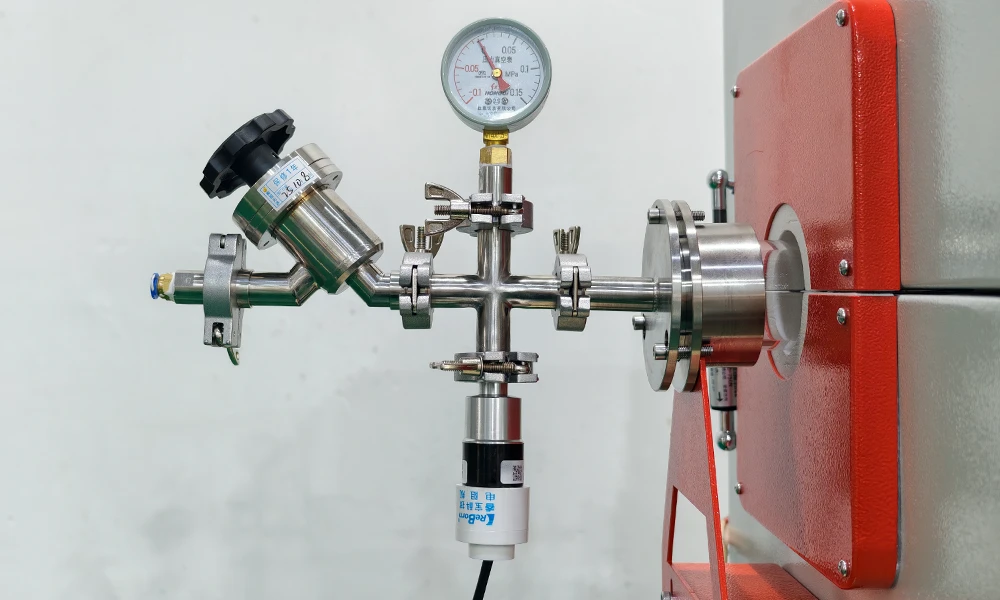
The atmosphere system is simple but robust. Gas enters through a flow‑metered inlet on one end‑flange, passes over the sample, and exits through the opposite flange to atmosphere or a vacuum pump. The flange seals are mechanical (O‑ring) and can hold a rough vacuum down to 0.5 Pa when the rotary vane pump is connected. For experiments that require inert gas but no vacuum, simply purge the tube with your chosen gas for 15–20 minutes before heating, and maintain a slight positive pressure during the run.
Key Engineering Advantages for Battery Material Synthesis
- 450 mm+ Uniform Zone from Three Independent Controllers
A long, truly isothermal zone is critical when you are scaling up powder synthesis from a few grams to tens of grams in a single boat. The three‑zone design actively maintains temperature uniformity across the entire sample, so the material at the centre of the boat is identical to the material at the edges. This reduces batch‑to‑batch variability and eliminates the need to discard end‑section powder due to under‑ or over‑firing.
- ±1℃ Control Precision with 31‑Segment Programmability
Complex thermal profiles—slow ramps, multiple dwells, and controlled cooling—are routine in advanced cathode synthesis. The Yudian controller’s 31‑segment capacity and auto‑tuning PID loops let you reproduce the exact thermal history every run. The ±1 ℃ display precision gives you confidence that the actual temperature tracks the program, which is especially important near the melting point of lithium salts or during phase transitions.
- All‑Fiber Alumina Insulation and Double‑Shell Cooling
The furnace lining uses high‑purity vacuum‑formed alumina fiber boards, 120 mm thick, with an additional coating of high‑temperature alumina paint inside the chamber. This combination stores very little heat, so ramping from room temperature to 1200 ℃ takes about 30 minutes (at 20 ℃/min), and cooling is equally fast when assisted by the built‑in fan that circulates air through the double‑shell casing. External surface temperature stays under 60 ℃, protecting operators and nearby electronics.
- Versatile Atmosphere and Vacuum Compatibility
Whether you need flowing oxygen for LCO calcination, nitrogen for carbonisation, or argon for sulfide electrolyte processing, the sealed quartz tube and gas‑tight flanges support them all. The optional rotary vane pump (0.5 Pa ultimate) adds vacuum annealing and vacuum‑assisted infiltration to the furnace’s capabilities, all without modifying the core hardware.
- Robust Construction with Long‑Life Heating Elements
Nickel‑chromium alloy wire is used for the heating elements, which offers good oxidation resistance up to 1200 ℃ and is far more tolerant of thermal cycling than molybdenum disilicide elements. The modular heating zone design means that if one zone’s element needs replacement after years of service, it can be swapped without rebuilding the entire furnace—a serviceability feature that busy labs appreciate.
Complete Technical Specifications
| Item | Specification |
| Model | TOB-G1200-60-III |
| Voltage AC | 220V |
| Heating power | <5KW |
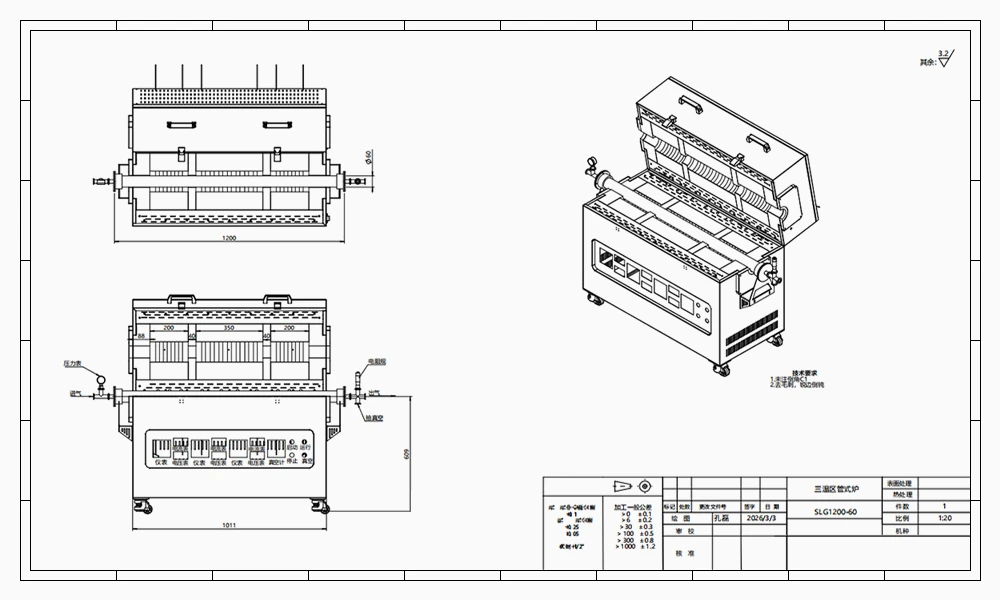
| Furnace tube dimensions | 60*1200mm |
| Furnace tube material | Quartz tube |
| Heating zone | 200mm*350mm*200mm (Three independent temperature zones) Heating zone: 750mm, Constant temperature zone: ≥450mm |
| Extreme operating temperature | 1200℃ |
| Long-term operating temperature | ≤1100℃ |
| Heating element | Nickel-chromium alloy wire |
| Heating rate | Adjustable from 1-20℃/min |
| Recommended heating rate | Temperature rise rate of 5-8℃/min |
| Temperature control accuracy | ±1℃ |
| Can open atmosphere | Various atmospheres such as oxygen, nitrogen, and argon |
| Temperature sensing element and temperature measurement range | K thermocouple, temperature measurement range 0-1200℃. The thermocouple is in close contact with the outer wall of the tube, which can reduce the surface temperature to room temperature and make the internal temperature distribution uniform. |
| Electrical components | Some of the products use imported Schneider Electric brands. |
| Instrument Control | Yudian GP518P |
| Sealing components | Flange |
| Vacuum system | Mechanical pump (optional) vacuum degree 0.5 Pa |
| Control method | Control Method: A fully automatic control system is adopted, which can automatically operate after the set temperature program is completed from room temperature. The system uses SCR control, and the temperature control system features a modular design, simple structure, and convenient maintenance. It employs Yudian Instruments, imported SCR control, a 31-segment programmable circuit, multi-segment power limiting function, multiple PID parameter self-tuning function, freely settable constant temperature and heat preservation curves, interference-free switching function, and the instrument has temperature correction and compensation functions. |
| Number of program curve segments | With 31 adjustable settings, it reduces unnecessary hassle caused by manual settings. |
| Display accuracy | ±1℃ |
| Digital display | Dual display for measured and set temperature |
| Furnace layout | |
| Control characteristics | The control system features a modular structure, long-life design for key components, and a simple, reliable, stable, and highly precise process. |
| Air-cooled system | The fan impeller is directly mounted on the bottom of the double-layer furnace shell and assembled with the control system. Air cooling is used when the sintering furnace is heated, which reduces the surface temperature of the furnace shell and provides heat dissipation protection for electrical components, making operation safer and improving efficiency. |
| Refractory materials | The furnace lining uses high-purity alumina fiber, vacuum-formed fiber-reinforced lightweight board material, and lightweight hollow spherical alumina plates. It has high operating temperature, low heat storage, resistance to rapid heating and cooling, no cracking, no slag shedding, and good heat preservation performance (energy saving effect is more than 80% of that of old-fashioned electric furnaces). The patented double-chamber structure features both rapid heating and robust durability, ensuring it will not collapse after long-term use. |
| Thermal insulation materials | Alumina multifiber insulation material, with an insulation layer of 120mm. |
| Shell | The furnace body and shell are welded from steel plates and profiles, and the shell is equipped with a removable protective plate, which is electrostatically sprayed and baked. The workmanship is exquisite and the appearance is elegant. |
| Furnace structure | The double-shell structure and air-cooled circulation reduce the outer shell temperature. The shell surface temperature is <60 degrees Celsius. The inner furnace surface is coated with a high-temperature alumina coating, which can improve the heating efficiency of the equipment and extend the service life of the instrument. |
| Energy efficiency | Lightweight, heats up quickly, saves more than 50% on energy, and saves time and effort. |
| Random spare parts | One instruction manual, one certificate of conformity, one furnace hook, and one pair of high-temperature gloves. |
 |
 |
Common Heat‑Treatment Problems and How the TOB Furnace Minimises Them
The table below draws on real challenges encountered in battery material calcination and explains how the TOB-G1200-60-III’s design avoids or mitigates each issue.
| Problem | Likely Cause in Inferior Furnaces | Solution with TOB-G1200-60-III |
| Phase inhomogeneity in cathode powder | Temperature gradient along boat; edges under‑calcined, centre over‑calcined. | Three‑zone independent PID control maintains ≥450 mm uniform zone, so the entire boat sees the same temperature history. |
| Uncontrolled oxidation or reduction | Poor gas flow design leads to dead spots or back‑diffusion of air. | Sealed flanges and directed gas flow from inlet to outlet prevent back‑mixing. The tube can be purged before heating to establish the desired atmosphere. |
| Quartz tube cracking during cooling | Thermal shock due to rapid, uncontrolled cooling rates. | 31‑segment program allows a controlled cooling ramp. After the program ends, the double‑shell fan cools the casing but not the tube directly, reducing thermal stress. |
| Incorrect temperature reading | Thermocouple placed too far from sample or poorly compensated. | K‑type thermocouples are close‑coupled to the tube wall near the heated zones. The GP518P controller includes temperature correction and compensation functions for long‑term accuracy. |
| Long ramp‑up times and high energy consumption | Heavy firebrick insulation with large thermal mass. | Ultra‑light alumina fiber insulation (120 mm thick) stores very little heat. Ramp to 1200 ℃ in ~30 min (at max rate), and energy consumption is reduced by over 50 % compared to old‑style brick furnaces. |
| Frequent element burnout | Over‑temperature or poor element quality. | The controller’s multi‑segment power limiting function prevents over‑shooting. Ni‑Cr alloy elements are robust under normal cycling; and the modular design allows replacement of a single zone. |
Why Choose TOB-G1200-60-III Over a Generic Single‑Zone Tube Furnace: A Comparison
| Feature | TOB-G1200-60-III | Typical Low‑Cost Single‑Zone Furnace |
| Temperature zones | 3 independent zones | 1 zone |
| Uniform heated length | ≥450 mm | Often 100–200 mm max |
| Temperature controller | Yudian GP518P, 31 segments, multi‑channel PID with auto‑tune | Basic 1‑segment or 8‑segment controller with fixed PID |
| Insulation | High‑purity alumina fiber, 120 mm, vacuum‑formed boards | Often lower‑grade fiber board or firebrick, higher thermal mass |
| Power consumption | <5 kW, rapid heat‑up, low heat loss | May require >5 kW for similar tube size due to heavier lining |
| External casing temperature | <60 ℃ (double‑shell with forced air) | May exceed 100 ℃ on single‑wall shells |
| Atmosphere control | Gas‑tight flanges, directed flow, optional vacuum | Often simple plugs or poorly sealed end caps |
| Useful for scaled‑up synthesis | Yes—uniform large zone accommodates full‑size boats | No—small uniform zone limits sample mass |
| Electrical components | Imported Schneider and quality domestic parts | Generic or unbranded |
| Serviceability | Modular zone construction, replaceable elements | Often monolithic, harder to repair |
Why battery labs upgrade to a three‑zone furnace:
If you’ve ever tried to calcine 30 g of NMC precursor in a single‑zone furnace and ended up with a gradient that gives you 5 different shades of powder in one boat, you already understand the problem. The TOB-G1200-60-III was designed specifically to eliminate that gradient. Combined with the programmable controller and the energy‑efficient insulation, it turns a “simple heating step” into a precise, reproducible unit operation that can be handed off from one researcher to another without a long re‑qualification process.
Engineering FAQ — Operating the Three‑Zone Tube Furnace
Q1: How do I determine the correct gas flow rate for my process?
As a rule of thumb, for a 60 mm diameter tube, a flow rate between 100 and 300 sccm ensures adequate atmosphere refresh without creating significant temperature disturbances. If you need a highly inert environment, a higher flow rate during initial purging (15–20 min before heating) is recommended, then reduce to 100–150 sccm during the dwell. Use a mass flow controller (not included) for precise regulation.
Q2: Can I use the furnace for vacuum‑only operation without any gas?
Yes, when the optional rotary vane pump is connected, you can achieve about 0.5 Pa in the tube. However, keep in mind that the flange O‑rings and quartz tube are not designed for high vacuum; this is for rough vacuum applications like vacuum drying or vacuum‑assisted impregnation. For high‑vacuum CVD, you may need a turbo pump and metal seals—contact TOB for custom solutions.
Q3: How do I prevent lithium loss from cathode materials during high‑temperature calcination?
Lithium can volatilise, particularly above 800 ℃ in oxidising atmospheres. A common method is to use a slight excess of lithium source in the precursor (typically 3–5 % extra Li) and to cover the alumina boat with a lid. The large uniform zone of the TOB-G1200-60-III helps because the entire sample is at the same temperature, so you don’t over‑compensate by increasing temperature for the edges and inadvertently driving off more lithium.
Q4: What is the typical lifetime of the heating elements, and can I replace them myself?
Ni‑Cr alloy elements operated at ≤1100 ℃ can last for several years under normal cycling. If they fail, the modular three‑zone design means you can isolate the affected zone and replace only that element set. TOB provides detailed instructions and spare element kits; a technician can typically perform the replacement in a few hours without returning the furnace to the factory.
Related Product
◉ TOB-K2-4-12TPD4 - Vacuum Atmosphere Tube Furnace. This TOB-K2-4-12TPD4 1200 ℃ vacuum atmosphere tube furnace is widely used in scientific research and small batch production in enterprises and institutions.
◉ TOB-GH1200-100 - High Temperature Tilting Rotary Tube Furnace. The tube of this rotary furnace can rotate 360 degrees, one end of the furnace body is equipped with a hinge, and the other end is equipped with a lifting support rod, which can be tilted at a large angle for easy discharge.
Need a proven temperature recipe for your battery material? Contact TOB’s thermal process team with your target compound and we’ll provide a recommended program, plus the full furnace specification sheet for your lab’s review.
tob.amy@tobmachine.com | +86 181 2071 5609
Previous:
1700°C Tube Furnace for Materials R&DNext:
1200℃ single-temperature zone rotating tube furnace
If you are interested in our products and want to know more details,please leave a message here,we will reply you as soon as we can.

 subscribe to us