Chinese
 français
 Deutsch
 italiano
 español
 português
 Nederlands
 日本語
日本語 한국의
한국의




- Tabless Cylindrical Battery Manufacturing Guide
- China Power Battery Market Report 2026 H1: Six Trends Reshaping Battery Equipment Demand
- Turnkey Solid-State Battery Lab Setup Guide
- Conductive Materials for Lithium Batteries: CNT vs Graphene Guide
- Step-by-Step Guide to Partnering with a Sodium-Ion Battery Technology Developer in China
How to Solve Electrode Slurry Sedimentation and Agglomeration
Electrode slurry preparation is one of the most critical yet underestimated steps in lithium-ion and sodium-ion battery manufacturing. Problems such as particle sedimentation, agglomeration, poor dispersion uniformity, and unstable viscosity often originate at the slurry stage, but their consequences propagate downstream into coating defects, capacity inconsistency, and yield loss.
This article systematically explains why slurry sedimentation and agglomeration occur, how key process parameters such as mixing speed and vacuum level influence slurry quality, and how to select a suitable vacuum mixer from an engineering perspective. The content is written for battery manufacturers, R&D centers, and pilot-line engineers seeking stable, scalable, and reproducible slurry preparation.
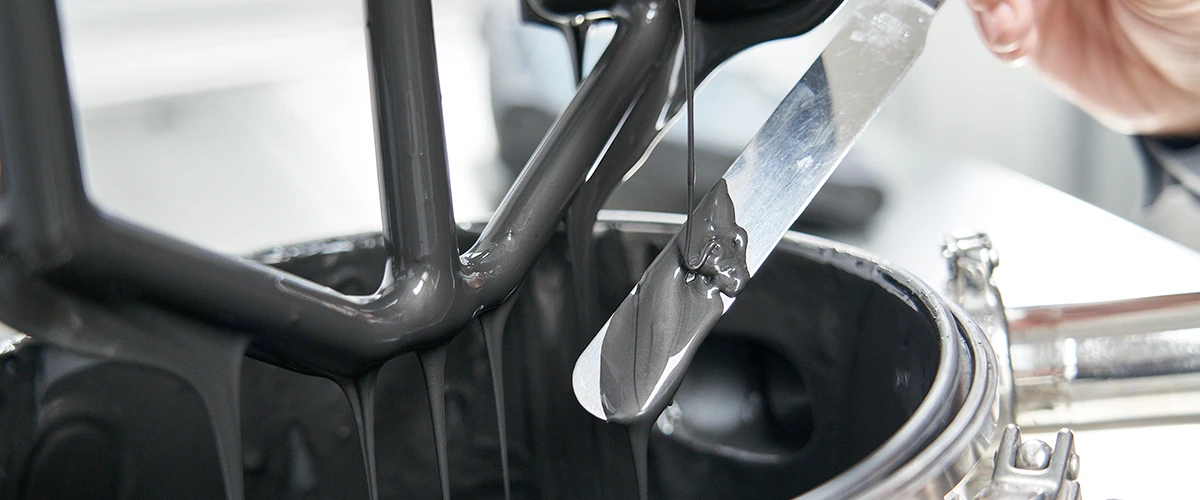
1. Why Do Electrode Slurries Sediment and Agglomerate During Mixing?
1.1 Sedimentation Caused by Density Differences and Insufficient Shear
Electrode slurries consist of high-density solid materials (active materials, conductive additives) dispersed in relatively low-density liquid phases (NMP or water-based solvents). Typical cathode and anode powders-such as NCM, LFP, graphite, silicon–graphite composites, or hard carbon-have densities several times higher than the solvent system.
If the shear force generated during mixing is insufficient, gravitational forces dominate over suspension forces, causing heavier particles to gradually settle. This phenomenon becomes more severe under the following conditions:
- High solid loading formulations (>50–60 wt%)
- Large batch volumes with limited flow circulation
- Long dwell times between process steps
Sedimentation leads to vertical composition gradients in the slurry. The bottom layer becomes over-concentrated with solids, while the upper layer becomes binder- and solvent-rich. Once such gradients form, they are difficult to eliminate and directly affect coating thickness uniformity, electrode density, and electrochemical consistency.
1.2 Agglomeration Driven by Surface Energy and Binder Bridging
Agglomeration originates from the high surface energy of fine powders. Nano- or micron-scale particles tend to cluster together to minimize total surface energy. In battery slurries, this natural tendency is amplified by process-related factors.
Common causes include:
- Rapid powder feeding without sufficient pre-wetting
- Binder added too early, forming localized polymer bridges
- Inadequate shear stress to break initial clusters
Once agglomerates form, they behave as large pseudo-particles that are resistant to dispersion. These hard clusters often survive the entire mixing process and later appear as pinholes, streaks, or localized resistance anomalies in coated electrodes.
1.3 Air Entrapment as a Hidden Root Cause
Air introduced during powder addition or high-speed atmospheric mixing becomes trapped inside particle clusters. These air pockets prevent solvent penetration and block effective wetting of internal particle surfaces.
Without degassing, trapped air stabilizes agglomerates and worsens sedimentation behavior. This is why slurries mixed under atmospheric conditions often show acceptable appearance initially but degrade rapidly during storage or transfer.
2. How Do Mixing Speed and Vacuum Level Affect Slurry Fineness and Stability?
2.1 Mixing Speed: Controlling Shear and Dispersion Efficiency
Mixing speed directly determines the magnitude of shear stress applied to particle clusters. As rotational speed increases:
- Agglomerates experience stronger mechanical forces
- Binder and conductive additives distribute more uniformly
- Solid–liquid contact efficiency improves
However, increasing speed alone has limitations. Excessive speed under atmospheric conditions can introduce new air, raise slurry temperature, and accelerate binder degradation. Therefore, mixing speed must be optimized rather than maximized.
2.2 Vacuum Level: Enhancing Wetting and Degassing
Vacuum fundamentally changes slurry behavior. Under reduced pressure, entrapped air expands and escapes from the slurry, allowing solvent to penetrate particle clusters more effectively.
At high vacuum levels (typically −0.08 to −0.095 MPa):
- Air bubbles are rapidly removed
- Powder wetting becomes more complete
- Binder penetrates micro-pores within agglomerates
This results in finer dispersion, lower apparent viscosity fluctuation, and improved long-term slurry stability.
2.3 Synergistic Effect of Speed and Vacuum
Engineering data consistently show that:
- Increasing speed alone improves fineness but quickly reaches a plateau
- Vacuum alone improves wetting but requires shear to break clusters
- Vacuum combined with appropriate speed delivers the best dispersion efficiency
In practice, vacuum acts as a multiplier for shear effectiveness, enabling high-quality dispersion without excessive mechanical stress.
3. How to Select the Right Vacuum Mixer for Electrode Slurry Preparation?
3.1 Limitations of Conventional Atmospheric Mixers
Traditional planetary or paddle mixers operating at atmospheric pressure are limited by:
- Incomplete air removal
- Poor repeatability at high solid loadings
- Long mixing cycles with inconsistent results
These limitations become critical when scaling from laboratory formulations to pilot and mass production.
3.2 Key Equipment Features Required for Stable Slurry Production
A vacuum mixer designed for battery electrode slurries should meet the following engineering requirements:
| Equipment Feature | Engineering Advantage | Practical Application |
|---|---|---|
| High-stability vacuum system | Efficient removal of entrapped air and dissolved gases | Prevents agglomeration and viscosity fluctuation |
| Variable speed control | Enables staged mixing from wetting to dispersion | Improves reproducibility across batches |
| High torque output | Handles high-viscosity and high-solid slurries | Suitable for high-energy-density formulations |
| Uniform mixing geometry | Eliminates dead zones and local concentration gradients | Ensures coating consistency |
| Temperature control (optional) | Prevents binder degradation and solvent loss | Critical for long mixing cycles |
3.3 Typical Application Scenarios
Vacuum mixers are widely used in:
- High-energy-density cathode slurry preparation (NCM, NCA)
- High-viscosity silicon–graphite anode systems
- Sodium-ion battery electrode development
- R&D and pilot lines requiring high formulation repeatability
In production environments, vacuum mixers enable process standardization, which is essential for yield control, scale-up, and quality assurance.
Conclusion
Sedimentation and agglomeration in electrode slurries are not random defects but predictable physical phenomena driven by density differences, surface energy, and air entrapment.
From an engineering perspective:
- Mixing speed controls shear force
- Vacuum level controls wetting and degassing efficiency
- Proper vacuum mixer selection allows both factors to work synergistically
By understanding these mechanisms and selecting appropriate equipment, battery manufacturers can achieve stable, reproducible, and scalable slurry preparation-laying a solid foundation for high-quality electrode production.
About TOB NEW ENERGY
TOB NEW ENERGY is a one-stop solution provider for battery laboratory lines, pilot lines, and mass production lines. With deep expertise in electrode slurry preparation, mixing process design, and customized battery equipment, TOB supports global battery manufacturers, research institutes, and universities in building stable, scalable, and reproducible electrode manufacturing systems.
Learn more about TOB NEW ENERGY’s battery equipment and engineering solutions
 subscribe to us