Chinese
 français
 Deutsch
 italiano
 español
 português
 Nederlands
 日本語
日本語 한국의
한국의




- Conductive Materials for Lithium Batteries: CNT vs Graphene Guide
- Step-by-Step Guide to Partnering with a Sodium-Ion Battery Technology Developer in China
- A Complete Guide to Implementing Industrial Solid State Battery Technology in Manufacturing
- How to Select a Professional Battery Equipment Provider for High-Volume Production
- Guide to Procuring High-Quality Lithium Battery Coating Machines from Chinese Manufacturers
Lithium Battery Laboratory Setup Checklist (2026 Edition)
Introduction: Why Battery Laboratory Design Matters More Than Ever in 2026
In 2026, lithium battery laboratories are no longer isolated research spaces dedicated only to material discovery. They have become critical engineering bridges between fundamental electrochemistry and industrial-scale manufacturing.
Over the past five years, battery innovation cycles have shortened significantly. New chemistries-such as sodium-ion systems, high-silicon anodes, solid-state electrolytes, and dry electrode processes-are now expected to move from laboratory validation to pilot-scale demonstration within 18–36 months.
As a result, laboratory infrastructure must meet three simultaneous requirements:
● Support high-variability experimental research
● Maintain process consistency and reproducibility
● Enable direct transfer to pilot and mass production environments
This 2026 laboratory checklist is structured to reflect these realities. Rather than listing equipment randomly, it organizes laboratory construction around budget tiers, cell formats, and engineering objectives, ensuring that every investment contributes to long-term scalability.
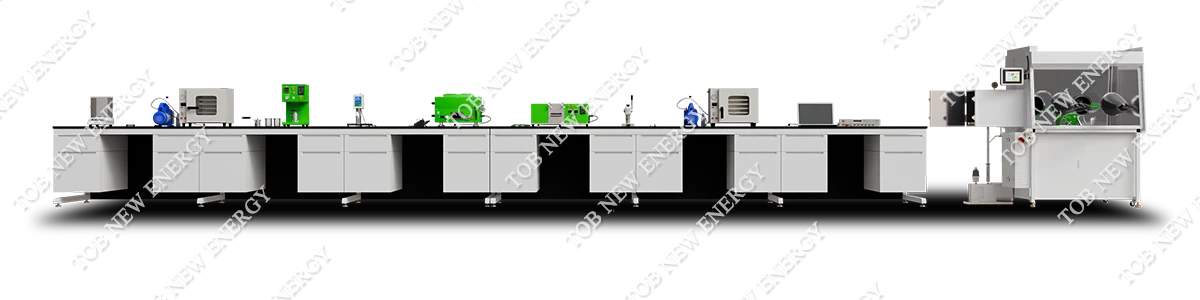
I. Low-Budget Laboratory Setup
Positioning: Fundamental research and feasibility validation
1. Core Infrastructure (All Cell Types)
|
Equipment |
Function |
Engineering Advantages |
Typical Applications |
|
Manual Glove Box |
Provides inert atmosphere (≤1 ppm H₂O/O₂) |
Prevents material degradation and parasitic reactions |
Electrode handling, slurry prep, cell assembly |
|
Analytical Balance (0.1 mg) |
Precise mass measurement |
Ensures accurate electrode loading |
Material formulation, electrolyte dosing |
|
Vacuum Drying Oven |
Removes residual moisture |
Improves electrochemical stability |
Electrode, separator, material drying |
|
Laboratory Fume Hood |
Solvent vapor extraction |
Enhances operator safety |
Slurry preparation, electrolyte handling |
|
Deionized Water System |
Supplies high-purity water |
Prevents ionic contamination |
Cleaning, material processing |
2. Coin Cell Laboratory (CR20xx)
|
Equipment |
Function |
Advantages |
Engineering Use |
|
Manual Coin Cell Crimper |
Seals coin cells mechanically |
Simple, reliable, low cost |
Material screening, baseline electrochemistry |
|
Disc Cutter |
Cuts electrodes/separators |
Uniform geometry, reduced variability |
Reproducible coin cell assembly |
|
Manual Slurry Mixer |
Mixes active materials and binders |
Flexible formulation testing |
Cathode/anode development |
|
Manual Coating Applicator |
Applies slurry to foil |
Fast iteration, adjustable thickness |
Small-batch electrode trials |
|
Compact Roll Press |
Densifies electrodes |
Improves conductivity and adhesion |
Capacity and cycle optimization |
3. Cylindrical Cell (18650 / 21700 – Feasibility Level)
|
Equipment |
Function |
Advantages |
Engineering Use |
|
Manual Slitting Machine |
Cuts electrode sheets into strips |
Low investment, format flexibility |
Small-batch cylindrical trials |
|
Manual Winding Jig |
Winds electrodes into cylindrical form |
Enables geometry validation |
Early cylindrical feasibility |
|
Spot Welding Machine |
Connects tabs and leads |
Stable electrical connection |
Internal resistance control |
|
Manual Electrolyte Filling |
Injects electrolyte |
Supports chemistry variation |
Wetting behavior studies |
|
Small Aging Cabinet |
Stores cells under control |
Enables initial formation |
Short-term stability evaluation |
4. Pouch Cell (Single-layer)
|
Equipment |
Function |
Advantages |
Engineering Use |
|
Manual Stacking Fixture |
Aligns electrodes/separators |
Improves layer consistency |
Prototype pouch validation |
|
Vacuum Sealing Machine |
Seals pouch under vacuum |
Prevents air/moisture ingress |
Leak prevention |
|
Electrolyte Injection Tool |
Fills electrolyte accurately |
Avoids over/under-filling |
Electrochemical consistency |
II. Mid-Budget Laboratory Setup
Positioning: Process optimization and pilot validation
1. Infrastructure Upgrade
|
Equipment |
Function |
Engineering Advantages |
Application |
|
Automatic Glove Box (Dual Station) |
Parallel inert processing |
Improved efficiency, workflow separation |
Medium-throughput R&D |
|
Vacuum Planetary Mixer |
Uniform slurry mixing + degassing |
Reduces coating defects |
Process optimization |
|
Continuous Coating & Drying Unit |
Continuous electrode fabrication |
Stable thickness and porosity |
Scale-up evaluation |
|
Automatic Roll Press |
Uniform densification |
Reduces batch variability |
Performance consistency |
|
Precision Slitter |
High-accuracy electrode cutting |
Supports multiple formats |
Cylindrical & pouch cells |
2. Coin Cell (High-Throughput)
|
Equipment |
Function |
Advantages |
Engineering Role |
|
Automatic Coin Cell Assembler |
Automated stacking & crimping |
High repeatability |
Statistical material screening |
|
Electrolyte Dispensing System |
Precise volume control |
Reduces operator error |
Comparative testing |
|
Barcode Tracking |
Sample identification |
Full traceability |
Data integrity |
3. Cylindrical Cell (18650 / 21700 / 32140)
|
Equipment |
Function |
Advantages |
Engineering Role |
|
Semi-Automatic Winder |
Controlled electrode winding |
Lower defect rate |
Yield evaluation |
|
Laser / Ultrasonic Welding |
High-quality tab welding |
Stable electrical paths |
Resistance control |
|
Controlled Filling System |
Accurate electrolyte injection |
Improved wetting |
Cycle life optimization |
|
Formation & Grading Cabinets |
Initial cycling & sorting |
Quality differentiation |
Process window definition |
4. Pouch Cell (Multi-layer)
|
Equipment |
Function |
Advantages |
Engineering Role |
|
Semi-Automatic Stacker |
Multi-layer electrode stacking |
Alignment accuracy |
Layer consistency |
|
Vacuum Heat Sealer |
Multi-edge sealing |
Repeatable sealing quality |
Reliability improvement |
|
Degassing Station |
Removes trapped gas |
Enhances cycle life |
Long-term stability |
III. High-Budget Laboratory / Pilot Facility
Positioning: Direct production transfer
1. Production-Grade Infrastructure
|
Equipment |
Function |
Engineering Advantages |
Application |
|
Central Slurry System |
Large-batch mixing |
High uniformity |
Pilot-scale coating |
|
Automatic Coating Line |
Precision coating |
Production-level consistency |
Scale validation |
|
Solvent Recovery System |
Solvent recycling |
Cost and environmental control |
Sustainable operation |
|
Roll-to-Roll Calender |
Continuous densification |
Industrial electrode quality |
Manufacturing transfer |
|
MES Data System |
Process monitoring |
Traceability & optimization |
Factory readiness |
2. Cylindrical Cell (Pilot Level)
|
Equipment |
Function |
Advantages |
Engineering Role |
|
High-Speed Winding Machine |
Automated winding |
High throughput |
Production simulation |
|
Inline Welding & Inspection |
Real-time defect detection |
Yield protection |
Quality assurance |
|
Vacuum Filling & Soaking |
Improved wetting |
Shorter formation |
Process efficiency |
|
Automated Formation & Aging |
Capacity grading |
Consistent quality |
Production readiness |
3. Pouch Cell Pilot Line
|
Equipment |
Function |
Advantages |
Engineering Role |
|
Automatic Stacking / Z-Folding |
High-precision stacking |
Layer repeatability |
Pilot production |
|
Inline Sealing Line |
Automated pouch forming |
Low leakage rate |
Reliability validation |
|
Automated Degassing |
Gas removal |
Safety and lifespan |
Quality control |
|
Formation & Aging Warehouse |
Large-scale formation |
Production simulation |
Capacity consistency |
4. Advanced Safety & Analysis
|
Equipment |
Function |
Engineering Value |
Application |
|
High-Power Cyclers |
High-current testing |
Power capability validation |
EV & ESS cells |
|
Abuse Test Chambers |
Safety testing |
Failure mechanism analysis |
Certification prep |
|
CT Scanning System |
Internal defect imaging |
Root cause analysis |
Design optimization |
Conclusion
A lithium battery laboratory in 2026 must be designed as a scalable engineering system, not a collection of isolated tools.
From low-budget research labs to pilot-scale facilities, each equipment decision should serve a clear engineering purpose: enabling reliable data, reducing scale-up risk, and accelerating the transition to production.
At TOB NEW ENERGY, laboratory systems are engineered as the first controllable stage of manufacturing, ensuring that innovation can move efficiently from concept to commercialization.
 subscribe to us