Chinese
 français
 Deutsch
 italiano
 español
 português
 Nederlands
 日本語
日本語 한국의
한국의




Categories
Hot Products
-
The Effect of Moisture on Lithium Batteries Dec 26, 20231. The battery is swollen and leaking If the water content in the lithium-ion battery is excessive, it will chemically react with the lithium salt in the electrolyte to form HF: Hydrofluoric acid (HF) is a very corrosive acid that can be very damaging to battery performance: HF destroys the SEI membrane (Solid-Electrolyte-Interface) inside the battery and reacts with the main components of the SEI membrane: Finally, LiF precipitation is generated inside the battery, so that the lithium ions undergo an irreversible chemical reaction in the negative electrode piece of the battery, and the active lithium ions are consumed, and the energy of the battery is reduced. When there is enough water, more gas is generated, and the pressure inside the battery will increase, which will cause the battery to be deformed by force, and there will be dangers such as bulging and leakage of the battery. Most of the battery swelling and opening the cover encountered in the use of mobile phones or digital electronic products on the market are caused by high moisture and gas production swelling inside the lithium battery. 2.The internal resistance of the battery becomes larger The internal resistance of the battery is one of the most important performance parameters of the battery, and it is the main indicator to measure the difficulty of the transmission of ions and electrons inside the battery, which directly affects the cycle life and operating state of the battery. The smaller the internal resistance, the less voltage is occupied when the battery is discharged, and the more energy is output. When the water content increases, POF3 and LiF precipitation will be generated on the surface of the SEI membrane (Solid-Electrolyte-Interface) of the battery, which will destroy the compactness and uniformity of the SEI membrane, resulting in the gradual increase of the internal resistance of the battery and the continuous decrease of the discharge capacity of the battery. 3. Shortened cycle life The water content is too large, which destroys the SEI film of the battery, the internal resistance gradually increases, the discharge capacity of the battery becomes smaller and smaller, the use time of the battery becomes shorter and shorter after each full charge, the number of charging and discharging (cycles) of the battery that can be used normally will naturally decrease, and the service time (life) of the battery will be shortened. Email :tob.amy@tobmachine.com Skype :amywangbest86 Whatsapp/Phone number :+86 181 2071 5609view more
-
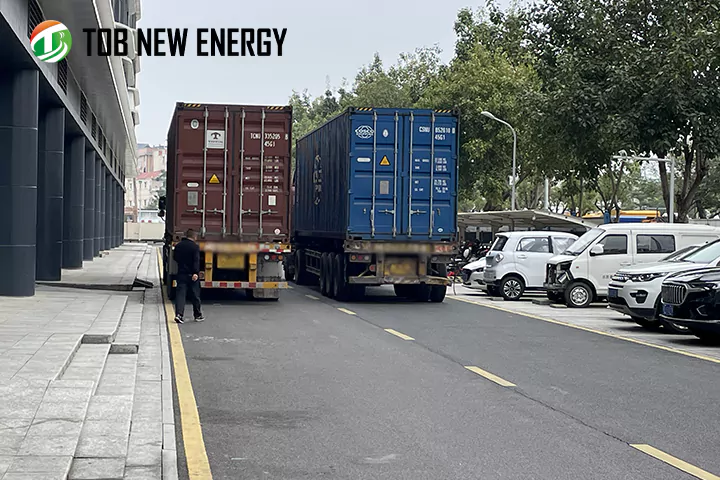
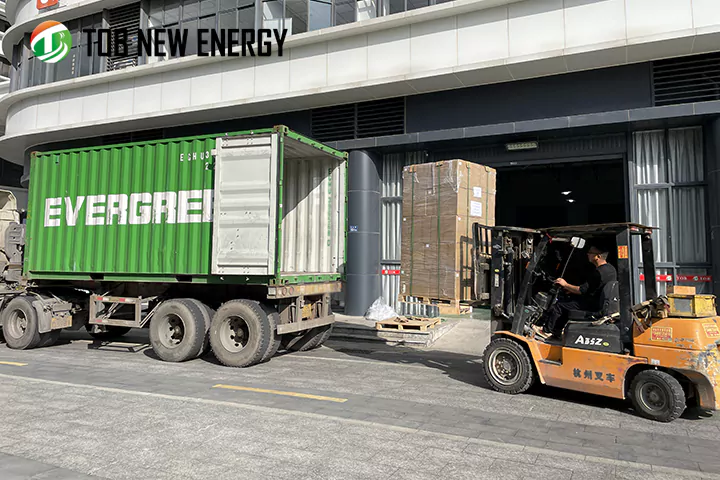
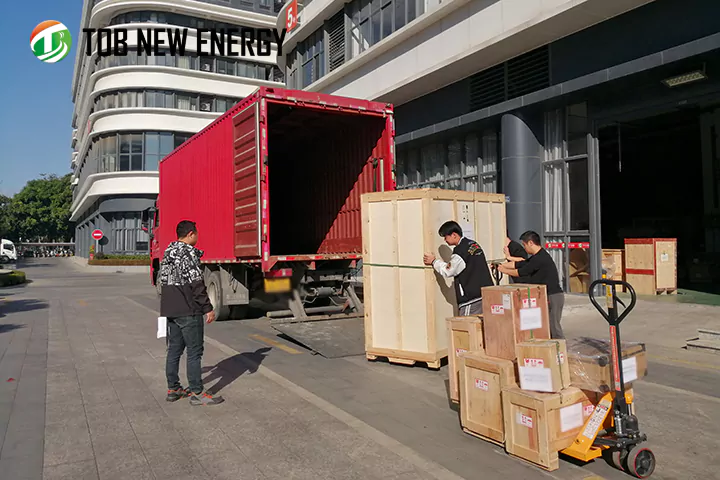
60138 Supercapacitor Equipment Being Shipped Dec 19, 2023Vacuum Oven TOB-DZF-6050 Planetary Vacuum Mixer TOB-XFZH05 Magnetic De-ironing Filtration System TOB-LB-FT02 Transfer Coating Machine TOB-SY300-2J NMP Process TOB-NMP-1 Electrode Vacuum Drying oven TOB-EVO-4 Big Electrode Cutter Machine TOB-CP500 Hydraulic Rolling Press machine with Hot function TOB-HRPC-300T Semi auto Battery Electrode Slitting Machine TOB-FT500 Semi Auto Winding Machine TOB-SJR-60138 Vacuum Oven TOB-SBVO-03AP Flattening of wound rolls TOB-CZF60 Laser Welding TOB-HJ-550-C Laser Welding TOB-HJ-550-F Cell Feeding Machine TOB-RK60 Grooving Machine TOB-GCK60 Sealing Machine TOB-MKF60 Filling Machine TOB-ZY60-1 Glove Box TOB-GB-2440-F2 Manual press machine for rubber stopper TOB-CP50 Ultrasonic welding machine for bottom TOB-USW-2050G PVC shrinking machine TOB-RS4015 Email :view more
-
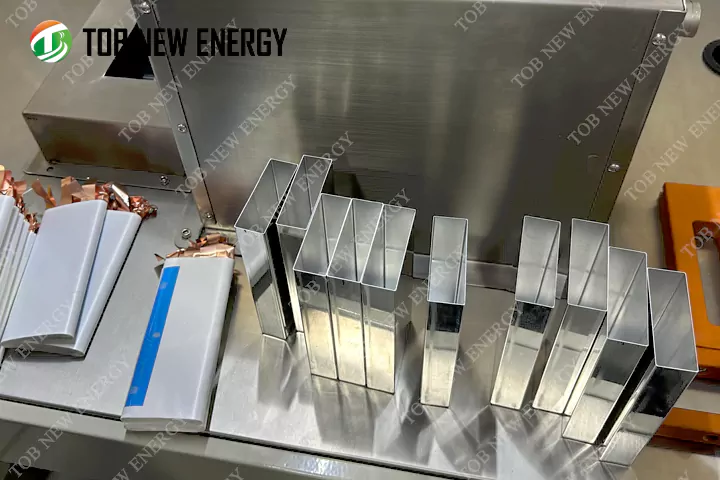
Lithium Ion Battery Materials Shipping from TOB New Energy Dec 07, 20231.Prismatic Cell Cases 2.Battery Current Collectors:Copper Foil Aluminum Foil 3.Battery Tab:Aluminum Strips, Nickel Strips 4.Battery Tape 5.Battery Separator Email :tob.amy@tobmachine.com Skype :amywangbest86 Whatsapp/Phone number :+86 181 2071 5609view more
-
TOB: Leading the Charge in Battery Innovation Dec 06, 2023The world is becoming increasingly reliant on batteries, and their role in powering the devices we use every day is only set to grow. From our smartphones to electric vehicles, from renewable energy storage to portable medical equipment, the demand for better-performing, longer-lasting, and more efficient batteries is enormous. And at the forefront of this rapidly expanding industry is TOB - the first brand in the battery lab and pilot line in worldwide. With a focus on research, development, and production of high-quality battery technologies, TOB has established itself as a leader in the field. Utilizing state-of-the-art facilities and cutting-edge techniques, the company has made significant progress in advancing the battery industry. One of the primary areas of expertise for TOB is the development of lithium-ion batteries, which are widely recognized as the most efficient and cost-effective battery technology available. With a team of experienced researchers and engineers, TOB is continually working to improve the performance and safety of these batteries while reducing their environmental impact. In addition to lithium-ion batteries, TOB is also involved in the development of other types of energy storage solutions, including Sodium-ion batteries, solid batteries, Li-S battery and more. Furthermore, the company is focused on exploring emerging technologies such as solid-state batteries, which have the potential to revolutionize the energy storage industry in the future. One of the key areas where TOB excels is in its battery lab and pilot line. These facilities are designed to allow the company to conduct fundamental research on batteries, as well as test and optimize new technologies before they are released into the market. By doing so, TOB can ensure the safety, reliability, and performance of its products, as well as keep up with the ever-changing demands of the industry. To achieve this, TOB has invested heavily in its research and development activities, and the company's scientists and engineers are among the best in the business. Through their collective expertise and experience, they are able to tackle complex problems and develop innovative solutions that drive the industry forward. The benefits of TOB's battery technology are numerous. They offer longer run times, faster charging times, greater environmental sustainability, and improved safety. Moreover, they can be used in a wide range of applications, making them a versatile option for companies and consumers alike. As the demand for better and more efficient batteries continues to grow, TOB's role in the industry will only become more essential. The company's commitment to innovation, quality, and safety means that it is well-positioned to lead the charge in developing the next generation of energy storage solutions. In conclusion, TOB is the first brand in the battery lab and pilot line in worldwide, and its innovative and sustainable battery technologies are driving...view more
-
Sodium-ion Batteries Have an Energy Density of 160 Wh/kg Nov 29, 2023European battery manufacturer Northvolt has successfully developed sodium-ion batteries and plans to commercialize them in the energy storage field. On November 21, Swedish battery company Northvolt announced that it had developed a state-of-the-art sodium-ion battery with an energy density of over 160 Wh/kg. However, the company did not disclose other technical indicators such as the cycle life of the battery. Sodium-ion batteries use sodium salts as electrode materials. Compared to lithium-ion batteries, sodium-ion batteries have advantages such as abundant resource reserves, low cost, and fast charging, but they lag behind lithium-ion batteries in energy density. Northvolt, founded in 2016, is the most well-known local battery manufacturer in Europe, and has received investments from Volkswagen Group, Goldman Sachs Asset Management and other well-known institutions. According to Northvolt's plan, its first generation of sodium-ion batteries will mainly be used in the field of energy storage, and it plans to release higher energy density sodium-ion batteries in the future, so as to achieve application in the field of electric vehicles. Its CEO and co-founder Peter Carlson told the Financial Times that the new technology of sodium-ion batteries may be worth tens of billions of dollars, as it opens up the energy storage market in the Middle East, Africa and India. According to Carlson's estimation, the order volume of energy storage batteries in the next decade may be larger than the current power battery market. Northvolt said that this type of sodium-ion battery is safer, more cost-effective and sustainable than traditional ternary batteries or lithium iron phosphate batteries. Ternary batteries and lithium iron phosphate batteries are the two main types of lithium batteries. At the same time, Northvolt's raw materials for producing sodium-ion batteries do not include lithium, nickel, cobalt and other minerals, but choose iron and sodium with richer reserves. According to Northvolt, the sodium-ion battery it developed uses Prussian blue cathode material and hard carbon as the anode. This technology line is consistent with the first generation of sodium-ion batteries released by CATL (300750.SZ). CATL released the product in July 2021, with an energy density of 160 Wh/kg. It plans to basically form an industrial chain of sodium-ion batteries this year. CATL also disclosed at that time that the energy density of its next-generation sodium-ion battery will exceed 200Wh/kg, but the product has not yet been released. According to the positive electrode material, in addition to the choice of Prussian white (Prussian blue), sodium-ion batteries also include two major technical routes: layered oxide and polyanion. Another domestic battery giant BYD (002594.SZ) mainly focuses on the latter two technologies. At a sodium-ion battery forum held in July this year, Yin Xiaoqiang, general manager of BYD's energy storage and new battery division, said that the...view more
-
Coin Cell Machine Being Shipped Nov 24, 2023TOB-ZKJB-150 Small Lab Vacuum Mixer TOB-VFC-150 Film Coating Machine TPB-CP60 Manual Coin Cell Electrode Disc Cutting Machine TOB-JS-100L Hot Rolling Press Machine TOB-MR-120 Coin Cell Crimper TOB-CT-4008-5V1A-TWS Battery Testing Machine TOB-GB-1220 Glove Box Email :tob.amy@tobmachine.com Skype :amywangbest86 Whatsapp/Phone number :+86 181 2071 5609view more
-
The Advantages of Solid-state Batteries Nov 17, 2023The advantages of solid-state batteries include: Higher energy density: Solid-state batteries use new electrolyte materials, which allow them to store more energy, resulting in a higher energy density. Faster charging and discharging: Solid-state batteries have faster ion transmission speeds, allowing them to charge and discharge more quickly. Stronger adaptability: Solid-state batteries can be used in a wide range of environments, including high temperature, low temperature, and humid conditions. Longer lifespan: Solid-state batteries have almost no lithium ion consumption during charging and discharging, resulting in a stable battery capacity over a long period of time. Stronger safety: Solid-state batteries use non-flammable and highly stable solid-state materials, making them safer than traditional batteries. More environmentally friendly: Solid-state batteries contain no liquid electrolytes or flammable materials, making them more environmentally friendly. Overall, solid-state batteries have many advantages and are expected to become the mainstream battery technology in the future. #Solid-state Batteries Machine# Email :tob.amy@tobmachine.com Skype :amywangbest86 Whatsapp/Phone number :+86 181 2071 5609view more
-
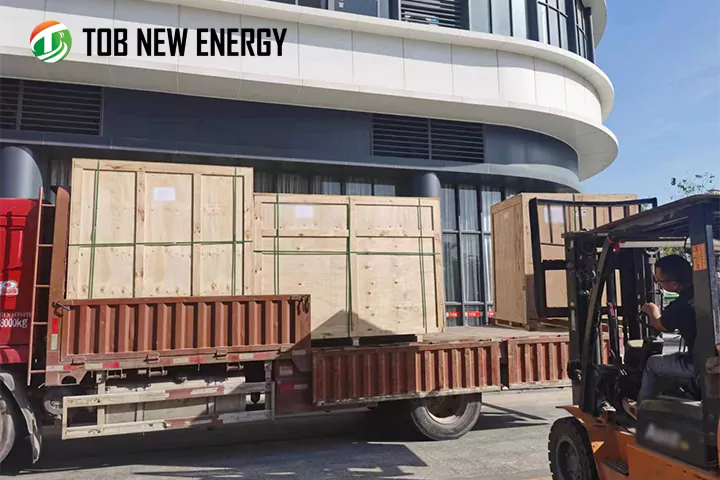
Polymer Battery Machine Being Shipped Nov 09, 2023Roll-to-Roll Die Cutting Machine Die Punching Machine Automatic Stacking Machine Turntable Vacuum Sealing and Trimming Machine Top Side Sealing Machine Email :tob.amy@tobmachine.com Skype :amywangbest86 Whatsapp/Phone number :+86 181 2071 5609view more
 subscribe to us