Chinese
 français
 Deutsch
 italiano
 español
 português
 Nederlands
 日本語
 한국의




- Home
- >
- Electrode Preparation
- >
- Battery Slurry Mixer
- >
- Vacuum Mixer For Battery Slurry
Categories
Hot Products
Loading...
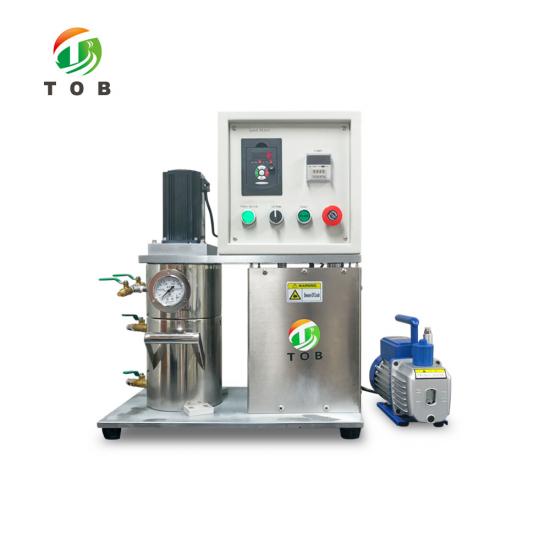
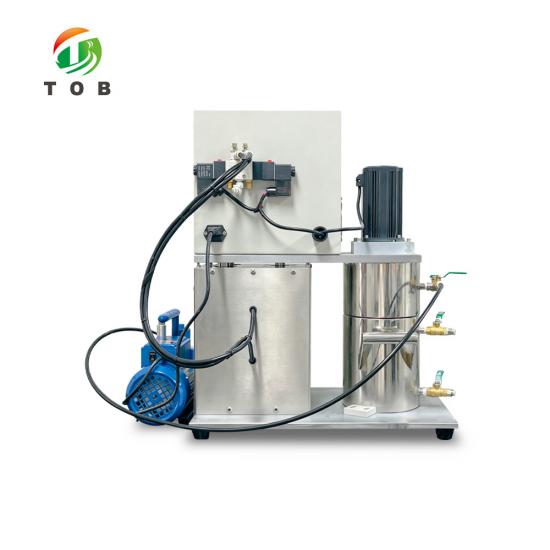
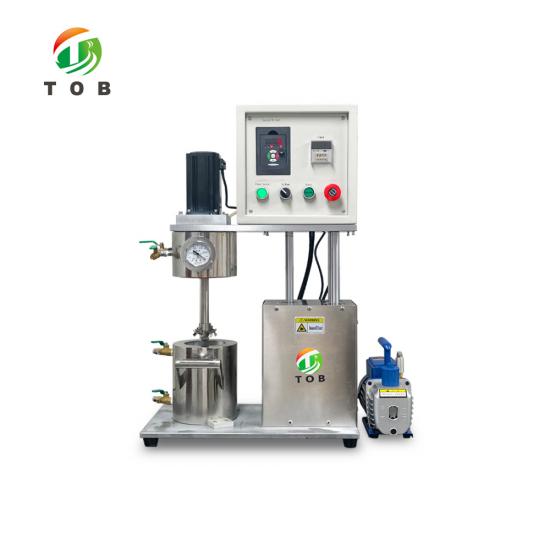
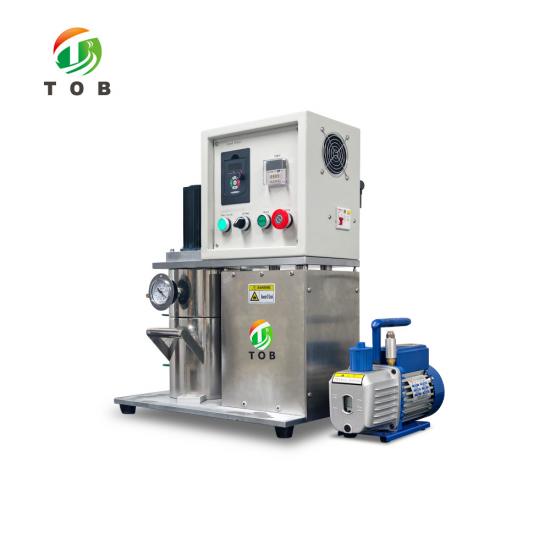
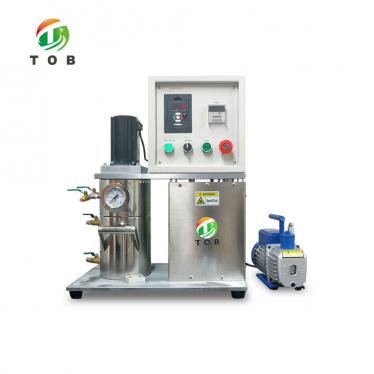
Vacuum Mixer For Battery Slurry
Brand:
TOB NEW ENERGYitem no.:
TOB-QVM-1Lorder(moq):
1setPayment:
L/C,T/Tproduct origin:
Chinashipping port:
XIAMEN
Laboratory Vacuum Mixer for Battery Slurry - TOB-QVM-1L
1 L 304 stainless steel vessel with a water-cooling jacket, 0 to 1400 r/min inverter drive, -98 kPa held for up to 24 hours, 254 L/min rotary vane pump included
Product Overview and Ideal Applications
TOB-QVM-1L is a 1 L laboratory vacuum mixer for the step between a beaker and a production mixer. One shaft carries a mixing and dispersing paddle into a 304 stainless steel vessel; a two-stage rotary vane pump holds the vessel at -98 kPa during the run, so entrained air leaves the slurry.
The vessel has a double-layer water-cooling jacket, inlet and outlet on the lower tank, so batch temperature is held while the inverter runs the shaft from 0 to 1400 r/min. The lid closes on a soft gasket, and the specified hold is -98 kPa for up to 24 hours: that is what lets a batch be de-aired overnight and coated next morning.
The 254 L/min pump is part of the delivery, not an option, and the controller sets time (0 to 99 h) as well as speed, so a de-airing cycle runs unattended. Capacity is 1 L; the same frame is built from 1 to 5 L. For a high-viscosity paste rather than a coatable fluid, a planetary machine is the right tool: see the 1L Vacuum Planetary Mixer.
Ideal for:
- battery slurry batches of 1 L for coin cells and small pouch cells
- de-airing NMP or aqueous slurry overnight before coating
- ceramic and powder dispersions that must not carry bubbles
- labs that want the pump included, not quoted separately
- groups scaling a formulation to the 1 to 5 L frame
The specification sets no viscosity limit. The 0 to 1400 r/min shaft is low-shear: not a high-speed disperser, not a planetary mixer.
Tell us your slurry system, batch size and the vacuum you need to hold. Our engineer will confirm vessel volume, pump and jacket connections.
Complete the inquiry form below and our engineer will review your requirements. Prefer email? Contact tob.amy@tobmachine.com.
Complete Specifications
The table below is the full parameter set for the 1 L build. Figures are the supplier's specified values, not measured results from a particular batch; where a value depends on the slurry or on the cooling water you connect, it is marked in the note column.
1. Main parameters
| Item | Value | Note |
| Model | TOB-QVM-1L | Vacuum mixer with dispersion |
| Source voltage | AC 220 V / 110 V | Customized at order |
| Power | 750 W | |
| Effective capacity | 1 L | 1 L to 5 L can be customized |
| Mixing speed | 0 to 1400 r/min | Through the inverter speed control |
| Vacuum degree | -98 kPa | With the two-stage rotary vane pump, 254 L/min, included |
| Time setting | 0 to 99 H | Set on the programmable controller |
| Dimensions (L x W x H) | 50 x 30 x 59 cm | 500 x 300 x 590 mm |
| Weight | About 65 kg | Machine only |
| Warranty | One year limited, lifetime support |
The 50 x 30 x 59 cm envelope is the machine; the pump sits beside it. Leave bench depth for the hose run and for the cooling lines at the lower tank.
2. Vessel, jacket and vacuum system
| Item | Specification | Note |
| Vessel material | 304 stainless steel | Wetted vessel |
| Vessel volume | 1 L effective | 1 L to 5 L customized on the same frame |
| Cooling | Double-layer water-cooling jacket | Inlet and outlet on the lower tank |
| Sealing | Soft sealing type | Specified to hold -98 kPa for up to 24 hours |
| Vacuum pump | Two-stage rotary vane, 254 L/min | Included with the machine |
| Control | Programmable controller plus inverter | Time 0 to 99 H, speed 0 to 1400 r/min |
To meet delivery requirements the supplier reserves the right to substitute a component with an equivalent-grade part, provided the rated performance in the tables above is unchanged. Tell us at enquiry stage if your own qualification or spare-parts policy fixes a brand, and it will be confirmed in the order specification.
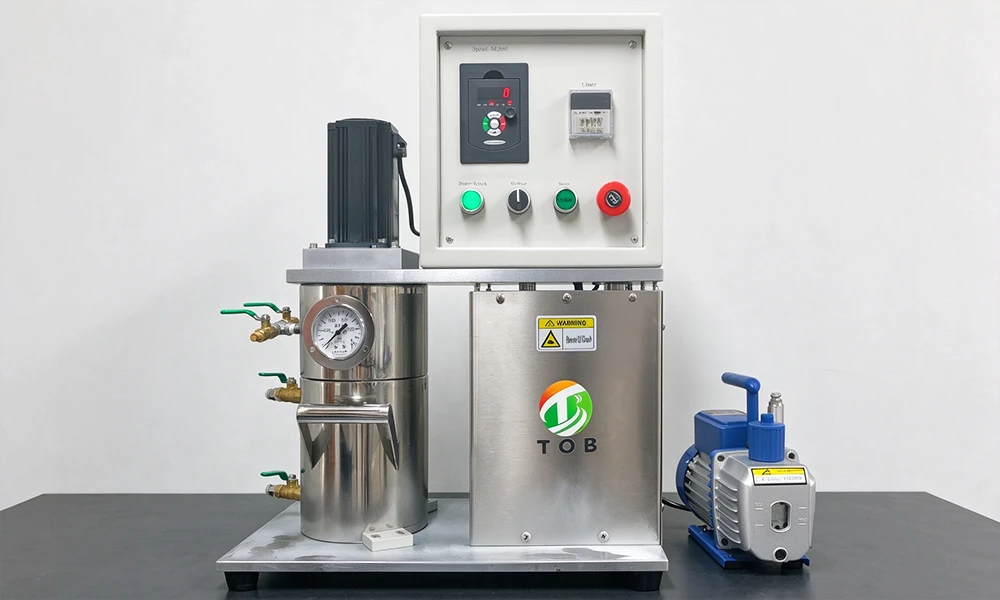
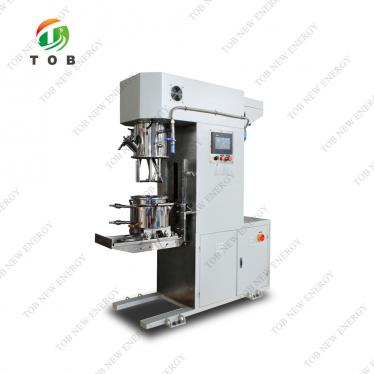
TOB-QVM-1L with the supplied vacuum pump, on a laboratory bench.
Construction and Wetted Parts
The vessel is the part that matters. It is 304 stainless steel, and the wall is doubled over the lower two thirds to form the water jacket, which is why the inlet and outlet sit low on the tank rather than on the lid: coolant enters cold at the bottom, travels up the jacket wall and leaves at the top of the jacket, so the slurry sees a cooled surface from below rather than a cold lid above it.
The lid carries the shaft, the vacuum port and the gauge. It closes on a soft gasket: the seal is a compressible ring, not a ground metal face, and the specified performance of -98 kPa for 24 hours is a statement about that ring as much as about the pump. A ring that has dried slurry on it will not hold, which is the single most common reason a lab mixer loses vacuum overnight.
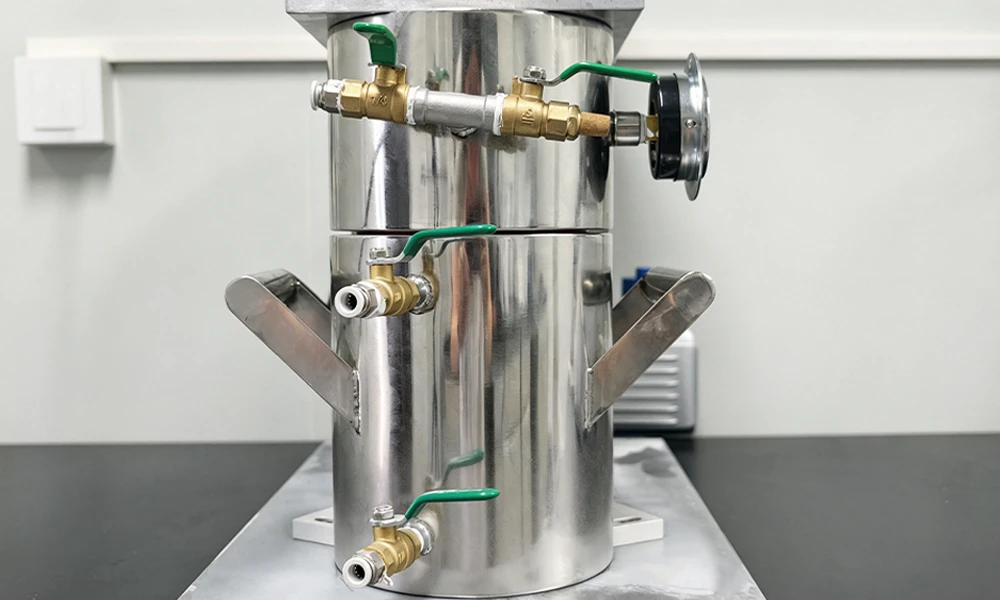
Lower tank: the two ports are the cooling water inlet and outlet for the jacket.
The paddle is a single-shaft mixing and dispersing paddle, raised and lowered with the lift switch on the panel so the vessel can be filled and cleaned without unscrewing anything. The pump is a separate two-stage rotary vane unit that stands beside the machine and connects by hose; it is oil-sealed, so it needs an oil level check rather than a service contract.
Key Engineering Characteristics
- One litre on a frame that goes to five. The 1 L vessel is the smallest build of a series that runs from 1 L to 5 L, so a formulation proved here can be scaled on the same geometry rather than on a different machine.
- 0 to 1400 r/min through an inverter. Speed is set on the controller, not by changing pulleys, so a ramp from low to working speed is a parameter rather than a mechanical job.
- -98 kPa with the pump that ships with it. A 254 L/min two-stage rotary vane pump is included, so the vacuum figure is a property of the delivered machine and not of an accessory you still have to buy.
- A soft seal specified for 24 hours. The claim is a hold time, not a peak: it is the difference between pulling vacuum for ten minutes before coating and leaving a batch under vacuum overnight.
- Double-layer water jacket on the vessel. Cooling is on the tank wall with ports at the lower tank, which is where the slurry actually is, not on the lid.
- Paddle lift from the panel. A dedicated switch raises the shaft, so filling, sampling and cleaning do not require dismantling the head.
- Time set in hours, 0 to 99. A de-airing cycle is programmed by time and speed together, which is what makes an unattended overnight run practical.
- 750 W on AC 220 V or 110 V. The voltage is fixed at order, so the machine arrives matched to the lab supply rather than behind a transformer.
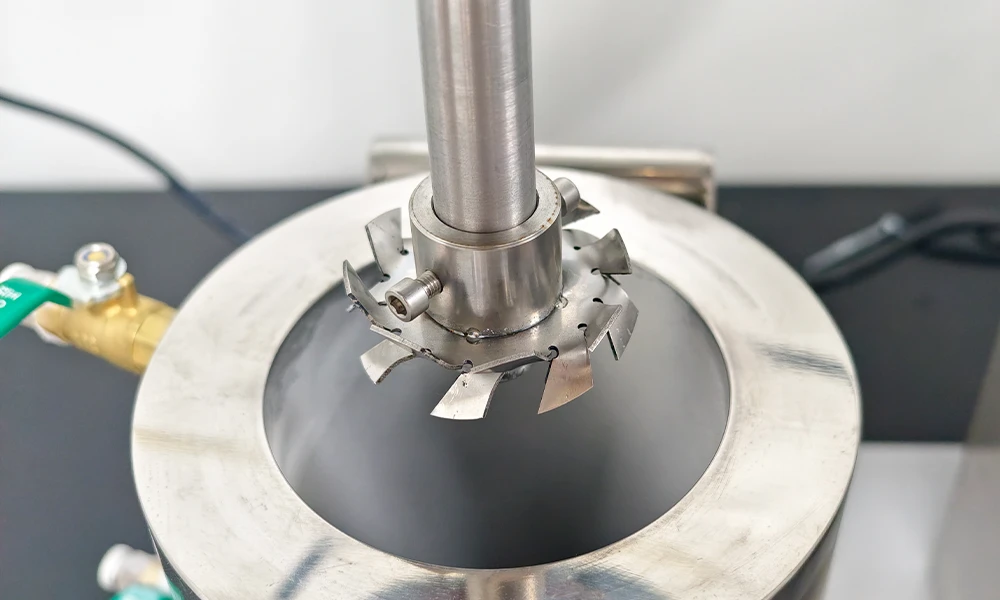
The single-shaft mixing and dispersing paddle; the lift switch on the panel raises it clear of the vessel.
Why Vacuum Mixing at 1 L Is Not a Smaller Stirrer
A bubble does not scale down with the batch. A 1 L batch carries roughly the same number of entrained bubbles as a larger one, but they are the same size, so in a 100 µm wet coating a bubble that was invisible in the vessel becomes a pinhole or a bare patch on the foil. That is the reason a lab mixer needs vacuum at all: not to look like the production line, but because the defect a bubble causes is a fixed size while the batch is not.
At 1 L the geometry works against you in a second way. The headspace is small, but the seal perimeter per litre of slurry is large, so a leak path matters more here than on a 30 L machine. This is why the specification talks about the seal and a hold time rather than only about pump displacement: a fast pump on a leaking lid reaches -98 kPa and then watches it drift.
Mixing also puts work into the slurry. Over an hour of dispersion that heat has nowhere to go in a sealed vessel, and slurry viscosity is temperature dependent, so a batch that warms up coats to a different areal density than the one before it. The jacket on the vessel wall is the only place that heat can be taken out without opening the lid.
The pump is deliberately larger than the vessel needs. A 1 L vessel with a few litres of headspace is evacuated quickly by a 254 L/min two-stage pump, and the two stages are what let it keep pulling as the pressure falls, instead of stalling near the end of the range where a single-stage pump becomes slow.
What it will not do is equally important. There is no revolution-and-rotation motion and no wall scraping, so a paste that stands up in the vessel will not be turned over by this shaft; that is the job of a planetary machine such as the 500ml Compact Dual-Shaft Lab Scale Planetary Vacuum Mixer, and at the other end of the range the 30L Vacuum Planetary Mixer for Battery Slurry shows what the same duty looks like at production scale.
Operation, Maintenance and Safety
1. The panel and the first run
The panel carries the speed controller, the timer, the power switch, the paddle lift switch, the start button and the emergency stop. Load the vessel with the paddle raised, lower it until the disc sits below the slurry surface, close the lid and start the pump before the shaft. Running the paddle in air does nothing useful and aerates the batch instead of de-airing it.
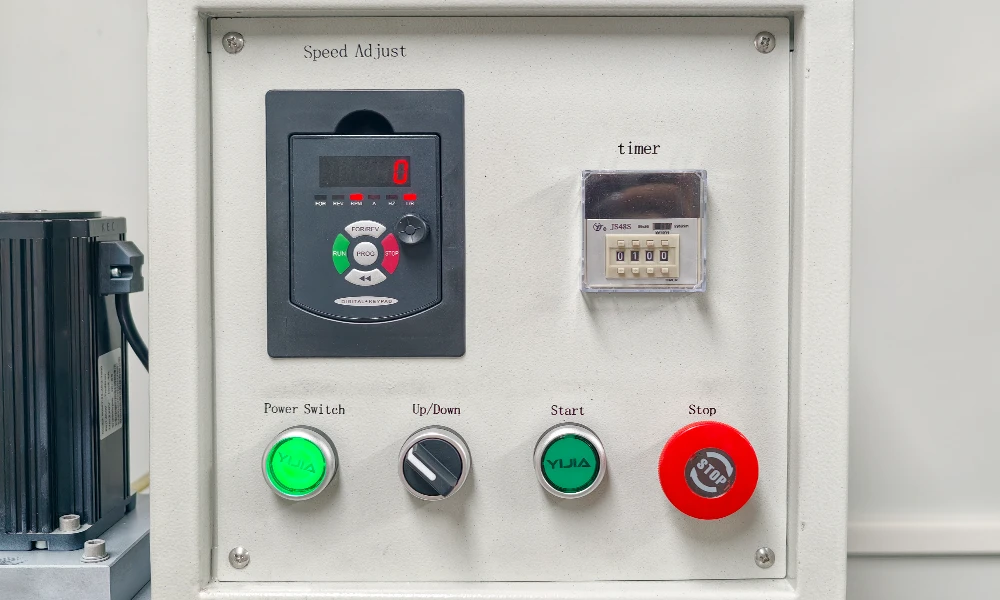
Panel, left to right: speed controller, timer, power switch, paddle lift switch, start, emergency stop.
2. Vacuum and cooling water
Connect the jacket ports at the lower tank before the first batch: inlet at the lower port, return at the upper one, with the hoses clear of the bench and of the paddle travel. The specification does not fix a flow rate or a supply temperature, so size the chiller or the tap-water loop to the heat your batch puts in over the run, and check the return temperature once rather than guessing.
The gauge on the lid is the only honest readout of the vacuum. Pump down with the vessel closed, watch the needle reach -98 kPa, then close the pump valve and watch it for a minute: a needle that creeps back is telling you about the gasket, not about the pump. Break the vacuum before undoing the lid clamp, and never open the vessel while the gauge still shows vacuum.
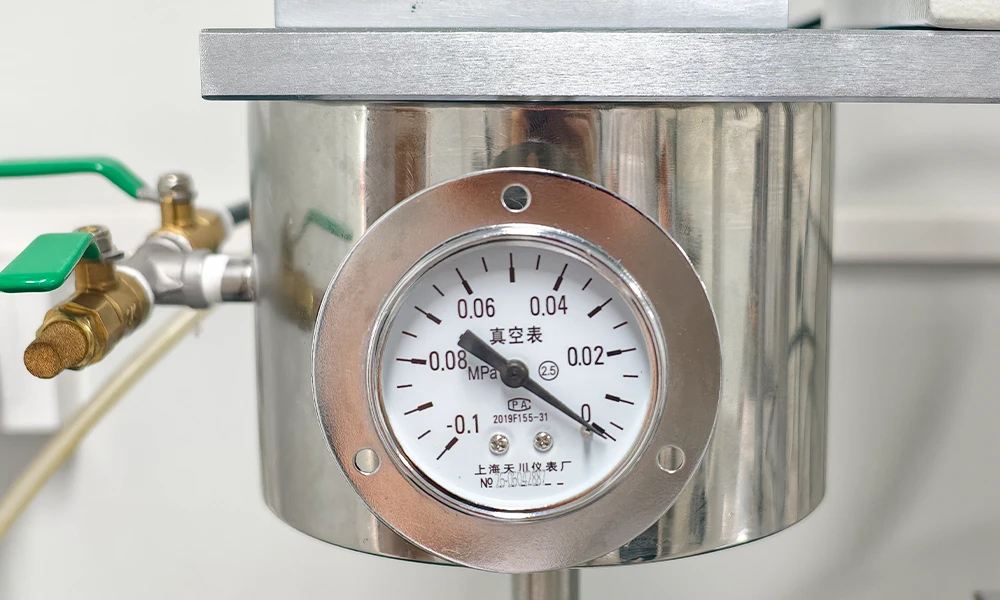
The gauge reads vessel pressure; a slow creep back is a seal problem, a fast one is a hose or valve problem.
3. Maintenance and safety
- Wipe the gasket and the vessel rim after every batch. Dried slurry on the sealing face is the usual cause of a vacuum that will not hold overnight.
- Check the pump oil level and colour weekly. The rotary vane pump is oil-sealed; cloudy or dropping oil means solvent is getting past the trap.
- Do not lift or move the machine by the lid or the paddle shaft. At about 65 kg it needs two people and the frame, not the head.
- Earth the frame and use the emergency stop as the routine way to end a run, so the button is known to work before it is needed.
- Vent the vessel to atmosphere before any cleaning, and keep NMP-wetted parts out of closed bins.
Certification, Patents and Research Record
1. CE marking: this model is named on the certificate
TOB-QVM-1L appears by designation in the 2024 CE files for this machine family: certificate M.2024.206.C00024 under the Low Voltage Directive 2014/35/EU, and certificate M.2024.206.C00045 under the Machinery Directive 2006/42/EC with the EMC Directive 2014/30/EU, both issued in 2024 through CAC. The model list on those files also carries TOB-SVM-1L and TOB-PVM-5L, and the LVD sheet prints this model with a stray space as TOB- QVM-1L, which is the same designation. The later 2025 certificate set (M.2025.206.C117273 and M.2025.206.C117275) lists the family as TOB-QVM without the litre suffix.
2. Management system certificates
|
|
|
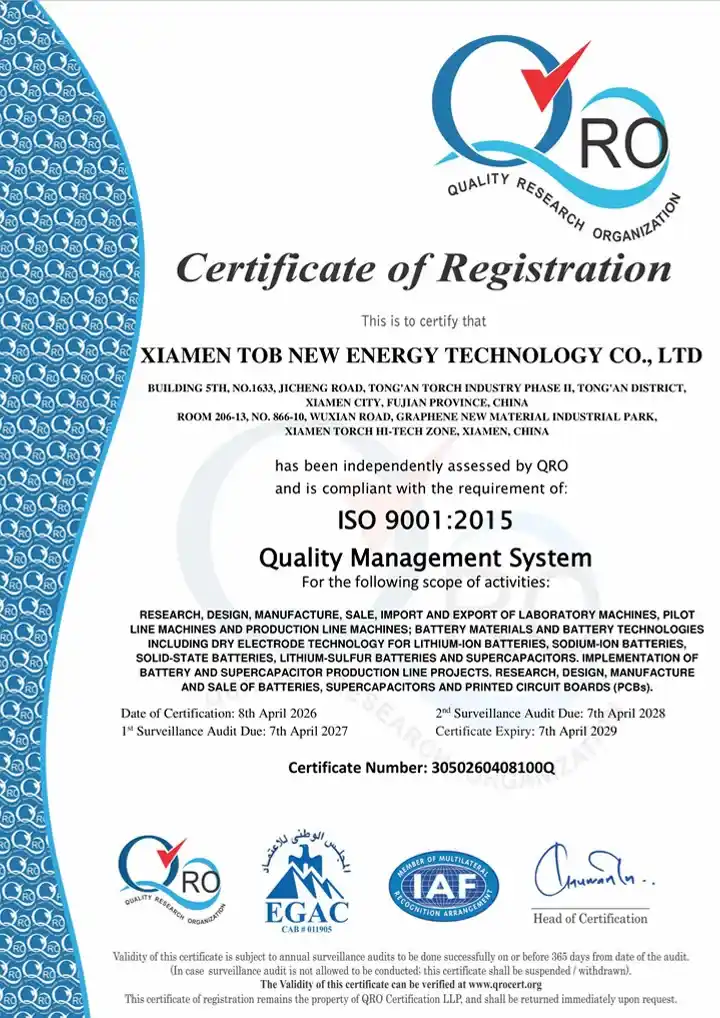
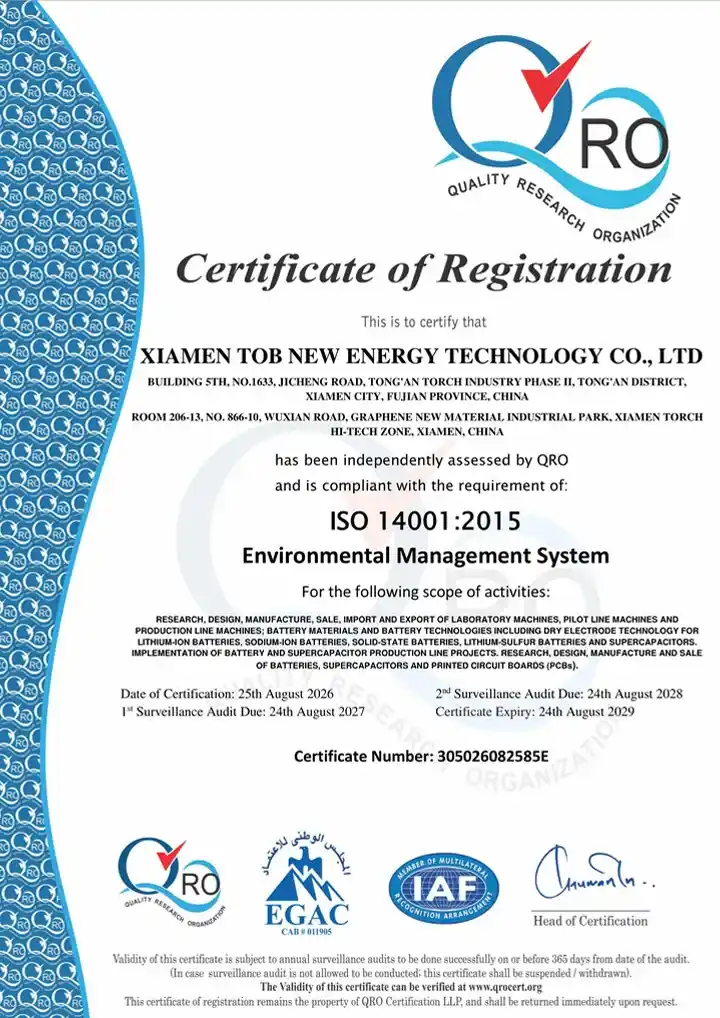
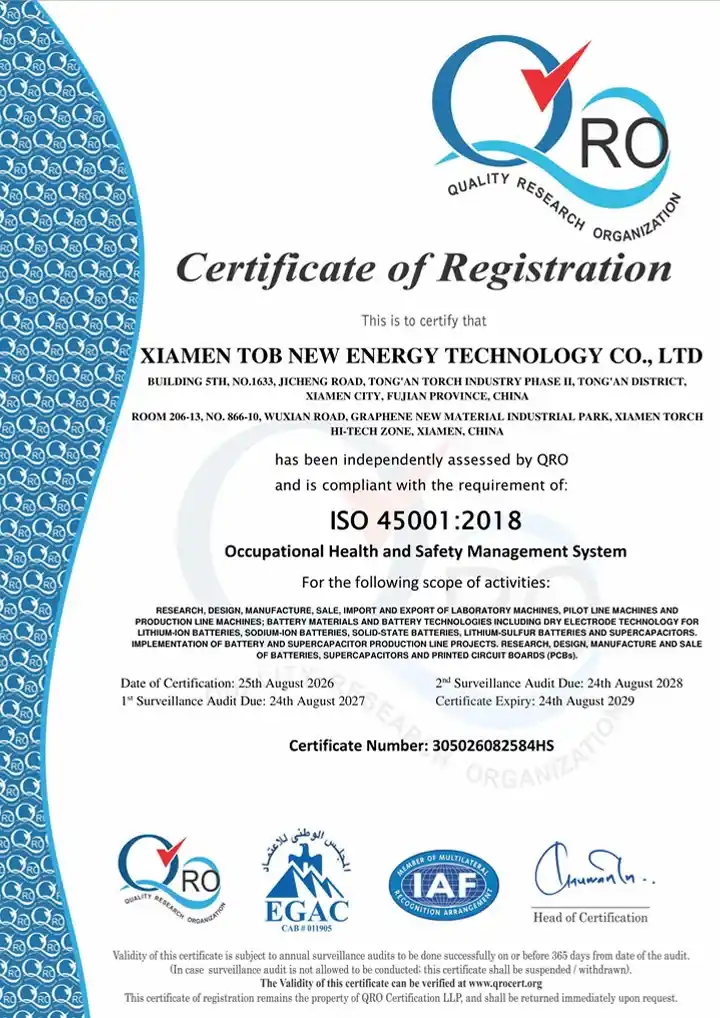
| ISO 9001: 3050260408100Q | ISO 14001: 305026082585E | ISO 45001: 305026082584HS |
ISO 9001 was issued on 8 April 2026 and runs to 7 April 2029; the 14001 and 45001 certificates cover the same plant. They describe the factory that builds the mixer, not a property of the mixer itself, which is why they are listed separately from the CE files.
3. Patents
The company holds 55 Chinese patents. Two of them concern mixers, and both are drawn on large machines rather than on this 1 L unit: CN215610864U large capacity vacuum slurry mixer, filed 26 August 2021, and CN215506637U, a feeding device for large mixers, filed 9 September 2021. No patent in the portfolio claims a laboratory-scale vacuum mixer, so nothing on this page rests on a patent claim.
4. Academic record
Our citation index holds 707 peer-reviewed records that mention equipment of this kind, 70 of which name a TOB model in the methods or acknowledgements. None of the 707 names TOB-QVM-1L. The index is rebuilt monthly from Crossref and OpenAlex; when a paper cites this model it will be listed here with its DOI rather than described in general terms.
5. Projects where a mixer of this class was used
- projects for lithium ion pouch cell lab scale line building in Brazil: a pouch cell laboratory line where slurry preparation sits upstream of the coater.
- 6080 supercapacitor pilot line building project: a pilot line built around a 6080 cell, with electrode slurry mixed on site.
Neither project page specifies TOB-QVM-1L, and neither is presented as a reference for this model; they show the kind of line the mixer is bought into.
Engineering FAQ
How is this different from the 1L vacuum planetary mixer?
The shaft. This machine turns one paddle on a fixed axis; a planetary mixer also revolves the paddle around the vessel wall and usually adds a second, offset shaft, which is what lets it turn over a paste that stands up. For a coatable slurry at 1 L this machine is enough and simpler to clean; for paste, the 1L Vacuum Planetary Mixer is the correct choice.
Does the price include the vacuum pump?
The two-stage rotary vane pump, 254 L/min, is part of the machine specification and ships with it, so -98 kPa is achievable on delivery rather than after a second purchase. Confirm it on the quotation; if you already run a house vacuum line, say so and the pump can be left out of the offer.
Can I order a 2 L or 5 L vessel instead of 1 L?
Yes. The series is customized from 1 L to 5 L, and the 1 L build on this page is the smallest. Give the working volume rather than the nominal one, since a vessel is normally filled to about two thirds for mixing, and the paddle position is set for that volume.
How long will it actually hold -98 kPa?
The specified hold is up to 24 hours with a clean soft seal. In practice the seal face decides it: close the pump valve after reaching -98 kPa and watch the gauge for a minute, because a needle that holds for a minute will hold overnight and one that creeps will not.
What viscosity can it mix?
The specification does not set a viscosity limit, and we will not invent one. The 0 to 1400 r/min inverter drive is a low-shear arrangement suited to coatable slurry; if your material is a paste that does not flow under its own weight, the planetary range starts at the 500ml Compact Dual-Shaft Lab Scale Planetary Vacuum Mixer.
What cooling water supply does the jacket need?
The specification fixes the jacket and the port positions at the lower tank, not the flow or the supply temperature. Size the chiller to the heat the batch takes over the run, connect inlet low and return high, and check the return temperature on the first batch rather than assuming room-temperature water is enough.
Send the slurry system, the working volume and the vacuum you need to hold, and we will confirm the vessel size, the pump and the jacket connections for your bench.
Email: tob.amy@tobmachine.com | Mobile phone: +86-18120715609
Reviewed by: Science Wang, Six Sigma Black Belt, Battery Lines | Last updated: 2026-11-17
If you are interested in our products and want to know more details,please leave a message here,we will reply you as soon as we can.




 subscribe to us