Chinese
 français
 Deutsch
 italiano
 español
 português
 Nederlands
 日本語
 한국의




- Home
- >
- Battery Tester
- >
- Battery and Supercapacitor Safety Tester
- >
- Over Charge Explosion Proof Box for Lithium ion Battery
Categories
Hot Products
Loading...


Over Charge Explosion Proof Box for Lithium ion Battery
Brand:
TOB NEW ENERGYitem no.:
TOB-001-1order(moq):
1Payment:
L/C,T/Tproduct origin:
Chinashipping port:
XIAMEN
Over Charge Explosion Proof Box - TOB-001-1
A single-chamber steel containment box for over charge and over discharge tests on 18650, button, phone, power bank and primary cells
Product Overview and Ideal Applications
The TOB-001-1 is a steel containment box built for one job: to keep a cell that explodes or burns during an over charge or over discharge test away from the person running that test. The cell sits inside a stainless steel chamber, the door is locked and chained, and the operator watches through explosion-proof glass instead of standing over the sample. The body is steel throughout, which is what gives the box its containment behaviour rather than a decorative enclosure.
One cabinet carries the whole assembly: the test chamber occupies the upper section, and an equipment cabinet forms the lower section. Inside, the chamber measures 500 x 500 x 500 mm and is lined throughout with 1.5 mm 304 stainless steel plate; outside, the shell is 1.2 mm cold rolled steel finished in a high-temperature powder coating, giving an overall envelope of 700 x 700 x 1,600 mm. The cabinet stands on four adjustable castors, so it can be repositioned without being fixed to the floor.
Containment is layered rather than single. A single-leaf door with one window closes against the body on powerful SUS 304 hinges and is held by an explosion-proof lock; two φ10 mm explosion-proof chains on each side of the door limit how far it can travel even if the lock is not fully engaged; and a mechanical pressure relief opening in the rear wall gives overpressure a defined path out of the box, away from the operator.
The box is a barrier, not a tester. It does not charge, discharge or measure anything: the over charge source, the data logger and the thermocouples belong to your own bench, and their leads enter the chamber through the φ50 mm port on the left. What the box contributes is the environment the test runs in.
Ideal for:
- Phone batteries, where a swollen pouch or a venting pack is the expected failure
- Button cells, small enough to be ejected but still hot enough to injure
- Power bank batteries, tested as a pack rather than as a bare cell
- AA and AAA primary cells (5 and 7 series), including the leakage and venting case
- A single 18650 cell, the format most often used for over charge and over discharge screening
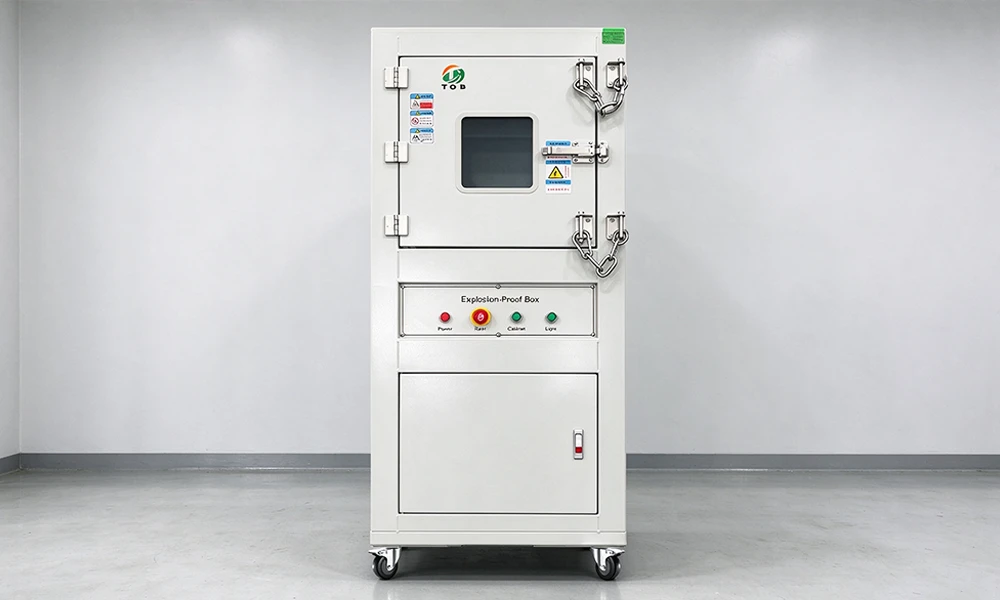
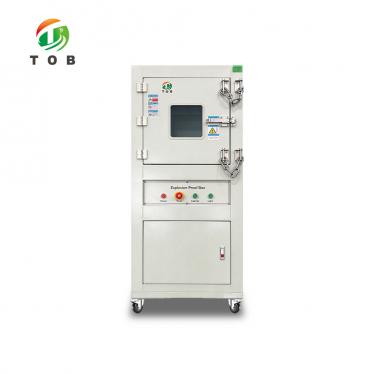
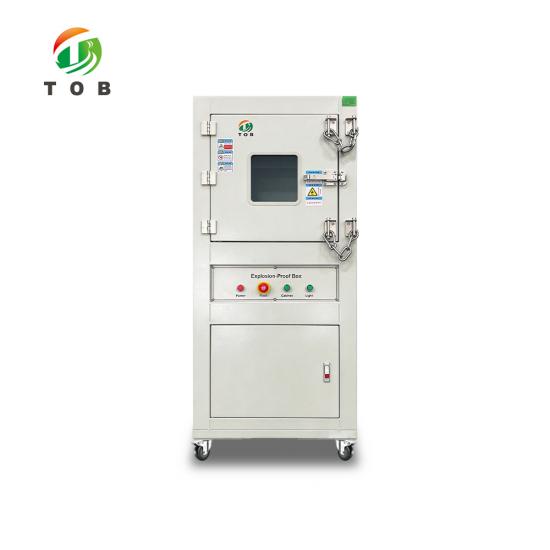
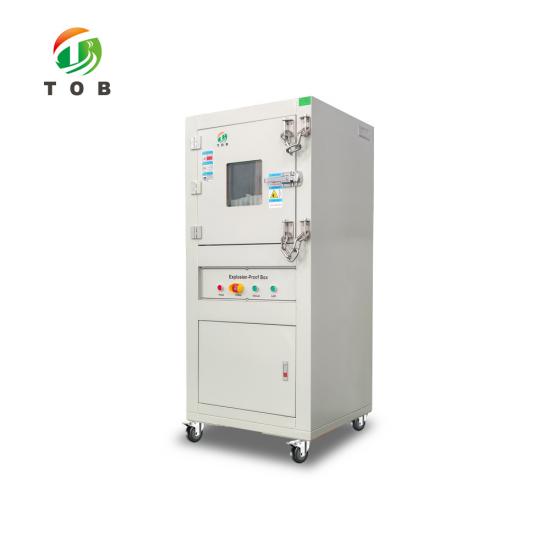
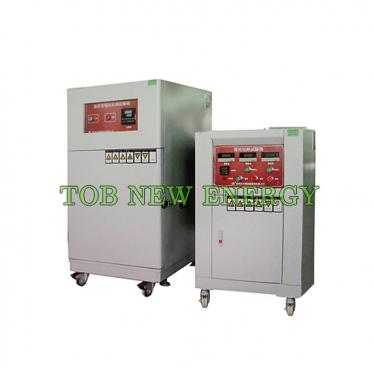
TOB-001-1 over charge explosion proof box, front view: single-leaf door with a flush recessed handle and the control panel beside it.
Why Over Charge Testing Needs a Physical Barrier
An over charged cell does not fail politely. Past the point where the cathode can no longer accept lithium, the electrolyte begins to decompose, the cell vents a flammable vapour, and in the worst case the can ruptures and throws hot parts outwards. The event is short, and the parts leave the cell with enough energy to injure anyone standing in front of it. A test bench that holds a cell in an open clamp assumes the cell will not fail in that direction.
A fume hood is not a substitute. A hood is an air-handling device: it dilutes and extracts vapour, and its sash, side panels and duct are built around that duty rather than around a pressure pulse and solid fragments. Extraction also happens after the fact, when the smoke has already been released into the working volume. The TOB-001-1 separates the two functions. The steel chamber takes the mechanical event, the exhaust fan at the rear clears the atmosphere afterwards, and the mechanical relief opening gives overpressure a defined exit at the back of the cabinet.
The third containment element is procedural rather than mechanical: the explosion-proof lock plus the chains. A door that is merely closed will open under a blast. Two φ10 mm chains on each side of the door are sized so that even a fully unlatched door can travel only a short distance, keeping the fragments inside and the operator outside.
Chamber Construction and Containment Features
The cabinet is one unit standing 1,600 mm high on four adjustable castors: the test chamber occupies the upper section and the equipment cabinet the lower section. The chamber itself is a 500 x 500 x 500 mm space, fully lined with 1.5 mm 304 stainless steel plate: not a coated panel, but a stainless liner across the walls that a venting cell will actually reach.
Double skin. The 304 stainless liner is chosen because it resists the hydrogen fluoride and organic solvents released by a venting lithium-ion cell far better than a painted mild steel surface would. Around it, the 1.2 mm cold rolled steel shell with its high-temperature powder coating carries the structural load and gives the box its finished appearance.
Marble base. The cell rests on a marble slab laid on the chamber floor rather than directly on steel. Marble is an insulator: if electrolyte leaks out of a ruptured cell, the puddle cannot bridge the cell can to the chamber wall and create an external short circuit that would end the test early and misrepresent the result.
Observation without opening. The single-leaf door has one viewing window, so the test can be watched from the first vent to the last without opening the chamber. Nothing has to be unlatched, and no one has to stand in front of an open door to see what the cell is doing.
Fittings, from the operator's side of the box:
- Door - single leaf, single window, flush recessed handle and SUS 304 hinges, joined to the body by a powerful hinge and held by an explosion-proof lock, so the door is a structural part of the containment rather than a cover.
- Explosion-proof chains - two φ10 mm chains on the left and two on the right of the door, as the second line of defence if the lock is not fully engaged.
- Pressure relief - a mechanical relief opening in the rear wall, opening outwards to release pressure when a cell explodes.
- Exhaust fan - a strong fan at the rear of the cabinet that discharges smoke to the outside, switched from the control panel.
- Lighting - one high-brightness energy-saving LED lamp at the top of the chamber, illuminating the whole test space so the window stays usable during a vent.
- Test port - a φ50 mm port on the left, with a silicone plug to seal around cables and a stainless steel cover for when the port is not in use.
- Control panel - switches the exhaust fan and the lighting, and nothing else on the cabinet is electrically live during a test.
- Castors - four adjustable, lockable castors, so the box can be moved to the bench and then fixed in place.
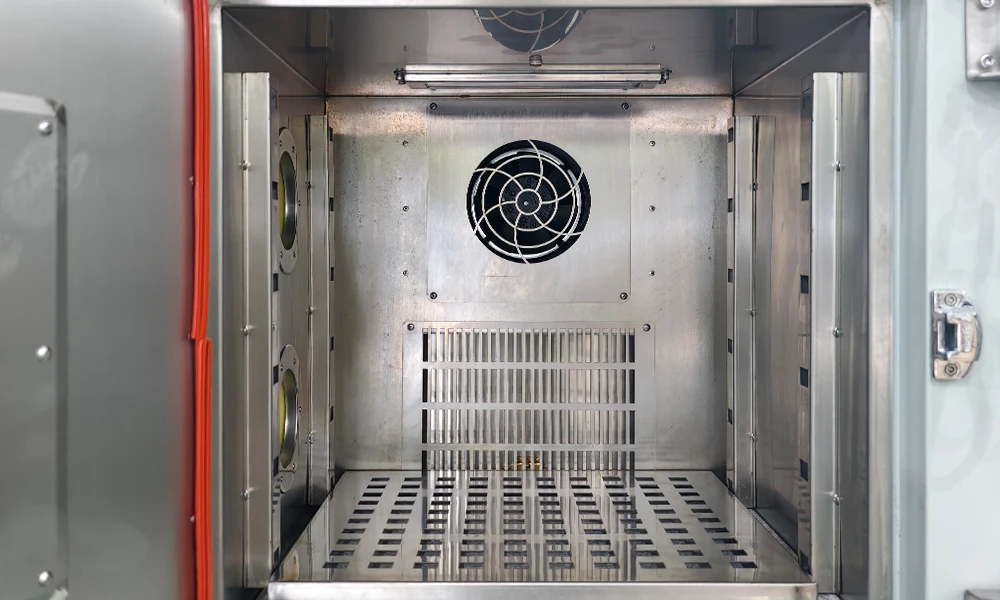
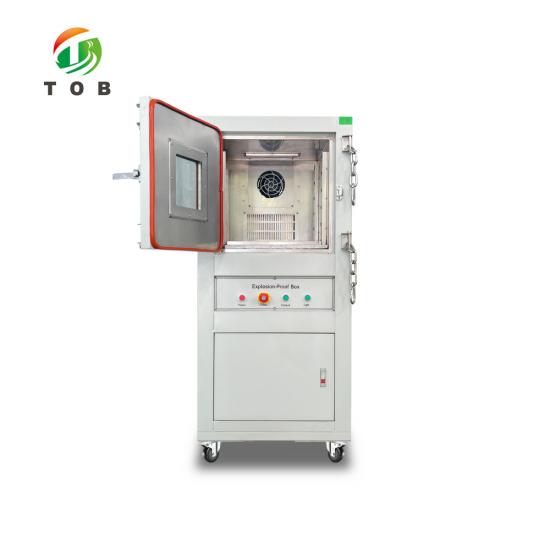
Inside the TOB-001-1: the 304 stainless steel liner across the chamber walls and the marble slab laid on the floor.
Complete Specifications
1. Dimensions and Materials
| Parameter | Value |
|---|---|
| Product name | Over charge explosion proof box |
| Model | TOB-001-1 |
| Cabinet structure | One cabinet: test chamber in the upper section, equipment cabinet in the lower section |
| Inner chamber size | W500 x D500 x H500 mm |
| Inner chamber material | 1.5 mm 304 stainless steel plate, full liner |
| External chamber size | W700 x D700 x H1600 mm, final size per the design drawings |
| External chamber material | Cold rolled steel, high-temperature powder coating, 1.2 mm |
The 1,600 mm external height covers the test chamber, the equipment cabinet, the frame and the castors; the external footprint is 700 x 700 mm.
2. Door, Fittings and Power
| Parameter | Value |
|---|---|
| Door | Single leaf, single window, flush recessed handle, SUS 304 hinges; joined to the body by a powerful hinge, with an explosion-proof lock |
| Viewing window | 2 panes of explosion-proof glass |
| Interior lighting | One high-brightness energy-saving LED lamp at the top of the chamber, illuminating the entire test space |
| Venting system | Strong exhaust fan at the rear, discharging smoke to the outside of the box |
| Control panel | Controls the exhaust and the lighting inside the chamber |
| Test port | φ50 mm port on the left of the cabinet, with silicone plug and stainless steel cover |
| Insulation | Marble slab laid on the chamber floor, to prevent external short circuit of the cell |
| Pressure relief | Mechanical pressure relief opening at the rear |
| Castors | 4 sets of adjustable, lockable castors, for moving the unit |
| Power source | AC 220V, 50Hz, single phase, 0.2 kW |
| Accessories | Marble slab, 1 piece; operation manual, 1 piece |
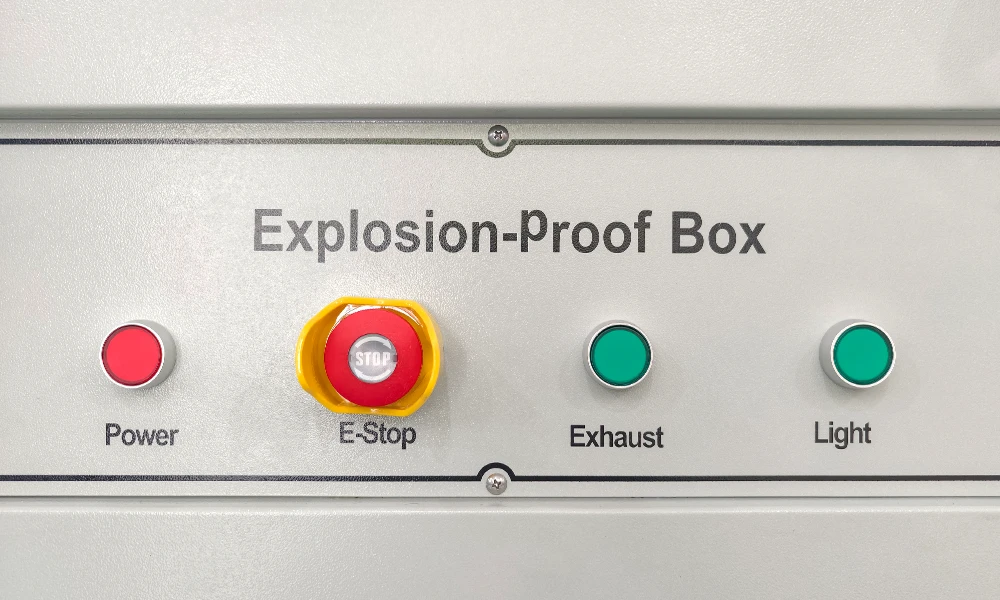
The control panel switches the exhaust fan and the interior LED; nothing else on the cabinet is electrically live during a test.
Operating Procedure
1. Before the test
- Switch on the lighting first and inspect the chamber: the marble slab must be dry and free of debris from the previous run, and the glass must be clean enough to see the cell.
- Place the cell on the marble slab, centred, with the vent side away from the window.
- Bring the test leads in through the φ50 mm port on the left and fit the silicone plug around them, so the cable entry is closed but the port is still usable.
- Close the single-leaf door, engage the explosion-proof lock, and hook the two φ10 mm chains on each side.
- Start the exhaust fan from the control panel, then begin the over charge or over discharge programme on your own current source.
- When the port is not in use, refit the stainless steel cover so the opening is fully closed.
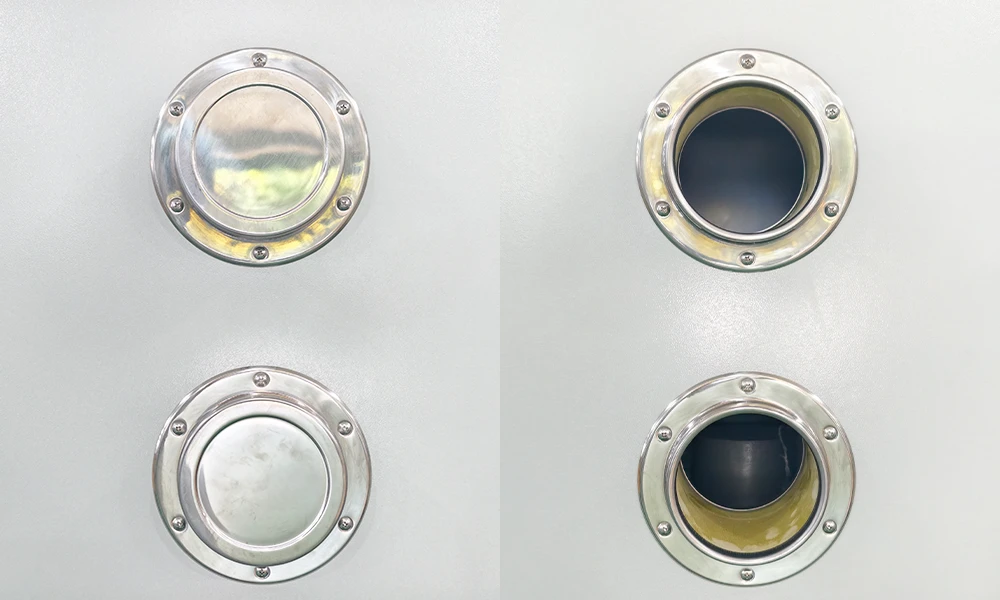
The φ50 mm port on the left: the silicone plug seals around the leads, and the stainless cover closes the port when it is not in use.
2. During and after the test
- Watch through the window, not through an opened door. The door stays locked and chained for the whole programme.
- If the cell vents or ruptures, let the exhaust fan run and do not open the chamber until the smoke has cleared and the chamber has cooled.
- After opening, check that the mechanical relief opening at the rear has returned to its closed position before the next run.
- Remove the debris with non-sparking tools, clean the marble slab and the glass, and record the cell condition against the test log.
Site Preparation and Maintenance
- Power. The cabinet needs a single phase AC 220V, 50Hz supply rated for 0.2 kW, with a protective earth. That supply runs the exhaust fan and the LED only; the over charge source is a separate instrument.
- Clearance. Leave room in front for the door swing and behind the cabinet for the relief opening and the fan discharge. A relief opening that is blocked by a wall is no longer a relief opening.
- Floor. The unit stands on four adjustable castors, so a level floor and a route wide enough for a 700 x 700 mm footprint are all that is required; lock the castors once the box is in place.
- Between tests. Wipe the glass, inspect the hinge and the lock face, and check that all four chains are still anchored and free of bent links.
- Never defeat the lock or the chains to shorten a test cycle, and never leave the test port open while a cell is venting.
Engineering FAQ
Q1: Why does a steel box do a job a fume hood cannot?
Because the two devices solve different problems. A fume hood is an air-handling device: it dilutes and extracts vapour, and its sash, side panels and duct are built around that duty. A rupturing cell produces a pressure pulse and solid fragments, neither of which a hood is designed to stop. By the time the hood extracts the smoke, the event has already happened in the working volume. The box changes the order: the steel chamber absorbs the mechanical event, and extraction deals with what is left afterwards.
Q2: Why is the test chamber in the upper section with an equipment cabinet below?
Because the chamber and the hardware that drives it have different requirements. The chamber has to be small, sealed and lined in stainless steel, and every millimetre inside it is working volume; the fan, the controls and the cabling do not have to sit in that volume to do their job. Stacking them vertically keeps the chamber compact and lifts the window to standing eye level, rather than burying a 500 mm cube at knee height.
Q3: Why a marble slab instead of a steel floor?
Because a conductive base can end the test early, and do it silently. If a cell ruptures and electrolyte leaks, a puddle on a steel floor bridges the cell can to the chamber wall: that is an external short circuit, and the cell now has a second failure path that has nothing to do with the over charge condition you meant to test. Marble is an insulator, so the leak stays a leak and the result stays attributable to the over charge.
Q4: Why does a closed box still have an exhaust fan, and what does the rear relief opening add?
It is a containment enclosure, not a pressure vessel. The fan is there for the ordinary case, where a cell vents smoke and electrolyte vapour without rupturing: it discharges that smoke to the outside so the next observation is made through clean air. The mechanical relief opening is there for the exceptional case, where internal pressure rises faster than any fan could remove it, and gives that pressure a defined exit at the back of the cabinet. One handles atmosphere, the other handles pressure, and neither replaces the other.
Q5: Why two chains on each side of the door rather than one?
Because the door is a large, heavy leaf and a blast loads it unevenly. A single chain per side lets the door rotate about the loaded chain and open at the opposite corner; two per side constrain the leaf at four points, so the travel is limited as a translation rather than as a swing. The chains are the second line of defence behind the explosion-proof lock, and they are sized so that even a fully unlatched door can only move a short distance.
Q6: What does this box not do, and when do you need a different tester?
The TOB-001-1 contains an event; it does not create the test condition or measure anything. It has no charge source, no data logging, no temperature control, no gas scrubbing and no active fire suppression, and its 500 x 500 x 500 mm chamber is sized for consumer cells rather than modules or packs. If your test is mechanical rather than electrical, the TOB-6047-2T nail penetration and crush tester applies the abuse in a controlled frame; if the failure mode you are studying is thermal propagation, the TOB-8401 thermal runaway test machine is the right instrument; and if the cell must be ignited on purpos
The whole family is listed under Battery and Supercapacitor Safety Tester, which is where this box sits alongside the short circuit, impact, vibration and thermal abuse instruments.
Tell us the cell format, the number of cells per shift and the space behind the bench, and we will confirm the chamber configuration and the accessory list before you order.
tob.amy@tobmachine.com | +86 181 2071 5609
Reviewed by: Science Wang, Six Sigma Black Belt, Battery Lines | Last updated: 2026-10-20
Previous:
High Temperature Aging Test Chamber for Lithium-ion BatteryNext:
Temperature Control Battery Short Circuit Tester
If you are interested in our products and want to know more details,please leave a message here,we will reply you as soon as we can.






 subscribe to us