Chinese
 français
 Deutsch
 italiano
 español
 português
 Nederlands
 日本語
日本語 한국의
한국의




- Home
- >
- Ball Mill
- >
- Roller Ball Mill
- >
- Precision Ceramic Three-Roll Mill
Categories
Hot Products
Loading...
Precision Ceramic Three-Roll Mill
Brand:
TOB NEW ENERGYitem no.:
TOB-SG-65ZPorder(moq):
1 setPayment:
L/C, T/Tproduct origin:
Chinashipping port:
XIAMEN
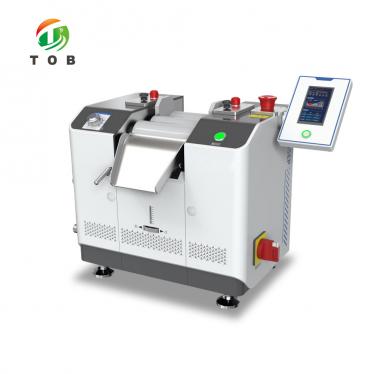
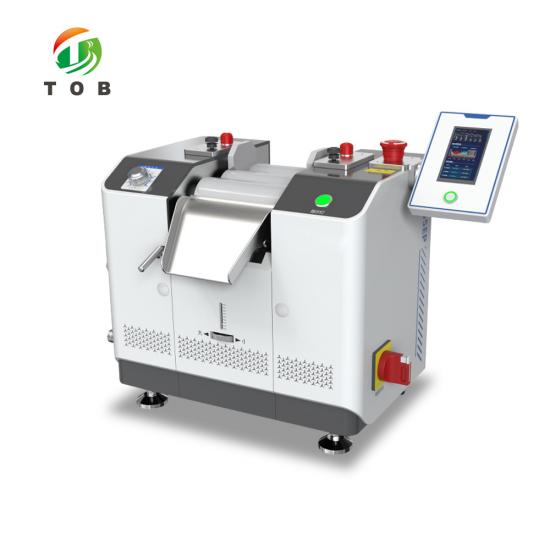
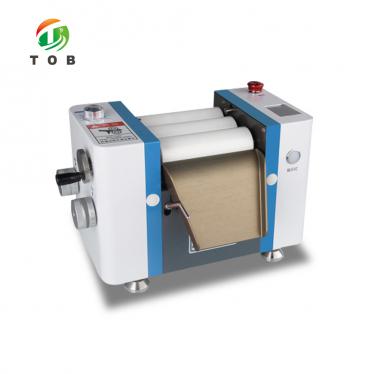
Precision Ceramic Three-Roll Mill - TOB-SG-65ZP
Automatic digital-display, external-interface version with temperature-controlled water cooling
Product Overview and Ideal Applications
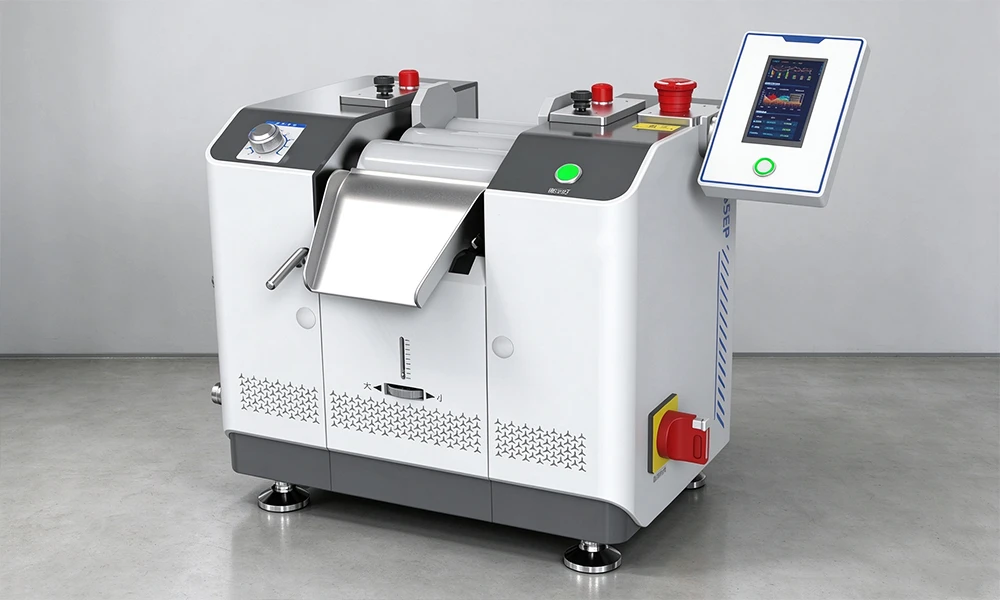
The TOB-SG-65ZP is a precision three-roll mill built around three zirconia ceramic rollers of Φ65×150mm. Material is fed between the rollers and dispersed by the shear produced by their speed differential, then scraped off the discharge roller as a finished paste.
The model code carries its roller diameter: the SG series uses the number after SG for the roller diameter and the letter for the roller material, so SG-65ZP is the zirconia version with Φ65 mm rollers. Gap setting is 1-150 μm with a 1 μm adjustment increment, roller speed is 0-500 rpm stepless, and maximum processing capacity is 0.02-14 L/h. Drive is an 800 W servo motor, and the control interface is external rather than built into the machine body.
Ideal for:
- Grinding and dispersing viscous and paste-like materials
- Processes that need a repeatable gap setting, taking the 1 μm increment as the control step
- Work where roller temperature has to be held and read on the interface while the mill runs
- Formulations carrying solids that would stain or wear a steel roller surface
- Not for dry powders or free-flowing low-viscosity liquids: a three-roll mill disperses by shear on a viscous paste held between rollers. For powder size reduction or low-viscosity slurry milling, use a ball mill instead.
Where This Mill Fits in Material Preparation
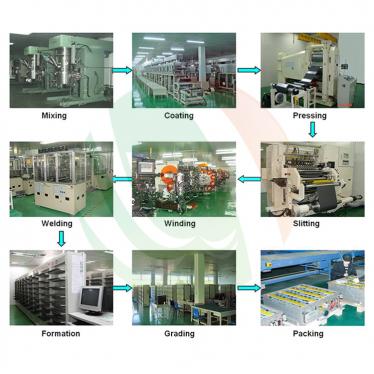
A three-roll mill is a dispersion and fine-grinding step, not a mixing step. It sits after the material has been combined into a paste and before the paste is used, coated or filled. In a typical sequence it is the third operation:
- Weighing and premixing the components into a paste
- Removing agglomerates so the paste is uniform enough to feed the rollers
- The three-roll mill is used here — the paste is drawn through the roller gap, dispersed by shear, and scraped from the discharge roller
- Downstream use of the dispersed paste, with the fineness and consistency set at the previous step
Alternative milling routes. A three-roll mill is one of several ways to reduce particle size and break down agglomerates; the others below work on different material states, which is what decides between them:
- Liquid Nitrogen Planetary Ball Mill - a planetary ball mill run under liquid nitrogen, for materials that must stay below room temperature during milling.
- High Energy Double Tank Vibrating Ball Mill - a high-energy vibrating route with two milling tanks, for laboratory powder work at high energy input.
- Laboratory Roller Ball Mill - jars rotated on driven rollers, for low-speed laboratory milling in sealed jars.
Key Engineering Characteristics of TOB-SG-65ZP
1. Ceramic Roller and Structural Technology
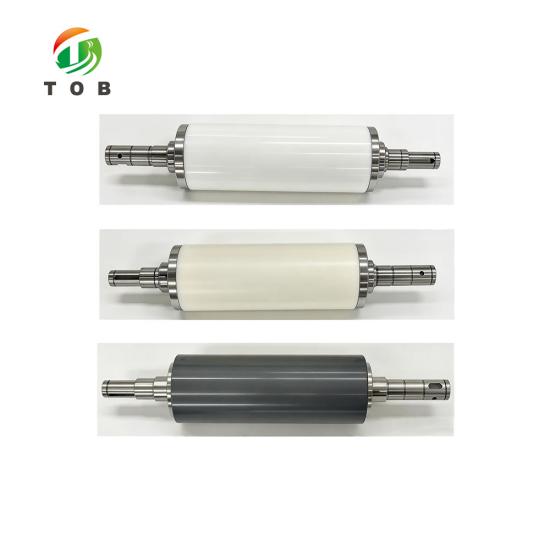
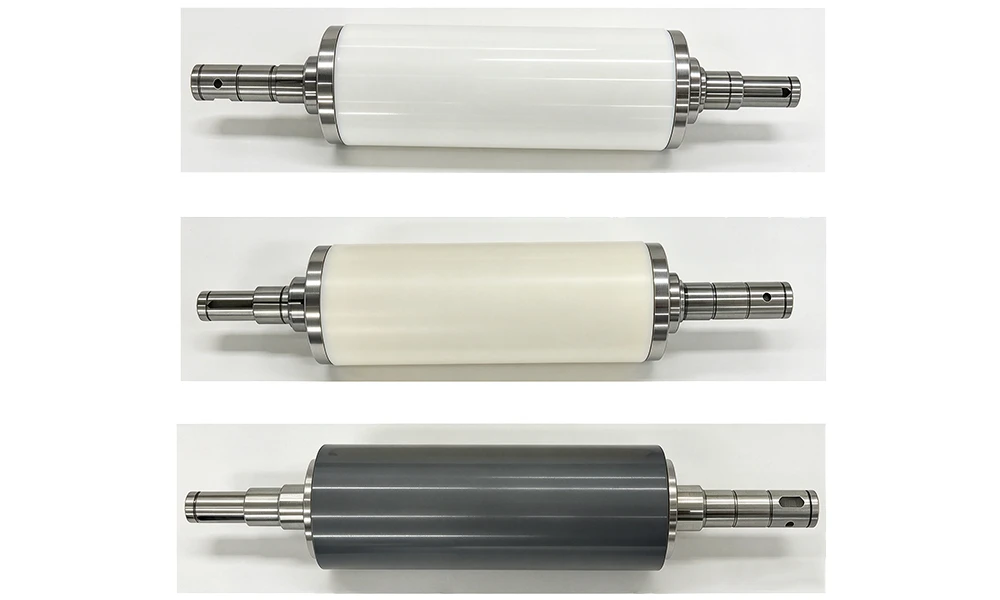
- Zirconia ceramic rollers: the rollers are zirconia ceramic, made from high-purity ceramic powder imported from Japan.
- Forming and sintering: after precision forming and sintering the rollers carry no black spots, and offer dimensional stability, stain resistance, easy cleaning and high wear resistance.
- Special sintering process: the process ensures full densification of the ceramic powder, so no powder is shed from the rollers during long-term service.
- Precision grinding: the ceramic rollers are precision ground on custom-built grinding machines to hold the machining accuracy the gap setting depends on.
- Laser inspection: every roller is dynamically inspected on a custom laser measuring system, which is how the concentricity and straightness figures below are controlled.
2. Drive, Control and Interface
- Servo drive: the mill runs on a servo motor for stable torque, with continuously adjustable speed and stepless regulation from 0 to 500 rpm.
- Control board: the machine uses a self-developed single-chip microcomputer control board. The custom modular design integrates three functions in one unit: single-chip microcomputer control, the mechanical mechanism, and sensor control. The practical effect is higher compatibility between the control and mechanical sides, and better controllability of the running settings.
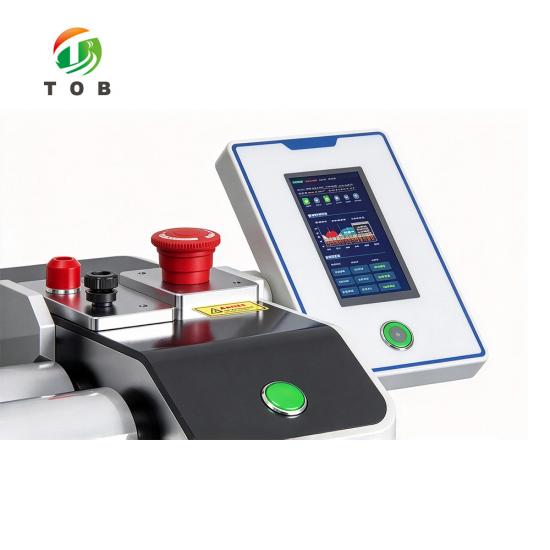
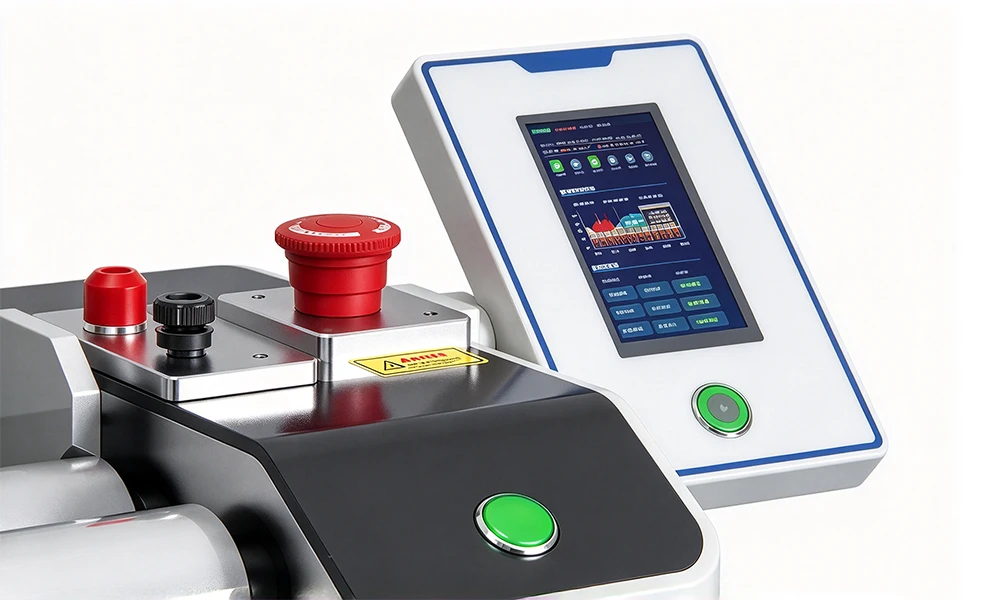
- External operation interface: the whole series uses an external operation interface, which is the design the higher precision and intelligence of this model come from.
- Interface functions: gap display and torque display, plus pressure curve, temperature display and intelligent alarm.
- Fingerprint recognition: the interface supports fingerprint recognition, so the machine can be locked to dedicated users.
- Torque curve assistance: available only on the top-spec model, it characterizes the particle size and dispersion status of the material intuitively. This model's operation mode includes torque mode with display.
3. Cleaning Protection, Discharge and Baffle
- Cleaning baffle: during equipment cleaning the baffle stops cleaning tools from falling into the feed roller and damaging the roller barrel.
- Cleaning-mode safety: under cleaning mode the machine is fitted with a safety protection mechanism, with emergency stop and an alarm on foreign object contact. The safety control complies with the ANSI B65 standard.
- Discharge mechanism: made of aluminum alloy with a special surface hardening treatment, so it resists corrosion and scratching, and uses a self-adaptive blade holder structure for a better fit against the roller.
- Adjustable fitting angle: the fitting angle can be adjusted flexibly to match materials of different viscosities, which widens the range of formulations one machine can handle.
- Blade options: metal, engineering plastic and ceramic blades are available, so the blade material can be matched to the product and the cleaning requirement.
- Material baffle: the baffle is designed to fit freely by swing angle with adjustable pressure, which supports a wide viscosity range. Node buckles let the working area be adjusted to suit the material.
4. Temperature Control and Roller Inspection
- Temperature control system: a built-in refrigeration system works with an external control unit to hold roller temperature, and the real-time roller temperature is shown on the interface.
- Water bath structure: the machine carries a built-in sealed internal circulation water bath system with ports, and an external cooling or heating system is optional.
- Circulation mode choice: an open-type internal circulation water bath is the recommended configuration; a sealed internal circulation water bath carries a risk of material aging during long-term operation.
- Roller inspection: dimensional stability, stain resistance, easy cleaning and wear resistance are the properties the roller surface is selected for. Concentricity and straightness are held to ≤ 2 μm and surface flatness to ≤ 0.3 μm.
Complete Technical Specifications
1. Technical Parameters
| Parameter | Value |
|---|---|
| Model | TOB-SG-65ZP |
| Maximum processing capacity | 0.02L-14L/hour |
| Roller dimension | Φ65×150mm (Zirconia Ceramic) |
| Roller concentricity/straightness | ≤ 2 μm |
| Surface flatness | ≤ 0.3 μm |
| Roller speed ratio | 1:2:4 |
| Control interface | External human-machine interaction interface |
| Speed | 0-500 rpm, stepless speed regulation |
| Gap range | 1-150 μm |
| Adjustment increment | 1 μm |
| Operation mode | Gap mode / Torque mode with display function |
| Power configuration | Servo motor |
| Safety control | Complies with ANSI B65 standard. Under cleaning mode, equipped with safety protection mechanism, emergency stop and alarm upon foreign object contact. |
| Safety protection | Emergency stop protection, abnormal load alarm protection, control alarm prompt protection. |
| Temperature control system | Built-in refrigeration system, coordinated with external command unit to control roller temperature; real-time roller temperature display on interface. |
| Voltage and Power | AC220V±5%, 50-60Hz, 800W |
| Net weight | Approx. 50 kg |
| Overall dimension | L620 × W380 × H470 mm |
2. Standard Accessories and Included Accessories
| Item | Quantity |
|---|---|
| POM baffle | ×2 |
| PVC material shovel | ×2 |
| Material receiving tray | ×1 |
| Foreign-object prevention cover | ×1 |
| Cleaning safety bracket | ×1 |
| Discharge blade holder | ×1 |
| Operation manual | ×1 |
| Operation process document | ×1 |
| Alloy stainless steel scraper blade | ×2 |
| Resin blade | ×2 |
Selection Guide: TOB-SG-65ZP vs the Smaller SG Model
The SG series uses the same working principle across models, so the choice between them is a capacity and roller-size decision rather than a change of process. Roller diameter and drive power are the two figures that predict where a model stops being suitable:
| Decision point | TOB-SG-65ZP (this product) | TOB-SG-50Z |
|---|---|---|
| Ceramic roller size | Φ65×150mm | φ50 mm / W150 mm |
| Gap range | 1-150 μm | 1-140 μm |
| Max. throughput | 0.02L-14L/hour | 0.02 L - 5 L/h |
| Drive | Servo motor, 800 W | DC motor, 400 W |
| Control interface | External human-machine interaction interface | Human-machine interface with real-time speed and gap display |
| Roller temperature control | Built-in refrigeration system with real-time roller temperature display | Not listed on the linked page |
| Dimensions (LWH) | L620 × W380 × H470 mm | L380 x W275 x H280 mm |
| Weight | Approx. 50 kg | 20 kg |
| Choose it when | Your batch volume and roller contact length call for the larger roller and the higher throughput | Your volumes are small and bench space is the binding constraint |
The TOB-SG-50Z figures above are taken from the TOB-SG-50Z three-roll mill for laboratory dispersion page.
Practical Operating Recommendations
- Set the gap from a trial, not from the target fineness alone: start from the fineness you need and step the gap down in 1 μm increments, because the increment is the control resolution the machine gives you and the result also depends on the material.
- Record the settings for each formulation: gap and speed together define the shear condition. Since the interface displays both, note them with the material so a later run can be reproduced instead of re-derived.
- Watch roller temperature on long runs: temperature is displayed in real time on the interface, so check it while a long run is in progress rather than only at the start, and use the cooling side if it climbs.
- Use the cleaning baffle and bracket every time: the baffle exists to keep cleaning tools out of the feed roller. It is positioned without any setup, so there is no reason to clean the machine without it fitted.
- Feed a premixed paste: the mill disperses, it does not combine separate components. Feeding unmixed material simply pushes the mixing problem downstream.
Engineering FAQ
Q1: Why do the three rollers run at different speeds?
Because the dispersion comes from the speed differential, not from pressure alone. The rollers run at a 1:2:4 ratio, so each successive nip produces a strong shear field as the material is transferred from the slower roller to the faster one. A machine with equal roller speeds would move the paste without dispersing it to the same degree.
Q2: Why is the control interface external rather than built into the machine?
It is the design the series uses across all models, and it keeps the control electronics away from the machine body while giving the operator a full-size interface. The control board integrates the microcomputer control, the mechanical mechanism and sensor control in one modular unit, which is what allows the settings to be managed from one place.
Q3: What is the difference between this model and the SG-50Z three-roll mill?
Roller diameter, throughput and drive. This model carries Φ65×150mm rollers, reaches 0.02L-14L/hour and runs an 800 W servo motor; the SG-50Z carries φ50 mm rollers, reaches 0.02-5 L/h and runs a 400 W DC motor. The working principle is the same, so the decision is about the batch size and roller contact length you need.
Q4: Can this mill handle a material that must not heat up?
That is what the temperature control system is for. A built-in refrigeration system works with an external control unit to hold roller temperature, and the real-time roller temperature is shown on the interface, so you can see the condition during the run rather than assuming it. If your material also needs to be kept cold before milling, a low-temperature milling route such as a liquid nitrogen planetary ball mill is the relevant comparison instead of a three-roll mill.
Q5: Which is the correct water bath configuration for this machine?
The open-type internal circulation water bath is the recommended configuration. A sealed internal circulation water bath also exists as an option, but it carries a risk of material aging during long-term operation, so it should only be chosen where that risk is acceptable for the product being made.
Q6: What should I check before choosing this model over a ball mill?
The state of the material, not the fineness figure. A three-roll mill works on a viscous paste held between rollers; a ball mill works on powder or on a low-viscosity slurry in a jar or tank. If the material can be fed as a paste, the three-roll mill gives direct gap control in 1 μm steps. If it is a powder or a thin slurry, one of the ball mill routes applies instead.
Need the TOB-SG-65ZP configured for a specific formulation, or a different roller diameter within the SG range? Send us the material, the target fineness and the batch volume.
tob.amy@tobmachine.com | +86 181 2071 5609
Reviewed by: Pinery Gong, Principal Engineer — battery assembly process and yield engineering, XIAMEN TOB NEW ENERGY TECHNOLOGY Co., Ltd. | Last updated: 2026-10-14
You May Also Need
-
Three-Roll Mill for Laboratory Dispersion (TOB-SG-50Z) - the same three-roll principle with φ50 mm rollers and 0.02-5 L/h throughput. Choose it when your volumes are smaller or bench space is the limiting factor; choose the SG-65ZP when the batch calls for the larger roller.
-
Laboratory Roller Ball Mill - jars turned on driven rollers. A different dispersion route for lower-viscosity material or powder in sealed jars, so it complements rather than replaces a three-roll mill.
-
High Energy Double Tank Vibrating Ball Mill - a high-energy vibrating route with two tanks. Relevant when the target is finer powder than a roller mill can reach, rather than dispersing an existing paste.
-
Liquid Nitrogen Planetary Ball Mill - planetary milling under liquid nitrogen. Check it when the material must be held cold through the milling step, which roller temperature control on a three-roll mill cannot do on its own.
If you are interested in our products and want to know more details,please leave a message here,we will reply you as soon as we can.

 subscribe to us