Chinese
 français
 Deutsch
 italiano
 español
 português
 Nederlands
 日本語
日本語 한국의
한국의




- Home
- >
- Ball Mill
- >
- Roller Ball Mill
- >
- Three-Roll Mill for Laboratory Dispersion
Categories
Hot Products
Loading...
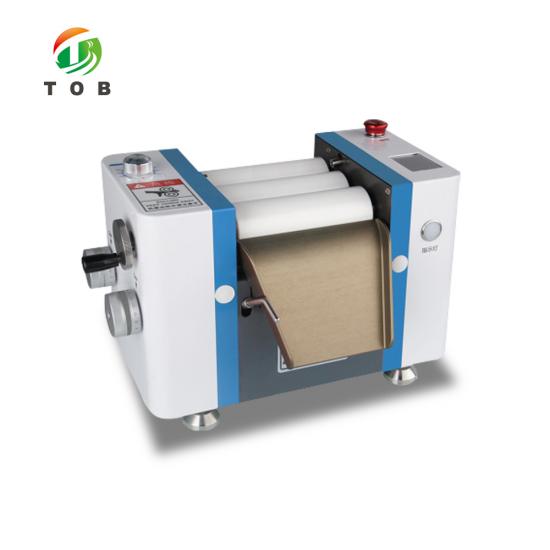
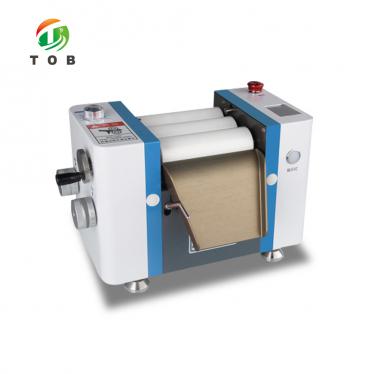
Three-Roll Mill for Laboratory Dispersion
Brand:
TOB NEW ENERGYitem no.:
TOB-SG-50Zorder(moq):
1Payment:
L/C, T/Tproduct origin:
Chinashipping port:
XIAMEN
Three-Roll Mill for Fine Grinding and Dispersion of Viscous Materials - TOB-SG-50Z
Product Overview and Ideal Applications
The TOB-SG-50Z is a three-roll mill used for the fine and dense distribution, homogenization, and dispersion of material to be ground in a viscous or semi-liquid dispersing medium. It serves small-batch R&D and laboratory work, as well as production work in the industries it supports - cosmetics, pigments, electronics, food, dental products, ceramics, lubricants, adhesives, soaps, and certain specialty products. Depending on the application, the machine can be configured to meet different requirements.
The machine is composed of three roller shafts, each sleeved in high-hardness zirconia or alumina ceramic, together with an electric motor, the electrical control circuit, and a series of transmission assemblies. The three ceramic rollers are divided into the feed roller, the middle roller, and the discharge roller, and they rotate at successively higher speeds during operation, producing a shearing and mutual grinding (attrition) effect through the speed differential. The fineness the machine can achieve is among the best of all wet grinding equipment, and the roller gap is adjusted by hand through a simple and reliable mechanism.
Despite its compact size - L380 x W275 x H280 mm and 20 kg - the TOB-SG-50Z is a precision instrument: the ceramic rollers are held to a precision of ≤ 2 µm (depending on the nature of the material), the roller gap is adjustable from 1 to 140 µm in 1 µm increments, and the roller speed is steplessly controlled from 0 to 500 rpm through an external speed control knob. A digital human-machine interface displays the speed and the gap in real time, so the operator can set and verify the two parameters that define the dispersion result.
Ideal for:
- Small-batch R&D and laboratory work requiring the fine grinding, homogenization, and dispersion of a viscous or semi-liquid material.
- Laboratories preparing high-viscosity dispersions such as pastes and slurries for evaluation, where the material must be finely and evenly distributed before it is tested or processed further.
- Product and process work in cosmetics, pigments, electronics, food, dental products, ceramics, lubricants, adhesives, soaps, and specialty products.
- Workflows in which colors or products are changed frequently, supported by the machine's clean discharge, minimal residue, and easy cleaning.
- Laboratories that need a compact, bench-top dispersion machine with digitally displayed speed and gap values, and a wide choice of roller and scraper blade materials.
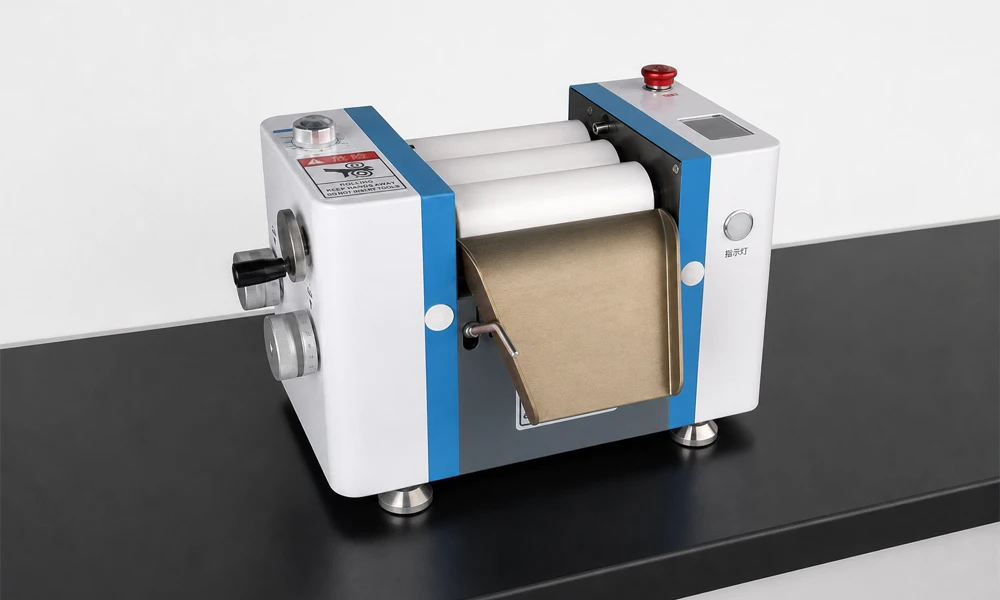
Technical Specifications
| Parameter / Model | TOB-SG-50Z (Automatic - Digital Display Model) |
| Roller material | Alumina / Zirconia / Silicon nitride / Alloy steel |
| Ceramic roller size | φ50 mm / W150 mm |
| Ceramic roller precision | ≤ 2 µm (depending on the nature of the material) |
| Speed ratio | 1:02:04 |
| Gap adjustment | Handwheel adjustment |
| Ceramic roller gap range | 1-140 µm, adjustment increment 1 µm |
| Ceramic roller speed | 0-500 rpm, stepless speed control, operated by an external speed control knob |
| Control interface | Human-machine interface, easy to operate! With real-time speed and gap display |
| Voltage | AC 220 V / 50 Hz |
| Power | 400 W |
| Drive configuration | DC motor |
| Dimensions (LWH) | L380 x W275 x H280 mm |
| Weight | 20 kg |
| Max. throughput | 0.02 L - 5 L/h |
| Safety protection | Emergency stop protection, abnormal load alarm protection |
Temperature Rise Reference
About the temperature rise of the three-roll mill: under normal conditions the temperature rises by about 5 °C after 1 hour of running, and reaches about 40-50 °C after 2 hours. The temperature rise also depends on the viscosity of the material - the higher the viscosity, the faster the temperature rises.
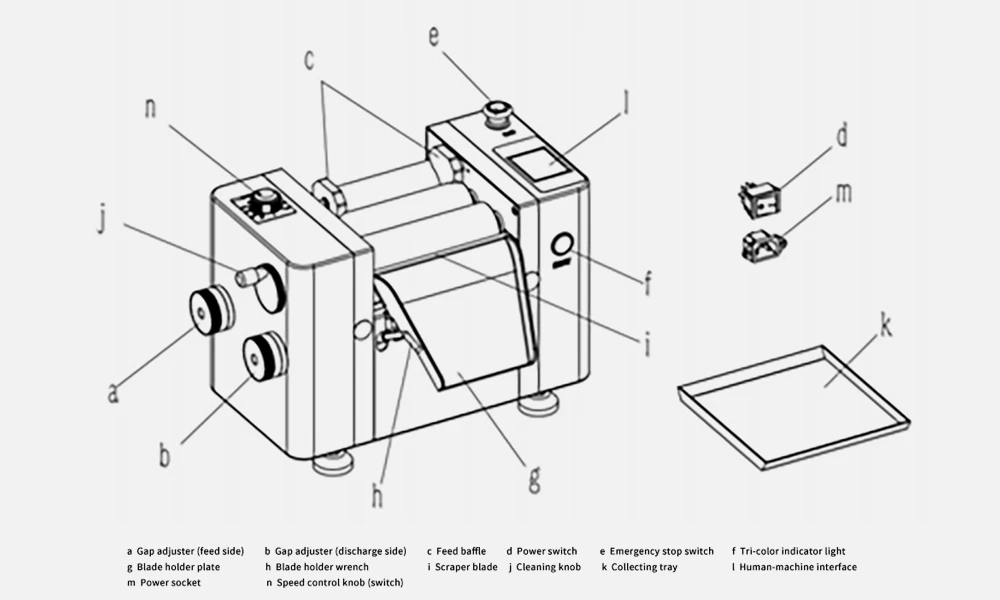
a Gap adjuster (feed side) b Gap adjuster (discharge side) c Feed baffle d Power switch
e Emergency stop switch f Tri-color indicator light g Blade holder plate h Blade holder wrench
i Scraper blade j Cleaning knob k Collecting tray l Human-machine interface
m Power socket n Speed control knob (switch)
Where the Three-Roll Mill Fits in Materials Processing
In materials processing, dispersion is the step that turns a mixture of solid particles and a liquid medium into a uniform product. Where the medium is viscous or semi-liquid, the material must be finely and densely distributed and homogenized through the whole batch - and this is the function the three-roll mill performs.
The machine sits at the fine-dispersion point of the process flow. Upstream, the components are combined into a premix; downstream, the homogenized dispersion is used, applied, evaluated, or processed further. The three-roll mill's role is to reduce agglomerates and distribute the solid phase through the medium at the fineness the product requires, using the shear generated between rollers that rotate at successively higher speeds.
The platform is configured for small-batch R&D and laboratory work, and it also serves production work where the batch and fineness fit its capacity. The industries it serves include cosmetics, pigments, electronics, food, dental products, ceramics, lubricants, adhesives, soaps, and certain specialty products. In laboratory settings, the same principle applies: where a viscous material must be ground and homogenized before it can be evaluated, characterized, or used, the three-roll mill provides that dispersion step on a small-batch scale.
Working Principle
The three-roll mill is a grinding and dispersing machine composed of three roller shafts sleeved in high-hardness zirconia or alumina ceramic, an electric motor, the electrical control circuit, and a series of transmission assemblies.
The three ceramic rollers are divided into the feed roller, the middle roller, and the discharge roller. In operation, the three rollers rotate at successively higher speeds, and the high linear speed differential between them produces a shearing and mutual grinding (attrition) effect in the film of material carried between the roller surfaces. The material is fed at the feed roller, passes through the gaps between the rollers, and is discharged at the discharge roller - so the dispersion is progressively refined as it moves through the machine.
The roller gap is adjusted by hand through a mechanism that is simple and reliable. The machine is suitable for processing high-viscosity materials, and it offers fine grinding, high efficiency, and a uniform particle size distribution with no dead corners. Discharge is clean with very little residue, and cleaning is easy, which makes changing colors or switching to another product convenient.
Key Engineering Characteristics of the TOB-SG-50Z
1. Fine and Dense Dispersion
The fineness this machine can achieve is among the best of all wet grinding equipment. The shearing and attrition between the rollers deliver fine grinding with high efficiency, a uniform particle size distribution, and no dead corners - so the whole batch receives the same dispersing treatment.
2. Built for High-Viscosity Materials
The three-roll principle is suited to processing high-viscosity materials. The material is carried through the roller gaps as a film, rather than being pumped or stirred, which is what allows the machine to work with viscous and semi-liquid dispersions that other mixing methods handle poorly.
3. Precision Gap Adjustment with 1 µm Increment
The ceramic roller gap range is 1-140 µm with an adjustment increment of 1 µm, set by handwheel adjustment. The gap is the primary control over the dispersion result, so a 1 µm increment gives direct, repeatable control over the fineness of the output.
4. Stepless Speed Control from 0 to 500 rpm
The ceramic roller speed is 0-500 rpm with stepless speed control, operated by an external speed control knob. The roller speed ratio is 1:02:04, so the three rollers each run at their defined speed and the shear condition follows the set speed. Speed and gap together are the two parameters the operator adjusts for a given material.
5. Ceramic Roller Precision of ≤ 2 µm
The ceramic rollers are held to a precision of ≤ 2 µm (depending on the nature of the material). This roller precision, combined with the gap adjustment, keeps the shear condition consistent across the roller surfaces and supports repeatable dispersion between runs.
6. Clean Discharge and Easy Cleaning
Discharge is clean with very little residue, and cleaning is easy. For work that involves frequent color changes or switching between products, this reduces the cleaning time between batches and the risk of cross-contamination between formulations.
7. Digital Display Interface with Real-Time Speed and Gap Readout
The control interface is a human-machine interface designed for easy operation, with real-time speed and gap display. The two parameters that determine the dispersion result are displayed while the machine runs, so the operator can verify the setup without separate measurement.
8. Safety Protection
The machine provides emergency stop protection and abnormal load alarm protection. The abnormal load alarm indicates an overload condition in the drive, and the emergency stop allows the machine to be halted immediately.
Configuration Options
- Roller materials. A wide choice of roller materials is available (alumina, zirconia, silicon carbide, stainless steel, and other special materials on request), so the roller surface can be selected to suit the material being processed and the requirement of the application.
- Scraper blade materials. A choice of scraper blade materials is available (zirconia, stainless steel, and various plastic materials), so the discharge blade can be matched to the product and to the cleaning requirements of the process.
- Application-based configuration. Depending on the application, the machine can be configured to meet different requirements. The final configuration is defined at order confirmation.
Practical Operating Notes
- Set the gap with the handwheel: the roller gap range is 1-140 µm with a 1 µm adjustment increment. Set the gap before running, and record the value with the speed setting, since gap and speed together define the dispersion result for a given material.
- Set the speed with the external knob: roller speed is steplessly controlled from 0 to 500 rpm through the external speed control knob, and the running values are shown on the display together with the gap.
- Match settings to viscosity: higher-viscosity materials generate heat faster, so the temperature rise depends on the material being processed as well as the running time. Monitor the machine when running high-viscosity batches.
- Plan for temperature rise: under normal conditions the machine rises by about 5 °C after 1 hour of running and reaches about 40-50 °C after 2 hours, which is normal behavior for the dispersion process rather than a fault condition.
- Clean between products: discharge is clean with very little residue and cleaning is easy, so cleaning between a color change or a product change is a short routine step rather than a full strip-down.
- Keep the safety protections active: the emergency stop protection and abnormal load alarm protection are part of normal operation. If the abnormal load alarm indicates an overload condition, stop the machine, check the gap setting and the material condition, and restart only after the cause is clear.
- Installation: the machine runs on AC 220 V / 50 Hz with 400 W power, weighs 20 kg, and occupies L380 x W275 x H280 mm, so it can be placed on a laboratory bench or in a process area as a compact stand-alone unit.
Engineering FAQ
Q1: What is a three-roll mill used for?
A three-roll mill is used for the fine and dense distribution, homogenization, and dispersion of material to be ground in a viscous or semi-liquid dispersing medium. The TOB-SG-50Z serves small-batch R&D, laboratory work, and production work in industries such as cosmetics, pigments, electronics, food, dental products, ceramics, lubricants, adhesives, and soaps.
Q2: How is the roller gap adjusted, and what is its adjustment range?
The gap is adjusted by handwheel adjustment. The ceramic roller gap range is 1-140 µm with an adjustment increment of 1 µm, and the current gap is shown on the display. The mechanism is simple and reliable, and the gap setting is recorded with the speed setting for each material.
Q3: What roller materials and scraper blade materials are available?
The machine is available with a wide choice of roller materials (alumina, zirconia, silicon carbide, stainless steel, and other special materials on request) and a choice of scraper blade materials (zirconia, stainless steel, and various plastic materials). The selection is made according to the application, and the final configuration is defined at order confirmation.
Q4: What is the roller speed range, and how is it controlled?
The ceramic roller speed is 0-500 rpm with stepless speed control, operated by an external speed control knob, and the speed ratio is 1:02:04. The three rollers run at successively higher speeds, and the speed differential produces the shearing and attrition effect.
Q5: What is the maximum throughput of the machine?
The maximum throughput is 0.02 L - 5 L/h as specified for the TOB-SG-50Z.
Q6: Does the machine heat up during operation?
Yes, and this is normal for the dispersion process. Under normal conditions the temperature rises by about 5 °C after 1 hour of running, and reaches about 40-50 °C after 2 hours. The temperature rise also depends on the viscosity of the material - the higher the viscosity, the faster the temperature rises.
Q7: Can the machine process high-viscosity materials?
Yes. The three-roll principle carries the material through the roller gaps as a film rather than pumping it, which is why the machine is suitable for processing high-viscosity materials. The temperature rise behavior of high-viscosity materials should be taken into account when planning a run.
Q8: What safety protections are provided?
The machine provides emergency stop protection and abnormal load alarm protection. The emergency stop allows the machine to be halted immediately, and the abnormal load alarm indicates an overload condition in the drive.
Q9: How much space does the machine require, and what are its utilities?
The machine measures L380 x W275 x H280 mm and weighs 20 kg, so it can be placed on a bench. It operates on AC 220 V / 50 Hz with 400 W power and a DC motor drive.
Ready to add fine grinding and dispersion of viscous materials to your laboratory workflow? Request a quotation for the TOB-SG-50Z with your material type, viscosity, target fineness, and preferred roller and scraper blade materials. Our laboratory equipment engineers can advise on the gap and speed settings for your material and on the configuration that suits your application.
tob.amy@tobmachine.com | +86 181 2071 5609
You May Also Need
▶ Laboratory Roller Ball Mill - A laboratory roller ball mill for grinding and mixing in the laboratory. Complements the TOB-SG-50Z upstream in workflows that begin with powder milling before a material is dispersed into a viscous medium.
▶ Liquid Nitrogen Planetary Ball Mill - A planetary ball mill that uses liquid nitrogen for cryogenic grinding. Complements the TOB-SG-50Z when a material must be ground cold - for example to protect a temperature-sensitive component - before it is dispersed in the three-roll mill.
▶ High-Speed Planetary Ball Mill - A high-speed planetary ball mill for particle size reduction in the laboratory. Complements the TOB-SG-50Z by preparing finer powder ahead of dispersion, so the mill and the three-roll mill can be combined to control both the incoming particle size and the final dispersion state.
If you are interested in our products and want to know more details,please leave a message here,we will reply you as soon as we can.

 subscribe to us