Chinese
 français
 Deutsch
 italiano
 español
 português
 Nederlands
 日本語
日本語 한국의
한국의




- Home
- >
Electrode Preparation
- >
Battery Tab Welder
- >
4000W Ultrasonic Metal Welding Machine for Battery Tabs | TOB-20K-4000W
Categories
Hot Products
Loading...
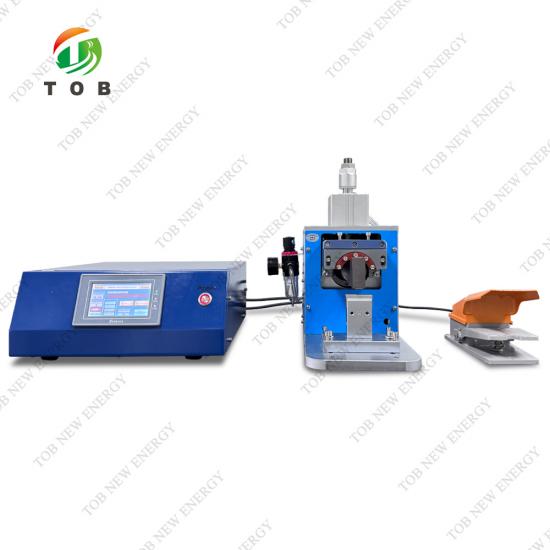
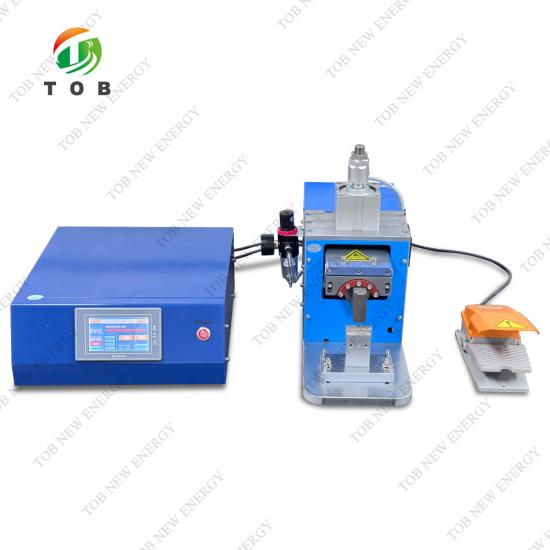
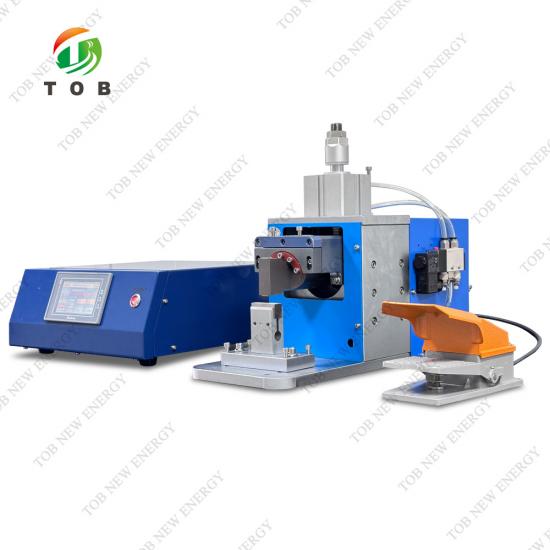
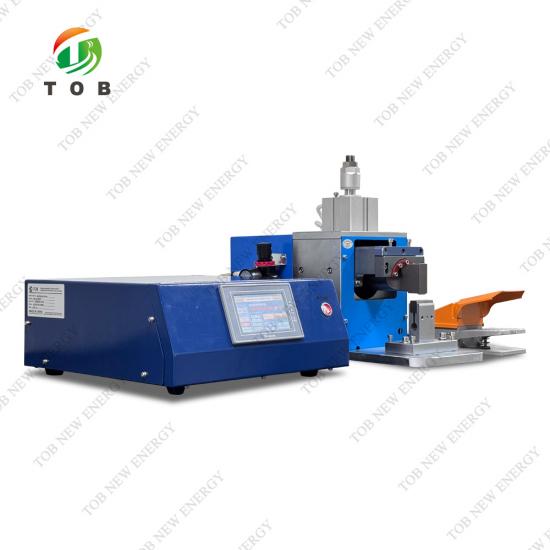
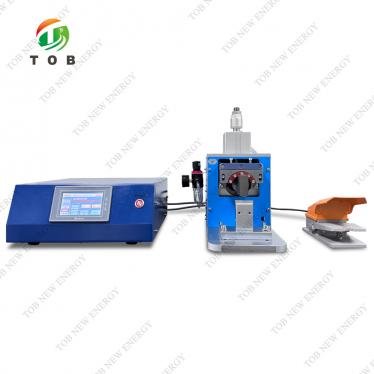
4000W Ultrasonic Metal Welding Machine for Battery Tabs | TOB-20K-4000W
Brand:
TOB NEW ENERGYitem no.:
TOB-20K-4000Worder(moq):
1setPayment:
L/C,T/Tproduct origin:
Chinashipping port:
XIAMEN
TOB-20K-4000W 20kHz High-Power Ultrasonic Metal Welding Machine for Battery Tab and Multi-Layer Foil Welding
Product Overview and Ideal Applications
An ultrasonic metal welding machine joins dissimilar thin metal workpieces without filler material, flux, or bulk melting. The TOB‑20K‑4000W generates 20 kHz high‑frequency mechanical vibrations and delivers them through a precision‑machined welding horn onto the metal stack under controlled pneumatic pressure. The oscillatory shear force breaks up surface oxides and creates a solid‑state metallurgical bond—clean, fast, and without the heat‑affected zone, spatter, or consumable electrodes associated with resistance or laser welding.
The TOB‑20K‑4000W is the high‑power member of the TOB 20K series, built around a fully digital German‑imported ultrasonic generator driving a 4000 W output stage. The generator uses IGBT power modules and a separately excited oscillation circuit to produce a stable, precisely shaped 20 kHz signal. An automatic frequency‑tracking system locks onto the transducer's resonance in real time and compensates for shifts caused by temperature and load changes, ensuring that the transducer always operates at peak efficiency without manual tuning. A constant‑amplitude function maintains the set horn amplitude even when the mains supply voltage fluctuates within the 215–238 V range, so the hundredth weld of a shift is identical to the first.
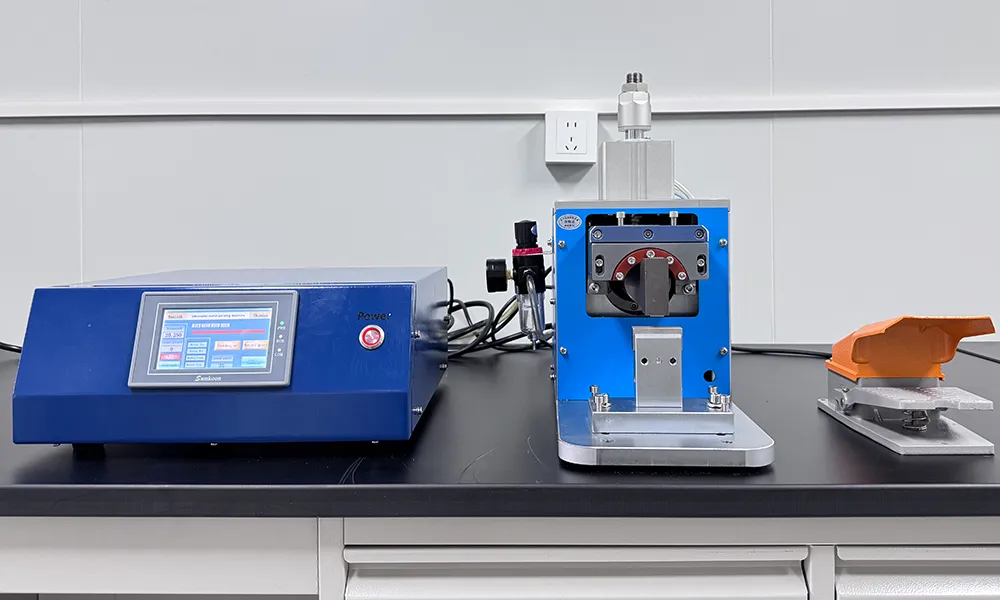
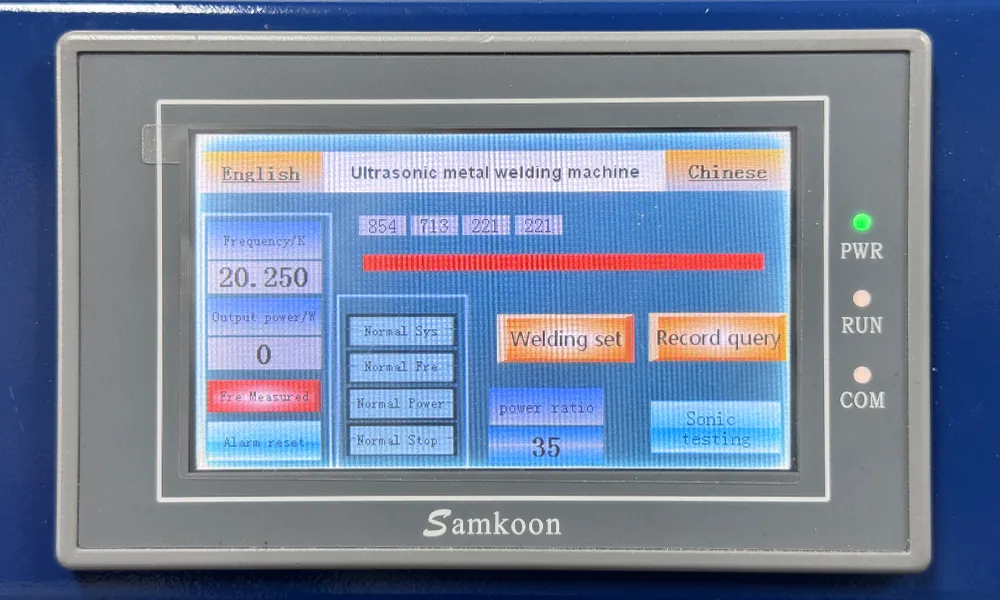
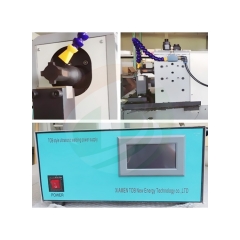
The welding head assembly combines a German‑wafer transducer (X20), a booster (Y20), and a welding horn machined from imported high‑speed steel with two usable faces. The head is mounted on a precision pneumatic cylinder (63 mm bore, 20 mm stroke) with adjustable rise and fall speeds, allowing the operator to program a rapid approach by a gentle, controlled contact. Welding parameters—energy, time, or intelligent time mode; amplitude from 1 % to 100 %; segmented power profiles—are set and stored on the high‑definition touch‑screen interface, which also logs over 100 welding records and provides intelligent fault alarms.
Ideal for:
- High‑volume battery pack assembly lines welding thick copper tabs (up to C1100, 0.25 mm) and aluminium tabs to cylindrical, pouch, or prismatic cells in EV and energy storage modules.
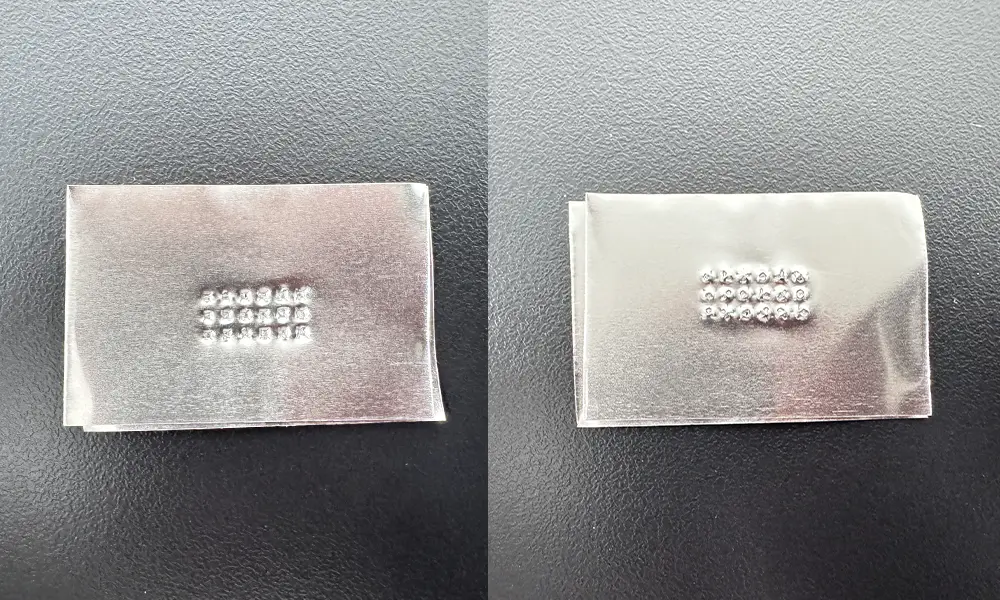
- Pouch‑cell multi‑layer stacking applications where 20–45 layers of foil must be welded to a single tab without burn‑through or blackening.
- Copper‑tube sealing, automotive wiring‑harness assembly, solar‑panel interconnection, and any production environment that requires a 4000 W ultrasonic power reserve for thicker or higher‑conductivity material stacks.
- Manufacturers upgrading from pneumatic resistance welders to a clean, cold, solid‑state process that eliminates electrode consumption and reduces energy cost.
Where High‑Power Ultrasonic Welding Fits in Battery Pack Assembly
In the production of lithium‑ion battery modules and packs, ultrasonic welding is the standard method for joining tabs to cell terminals and for creating the series‑parallel electrical interconnects between cells. The process chain is:
- Cell sorting and positioning – Cells are grouped by capacity and internal resistance, then placed into a fixture that defines the module layout.
- Tab‑to‑terminal welding – Nickel, nickel‑plated copper, or pure copper tabs are joined to the positive and negative terminals of each cell.
- Interconnect welding – Tabs from multiple cells are gathered and welded together, or welded to a busbar, to form the series‑parallel network.
- BMS and voltage‑sense wire attachment – Often also performed by ultrasonic or resistance welding.
The TOB‑20K‑4000W handles steps 2 and 3, with a particular strength in the thicker, higher‑conductivity materials found in high‑capacity EV and energy‑storage cells. Where lower‑power ultrasonic welders may struggle to achieve a full‑penetration bond on 0.25 mm C1100 copper tabs without exceeding the recommended weld time, the 4000 W output of the TOB‑20K‑4000W provides the energy reserve to complete the bond within a single, short pulse—typically under one second. The result is a weld that meets the "layer‑by‑layer penetration, no blackening" quality standard specified by the manufacturer, with weld strength approaching that of the parent material.
Key processing advantage of ultrasonic over resistance welding for thick tabs:
Resistance welding of thick copper tabs requires very high currents and can generate excessive heat that damages the cell's internal separator or electrolyte. Ultrasonic welding, being a solid‑state process, confines the heating to the immediate interface between the materials. The bulk of the tab and the cell remain cool, preserving the cell's electrical characteristics and safety margin.
How the Ultrasonic Metal Welding System Works
The TOB‑20K‑4000W converts electrical energy into a solid‑state metallic bond through a chain of precisely controlled transformations:
- Ultrasonic generation: The German‑imported fully digital generator converts the AC mains supply (220 V, 50/60 Hz) into a precisely controlled 20 kHz electrical signal using IGBT power modules and a separately excited oscillation circuit. This architecture provides inherently stable, low‑noise power conversion that is resistant to electromagnetic interference from nearby motor drives and inverters.
- Transduction and amplification: The electrical signal drives a piezoelectric transducer (X20, German‑wafer technology) housed in the welding head. The transducer converts the electrical oscillations into mechanical vibrations of the same frequency. These vibrations pass through a booster (Y20) that amplifies the displacement to a usable semi‑cycle amplitude of 20–40 µm, adjustable steplessly.
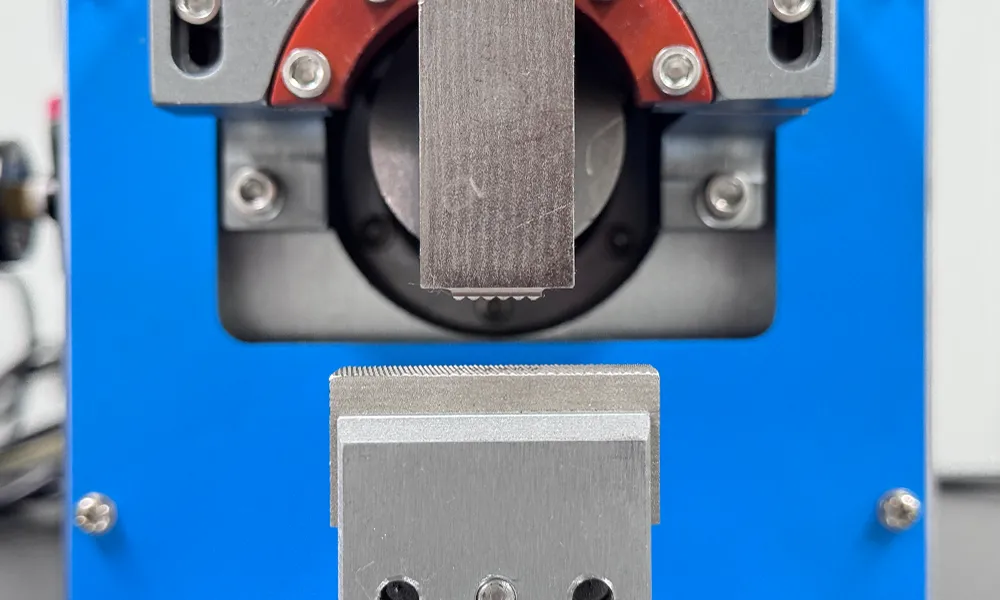
- Energy delivery to the workpiece: The amplified motion reaches the welding horn, which is machined from imported high‑speed steel with two independent usable faces. The horn face pattern—selectable as straight‑line or cross‑hatch ("rice") for the upper horn, mesh for the lower anvil—grips the metal stack and transmits the oscillatory shear force through it. The horn descends under pneumatic pressure (cylinder diameter 63 mm, stroke 20 mm) at an adjustable speed; the rise and fall velocities are independently controlled so that the final contact is gentle, preventing impact damage to thin foils.
- The welding event: Under the pre‑set pressure (adjustable via the pneumatic regulator, up to 6 kg/cm²), the horn tip scrubs laterally against the top metal layer at 20,000 cycles per second while the lower layers are held stationary against the anvil. This differential motion generates localised frictional heat and intense plastic deformation specifically at the interfaces. Oxide films are fragmented and dispersed, exposing clean metal. Under the combined influence of atomic diffusion and plastic flow, a solid‑state metallurgical bond forms within milliseconds—typically well under one second, per the specification. The preloading time before the ultrasonic pulse is separately adjustable from 0.02 s to 10 s to suit the specific stack geometry.
- Intelligent control and monitoring: The DSP‑based controller provides three welding modes: energy mode (terminates at a set Joule target), time mode (fixed pulse duration), and intelligent time mode (auto‑senses the completion of bonding and terminates the pulse). The amplitude can be profiled in 1 %–100 % increments within a 0–100 ms window, enabling a gentle initial engagement by full‑energy bonding. Throughout the cycle, the controller tracks the transducer's resonant frequency (search range 19.0000–21.0000 Hz, auto‑tracking range ±20 Hz) and adjusts the driving frequency in real time. It also monitors the internal power‑tube temperature and triggers automatic protection at 60 °C, while the voltage protection system compensates for mains fluctuations between 215 V and 238 V.
- Post‑weld hold and retraction: After the ultrasonic energy stops, the pneumatic pressure is maintained for a few seconds to allow the bond to solidify under compression, forming a robust molecular‑level joint. The fast‑acting solenoid valve then retracts the cylinder, and the head returns to the home position.
Complete Technical Specifications
Device Parameter
|
Name |
20KHz ultrasonic welding machine |
|
Model |
TOB-20K-4000W |
|
Power supply voltage |
50/60Hz-/AC220V |
|
Screen |
Touch screen |
|
Digital system |
High stability |
|
Frequency |
Automatic tracking |
|
Power |
4000W |
|
Parameter saving function |
Yes |
|
Welding parameter calling can be customized |
Yes |
|
Segmented power regulation |
Yes |
|
Welding time |
Adjustable (0.01s-2s) |
|
Welding method |
Single point |
|
Preloading time |
Adjustable (0.02s-10s) |
|
Frequency calculation displays search range |
19.0000-21.0000HZ |
|
Adjustable power |
2000W/4000W |
|
Welding mode |
Selectable |
|
Amplitude adjustment |
Amplitude infinite adjustment |
|
Chassis protection |
Intelligent protection and fault alarm prompt |
|
Automatic frequency tracking |
Range ± 20Hz |
|
Automatic temperature tracking |
Internal power tube 60 ° automatic protection |
|
EMI/EMC |
Strong anti-interference ability |
|
Input gas source |
Compressed air 7-8BAT (kg/cm2) |
|
Maximum working pressure |
6 kg/cm2 |
|
Minimum working air pressure |
0.3 kg/cm2 |
|
Intake connector |
Quick connector 8mm |
|
Cylinder diameter |
63mm |
|
Cylinder stroke |
20mm |
Technical parameter
|
1.Base material |
|
|
|
1.1 Cathode |
|
|
|
1.1.1 Material of the base |
|
|
|
1.1.2 Thickness of the base |
|
|
|
1.1.3 Material of the tabs |
Copper C1100 |
|
|
1.1.4 Thickness of the tabs |
0.25mm |
|
|
1.2 Anode |
|
|
|
1.2.1 Material of the base |
|
|
|
1.2.2 Thickness of the base |
|
|
|
1.2.3 Material of the tabs |
Copper C1100 |
|
|
1.2.4 Thickness of the tabs |
0.25 mm |
|
|
2.Cell |
|
|
|
2.1 Stacking process |
|
|
|
2.2 Max stacking layer (Acceptance standard) |
|
|
|
2.3 Cell thickness |
|
|
|
3.Tabs welding |
|
|
|
3.1 Tab welding method |
Customizable |
|
|
3.2 Tab welding capability |
Each layer is fused without blackening. |
|
|
3.3 Solder joints length |
Customizable |
|
|
3.4 Solder joints width |
Customizable |
|
|
3.5 Welding time |
Within 1S |
|
|
3.6 Number of solder joints |
Design based on welding process |
|
|
3.7 Time adjustment range |
0~60S,adjustable |
|
|
3.8 Welding surface life |
≥ 100000 times |
|
|
4.Welding head standard |
|
|
|
4.1 Welding head material |
Imported high-speed steel |
|
|
4.2 Solder joints height |
0.8mm (Depending on different products, product technology needs to be provided). |
|
|
4.3 Distribution status of solder joints/patterns |
Straight or rice shaped pattern on the welding head; Bottom mold mesh |
|
|
4.4 The height between the welding surface and the welding head |
>5mm (Adjusted according to product height) |
|
|
4.5 Welding head length |
≥130mm |
|
|
4.6 Available welding surfaces for welding heads |
2 |
|
|
4.7 Installation direction of welding head |
Horizontal |
|
|
4.8 Adjustable amplitude range |
Semi-cycle 20~40um |
|
|
5.Transducer |
|
|
|
5.1 Frequency difference between each transducer |
≤400Hz |
|
|
5.2 Impedance difference between each transducer |
≤4Ω |
|
|
5.3 Capacitance difference between each transducer |
≤400PF |
|
|
5.4 Insulation resistance between transducer and casing |
≥30MΩ |
|
|
6.Ultrasonic generator |
|
|
|
6.1 Frequency control method |
Built in frequency adjustable |
|
|
6.2 Constant amplitude function |
(Constant amplitude) |
|
|
6.3 Amplitude infinitely adjustable |
Stepless adjustable |
|
|
7.Product |
|
|
|
7.1 Appearance |
No welding penetration or leakage, firm welding, layer by layer penetration |
|
|
8.Equipment design service life |
8~10 years |
|
Dimension
|
Dimension |
About 900mm×600mm×750mm |
|
Total weight |
About 60kg |
|
Package dimensions |
About 1000mm×600mm×800mm |
|
Chassis dimensions |
About 360mm×340mm×150mm |
|
Welding head size |
About 500mm×310mm×620mm |
Why Choose TOB‑20K‑4000W Over the 1500 W Model or a Generic Ultrasonic Welder
| Feature | TOB‑20K‑4000W | TOB‑20K‑1500W | Typical Generic 20 kHz Welder |
| Output power | 4000 W (selectable 2000 W) | 1500 W (selectable 1000 W) | Often ≤ 2000 W |
| Max. copper tab thickness (single pulse) | 0.25 mm C1100 | 0.15–0.2 mm (nickel‑plated copper) | 0.1–0.15 mm |
| Generator technology | German‑sourced digital, IGBT, separately excited oscillation | German‑sourced digital, IGBT, separately excited oscillation | Often analog or basic digital |
| Constant‑amplitude | Yes | Yes | No |
| Welding modes | Energy, time, intelligent time | Energy, time, intelligent time | Time‑only or basic energy |
| Horn material | Imported high‑speed steel, 2 faces | Imported high‑speed steel, 2 faces | Lower‑grade tool steel |
| Segmented amplitude | Yes (1 %–100 %) | Yes (1 %–100 %) | No |
| Data logging | > 100 records, cloud‑ready | > 100 records, cloud‑ready | None or limited |
| Design life | 8–10 years | 8–10 years | 3–5 years |
| Typical application | High‑power EV/ESS pack welding of thick copper | General battery tab welding, thinner materials | Low‑volume or prototype work |
When to select the 4000 W model:
If your production involves copper tabs of 0.20 mm or thicker, or multi‑layer pouch stacks exceeding 20 layers, the extra power of the TOB‑20K‑4000W reduces the weld time, broadens the process window, and extends horn life by allowing the amplitude to be set at a lower percentage for the same energy delivery. The 2000 W selectable setting also allows the same machine to handle lighter work when needed, providing flexibility across a mixed‑product production line.
Engineering FAQ
Q1: Can the TOB‑20K‑4000W weld pure copper (C1100) directly to aluminium, or does the copper need to be nickel‑plated?
Ultrasonic welding can join copper directly to aluminium, and the mechanical bond strength is good. However, in a battery‑cell environment where electrolyte vapours and moisture may be present, a galvanic couple between copper and aluminium can lead to corrosion over time. For battery tabs, the use of nickel‑plated copper is common practice to prevent this. The TOB‑20K‑4000W welds both bare copper and nickel‑plated copper equally well; the choice depends on the cell's expected service environment and design life.
Q2: How often should the welding horn be inspected and re‑ground?
The horn‑face pattern (straight‑line or cross‑hatch) is designed for a life of ≥ 100,000 welds per face under normal conditions. With two usable faces, the total service interval is ≥ 200,000 welds before re‑grinding is needed. Inspect the pattern depth with a depth gauge every 10,000–20,000 welds. When the pattern depth drops below approximately 0.5 mm, rotate to the second face. Re‑grinding restores the original texture and can be performed several times before the horn must be replaced. The automatic frequency‑tracking system ensures that a re‑ground horn locks onto resonance immediately; no manual tuning is required.
Q3: Does the constant‑amplitude function eliminate the need for a voltage stabiliser on the mains supply?
Yes, within the specified input voltage range of 215–238 V. If your factory's mains supply occasionally falls outside this range, a voltage stabiliser is still recommended. However, for the vast majority of industrial environments, the constant‑amplitude function provides sufficient compensation to maintain weld‑to‑weld consistency without additional power‑conditioning equipment.
Q4: What maintenance does the pneumatic system require?
The air supply must be clean, dry, and free of oil mist—a standard filter‑regulator‑lubricator (FRL) unit on the supply line is recommended, set to deliver 7–8 kg/cm² with the lubricator turned off or filled with a food‑grade, non‑contaminating lubricant. The cylinder (63 mm bore, 20 mm stroke) and the quick‑connector (8 mm) should be checked weekly for leaks. The working pressure range is 0.3–6 kg/cm²; the factory recommendation is to start at the middle of this range and adjust upward for higher welding currents.
Q5: Is the TOB‑20K‑4000W compatible with the tooling and horns from the TOB‑20K‑1500W?
The transducers and boosters of the two models operate at the same frequency (20 kHz) and have matching interface dimensions. However, the 4000 W horn is designed to handle the higher power level, and using a 1500 W horn on the 4000 W machine may lead to premature horn cracking if the full power is applied. It is recommended to use the horn supplied with each machine. TOB can advise on cross‑compatibility for specific horn geometries.
Ready to weld thick copper tabs and multi‑layer pouch stacks with the power and control of a 4000 W digital ultrasonic system? Request a quotation for the TOB‑20K‑4000W, configured for your specific tab material and thickness. Our joining process engineers can provide a weld‑parameter starting sheet based on your production requirements.
tob.amy@tobmachine.com | +86 181 2071 5609
You May Also Need
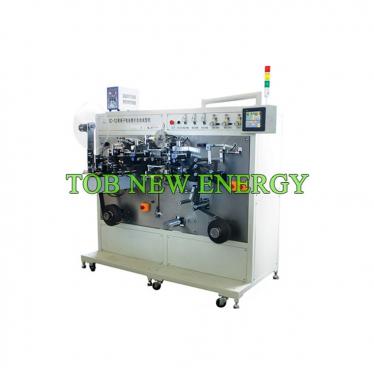
- Automatic Cathode Electrode Making Machine — A fully integrated coating, calendaring, and slitting line that produces the precision electrode sheets whose tabs are later welded by the TOB‑20K‑4000W on the pack assembly line.
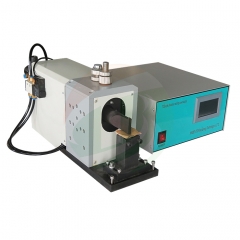
- 20kHz Ultrasonic Metal Welding Machine for Battery Electrode and Multi‑Layer Tab Welding (1500W) — The 1500 W model in the same 20K series. A cost‑effective alternative for thinner tabs and lighter stacks where the full 4000 W power is not required. Shares the same digital generator architecture, horn design, and touch‑screen interface for a seamless operator experience across both power levels.
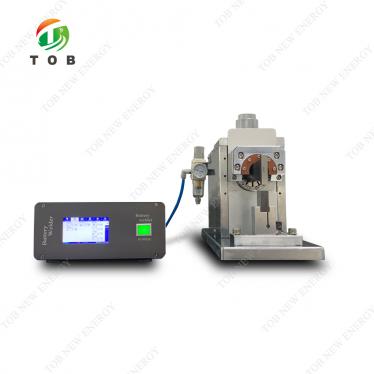
- 800W Ultrasonic Welding Machine — A compact, lower‑power ultrasonic welder for small‑format cells, fine‑wire terminations, and laboratory‑scale prototype builds. Suitable where the workpiece cross‑section is small and a full‑size 1500 W or 4000 W unit would be oversized.
Previous:
Automatic Lithium Battery Cathode Electrode Making MachineNext:
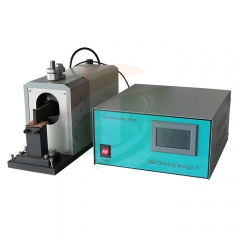
20kHz Ultrasonic Metal Welding Machine for Battery Electrode and Multi-Layer Tab Welding
If you are interested in our products and want to know more details,please leave a message here,we will reply you as soon as we can.

 subscribe to us