Chinese
 français
 Deutsch
 italiano
 español
 português
 Nederlands
 日本語
日本語 한국의
한국의




- Tabless Cylindrical Battery Manufacturing Guide
- China Power Battery Market Report 2026 H1: Six Trends Reshaping Battery Equipment Demand
- Turnkey Solid-State Battery Lab Setup Guide
- Conductive Materials for Lithium Batteries: CNT vs Graphene Guide
- Step-by-Step Guide to Partnering with a Sodium-Ion Battery Technology Developer in China
One-Step and Two-Step Pressing Method for Battery Electrode
Two-Step Pressing, it is rolling the battery electrode to a certain thickness (such as 90μm) at first time, and achieve the designed thickness (such as 70μm) and desired density through the second time pressing.
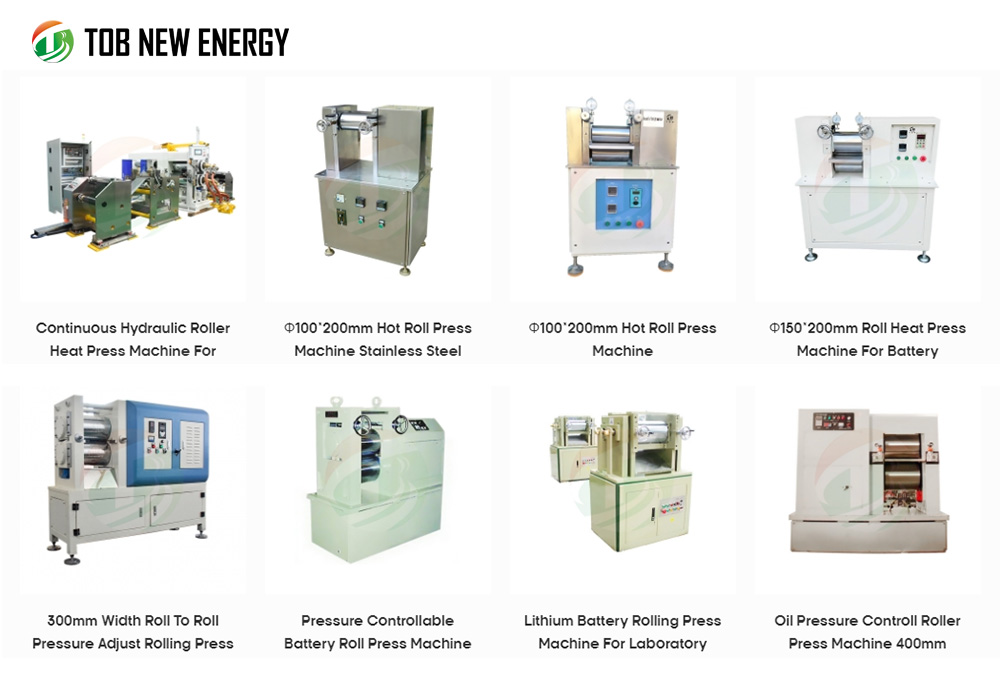
The main purpose of the rolling press is to control the electrode in the designed range, enhance the peel strength of the electrode, and reduce the transmission distance of lithium ion. TOB New Energy can provide a full set battery electrode rolling press machine system for lithium ion battery manufacturing and research. The continuous Heat roller press machine, automatic roller press and lab press machine is suitable for all battery electrode pressing.
Due to the different material systems, the roll pressure rebound of the cathode electrode is relatively small, while the roll pressure rebound of the anode electrode is larger. Therefore, it is generally accepted that the cathode electrode should be rolled only once. For the anode electrode sheet, some enterprises only roll once, while some enterprises choose to roll twice, which is quite different. In view of this situation, the researchers compared the One-Step and Two-Step pressing of graphite anode sheet. The results showed that One-Step pressing could easily lead to the rupture and crushing of the active particles, the aperture of the upper layer (away from the copper foil) is greater than that of the lower layer (near the copper foil). The Two-Step pressing can not only reduce the fracture of the active particles as much as possible, but also make the pore diameter distribution in the electrode sheet even, It can promote the cell electrolyte wetting effect, and finally significantly improve the battery performance.
 subscribe to us