Chinese
 français
 Deutsch
 italiano
 español
 português
 Nederlands
 日本語
日本語 한국의
한국의




- Turnkey Solid-State Battery Lab Setup Guide
- Conductive Materials for Lithium Batteries: CNT vs Graphene Guide
- Step-by-Step Guide to Partnering with a Sodium-Ion Battery Technology Developer in China
- A Complete Guide to Implementing Industrial Solid State Battery Technology in Manufacturing
- How to Select a Professional Battery Equipment Provider for High-Volume Production
Turnkey Solid-State Battery Lab Setup Guide
The global transition from liquid lithium-ion cells to next-generation solid-state architectures represents the most significant manufacturing evolution in electrochemical energy storage. While academic laboratories regularly report high-capacity half-cell demonstrations, the engineering chasm between synthesizing a gram of solid electrolyte powder and assembling a functional, multi-layer solid-state pouch cell remains daunting.
For research institutes, university laboratories, and automotive battery development divisions, the primary barrier to commercialization is rarely theoretical electrochemistry. It is process continuity, moisture management, and interfacial pressure control. A successful pilot development program requires an integrated, turnkey facility where every piece of equipment—from precursor milling to cell packaging—operates under calibrated environmental envelopes.
As a global turnkey equipment and materials pioneer, TOB NEW ENERGY has engineered end-to-end solid-state R&D lines deployed in tier-one battery labs worldwide. This guide provides an engineering roadmap for establishing an industrial-grade solid-state battery development laboratory.
1. Environmental Foundation: Inert Glovebox Lines vs. Ultra-Dry Rooms
Unlike conventional lithium-ion manufacturing where a dry room dew point of -40°C is standard, solid-state chemistries impose far stricter environmental constraints depending on the chosen electrolyte system:
- Sulfide-Based Systems (LPS, LPSCl, Argyrodites): Sulfide solid electrolytes react irreversibly with trace atmospheric moisture to produce hazardous hydrogen sulfide (H2S) gas while deteriorating ionic conductivity. Processing requires an integrated argon or nitrogen glovebox cluster with continuous H2O and O2 purification (<0.1 ppm), or an ultra-dry room maintaining a dew point of -50°C to -65°C.
- Oxide-Based Systems (LLZO, LATP): While chemically stable in ambient oxygen, ceramics like LATP powder and LLZO form passive lithium carbonate (Li2CO3) surface films upon atmospheric exposure. These non-conductive layers inflate interfacial resistance, mandating dry atmosphere handling prior to sintering.
- Polymer & Composite Systems (PEO / In-situ Polymerized): Moderate moisture sensitivity, requiring cleanroom conditions with controlled dew points to prevent side reactions during polymerization.
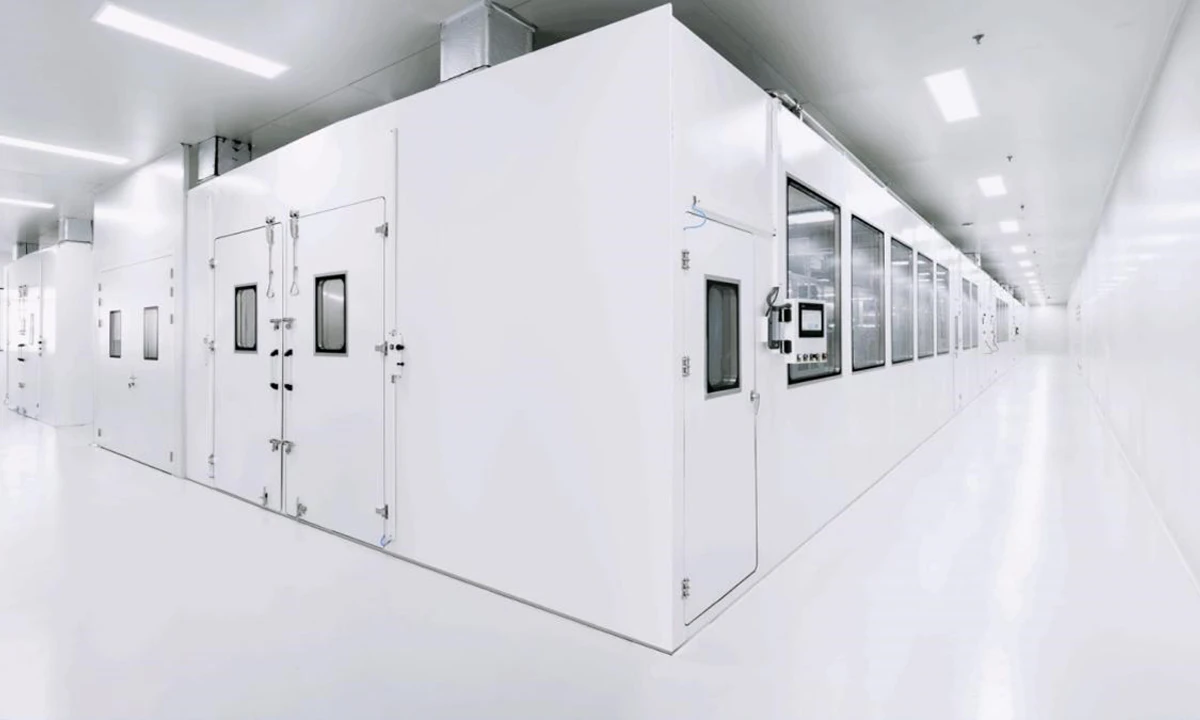
For full turnkey installations, TOB supplies modular industrial dry rooms with multi-stage desiccant rotor systems, paired with multi-station transit glovebox lines that allow seamless transfer between powder handling, coating, and assembly without atmospheric exposure.
2. The Turnkey Solid-State Laboratory Equipment Chain
An industrial R&D line is categorized into four interconnected process zones:
| Process Stage | Key Equipment | Critical Engineering Parameters | TOB Solution |
| Phase 1: Powder & Slurry Synthesis | Planetary Ball Mill & High-Shear Vacuum Mixer | Particle size D50 ≤ 1.5 μm, non-polar solvent compatibility (xylene, heptane) | Glovebox-compatible Planetary Ball Mills & Sealed Vacuum Mixers |
| Phase 2: Electrolyte Membrane Fabrication | Slot-Die Coater & Transfer Laminator | Membrane thickness 15–40 μm, thickness tolerance ±1 μm, pinhole-free | Solid Electrolyte Transfer Lamination Machine |
| Phase 3: Cell Stacking & Consolidation | Precision Z-Stacker & Warm Isostatic Press (WIP) | Omni-directional hydrostatic pressure (100–300 MPa), temperature control (60–90°C) | High-Pressure Warm Isostatic Press (WIP) & Pouch Vacuum Pre-Sealers |
| Phase 4: In-Situ Testing & Characterization | Constant-Pressure Battery Test Fixtures | Programmable stack pressure (0.1–10 MPa), real-time EIS measurement | Custom Solid-State Pressure Fixtures & Multi-Channel Cyclers |
3. Key Breakthrough: Eliminating Solid-Solid Interfacial Impedance
In conventional liquid batteries, electrolyte naturally wicks into the porous electrode matrix, establishing intimate nanoscale contact. In all-solid-state cells, physical contact is strictly solid-to-solid. Microscopic surface asperities lead to point-to-point contact, causing localized current crowding, high interfacial resistance, and premature lithium dendrite penetration.
To resolve this, modern solid-state pilot lines employ two vital steps:
A. Electrolyte Transfer and Lamination: Direct slot-die coating of fragile solid electrolyte slurry onto active cathode layers, by continuous transfer using a dedicated Solid Electrolyte Transfer Lamination Machine. This minimizes void space and eliminates freestanding membrane handling risks.
B. Warm Isostatic Pressing (WIP): Unlike uniaxial flat presses that cause edge stress concentration and uneven density distribution, Warm Isostatic Pressing applies uniform hydraulic fluid pressure (up to 300 MPa) at elevated temperatures. This plastically deforms the composite layers, eliminating micro-voids and achieving theoretical packing density across the entire active area.
4. Prototype Pouch Cell Assembly Protocol
Transitioning from coin cells to multi-layer pouch cells requires a controlled sequence:
- Electrode Slitting & Die-Cutting: Laser or precision die-cutting with burr tolerances held strictly under 5 μm to prevent separator membrane puncture.
- Multi-Layer Stacking: High-precision alignment (±0.2 mm) of composite cathode, solid electrolyte film, and ultra-thin lithium metal foil or anode-free copper current collectors.
- Vacuum Sealing: Packaging inside heavy-duty aluminum laminated film, by thermal vacuum pre-sealing.
- Post-Assembly Consolidation: Placement inside the WIP system for structural integration prior to initial electrochemical cycling.
Frequently Asked Questions (FAQ)
Q: What dew point is required for a solid-state battery manufacturing dry room?
A: For sulfide-based solid-state batteries (such as LPSCl or argyrodites), the dry room must maintain an ultra-low dew point between -50°C and -65°C to prevent hazardous H2S gas generation and electrolyte degradation. For oxide-based systems, a standard dry room at -40°C is acceptable, though an inert glovebox line (<0.1 ppm H2O/O2) is strongly recommended for powder handling.
Q: Why is Warm Isostatic Pressing (WIP) preferred over flat unaxial pressing for solid-state cells?
A: Warm Isostatic Pressing (WIP) applies uniform, omni-directional hydraulic fluid pressure (typically 100 to 300 MPa) combined with moderate heat (60°C to 90°C). Unlike uniaxial flat platen pressing, which causes edge stress concentration and cracked ceramic sheets, WIP eliminates microscopic interface voids evenly across the active area, dramatically reducing solid-solid interfacial impedance.
Q: Can conventional lithium-ion coating equipment be used for solid-state batteries?
A: Conventional NMP-based coating lines cannot be directly used for sulfide electrolytes because sulfides react with polar solvents. Sulfide slurries require non-polar solvents (e.g., xylene, heptane), sealed drying chambers with specialized explosion-proof solvent recovery, and airtight transfer mechanisms such as TOB's Solid Electrolyte Transfer Lamination systems.
Turnkey Engineering Support from TOB NEW ENERGY
TOB NEW ENERGY provides complete EPC turnkey solutions for solid-state battery laboratories and pilot lines, including cleanroom architectural layout design with H2S safety exhaust integration, high-purity solid electrolyte materials (LATP, LLZO, and sulfide LPSCl powders), full equipment toolsets, and on-site commissioning.
Need to configure your solid-state laboratory? Contact our senior engineering team at tob.amy@tobmachine.com or call +86-18120715609 for a technical consultation.
 subscribe to us