Chinese
 français
 Deutsch
 italiano
 español
 português
 Nederlands
 日本語
 한국의




- Home
- >
- Battery and Materials Drying Oven
- >
- Battery Vacuum Drying Oven
- >
- Contact Heating High Vacuum Oven
Categories
Hot Products
Loading...
Contact Heating High Vacuum Oven
Brand:
TOB NEW ENERGYitem no.:
TOB-GZK03-K1order(moq):
1 setPayment:
L/C,T/Tproduct origin:
Chinashipping port:
XIAMEN
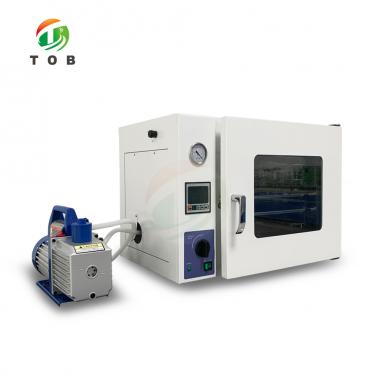
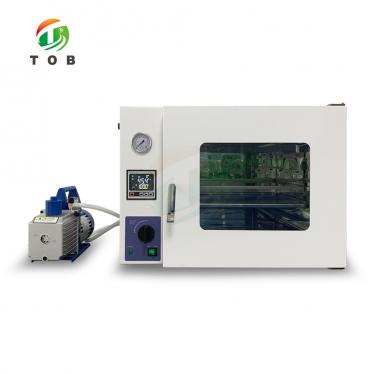
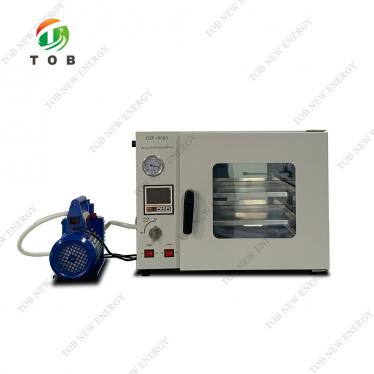
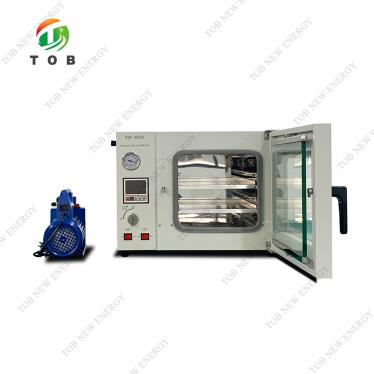
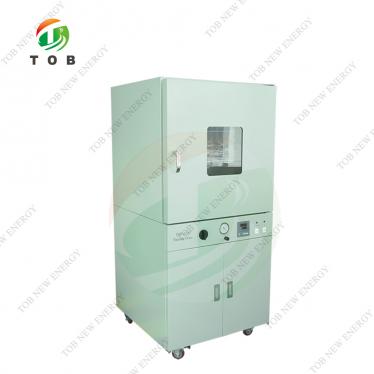
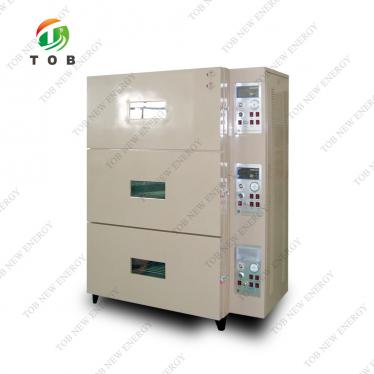
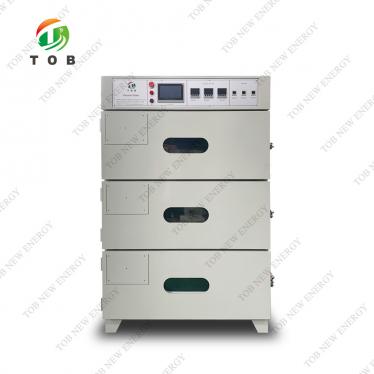
Contact Heating High Vacuum Oven for Cell and Electrode Drying - TOB-GZK03-K1
Three layer single door, base plate contact heating to 100 °C, 10 Pa empty and 50 to 100 Pa working, dry screw pump system
Product Overview and Ideal Applications
The TOB-GZK03-K1 is a three layer, single door high vacuum oven for removing water from lithium-ion cells and electrodes before electrolyte filling. It is built as seven assemblies: the rack, the inner cavity, the vacuum and nitrogen system, the electrical control part, the external circulation part, the internal circulation part and the contact part. Each of the three layers can be pumped, purged and heated independently, which is the difference between an oven that bakes one batch at a time and an oven that keeps three batches at different stages of the same cycle.
The word that matters in the name is contact. Heat reaches the load by three routes in a vacuum oven, and they are not equivalent: radiation from the walls, convection from a circulating gas, and conduction from a surface the part is touching. In a vacuum there is very little gas to convect, so a purely hot-air oven becomes a radiator and the drying rate is set by how much of the load can see the wall. This oven puts a silicone heating plate under each layer, the tray sits on that plate, and the cell bottom is heated by conduction through the tray. The plate is the primary heat source; the U-shaped circulating air, left side out and right side in, with exhaust at the top and bottom edges, exists to keep the cavity walls and the air at the same temperature as the plate so that the load is not heated from one side and cooled from the other.
The second half of the drying cycle is the vacuum and nitrogen sequence, and it is what actually removes the water. Pumping alone removes free moisture slowly, because water bound in the electrode or in the separator has to diffuse out to the surface first. Alternating a vacuum hold with a dry nitrogen purge shortens that path: the purge replaces the water vapour in the cavity with dry gas, the next pump-down removes it, and the cycle repeats. On this machine the sequence is programmed, not manual. The operator sets a heating time, a vacuum time and a nitrogen time, and the PLC runs heat, pump, purge and hold through the number of cycles the recipe calls for.
The vacuum is produced by a dry screw pump set, the BaoSi GSD series, with the GSD160/1300D as the largest option at 1300 m³/h. A dry pump is the right choice here for a reason that has nothing to do with specifications: an oil-sealed pump backstreams oil vapour into the chamber, and in a battery drying oven that vapour lands on the very surfaces you are trying to dry. The pump set serves the three chambers through a manifold, with an interlock that allows one to three chambers to be pumped at a time: when a chamber reaches its set vacuum the branch valve closes automatically before another branch opens, so the pump is never asked to pull three chambers from atmosphere at once.
Ideal for:
- Final drying of prismatic, pouch and cylindrical cells before electrolyte filling, where the residual water specification is the gate to the next process
- Electrode and separator drying, where the load is flat and sits directly on the heated plate
- Pilot and small series lines that need several batches in flight at once without buying several ovens, because the three layers run independently
- Process development where the vacuum, nitrogen and hold times are still being tuned, since all three are set from the touch screen rather than by hand valves
- Dry rooms with a nitrogen supply, where the oven can be run as a nitrogen-purged cycle rather than a pure vacuum cycle
Three other ovens in this catalogue do overlapping jobs, and the difference is format rather than quality. If the drying sequence has to run without an operator, the high vacuum automatic drying oven is the automated format. If two layers are enough for the batch size, the double layer high vacuum oven reaches 150 °C and takes the same tray. If the work is laboratory scale rather than production, the DZF-6050 vacuum lab oven is the small bench unit. What this page describes is the three layer contact heated format, and what it cannot do is dry a load that has to be tumbled or rotated while it dries: the trays are static, and the contact plate only heats what is sitting on it.
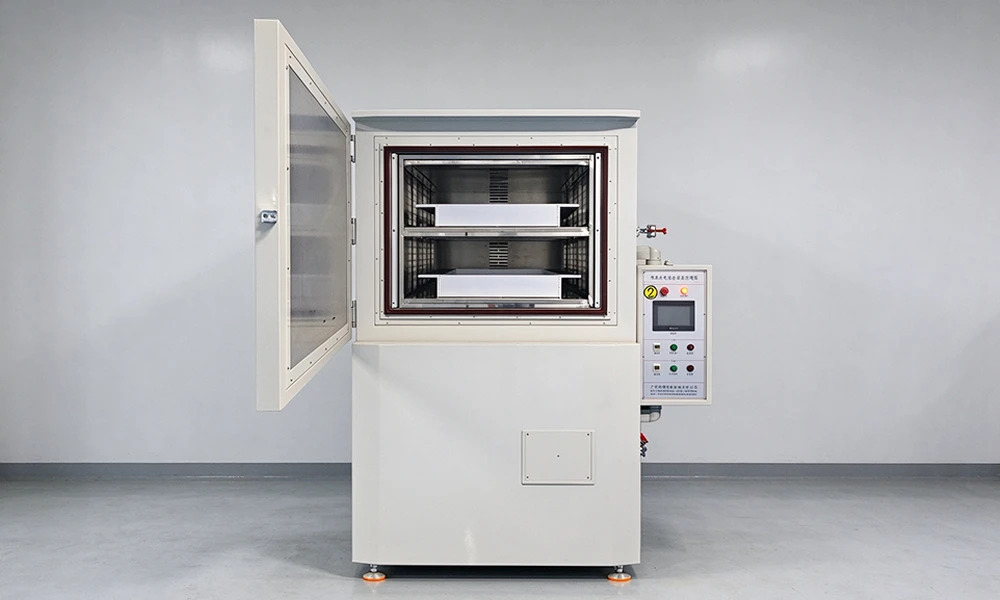
TOB-GZK03-K1 three layer single door contact heating high vacuum oven
Complete Specifications
The tables below are the datasheet, reproduced without rounding. Two conventions are worth stating before you read them. First, every vacuum figure is a pressure, not a gauge reading, so 10 Pa means an absolute pressure of 10 Pa and not a 10 Pa deficit below atmosphere. Second, uniformity and heat-up times are quoted for an empty cavity at constant temperature, which is the only condition in which they are comparable between suppliers; a loaded cavity with cold cells in it will always read differently.
1. Chamber, Door and Construction
| Item | Specification |
|---|---|
| Construction | Seven assemblies: rack, inner cavity, vacuum and nitrogen system, electrical control, external circulation, internal circulation, contact heating |
| Layers | Three, each operating independently for heating, vacuum and nitrogen |
| Inner cavity size | Designed to the customer's cell and tray dimensions to raise space utilisation; fixed on the approved drawing before build |
| Shell material | A3 cold rolled steel plate, painted, grey-white with orange |
| Interior material | Stainless steel industrial brushed plate, 4.0 mm thick |
| Door | Single door, explosion resistant, pressure resistant, with over-pressure self-relief |
| Interior seal | Moulded silicone rubber O-ring, high temperature and corrosion resistant |
| Heating method | Silicone heating plate in the base plate for contact heating, plus internal circulating air; conduction, radiation and convection combined |
| External circulation | U-shaped circulating air: outlet on the left, suction on the right, exhaust along the top and bottom edges |
| Cooling | Heaters are switched off and the circulating air carries the heat out, shortening the cool-down |
| Control | PLC automatic control with touch screen operation, manual and automatic modes selectable |
| Vacuum and gas ports | At the rear of the machine; vacuum port KF40, dry gas port 12 mm air pipe |
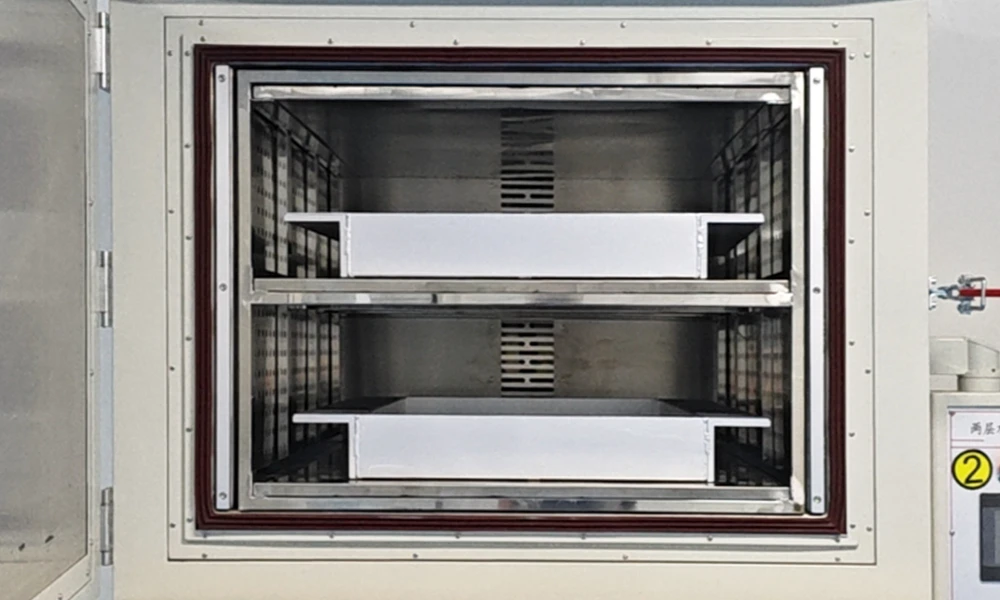
The cavity seen through the open door: the contact plates on their side rails, the moulded seal around the opening, and the circulation grilles on the rear wall.
2. Vacuum and Temperature Control
| Item | Specification |
|---|---|
| Ultimate vacuum, empty cavity | Not more than 10 Pa |
| Working vacuum | 50 Pa to 100 Pa for high vacuum drying; low vacuum controlled to not more than -20 kPa, the lower limit for nitrogen exchange |
| Leak rate | After pumping to ultimate vacuum and closing the valve, the pressure rises by not more than 500 Pa in 24 hours |
| Pump-down time | One chamber from atmosphere to 10 Pa in 10 minutes or less, empty cavity |
| Temperature range | Room temperature +10 °C to 100 °C |
| Temperature uniformity | ±3 °C in the cavity at constant temperature, empty box |
| Heat-up time | Room temperature to 85 °C in 30 minutes or less, at atmospheric pressure and empty; cavity stabilises 60 minutes after the controller reaches setpoint, empty box |
| Heat-up profile | Curve rise from room temperature to setpoint, straight line once at constant temperature |
| Surface temperature | Not more than room temperature +20 °C with the cavity at 100 °C |
| Temperature control | Thyristor SSR with PID, small thermal inertia; K type thermocouple sensor; separate over-temperature controller |
| Per layer operation | Heating, vacuum pumping and nitrogen filling are set and run per layer |
3. Power, Weight and Site Requirements
| Item | Specification |
|---|---|
| Power supply | 380 V, 50 Hz, three phase five wire; the customer provides a dedicated breaker and the external wiring to the oven |
| Oven rated power | 30 kW |
| Vacuum system power | 10 kW |
| Chiller power | 4 kW |
| Power consumption | Not more than 30 kWh at peak and 6 kWh in steady state, oven only, excluding the vacuum pump and the cooling system |
| Machine weight | Approximately 1850 kg |
| Clearance, front | Not less than 1500 mm between the oven front and the wall |
| Clearance, sides and rear | Not less than 300 mm |
| Compressed air | 0.6 to 0.7 MPa through an 8 mm air pipe, for valve actuation only |
| Nitrogen | 0.1 to 0.2 MPa through a 12 mm pipe, 2 m³ per cycle per oven |
| Ambient conditions | -5 to 35 °C, 40 percent RH or less, no flammable or explosive gas, liquid or solid nearby |
Sizing note: the datasheet gives the oven as 30 kW, the vacuum system as 10 kW and the chiller as 4 kW, and the consumption figure is explicitly the oven only. If the pump set and the chiller are supplied with the oven, the incoming supply has to be sized from the sum rather than from 30 kW alone. Confirm this against your electrical layout before the site work is fixed.
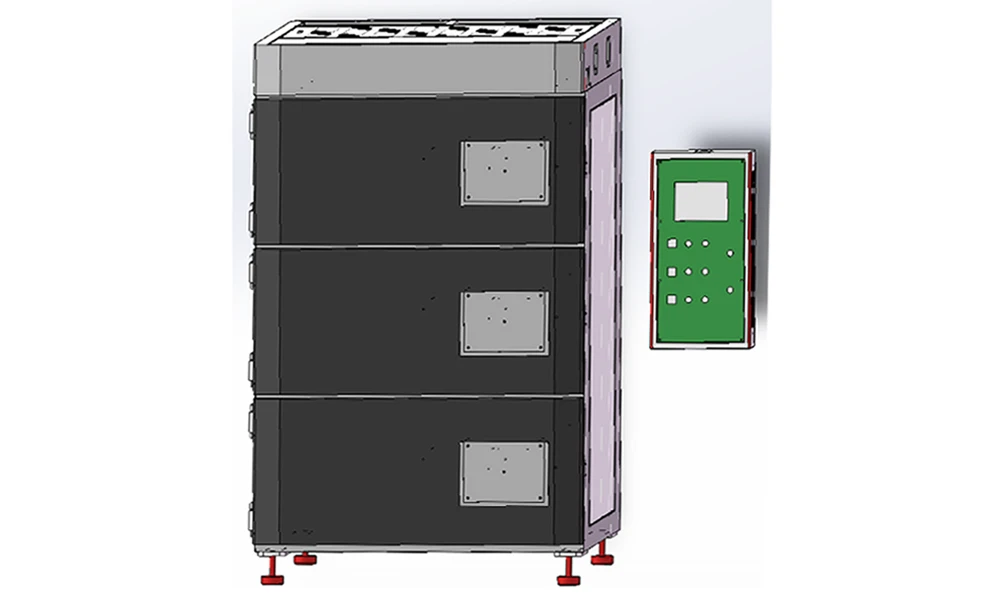
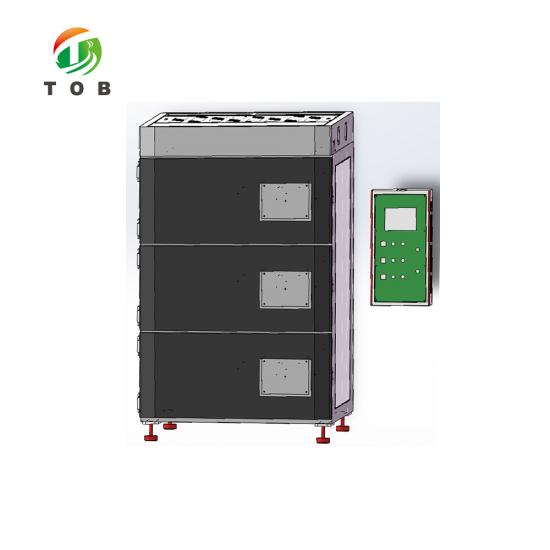
The arrangement drawing: the layer stack on the left, and the control box shown beside it. Confirm the delivery format, integrated panel or separate cabinet, against your floor plan.
4. Vacuum System and Pump Options
The pump set is supplied as part of the oven system, or may be provided by the customer. The table covers the five BaoSi GSD dry screw models offered, with GSD160/1300D being the largest and the one specified for this machine.
| Model | GSD120D | GSD160D | GSD120/600D | GSD160/1080D | GSD160/1300D |
|---|---|---|---|---|---|
| Pumping speed, m³/h | 120 | 160 | 600 | 1080 | 1300 |
| Ultimate total pressure, Pa | 0.5 or less | 0.5 or less | 0.1 or less | 0.1 or less | 0.1 or less |
| Motor rated power, kW | 3.7 | 5.5 | 2.2 + 3.7 | 3.7 + 5.5 | 3.7 + 5.5 |
| Motor voltage, three phase, V | 380, 400 | ||||
| Inlet port | KF40 | KF40 | VG80 | VG100 | VG100 |
| Exhaust port | KF40 | ||||
| Cooling water pressure, MPa | 0.1 to 0.4 | ||||
| Cooling water flow, L/min | 4 or more | ||||
| Cooling water temperature, °C | 5 to 30 | ||||
| Cooling water port | G3/8 | ||||
| N2 purge pressure, MPa | 0.2 to 0.6 | ||||
| N2 purge flow, L/min | 12 to 50 | ||||
| N2 purge port | G1/4 | ||||
| Maximum outlet pressure, MPa | 0.14 | ||||
| Noise, with silencer and check valve, dB | 70 or less | 70 or less | 68 or less | 70 or less | 70 or less |
| Ambient temperature and humidity | 5 to 40 °C, below 90 percent RH | ||||
| Weight, kg | 335 | 350 | 455 | 490 | 495 |
The manifold rule is part of the specification, not an operating preference. Up to three chambers may be pumped at the same time, and when a chamber reaches its set vacuum the branch valve closes automatically before another branch is opened; above two layers the vacuum protection setpoint has to be turned off, which is why the sequence is written into the PLC rather than left to the operator. The vacuum pipework follows the approved contract drawing, laid out to keep the pump as close to the ovens as the layout allows, with the short flexible bellows supplied. Where extra pipe runs are needed they are agreed in advance and the installer is nominated at that point.
Electrical and Mechanical Components
The instrument list is deliberately conservative. A vacuum oven spends its life cycling between atmosphere and 100 Pa at 100 °C, and the parts that fail first are the controller, the SSR and the valves rather than the chamber. Naming the brands is the honest way to say what you are buying.
| No. | Component | Brand or specification |
|---|---|---|
| 1 | Temperature controller | Digital intelligent controller with microcomputer PID auto-tuning, Xiamen Yudian |
| 2 | Temperature control module | PID with SSR thyristor, Xiamen Yudian |
| 3 | Over-temperature protection | Separate digital intelligent controller with microcomputer PID auto-tuning, Xiamen Yudian |
| 4 | Temperature sensor | K type thermocouple |
| 5 | Vacuum gauge | Resistance vacuum gauge, Inficon, Switzerland |
| 6 | Vacuum valve and gas valve | High vacuum baffle valve |
| 7 | PLC | Inovance |
| 8 | Touch screen | Inovance |
| 9 | Solid state relay | Yangming |
| 10 | Heating element | Custom made, Hengkao |
| 11 | Earth leakage breaker | CHINT |
| 12 | Contactor | Schneider |
| 13 | Control mode | PLC automatic cycle for heating, vacuum and gas filling, each stage set from the touch screen |
Why Contact Heating Removes Water Faster Than Hot Air Alone
Heat reaches a load in an oven by three routes: conduction through whatever it touches, convection through the gas around it, and radiation from the surfaces that see it. At atmospheric pressure all three work and a well-built hot-air oven is fine. As the pressure falls toward the working range of this machine, the gas thins out and convection stops carrying meaningful heat, so the load is left with radiation and contact. A conventional oven in that condition heats slowly from the outside in, and the last part of the load to reach temperature is the part that dries last.
Contact heating changes which route is primary. Each layer has a silicone heating plate built into the base plate, the tray sits flat on it, and the cells sit on the tray. The heat path is short and it does not depend on the pressure in the cavity, so the drying rate stays high even at 50 Pa where a hot-air oven would be struggling. That is the whole argument for the format, and it is why the temperature figure in the datasheet is only half the story: what matters on a contact oven is that the plate stays at setpoint while the chamber is being pumped and purged.
The other half is keeping the rest of the cavity from becoming a heat sink. The U-shaped air path draws from the left, returns on the right and exhausts along the top and bottom edges, and the wall air is held at the same temperature as the plate. Without that, the door and the side walls would sit cooler than the load, water vapour would condense on them, and the next pump-down would have to remove it again. This is also why the surface temperature figure is quoted at 100 °C cavity temperature: a cabinet that runs hot on the outside is a cabinet that is losing the heat you are paying for.
Contact heat is unforgiving in one specific way, and it is worth knowing before you specify trays. Two interfaces sit between the heater and the cell: plate to tray, and tray to cell. Each one is a thermal resistance, and each one gets worse if the surfaces are not flat and clean. A tray that has been dropped, a burr on the underside, a dried speck of slurry under a cell: any of these creates a local cold spot that the controller cannot see, because the thermocouple reads the cavity rather than the cell. The load will look dry on the outside and test wet on the inside, and the failure will follow the tray rather than the oven.
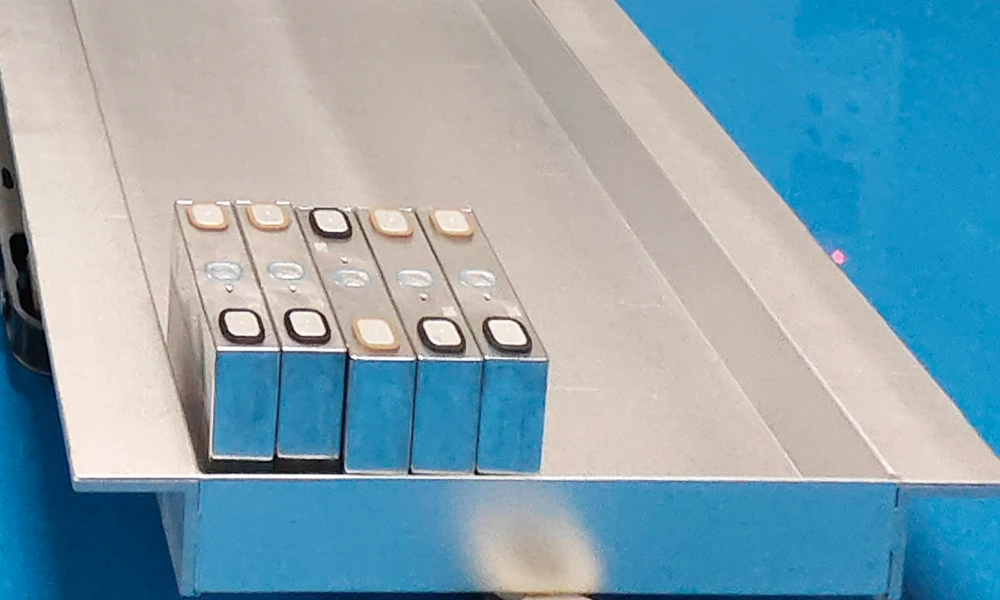
Cells standing on their tray: the tray to cell interface, together with the plate to tray interface below it, is where the contact heat has to cross.
The vacuum and nitrogen sequence is what turns heat into dryness. Water in an electrode is not sitting on the surface waiting to be pumped away; it has to diffuse out through the coating and the separator first, which is slow. A vacuum hold pulls the vapour away as it appears, and a dry nitrogen purge replaces the cavity atmosphere so the next pump-down starts from dry gas rather than from humid air. Alternating the two is faster than either alone, and it is why the recipe asks for a heating time, a vacuum time and a nitrogen time rather than a single duration. The number of cycles is the variable that gets tuned per product.
The dry screw pump closes the loop. An oil-sealed pump in a water-removal duty pulls water vapour into its oil, the oil emulsifies, and the ultimate pressure drifts upward until somebody changes the oil. A dry screw pump has no oil in the swept volume, so the water leaves with the exhaust instead of accumulating, and there is no oil vapour to backstream onto the parts you have just dried. That is the reason the GSD series is specified here rather than a cheaper oil pump, and it is a statement about the process rather than about the pump.
What contact heating does not fix is load geometry. The plate heats from below, so a tray loaded with a single layer of cells behaves very differently from the same tray stacked three deep: the cells at the top of the stack are heated by their neighbours and by radiation rather than by the plate, and they lag. If your process needs a defined hold time, keep the tray single layer or accept a longer cycle, and treat the ±3 °C uniformity figure for what it is: a statement about an empty cavity at constant temperature, not a promise about the centre of a tall stack.
Key Engineering Characteristics
- Contact heating on every layer. A silicone heating plate is built into the base plate of each layer, so the primary heat path is conduction into the tray and is not weakened by the vacuum. This is the feature that separates the format from a hot-air vacuum oven.
- Three layers, each with its own cycle. Heating, vacuum and nitrogen are set and run per layer, so one layer can be baking while another is purging and a third is cooling.
- 10 Pa empty, 50 to 100 Pa working, 500 Pa per 24 hours. The leak figure is the one to hold on to: a chamber that gains 500 Pa a day will still hold 50 Pa during a bake, and a chamber that gains 5,000 Pa will not.
- 3 degree uniformity from two heat sources. The plate heats the load and the U-shaped wall air holds the cavity at the same temperature, so the load is not heated from one side and cooled from the other.
- A dry screw pump set with a manifold interlock. No oil in the swept volume, so water leaves with the exhaust, and the branch valves close automatically as each chamber reaches setpoint.
- Pressure vessel welding, 4.0 mm stainless interior. The cavity is welded to pressure vessel practice rather than folded and seamed, which is what keeps it from deforming across thousands of atmosphere-to-vacuum cycles.
- Seven protections, including over-pressure relief and automatic gas shutoff. The door is explosion and pressure resistant with a self-relief feature, and the gas inlets close automatically if a cavity is over-filled, which saves nitrogen as well as protecting the chamber.
Operating Sequence, Safety and Maintenance
1. The Bake Cycle, Step by Step
Loading is done with a cart brought up to the height of the layer being filled, and the single full-height door is what allows that: the tray goes in on its rails from the cart rather than being passed through a small hatch. Once the door is closed and the interlock is satisfied, the cycle runs from the recipe. The sequence below is the one the PLC executes.
- Load the tray of cells or electrodes onto the contact plate of the layer being used, and close the door.
- Confirm the recipe on the touch screen. Heating time, vacuum time and nitrogen time are already set; starting the layer hands control to the PLC.
- Pump down to the vacuum setpoint.
- Fill with dry nitrogen to the low vacuum limit, not more than -20 kPa, which is the lower limit for the exchange.
- Heat to the set temperature and hold.
- Pump down again, removing the water vapour the first hold has driven out of the load.
- Vacuum bake for the programmed vacuum time.
- Fill with nitrogen again.
- Nitrogen bake for the programmed nitrogen time. Steps 6 to 9 repeat until the set number of cycles is complete.
- Cool naturally, with the heaters off and the circulating air carrying the heat away.
- Unload the tray when the cavity has cooled, and start the next layer or the next batch.
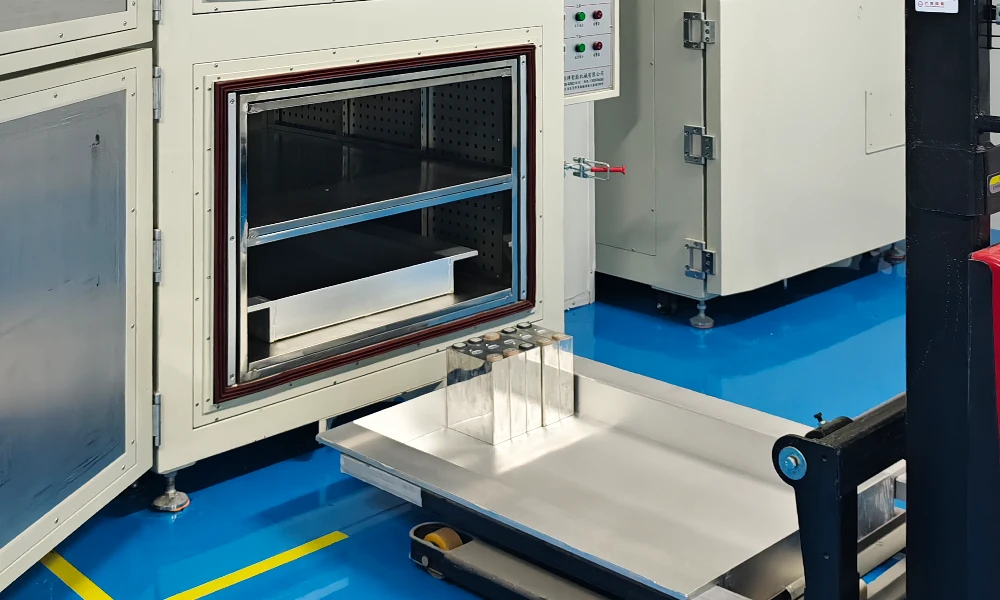
A tray of prismatic cells brought to the layer on the loading cart, with the contact plate level with the cart deck.
2. Safety Protection
The protection list covers the four things that actually go wrong on a vacuum oven: a runaway heater, a shorted element or fan, a door that is opened under vacuum, and a chamber that keeps filling after it should have stopped. Each of the seven items below is a physical device, not a software limit.
- Cavity over-temperature protection, which cuts the power automatically when the limit is reached.
- Over-current and short circuit protection on the heating elements.
- Over-current and short circuit protection on the internal circulation fan.
- Over-current and short circuit protection on the control system.
- A purpose-built explosion resistant door rated for pressure, with an over-pressure self-relief function.
- Automatic shutoff of the nitrogen and dry gas inlets if a cavity is over-filled, which saves gas and protects the chamber at the same time.
- An audible and visual alarm at the end of the set time, per layer.
The door interlock is worth stating separately because it is easy to assume and expensive to get wrong: the bake cannot be started until the door is closed and the cavity is sealed. Beyond that, the site rules in the datasheet are not decoration. Do not bake flammable, corrosive, combustible or explosive materials in the cavity, and keep the machine out of an area where such gases, liquids or solids are present.
3. Maintenance and What Actually Wears
The consumable on this machine is the door seal, not the heater. A moulded silicone O-ring that is compressed against a stainless flange once or twice an hour, at 100 °C, in a chamber that is pumped and vented, is the part that will eventually let the leak rate drift past 500 Pa per 24 hours. Watch that number: it is measured empty after a pump-down with the valve closed, and a rising trend is the earliest warning you will get.
Second is the pump set. A dry screw pump needs its cooling water within the stated band of 0.1 to 0.4 MPa and 4 L/min or more at 5 to 30 °C, and it needs the nitrogen purge to stay within 0.2 to 0.6 MPa at 12 to 50 L/min. Cooling water that is too warm or too slow shows up first as a higher ultimate pressure rather than as an alarm, and it is often blamed on the chamber seal. Check the water before you change the seal.
Third are the trays, and they are the cheapest thing to keep right. A flat tray that sits fully on the plate conducts; a tray with a burr or a warped corner does not, and the fault will present as one cold layer rather than as a machine fault. Keep a straight edge at the oven, not in the stores. The same applies to the valve seats on the manifold: a baffle valve that does not seal cleanly makes the pump work against a leak and looks like a pump problem from the pressure trend.
Engineering FAQ
Q: What cavity size do I get, and can it be built around my tray?
The cavity is designed around the customer's cell and tray dimensions rather than picked from a list, which is stated in the datasheet as a feature and is also the reason no cavity dimension appears on this page. Send the tray drawing, the cell height and the number of trays per layer, and the cavity will be fixed on the approved drawing before the build starts. Treat any cavity size quoted without your tray as an assumption.
Q: Can all three layers be pumped at the same time?
Yes, with sequencing. Up to three chambers may be pumped together, and when a chamber reaches its set vacuum the branch valve closes automatically before another branch opens, so the pump is protected from being asked to pull several chambers from atmosphere at once. Above two layers the vacuum protection setpoint has to be switched off for the sequence to run, which is a setting rather than a modification.
Q: Is 30 kW the total electrical load I have to provide?
No, and this is the item most often missed at the site planning stage. The oven is rated 30 kW, the vacuum system is listed separately at 10 kW and the chiller at 4 kW. The consumption figures of 30 kWh at peak and 6 kWh in steady state are explicitly for the oven without the vacuum pump and the cooling system. If the pump set and the chiller are part of the supply, size the incoming feed from the total.
Q: What utilities have to be on site before installation?
Four. Power at 380 V, 50 Hz, three phase five wire with a dedicated breaker and the external wiring to the oven. Nitrogen at 0.1 to 0.2 MPa through a 12 mm pipe, allowing about 2 m³ per cycle per oven. Compressed air at 0.6 to 0.7 MPa through an 8 mm pipe for valve actuation only, so a small supply is enough. Cooling water for the pump at 0.1 to 0.4 MPa, 4 L/min or more, 5 to 30 °C. The room itself has to stay between -5 and 35 °C at 40 percent RH or less, with 1500 mm clear at the front and 300 mm at the sides and rear.
Q: The range stops at 100 °C. Is that enough for cell drying?
Room temperature +10 to 100 °C is the specified range, and it is set by what the contact plate and the seal are built for rather than by the controller. Whether it is enough depends on your recipe: cell and electrode drying is normally done well inside this band, which is why the format exists. If your process needs 120 or 150 °C, this is the wrong oven and the double layer high vacuum oven linked above reaches 150 °C, at the cost of the contact plate.
Q: Why specify a dry screw pump instead of a cheaper oil pump?
Because this oven's job is removing water. An oil-sealed pump takes that water into its oil, the oil degrades, and the achievable pressure drifts upward until the oil is changed, which turns a process variable into a maintenance task. A dry screw pump has no oil in the swept volume, so the water leaves with the exhaust and there is no oil vapour to backstream onto freshly dried parts. The trade is a higher purchase price and a cooling water requirement that has to be respected.
Send your tray drawing and your moisture target, and we will come back with the cavity size, the layer count and the pump model that the cycle needs.
Email: tob.amy@tobmachine.com | Tel / WhatsApp: +86 181 2071 5609
Reviewed by: Science Wang, Six Sigma Black Belt, Battery Lines | Last updated: 2026-11-03
If you are interested in our products and want to know more details,please leave a message here,we will reply you as soon as we can.

 subscribe to us