Chinese
 français
 Deutsch
 italiano
 español
 português
 Nederlands
 日本語
日本語 한국의
한국의




- Home
- >
- Battery Tester
- >
- Coin Cell Tester
- >
- Four-Range 5V100mA Coin Cell Tester
Categories
Hot Products
Loading...
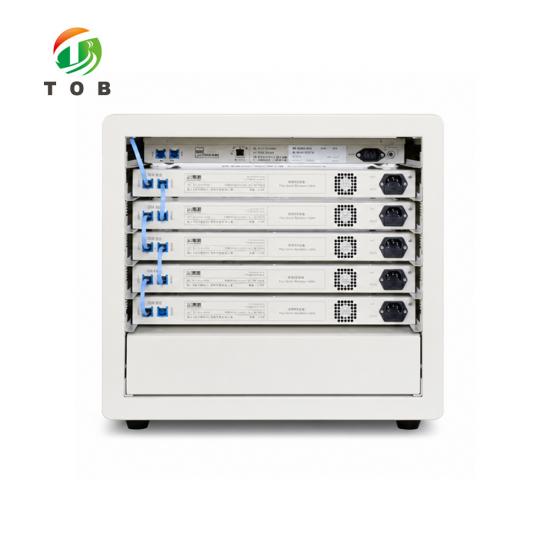
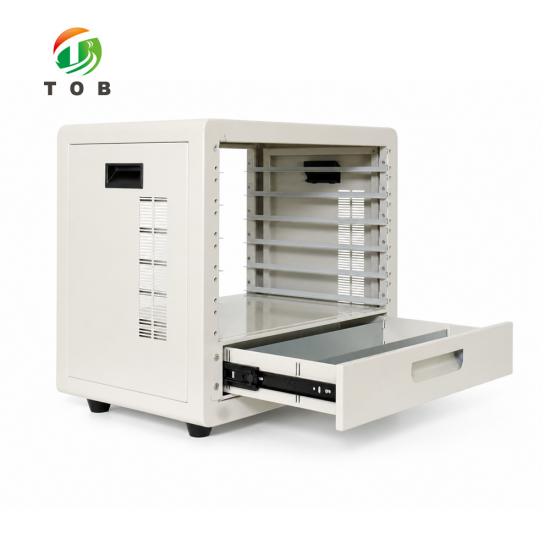
Four-Range 5V100mA Coin Cell Tester
Brand:
TOB NEW ENERGYitem no.:
TOB-CT-4008Q-5V100mA-HWXorder(moq):
1setPayment:
L/C,T/Tproduct origin:
Chinashipping port:
XIAMEN
Four Testing Range 5V100mA Coin Cell Tester - TOB-CT-4008Q-5V100mA-HWX
Product Overview and Ideal Applications
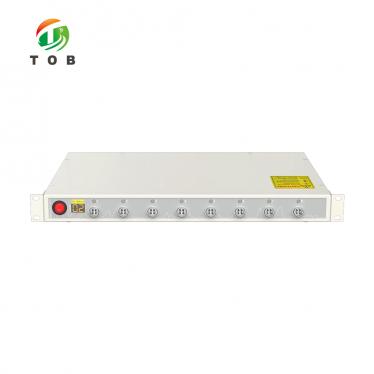
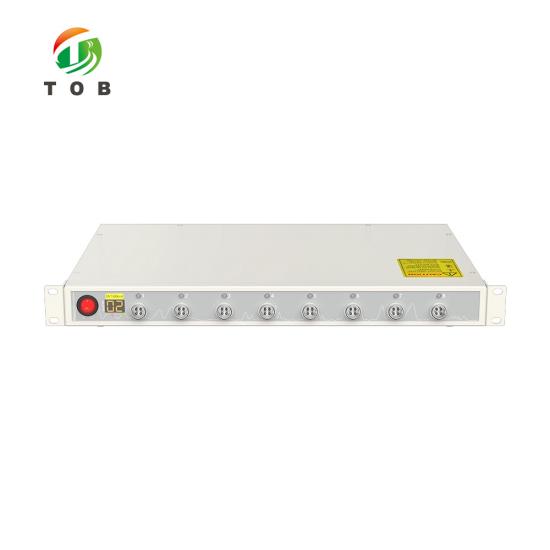
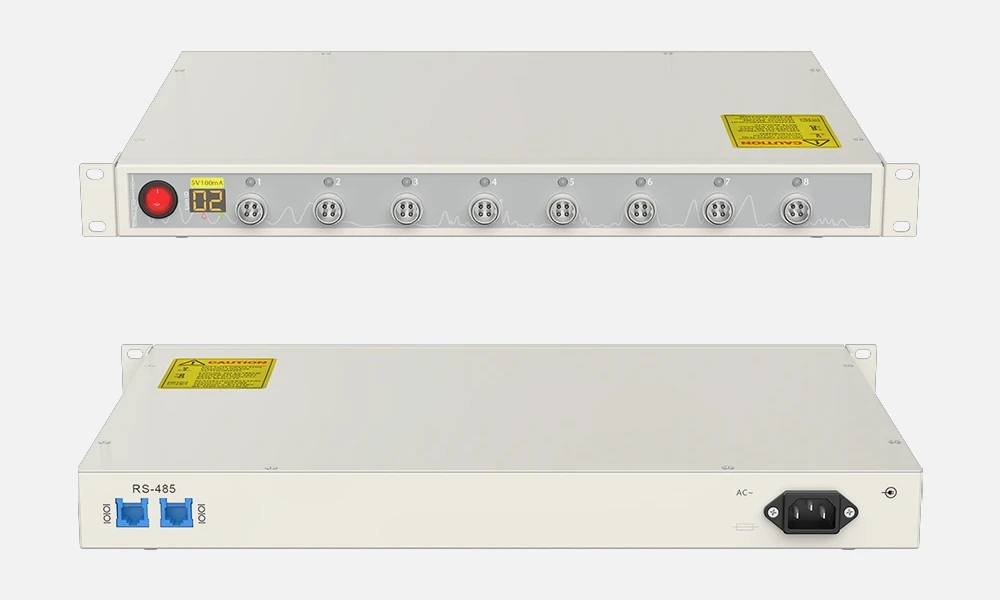
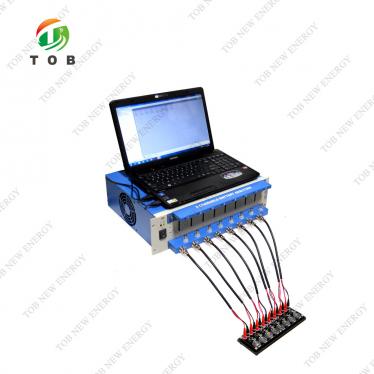
The TOB-CT-4008Q-5V100mA-HWX is a four testing range coin cell tester designed for charge-discharge cycling, capacity testing, DCIR measurement, and pulse testing of coin cells and other small-format cells. The instrument provides 8 independent channels in a 1U 19-inch chassis (483 x 310 x 43 mm), with each channel built around a dual closed-loop structure - one loop for the constant current source and one for the constant voltage source - and four-wire data acquisition for accurate measurement at the cell terminals.
The defining strength of this tester is its four current ranges - 0.1 mA, 1 mA, 10 mA, and 100 mA - combined with a minimum output current of 0.2 μA. Coin cells carry very small amounts of active material, so the currents required to test them range from microamps to a hundred milliamps; a single-range instrument cannot measure across this span with consistent accuracy. The four-range architecture lets the tester run each test on the range where it is most accurate, from the microamp-level currents used in materials research to the 100 mA currents needed for higher-rate evaluation. The input resistance of ≥ 1 GΩ keeps the voltage measurement from loading the cell, preserving accuracy at the smallest currents.
Beyond basic cycling, the instrument supports DCIR testing and pulse charge/discharge programs - in current or power mode, with a minimum pulse width of 500 ms and up to 32 pulses per step, cut off by voltage or relative time. Test data is managed through a MySQL database over a TCP/IP connection, with exports in EXCEL, TXT, GRAPH, PDF, and CSV formats. An optional communication expansion supports CAN, RS485, and BMS communication with DBC configuration.
Ideal for:
- Battery materials research and development, where coin cells (CR2032-class and similar) are used to evaluate cathode materials, anode materials, electrolytes, and additives.
- University and institutional battery laboratories running coin cell cycling, rate testing, and formation studies.
- Cell development teams that need microamp-level measurement resolution and a wide current span on one instrument.
- Quality-control and evaluation laboratories testing small-format cells, using the optional clamp types (alligator, polymer, or coin cell clamps) selected to suit the sample format.
Where Coin Cell Testing Fits in Battery Materials Research
Coin cells are the standard test vehicle of battery materials research. A coin cell is assembled with a small disc of the material under study (often only a few milligrams of active material), a separator, electrolyte, and a counter electrode, all sealed into a button-shaped case. Because the active material loading is tiny, the test currents are small - from microamps during low-rate characterization to a hundred milliamps at the higher end - and the voltage measurement must not load the cell.
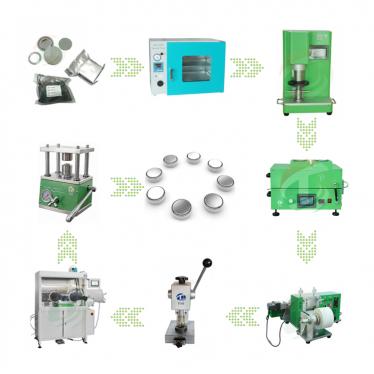
The testing workflow around a coin cell tester is:
- Coin cell assembly: the electrode sample, separator, and electrolyte are assembled and sealed in the coin cell case in a glove box or dry environment.
- Fixture connection: the coin cell is connected to the tester through the appropriate clamp - the coin cell clamp for button cells, or the alligator and polymer clamps for other small-format samples.
- Electrical testing: the tester runs the defined program - charge-discharge cycling, rate testing, DCIR measurement, or a pulse profile - with each channel controlling one cell independently.
- Data analysis: results are recorded in the MySQL database and exported in EXCEL, TXT, GRAPH, PDF, or CSV format for analysis, reporting, or archiving.
- Next batch: with 8 independent channels, several cells can be tested in parallel, then unloaded and replaced for the next batch.
This is the workflow that makes a multi-channel, multi-range tester central to a materials laboratory: each new material, electrolyte, or additive formulation requires a fresh set of coin cells to be cycled under identical conditions, and the 8 independent channels of the TOB-CT-4008Q-5V100mA-HWX provide that parallel capacity in a single 1U instrument.
Key Engineering Characteristics of the TOB-CT-4008Q-5V100mA-HWX
- Four Testing Ranges: 0.1 mA / 1 mA / 10 mA / 100 mA - The four-range structure, with a minimum output current of 0.2 μA and CV cut-off currents scaled per range (0.1 μA / 1 μA / 10 μA / 0.1 mA), gives the tester a wide dynamic range for coin cell work. Low-rate characterization runs on Range 1; higher-rate evaluation runs on Range 4, all on one instrument without hardware changes.
- Minimum Output Current of 0.2 μA - The 0.2 μA minimum output current lets the tester apply the very small currents used for low-rate and high-resolution evaluation of coin cells - currents that single-range instruments cannot deliver accurately.
- High Input Resistance of ≥ 1 GΩ - The input resistance of ≥ 1 GΩ minimizes the loading effect of the voltage measurement on the cell. At the microamp currents typical of coin cell testing, a low-impedance input would draw current from the cell and distort the measurement; the high input resistance of this instrument preserves voltage accuracy at the smallest currents.
- Eight Independent Channels in a 1U Chassis - The instrument provides 8 channels, each with independent control, fitted in a 1U 19-inch chassis (483 x 310 x 43 mm). This gives a materials laboratory eight parallel test positions in a single rack unit - high channel density for the bench space available.
- Dual Closed-Loop Independent CC/CV Sources - Each channel pairs an independent constant current source and constant voltage source in a dual closed-loop structure. This holds voltage or current precisely through the CC-CV transition - the critical point of any charge protocol. Channel parallelism is not supported, so each channel is used for one independent cell.
- Four-Wire Data Acquisition and 24-Bit AD / 16-Bit DA Chain - Voltage and current detection use a four-wire (Kelvin) connection, and the measurement chain uses 24-bit AD and 16-bit DA conversion with voltage and current accuracy of ± 0.01 % of FS and power accuracy of ± 0.02 % of FS. Data is recorded at 10 Hz (100 ms minimum interval), with current response time within 1 ms (10 % ~ 90 % of FS).
- Pulse Testing and DCIR - Pulse charge/discharge programs run in constant current or constant power mode, with a minimum pulse width of 500 ms and up to 32 pulses per step, cut off by voltage or relative time. DCIR testing is supported for internal-resistance evaluation of coin cell samples.
- Comprehensive Protection: Software and Hardware - Software protection allows settable safety conditions - voltage upper/lower limits, current upper/lower limits, and additional parameters - while hardware protection covers anti-reverse connection, over-voltage, over-current, and over-temperature, protecting both the coin cell samples and the instrument during long-duration cycling.
- Database-Managed Data with Standard Export Formats - Test data is managed through a MySQL database with TCP/IP host communication and exported in EXCEL, TXT, GRAPH, PDF, and CSV formats for analysis, reporting, and archiving - supporting research documentation and batch comparison.
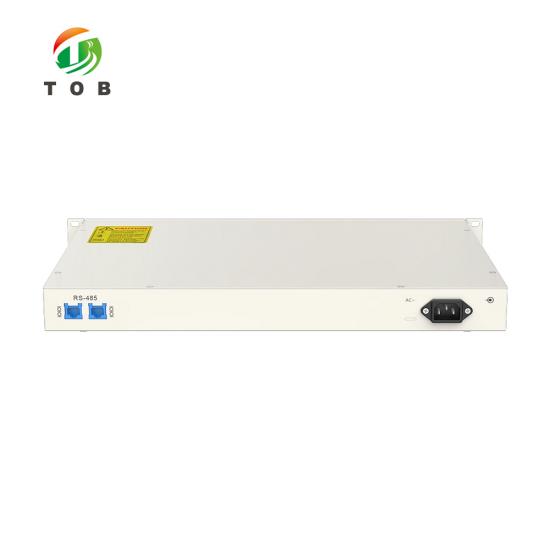
- Comprehensive Communication Options - The optional communication expansion supports CAN and RS485 communication, including BMS communication with DBC configuration, extending the instrument to test programs where battery management systems participate.
Technical Specifications
1. General
| Item | Value |
| Model | TOB-CT-4008Q-5V100mA-HWX |
| Input power | AC 220 V ± 10 % / 50 Hz |
| Input power | 40 W |
| Resolution | AD: 24-bit; DA: 16-bit |
| Input resistance | ≥ 1 GΩ |
| Overall system efficiency | Not |
| Noise | < 55 dB (measured at 1 m) |
| Parallel ability | Channel parallelism is not supported |
| IP Level | IP20 |
| Channels feature | Independent pairs of closed loop for constant current source and constant voltage source |
| Channels control mode | Independent control |
| Data acquisition | Four-wire connection |
2. Voltage
| Item | Parameter |
| Output range | 10 mV - 5 V |
| Min discharge voltage | -5 V |
| Accuracy | ± 0.01 % of FS |
| Stability | 0.02 % of FS |
3. Current
| Item | Parameter |
| Output range | Range 1: 0.1 mA; Range 2: 1 mA; Range 3: 10 mA; Range 4: 100 mA |
| Accuracy | ± 0.01 % of FS |
| Minimum output current | 0.2 μA |
| CV cut-off current | Range 1: 0.1 μA; Range 2: 1 μA; Range 3: 10 μA; Range 4: 0.1 mA |
| Stability | 0.02 % of FS |
4. Power
| Item | Parameter |
| Single channel output power | 0.5 W |
| Accuracy | ± 0.02 % of FS |
| Stability | 0.04 % of FS |
5. Time
| Item | Parameter |
| Current response time | ≤ 1 ms (10 % ~ 90 % of FS) |
| Current conversion time | ≤ 40 ms (-90 % ~ 90 % of FS) |
| Working step time | ≤ (365 x 24) h/step; time format 00:00:00.000 (h, m, s, ms) |
| Frequency | 10 Hz (minimum time interval: 100 ms) |
6. Working Mode
| Item | Parameter |
| Charge/Discharge modes | CC, CV, CCCV, CP, Pulse, etc. |
| Cut-off condition | Voltage, current, time, capacity, energy, etc. |
| DCIR | Supported |
| Pulse charge/discharge mode | Current, Power |
| Min pulse | 500 ms |
| Pulse counts | Up to 32 |
| Chg and Dchg switch | unsupported |
| Cut-off condition | Voltage, Delta Time |
7. Cycle
| Item | Parameter |
| Max cycles | 1 - 65535 |
| Max steps | ≤ 255 |
| Cycle nest | < 10 |
8. Protection Mode
| Item | Parameter |
| Software protection | Safety protection conditions can be set, including: voltage lower limit, voltage upper limit, current lower limit, current upper limit, etc. |
| Hardware protection | Anti-reverse connection, over-voltage, over-current, over-temperature, etc. |
9. Communication and Computer Configuration Requirements
| Item | Requirement |
| CPU | Pentium dual-core or above, frequency 4G or above |
| Computer memory | Recommended 16G or above |
| Connection for PC | TCP/IP |
| Disk drive config | Min. 500GB |
| PC operating system | Windows 7 and above |
| Database | MySQL |
| Data export format | EXCEL, TXT, GRAPH, PDF, CSV |
| Communication expansion (optional) | Support CAN, RS485 communication and BMS communication, with DBC configuration function |
10. Operation and Storage Environment Requirement
| Item | Parameter |
| Operating temperature | 0 °C ~ 40 °C (when the temperature is 25 ± 10 °C, the accuracy offset caused by temperature is less than 50 ppm/°C) |
| Storage temperature | -10 °C ~ 50 °C |
| Operating humidity | ≤ 70 % RH (no moisture condensation) |
| Storage humidity | ≤ 80 % RH (no moisture condensation) |
11. Fixture Specifications and Equipment Dimensions
| Item | Specification |
| Clamp types | Optional (to be clearly specified at order confirmation) |
| Clamp pictures (for reference only) | Alligator, polymer, coin cell |
| Channel | 8 |
| Dimension WDH (mm) | 1U (19"), 483 x 310 x 43 |
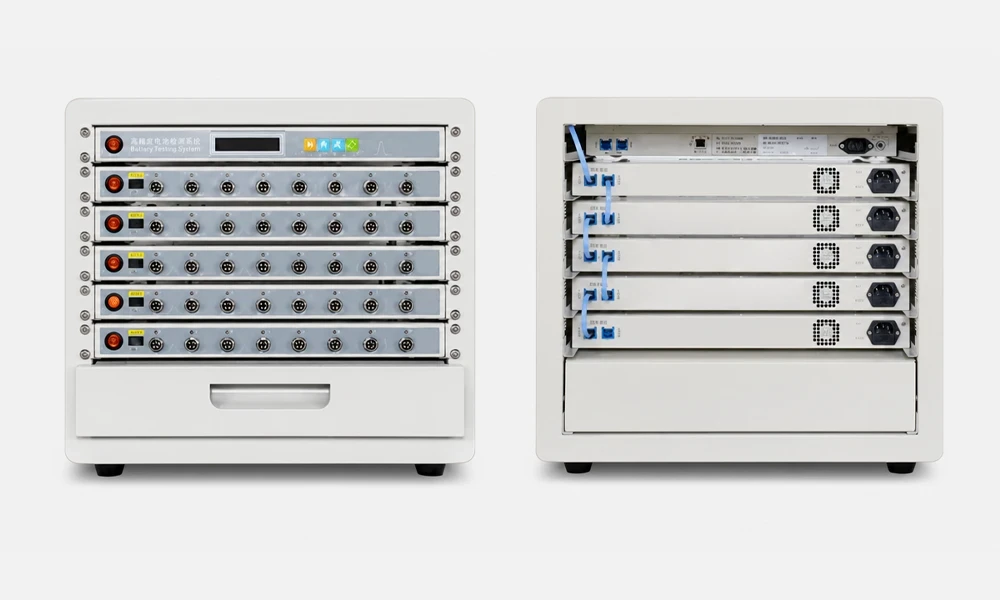
Ordering note: when 5 sets of the tester are ordered, 1 control unit and 1 shelf will be supplied free of charge (as provided in the product ordering information; confirm the final configuration at order confirmation).
Practical Testing Recommendations
- Clamp selection: the clamp type is optional and must be clearly specified at order confirmation - alligator, polymer, or coin cell clamps. Select the clamp that matches your sample format: the coin cell clamp for button-cell samples, and the alligator or polymer clamps for other small-format samples.
- Wiring: connect the sample using the four-wire scheme to preserve voltage measurement accuracy at the cell terminals.
- Range selection: run low-rate characterization and formation studies on Range 1 (0.1 mA), and higher-rate evaluation on Range 4 (100 mA), where the CV cut-off current scales to 0.1 mA accordingly. The 0.2 μA minimum output current on the low range supports the smallest test currents used in materials research.
- Protection setup: configure the software protection conditions - voltage upper/lower limits and current upper/lower limits - before starting long-duration cycling, so an anomalous sample is cut off automatically.
- Pulse and DCIR programs: for pulse testing, note the 500 ms minimum pulse width and the 32-pulse limit per step; pulse steps are cut off by voltage or relative time. Run DCIR measurements under consistent current and timing conditions to keep results comparable between samples and batches.
- Channel operation: the 8 channels are independently controlled; channel parallelism is not supported, so each channel is used for one independent cell. Load and unload samples without forcing the clamps, and keep the clamp contacts clean.
- Data management: operate the instrument through the TCP/IP host connection and back up the MySQL database periodically. Export data in EXCEL, TXT, GRAPH, PDF, or CSV formats per your research-records requirements.
- Installation environment: operate within 0 °C to 40 °C and ≤ 70 % RH without moisture condensation, on a 40 W supply; the instrument produces noise below 55 dB (measured at 1 m) and is rated IP20.
Engineering FAQ
Q1: What is the TOB-CT-4008Q-5V100mA-HWX used for?
The instrument is a four testing range coin cell tester for charge-discharge cycling, capacity testing, DCIR measurement, and pulse testing of coin cells and other small-format cells. Its four current ranges (0.1 mA to 100 mA) and 0.2 μA minimum output current make it suited to battery materials research and cell development, where coin cells are used to evaluate electrode materials, electrolytes, and additives.
Q2: Why does the tester have four current ranges?
Coin cell testing spans currents from microamps to about a hundred milliamps. A single range cannot measure across this span with consistent accuracy, so the four-range structure (0.1 mA / 1 mA / 10 mA / 100 mA) lets each test run on the range where the measurement is most accurate, with CV cut-off currents scaled per range (0.1 μA / 1 μA / 10 μA / 0.1 mA).
Q3: What does the high input resistance of ≥ 1 GΩ provide?
The input resistance of ≥ 1 GΩ minimizes the loading effect of the voltage measurement on the cell under test. At the very small currents used in coin cell research, a low input impedance would draw current from the cell and distort the measured voltage; the high input resistance of this instrument preserves accuracy at those currents.
Q4: How many channels does the instrument have, and what are its dimensions?
The instrument provides 8 channels, each independently controlled, in a 1U 19-inch chassis measuring 483 x 310 x 43 mm (W x D x H). Channel parallelism is not supported; each channel is used for one independent cell.
Q5: What clamp types are available?
Clamp types are optional and must be clearly specified at order confirmation. The available clamps are alligator, polymer, and coin cell clamps, covering button-cell samples and other small-format sample connections.
Q6: What pulse and DCIR capabilities does the instrument support?
Pulse charge/discharge programs can run in constant current or constant power mode, with a minimum pulse width of 500 ms and up to 32 pulses per step, cut off by voltage or relative time. DCIR testing is supported for internal-resistance evaluation of the samples under test.
Q7: How is test data managed?
Test data is stored in a MySQL database managed by the host software, connected over TCP/IP, with exports in EXCEL, TXT, GRAPH, PDF, and CSV formats. Software protection conditions (voltage and current limits) are settable in the same environment, and hardware protection - anti-reverse connection, over-voltage, over-current, and over-temperature - operates independently.
Q8: Is there an ordering benefit for multiple testers?
Yes - as provided in the product ordering information, when 5 sets of the tester are ordered, 1 control unit and 1 shelf will be supplied free of charge. Confirm the final configuration at order confirmation.
Q9: What operating conditions does the instrument require?
Operating temperature 0 °C ~ 40 °C and operating humidity ≤ 70 % RH without moisture condensation; storage at -10 °C ~ 50 °C and ≤ 80 % RH. Within 25 ± 10 °C, the accuracy offset caused by temperature is less than 50 ppm/°C. The instrument is rated IP20 with a noise level below 55 dB (measured at 1 m) and should be installed in a clean, dry, well-ventilated location.
Ready to add four-range, microamp-capable coin cell testing to your battery materials laboratory? Request a quotation for the TOB-CT-4008Q-5V100mA-HWX, specifying your sample format and required clamp types (alligator, polymer, or coin cell), and whether the optional CAN / RS485 / BMS communication is required. Our battery testing engineers can advise on range selection and test-program setup.
tob.amy@tobmachine.com | +86 181 2071 5609
You May Also Need
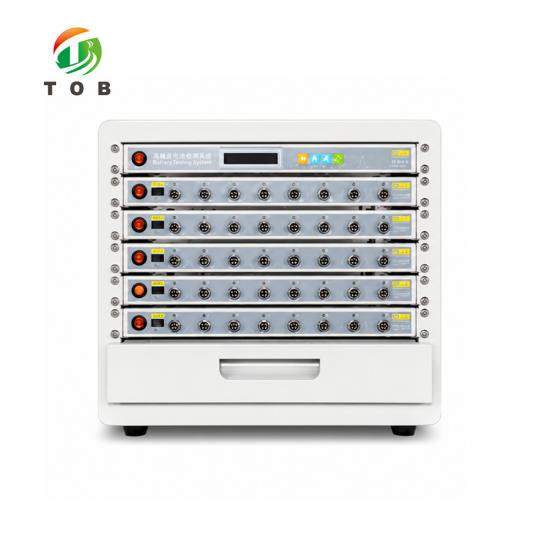
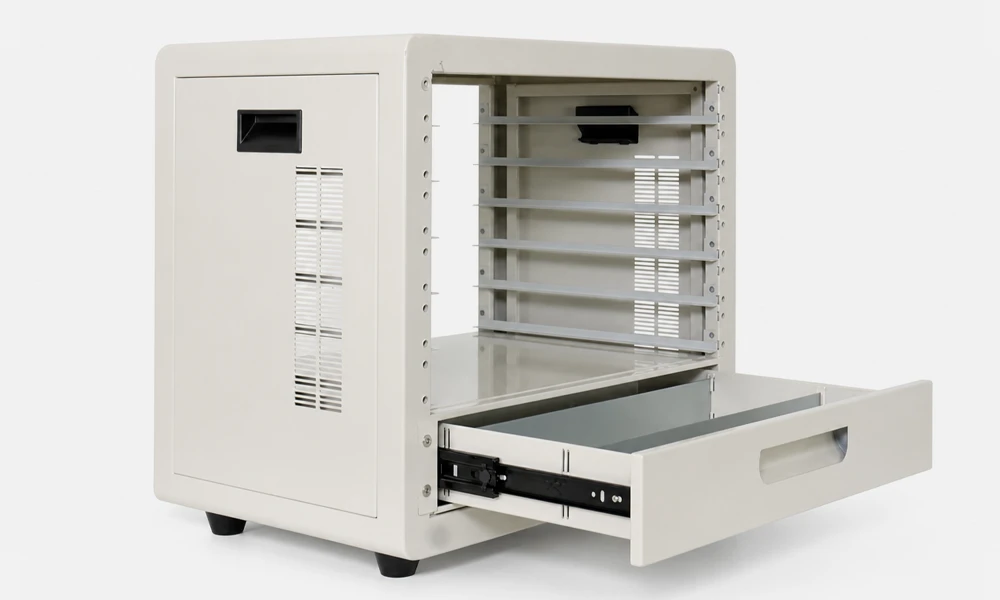
▶ Movable Rack for Coin Cell Tester - A movable rack designed to hold coin cell testers. Complements the TOB-CT-4008Q-5V100mA-HWX by providing a mobile, organized test station for multi-channel coin cell testing - relevant to multi-unit orders, which include 1 free control unit and 1 free shelf when 5 sets are ordered.
▶ 5V10mA Button Cell Tester with Three Testing Range - A button cell tester with three testing ranges in a 5 V / 10 mA class. A related TOB coin cell testing platform for laboratories whose current requirements fit a lower power class.
▶ Four-Zone Constant Temperature Environmental Test Chamber for Coin Cell Testing - A four-zone constant-temperature test chamber for coin cell programs. Complements the TOB-CT-4008Q-5V100mA-HWX for test programs that must run under controlled temperature conditions.
Previous:
Single Temperature Zone 5V100mA All-in-One Coin Cell Constant Temperature Testing SystemNext:
Movable Rack for Coin Cell Tester
If you are interested in our products and want to know more details,please leave a message here,we will reply you as soon as we can.

 subscribe to us