Chinese
 français
 Deutsch
 italiano
 español
 português
 Nederlands
 日本語
 한국의




- Home
- >
- Coin Cell Equipment
- >
- Coin Cell Crimping Machine
- >
- Electric Coin Cell Crimping Machine
Categories
Hot Products
Loading...
Electric Coin Cell Crimping Machine
Brand:
TOB NEW ENERGYitem no.:
TOB-DF-160order(moq):
1setPayment:
L/C,T/Tproduct origin:
Chinashipping port:
XIAMEN
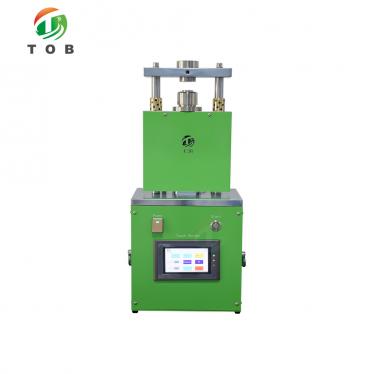
Coin Cell Crimper Electric Crimping and Disassembling Machine - TOB-DF-160
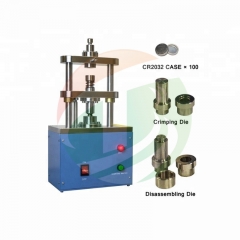
Electric crimping press with a 1200 kg digital setpoint and interchangeable dies, for CR20 series coin cells in and outside a glovebox
Product Overview and Ideal Applications
The TOB-DF-160 is an electric coin cell crimping and disassembling machine: it closes CR20 series cases under a pressure that is typed on a touch screen, and it opens them again when a cell has to be taken apart for inspection. It is the sealing step of a coin cell line, sitting between cell assembly and electrochemical testing.
Where a hydraulic hand crimper asks the operator to pump to a feel, this machine holds a setpoint of up to 1200 kg and keeps the value on screen, so cell twenty and cell two hundred are closed under the same number. The 20 mm work stroke, 250 mm x 185 mm x 450 mm frame and 30 kg net weight are sized so the unit can be carried to a glovebox and passed through a 360 mm antechamber rather than crimping air-sensitive cells in open air.
New upgrade: faster sealing speed and less noise than the earlier version of this machine.
Ideal for:
- Battery material research labs that seal CR2016, CR2025 and CR2032 cells in batches and need one pressure value for the whole batch.
- Glovebox workflows, where the press has to be transferred in through the antechamber and operated inside the box.
- Small scale button cell production in a factory, where the same unit has to run all day without an operator pumping a handle.
- Labs that also press dry powder tablets, wet powder tablets, press mouldings or riveted parts, because the die is interchangeable.
- Not the right choice when the required crimping force is above 1200 kg, when the cell is a larger format such as 4680, or when the line needs a fully automated sealing station.
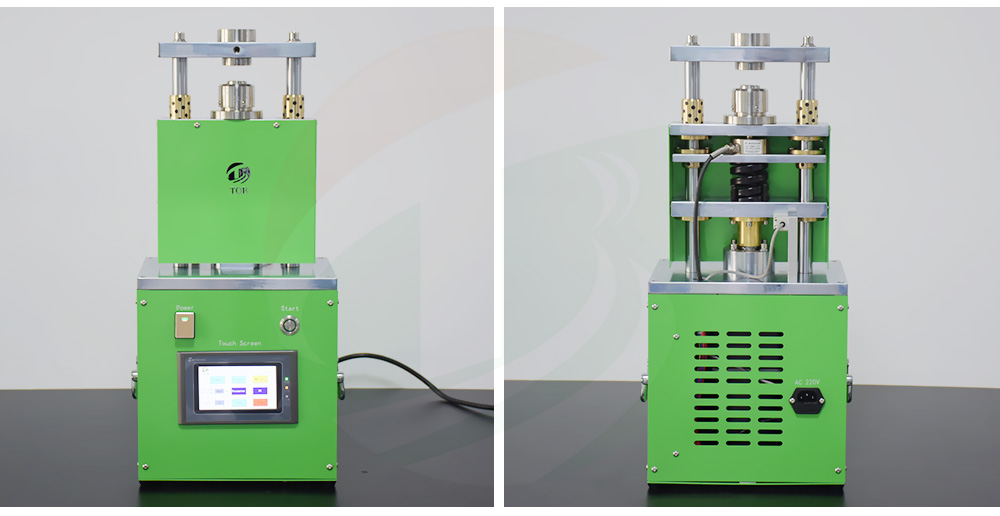
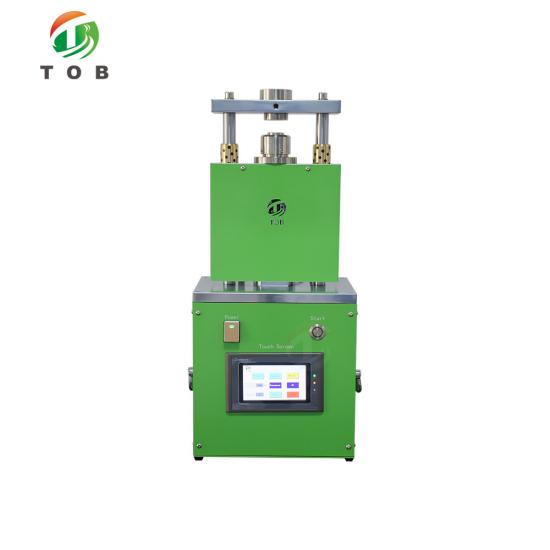
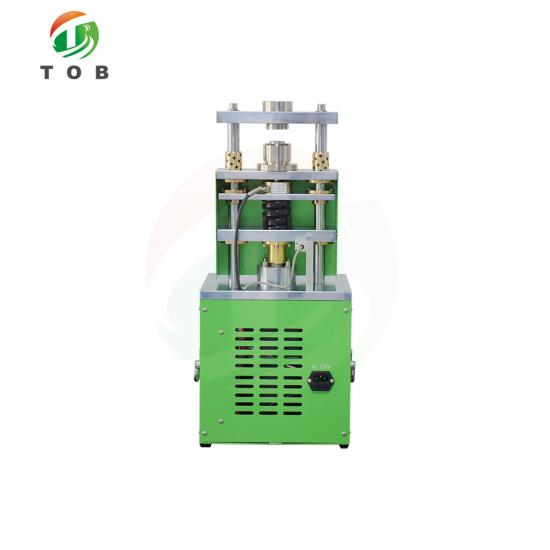
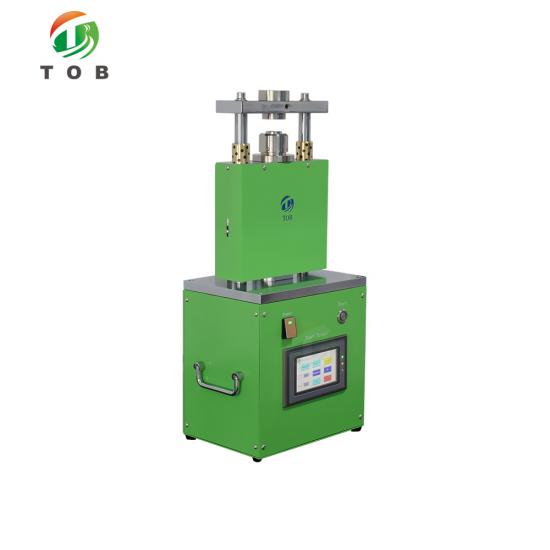
The TOB-DF-160 from the front and from the rear: touch screen and upper die on the front face, motor and frame on the rear.
Where the Sealing Step Fits in the Coin Cell Workflow
A coin cell is a stack of five or six parts closed by one crimp, and every step before it decides whether the crimp holds. The TOB-DF-160 owns the last mechanical step of that chain:
- Electrode discs are punched from coated foil or a dried electrode sheet with a cutting die, on the TOB-CP60 manual coin cell electrode disc cutting machine.
- The case, cap, spacer, wave spring and washer are picked for the chosen format from the coin cell parts range.
- Electrode, separator and electrolyte go into the case, inside the glovebox for lithium and other air-sensitive chemistries.
- The loaded case is seated in the die and crimped at the set pressure on the TOB-DF-160, which is the step this page covers.
- The sealed cell is rested, then cycled on a coin cell test analyzer such as the TOB-CT-4008-5V5mA.
Two things travel down this chain and are decided by the crimp: the compression of the separator and gasket, and the contact resistance between the case and the electrode. A crimp that is short on pressure leaves the gasket uncompressed and the cell leaks; a crimp that is long on pressure flattens the seal and can distort the can. That is why the pressure value, not the machine size, is the parameter worth controlling.
Key Engineering Characteristics of TOB-DF-160
- Touch screen pressure control: the sealing pressure is entered on a touch screen and stays visible on the display during the cycle, so parameters are set once for a batch instead of being repeated by hand on every cell. High degree of automation is the practical result, not a marketing line: the operator loads the case and the machine does the rest of the cycle.
- 1200 kg maximum, freely settable: the press is rated to a maximum of 1200 kg and the working value is set below that ceiling on the screen. The readout matters more than the ceiling: it is the number the next batch is reproduced from.
- 20 mm work stroke: the ram travels 20 mm between the open and closed position, which is the room needed to seat a die and a loaded case by hand and still close the stack, without a long lever arm in the way.
- Passes into a glovebox through a 360 mm antechamber: the frame is 250 mm x 185 mm x 450 mm and the net weight is 30 kg, so the machine goes through a φ360 antechamber without being dismantled and is then operated inside the box. For lithium metal and reactive electrolytes this removes the open-air transfer that a benchtop-only press forces.
- Electric drive, no hand pumping: an electric driver replaces the hydraulic handle, which is the labour saving against a hydraulic type crimper. The crimping process runs without the vibration of hand pumping and without the leakage that follows an unevenly closed case.
- Interchangeable die, steel structure: a precise die seats the case squarely and a strong steel frame keeps the ram aligned, which is what makes the seal accurate and repeatable. Because the die is a separate part, the same press also handles dry powder tablets, wet powder tablets, press moulding and riveting.
- Small footprint, built to be maintained: the unit is small enough to operate inside a glovebox, and its appearance and layout are arranged so the guide post, moving plate and die can be cleaned and oiled without taking the frame apart.
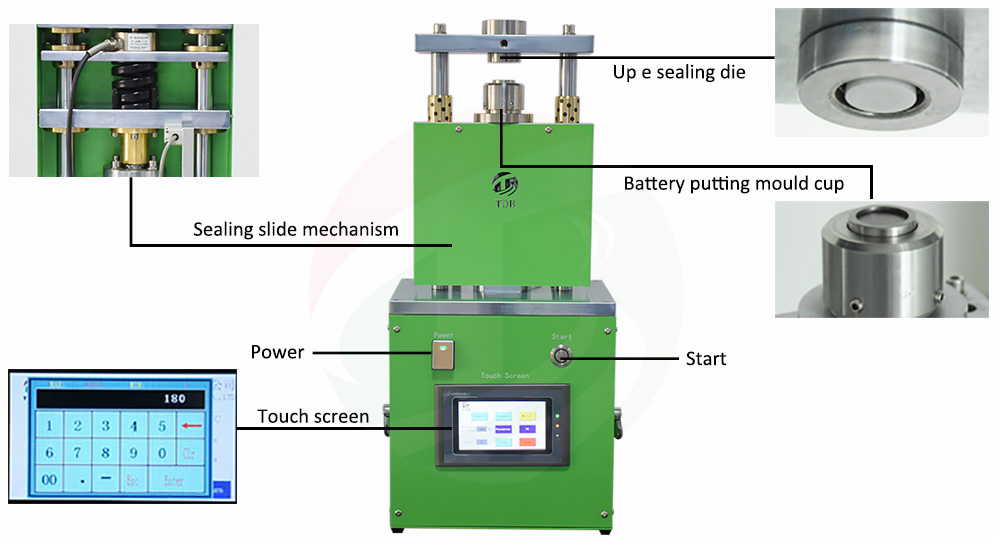
Every component of the TOB-DF-160 labelled: touch screen, upper die, guide post, moving plate and base.
Complete Specifications
1. Machine Specifications
| Parameter | Value |
|---|---|
| Model | Electric Crimping and Disassemble Machine TOB-DF-160 |
| Voltage | 110V/220V AC±10% 50Hz/60Hz |
| Power | 100W |
| Pressure | Max 1200 kg, digital display can be set |
| Work stroke | 20 mm |
| Die | Standard die for CR20 series crimping, other dies is optional |
| Advantages | Precision controlled sealing pressure; the pressure is shown on the screen and it can be set freely. |
| Warranty | One year with lifetime support |
| Dimension (L*W*H) | 250 mm x 185 mm x 450 mm |
| Net weight | 30 kg |
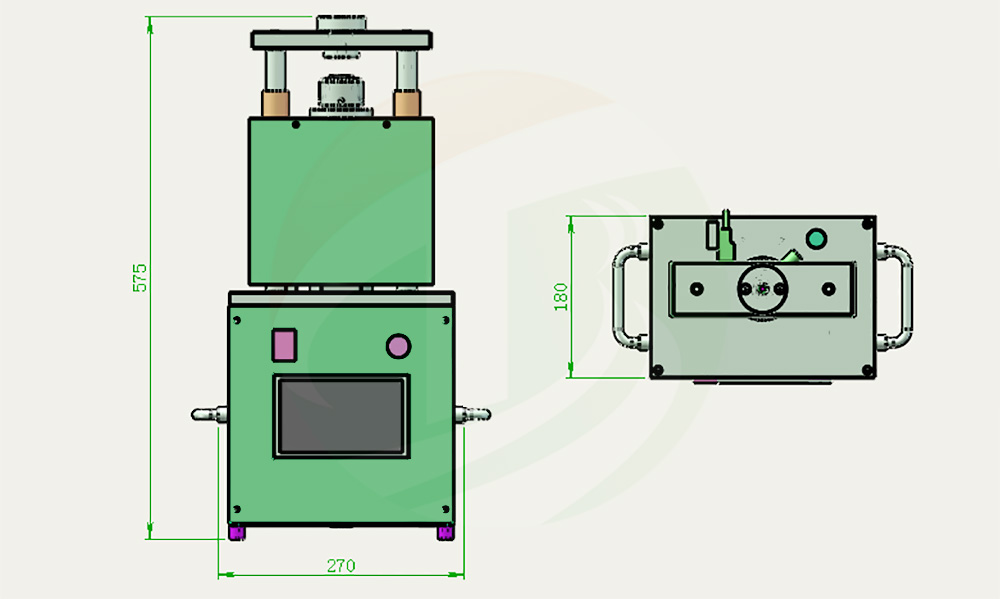
Front view and top view of the TOB-DF-160 with the 270 mm x 180 mm x 575 mm (Old version) envelope dimensioned.(As the product is constantly being updated and iterated, the images and dimensions are for reference only.)
2. Die and Case Compatibility
The die is the part that decides which cell the machine can close, and it is the only part that changes when you move between formats.
| Die | Coin cell formats | Availability |
|---|---|---|
| Standard CR20 die | CR2016, CR2025, CR2032 | Supplied with the machine as the standard crimping die for the CR20 series |
| CR1016 die | CR1016 | Optional, ordered with the machine or added later |
| Other dies | Dry powder tablets, wet powder tablets, press moulding, riveting | Optional; specify the part geometry when ordering |
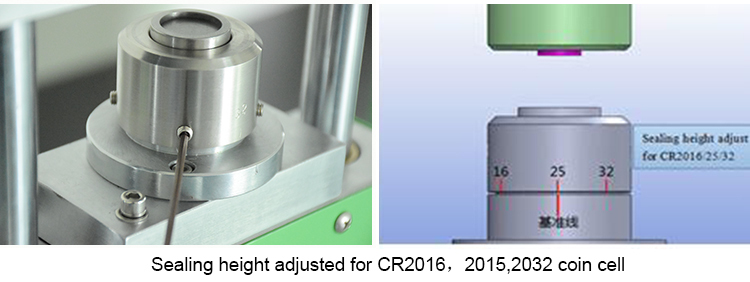
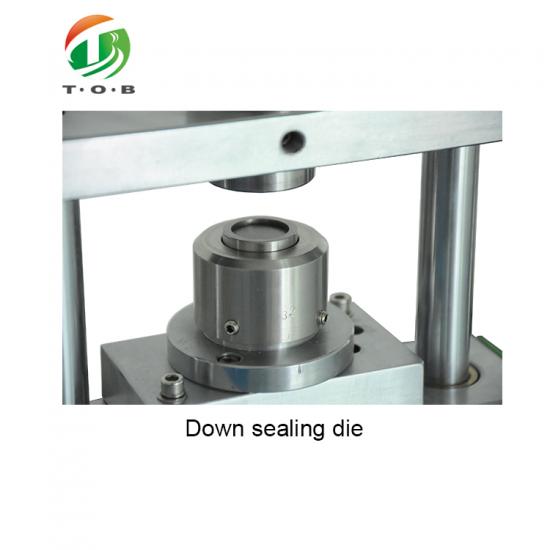
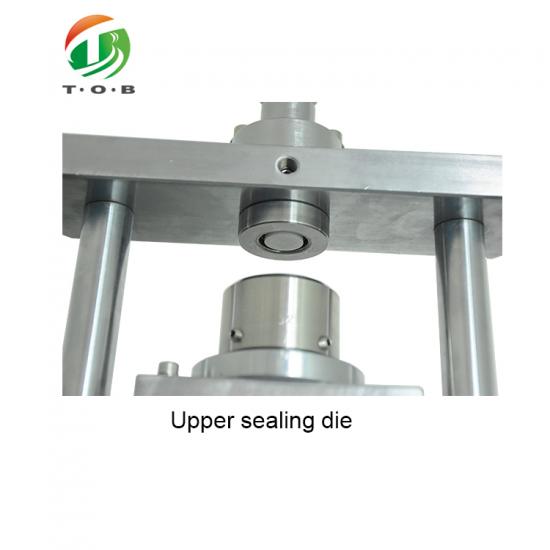
The crimping die of the TOB-DF-160, sized for CR2016, CR2025 and CR2032 coin cell cases.
CR1016 Die and Case Option
Matching the die to a CR1016 case
The CR1016 is the smallest format in common use, and it is the one that catches people out: a CR20 die is cut for a case roughly twice that diameter, so the cap is not guided and the gasket is never compressed. A dedicated CR1016 die is available for this machine as an option, and the case sets supplied with it are 304 stainless steel.
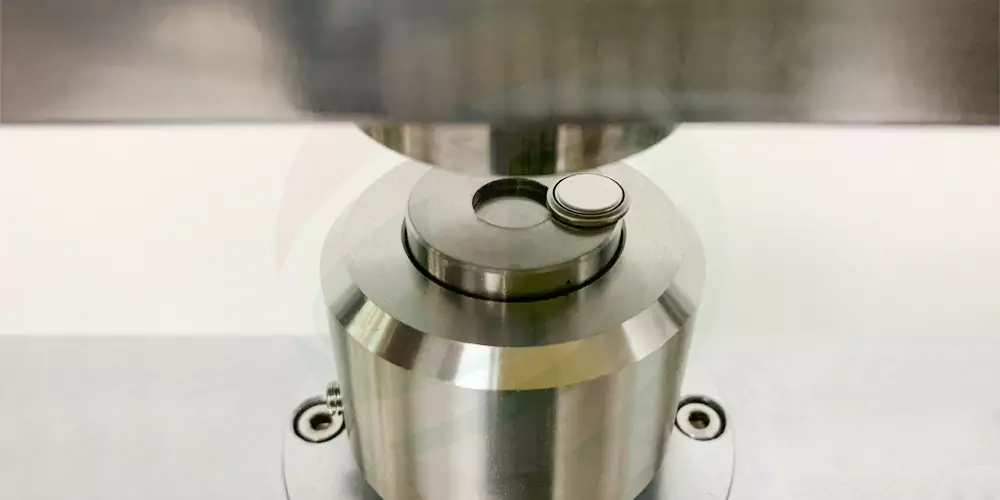
Crimped CR1016 coin cells next to the matching CR1016 crimping die.
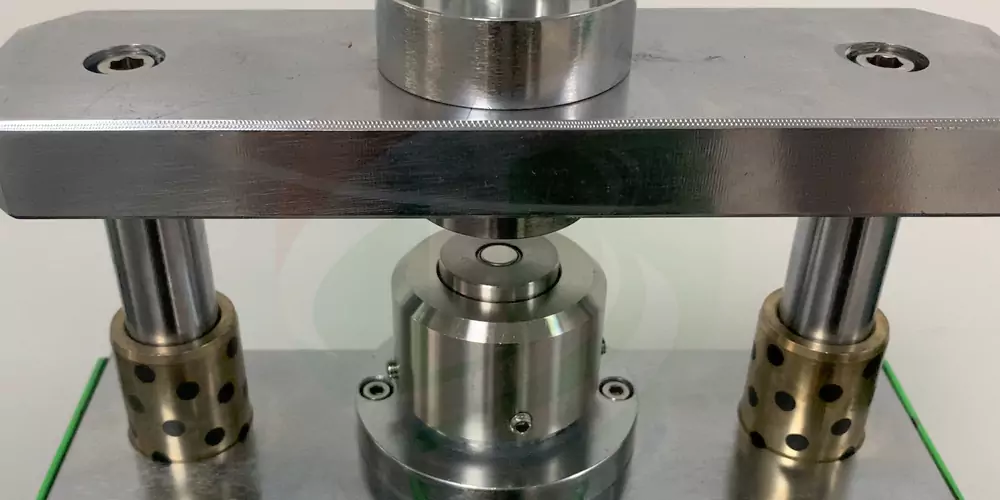
A CR1016 coin cell seated in the die and being crimped.
We also provide the CR1016 case itself in sets of 100: 304 stainless steel, supplied with the matching die option so the case and the die are known to fit each other. The case set is listed separately as the CR1016 coin cell case 304SS and crimping die, part number TOB-1016-304SS.
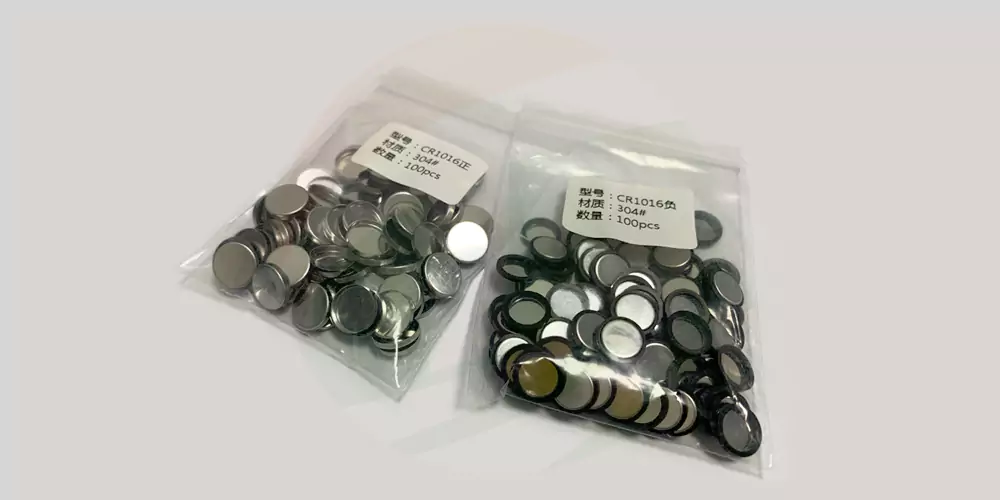
100 sets of 304 stainless steel CR1016 coin cell cases, the consumable that pairs with the CR1016 die.
Practical Operating Recommendations
1. Before the first cell of a batch
- Confirm the die against the case: the case code on the box should match the die in the machine. Mixing a CR2032 cap with a CR2016 can is the most common source of a cell that will not seal.
- Check the setpoint on screen: the pressure value is visible on the display before the cycle starts. Read it at the start of each batch rather than assuming the last operator left it where you need it.
- Clean and oil the die faces and the guide post: residue on a die face is transferred to every cell that follows, and a dry guide post makes the ram drag.
- Seat the case squarely: the case should drop into the die under its own weight. If it has to be forced, the die and the case are not the same format.
2. Maintenance and safety
- Daily: wipe dirt from the guide post and other moving parts, keep them clean, and lubricate with oil so the movement stays smooth.
- After use: switch off the power and return the moving plate to its original position. For long storage, remove the upper die screw, take out the crimping die and clean it, and keep its surface clean and lightly oiled.
- Periodically: inspect the screws, nuts, pins and other fasteners on each part of the machine for loosening, so that neither the finished cell nor the operator is put at risk.
- Never: put hands or other parts into the danger zone of the guide post, the slide plate or the working area, and never let two or more people operate the machine at the same time.
Engineering FAQ
Q1: Why does the pressure setpoint matter more than the 1200 kg maximum?
The maximum is a ceiling, not a working value. What decides whether a cell seals is the force actually applied to the case, and the same case closed at two different forces gives two different gasket compressions. On a hydraulic hand crimper that force depends on how hard and how long the operator pumps; on this machine it is typed in and held on screen, so the value becomes a written parameter of the process instead of a skill of the person at the bench. For a lab that has to defend a result in a paper, that is the difference between a repeatable method and an anecdote.
Q2: Why is a 20 mm work stroke enough for CR20 series cases?
The stroke is travel, not the closed height of the cell. A CR20 cell is only a few millimetres tall once sealed, but the ram has to start far enough above the die to drop a loaded case in by hand and to lift a die out for a format change. Twenty millimetres covers the open position, the die and case stack, and that hand clearance. A longer stroke would not press harder or seal better; it would only make the machine taller, which works against putting it inside a glovebox.
Q3: Why does a 360 mm antechamber figure appear on a machine this small?
Because the antechamber, not the bench, is the real constraint in an air-sensitive workflow. If the press does not pass through it, the cell has to be crimped outside the glovebox, which exposes the electrolyte at the exact moment it is being sealed in. The 250 mm x 185 mm x 450 mm frame and 30 kg net weight are what allow the unit to be transferred through a φ360 antechamber without being dismantled and then operated inside the box.
Q4: Should I take the electric TOB-DF-160 or the hydraulic manual TOB-MR-120?
They do the same mechanical job and differ in how the force is produced. The TOB-MR-120 hydraulic manual coin cell crimper has no motor and no screen: the pressure comes from a hand pump, so it needs no power and costs less. The TOB-DF-160 drives the ram electrically and holds a setpoint on a touch screen. If you seal a handful of cells a week and work in a place where power at the bench is awkward, the manual crimper is enough. If you run batches, or the pressure value has to be reproduced and recorded from one session to the next, the electric machine pays for itself in operator fatigue alone.
Q5: When is the TOB-DF-160 the wrong machine?
Four boundaries are worth checking before you order. First, if the force your case needs is above 1200 kg, there is no headroom left and a larger press is required. Second, it is a coin cell machine: 4680, pouch and cylindrical formats need a different press, not a different die. Third, it is a benchtop unit operated one cell at a time, so it is not a substitute for an automated sealing station on a production line. Fourth, the drive runs on 110 V or 220 V AC at 50/60 Hz with no manual fallback, so a site without mains power at the bench cannot use it.
Q6: A cell leaks, or the can deforms, after crimping. What do I check first?
Work from the part that is easiest to get wrong. Check that the die and the case are the same format, then that the die faces are clean and the case is seated squarely, then the setpoint against the value that produced a known-good cell, then the stack height, because too many spacers or an over-tall wave spring prevents the case from closing to its designed height regardless of pressure. A leak at the seal ring usually means the gasket was never compressed, which points to low force or a mis-seated case; a distorted can usually means the force went past what the case was designed for.
TOB-DF-160 in Scientific Literature
The TOB-DF-160 is named by model number in 10 scientific records, which also describe how it was used in their experimental procedure.
- 10 records covering 9 distinct studies (one study appears as both a preprint and its published version)
- 8 peer-reviewed journal articles and 2 preprint versions; author institutions span 3 countries
| Publication platform | Article | First author and institutions | Country | How the TOB-DF-160 is cited |
|---|---|---|---|---|
|
ChemRxiv (preprint) 2025 DOI 10.26434/chemrxiv-2025-lhxgk |
A transition-metal-and-solvent-free dual-graphite battery for grid-scale energy storage |
Minh Canh Vu et al. University of Chicago |
United States | Finally, the Al disk and the Al-coated positive case were sequentially placed, and the cell was assembled under a pressure of 900 MPa using the TOB-DF-160 assembly tool from Xiamen TOB New Energy Technology Co., Ltd. |
|
Matter (Elsevier) 2023, 6(12), 4357-4375 DOI 10.1016/j.matt.2023.10.017 |
Low melting alkali-based molten salt electrolytes for solvent-free lithium-metal batteries |
Minh Canh Vu et al. University of Chicago |
United States | Finally, the Al disk (18 mm in diameter) and the Al-coated positive case (Al-Clad CR2032, MTI) were subsequently placed, and the cell was vacuumed in the glovebox antechamber for 2 min to remove any bubbles in the electrolyte and ensure the wetting of the separator prior to coin cell crimping at 700 MPa (TOB-DF-160, Xiamen TOB New Energy Technology). |
|
Journal of Materials Chemistry A (RSC) 2026, 14(47), 31889-31903 DOI 10.1039/d6ta00159a |
A transition-metal-and-solvent-free dual-graphite battery |
Minh Canh Vu et al. University of Chicago |
United States | Finally, the Al disk and the Al-coated positive case were sequentially placed, and the cell was assembled under a pressure of 900 MPa using the TOB-DF-160 assembly tool from Xiamen TOB New Energy Technology Co., Ltd. |
|
Journal of the European Ceramic Society (Elsevier) 2023, 43(2), 407-418 DOI 10.1016/j.jeurceramsoc.2022.10.030 |
Effect of argon sputtering pressure on the electrochemical performance of LiFePO4 cathode |
Raúl Manuel Ugalde-Vázquez et al. Instituto Politécnico Nacional |
Mexico | After the assembly, the coin cells were sealed using a hydraulic crimper (TOB-Df-160, Tob machine). |
|
Materials Science in Semiconductor Processing (Elsevier) 2026, 203, 110219 DOI 10.1016/j.mssp.2025.110219 |
Photon-assisted charging in thin-film lithium-ion batteries using LiMn2O4 cathodes |
D.A. Medina-Sánchez et al. Tecnológico Nacional de México / Instituto Tecnológico de Cd. Madero; Instituto Nacional de Astrofísica, Óptica y Electrónica |
Mexico | The assembled coin cells were hermetically sealed using a hydraulic crimping machine (TOB-Df-160, Tob Machine) with a pressure of 700 Kg. |
|
The Journal of Physical Chemistry C (ACS) 2026, 130(30), 10504-10519 DOI 10.1021/acs.jpcc.6c02264 |
Role of Sputtering Deposition Pressure on the Electrochemical Performance of Li4Ti5O12 Anodes |
L. Salvador Valle-García et al. Universidad Nacional Autónoma de México |
Mexico | Final sealing was performed using a hydraulic crimper (TOB-Df-160, TOB Machine, China). |
|
Batteries (MDPI) 2024, 10(12), 449 DOI 10.3390/batteries10120449 |
Fine-Tuning Cathode Performance: The Influence of Argon Deposition Pressure on LiMn2O4 Thin Film Electrochemistry for Li-Ion Batteries |
Fabián Ambriz-Vargas et al. The University of Texas at Dallas |
United States | After assembly, the coin cells were sealed using a hydraulic crimper (TOB-Df-160, Tob Machine). |
|
ChemRxiv (preprint) 2026 DOI 10.26434/chemrxiv-2026-p1sk9 |
Anion and cation (co-)intercalation behavior from an inorganic molten salt for dual-ion batteries |
Hrishikesh Srinivasan et al. The University of Chicago |
United States | The cell was sealed using a TOBDF-160 automatic coin cell crimper from Xiamen TOB New Energy Technology Co., Ltd. |
|
Journal of Materials Science: Materials in Electronics (Springer) 2025, 36(34), 2188 DOI 10.1007/s10854-025-16260-2 |
Influence of plasma atmosphere on the sputter deposition of Li–Mn–O cathodes |
L. S. Valle-García et al. INRS; The University of Texas at Dallas |
Canada; United States | Final sealing was performed using a hydraulic crimper (TOB-Df-160, TOB Machine, China). |
|
MRS Advances (Springer) 2026, 11(3), 246-253 DOI 10.1557/s43580-025-01476-5 |
Electrochemical evaluation of aluminum-diffused LiMn₂O₄ thin-film cathodes prepared by RF magnetron sputtering |
Joao Trujillo et al. Centro de Investigaciones en Óptica |
Mexico | Final sealing was performed with a hydraulic crimper (TOB-Df-160, TOB Machine, China). |
Compiled October 2026 from a Google Scholar keyword search screened for an explicit TOB-DF-160 mention. Preprints are identified as such and have not necessarily completed peer review.
Tell us the coin cell format and the pressure your process already uses, and we will confirm the die and the setpoint before you order, so the first cell you crimp is the one you can repeat.
tob.amy@tobmachine.com | +86 181 2071 5609
Reviewed by: Pinery Gong, Battery Assembly & Yield Process | Last updated: 2026-10-19
If you are interested in our products and want to know more details,please leave a message here,we will reply you as soon as we can.

 subscribe to us