Chinese
 français
 Deutsch
 italiano
 español
 português
 Nederlands
 日本語
日本語 한국의
한국의




- Home
- >
- Prismatic Cell Assembly Machine
- >
- Prismatic Cell PET and PVC Wraping Machine
- >
- Prismatic Cell Insulation Film Wrapping Machine | TOB-SFCA-300
Categories
Hot Products
Loading...
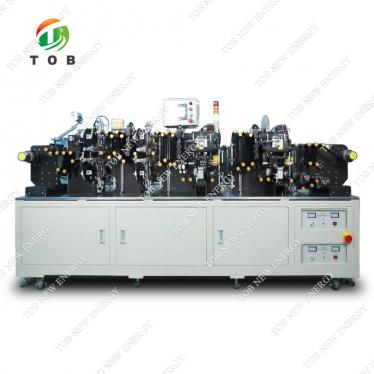
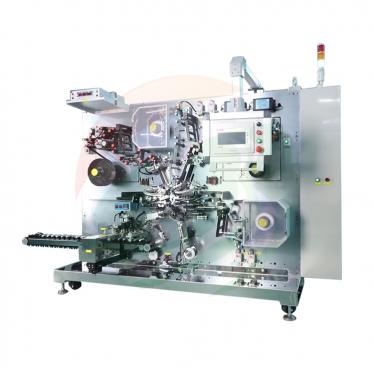
Prismatic Cell Insulation Film Wrapping Machine | TOB-SFCA-300
Brand:
TOB NEW ENERGYitem no.:
TOB-SFCA-300order(moq):
1 setPayment:
L/C,T/Tproduct origin:
Chinashipping port:
XIAMEN
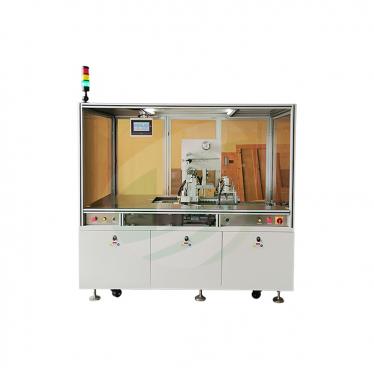
Automatic Prismatic Battery Cell Insulation Film Wrapping Machine
Product Overview and Ideal Applications
The TOB-SFCA-300 is an automatic prismatic battery cell insulation film wrapping machine that applies insulation film to finished prismatic aluminum-shell lithium-ion battery cells. The wrapping step is a critical quality and safety operation in prismatic cell production: the insulation film electrically insulates the aluminum casing, prevents short circuits if cells contact one another or a metal fixture inside a module, and provides a clean, uniform appearance that identifies the finished product.
The TOB-SFCA-300 performs the complete wrapping sequence automatically: conveyor-belt cell feeding, insulation film unwinding, loop wrapping of the cell body, folding of the top and bottom edges, and conveyor-belt unloading. The machine is designed to handle a wide range of prismatic cell sizes—cell width from 115 mm to 300 mm, cell height from 90 mm to 200 mm, and cell thickness from 25 mm to 45 mm—covering most commercial prismatic cell formats from energy-storage and EV applications down to smaller consumer formats.
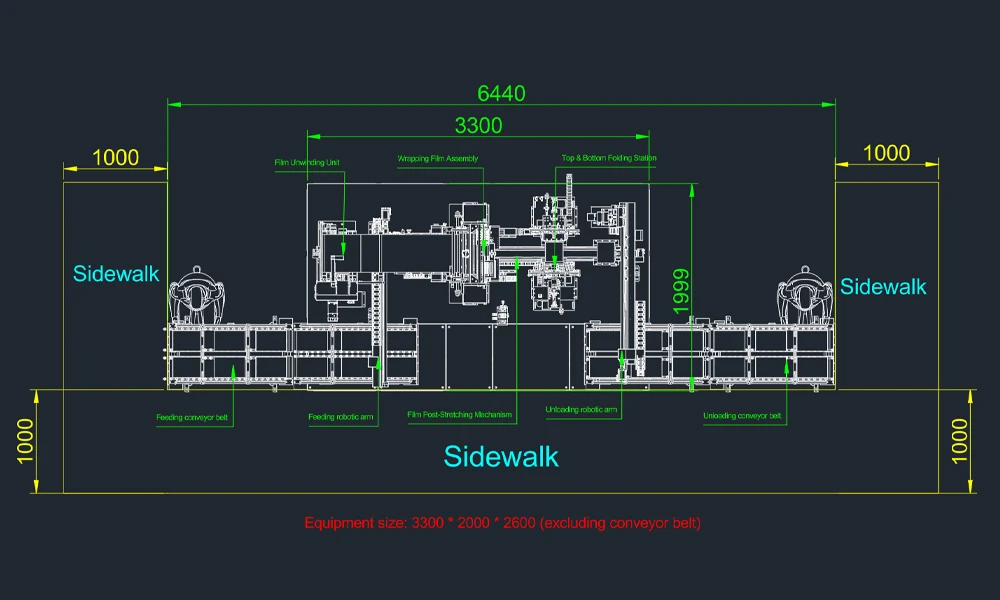
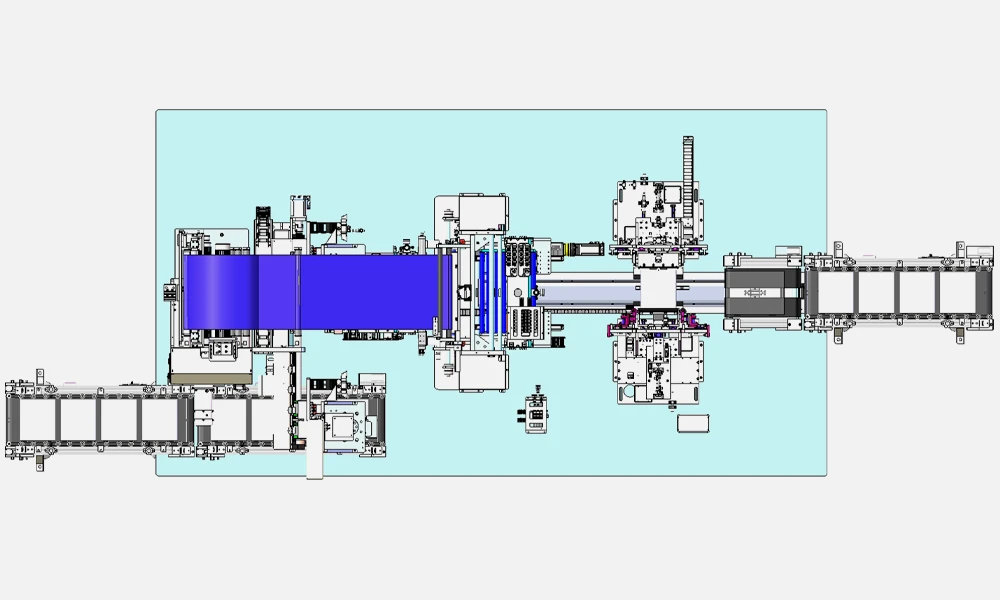
The system is built on a welded square-tube frame with a profile-and-acrylic enclosure, and it integrates eight functional modules: rack and enclosure, main electrical wiring, feeding, unwinding, wrapping, loop-wrapping side folding, top and bottom folding, and unloading. A servo-controlled traverse robot loads the cell into the wrapping station, the unwinding module feeds the insulation film with automatic web guiding and tension control, the wrapping module presses the film onto the bottom and both large faces, and the folding modules complete the top and bottom edges before the finished cell is transferred to the unloading belt. Each machine is operated by one person per shift.
Ideal for:
- Prismatic aluminum-shell cell production lines that require the insulation film wrapping step to be fully automated after formation and capacity grading.
- Energy-storage and EV cell manufacturers processing large-format prismatic cells (up to 300 mm wide) where manual wrapping is physically demanding and inconsistent.
- Pilot and small-series production facilities that need a single operator per shift to manage an automatic wrapping station.
- Cell manufacturers whose quality system requires documented, repeatable wrapping quality, MES data upload for film consumption, and strict particle and scratch control on the cell surface.
Where the Insulation Film Wrapping Step Fits in Prismatic Cell Production
In the manufacturing flow for a prismatic aluminum-shell cell, film wrapping occurs after cell assembly, formation, degassing, and capacity grading, and immediately before final inspection and module assembly. The sequence is:
- Cell assembly – Electrode stacking or winding, tab welding, insertion into the aluminum shell, electrolyte filling, and sealing.
- Formation and grading – First charge and discharge, SEI formation, capacity measurement, and cell sorting.
- Degassing and final sealing – Removal of formation gases and hermetic closure.
- Insulation film wrapping (the TOB-SFCA-300's role) – Application of the insulation film to the cell body and edges.
- Final inspection and module assembly – Visual check, OCV verification, and pack integration.
The insulation film serves two purposes. Functionally, it prevents the electrically live aluminum casing from contacting other cells or conductive parts within the module, reducing the risk of external short circuits. Commercially, it provides a consistent, professional finish and a surface on which the cell model and traceability information can be printed.
The TOB-SFCA-300 integrates into this chain as a self-contained, one-operator station. The operator loads cells onto the feeding belt, and the machine automatically conveys, wraps, folds, and unloads the finished cells. The PLC-based control system supports three operating modes—automatic, manual, and maintenance—with manual mode allowing individual operation of each moving part for setup, and maintenance mode locking the moving parts for safe servicing. The servo drivers communicate over the EtherCAT bus, providing fast response and strong anti-interference performance in the production environment.
How the Automatic Prismatic Battery Cell Insulation Film Wrapping System Operates
The TOB-SFCA-300 executes the wrapping process through a coordinated sequence of servo-driven modules, as described in the equipment specification:
1. Cell feeding: The cell is placed on the feeding belt and conveyed to the wrapping station. The feeding module includes an adjustable pull-strap design with polyurethane double-layer rubber-coated guide rollers, an anti-rear-collision sensor, and a brush-and-dust-collection box mounted under the pull strap for automatic cleaning. A servo-controlled traverse robot—designed with a flexible arm, dual sensors to prevent cell tilting, and power/gas cut-off protection—transfers the cell into the wrapping station. All parts that contact the cell are made of non-metallic materials, and the positioning blocks are chamfered to prevent scratches.
2. Insulation film unwinding: The insulation film, supplied on a roll with a release liner, is loaded onto the unwinding air shaft. The release liner and the film are separated: the film passes through a buffer roller, is corrected by the automatic web-guiding system (correction response ≤ 0.5 s, deviation ≤ ±0.5 mm), passes through a static eliminator, and reaches the film-pulling position. The release liner is rewound by a motor-and-brake winding mechanism. The unwinding shaft is designed to withstand a load of > 30 kg without bending, and the film roll diameter is ≥ 420 mm with a maximum width ≥ 330 mm. The unwinding tension is controlled by a servo mechanism and is adjustable, and a material sensor provides a low-film warning.
3. Loop wrapping: The cell is pushed into the wrapping station, guided by bottom rollers inclined at 1–2° and positioned by single-side guide wheels with a positioning accuracy of ±0.2 mm. The upper and lower pressure rollers—each driven by an independent servo motor with a positioning accuracy of 0.02 mm—press the two large faces of the cell while the film is wrapped around the bottom surface and both large faces. A film-pulling rod, servo-controlled with a positioning accuracy of ±0.2 mm, rotates 10–30° during pulling to increase the pulling area and prevent film peeling. After the wrapping is complete, the film is cut by a rodless cylinder (stroke ≥ 400 mm) with guide-rail guidance; the cutter is fitted with a safety protective cover. The top pushing block is designed to avoid the poles and the explosion-proof valve.
4. Loop wrapping side folding: The side folding module uses upper and lower folding side rollers, together with material detection and positioning mechanisms, to complete the wrap on the side edges of the cell body.
5. Top and bottom folding: The cell arrives at the bottom of the folding station and is first precisely positioned (accuracy ±0.2 mm), then pressed and fixed on all five sides—left and right, front and back, and the top surface. The pressing area exceeds 2/3 of the large-face area of the cell. The folding sequence is: first the short edges of the top and bottom are folded simultaneously, then the long edges of the top and bottom. The folding blocks are driven by cylinders with guide-rail guidance, and the stroke of the folding blocks is adjustable. During folding, the cell is held stationary with no rotational angle deviation, and no dents, scratches, or deformation are permitted.
6. Unloading: After the wrapped prismatic cell is picked up by a servo-controlled traverse mechanism, it is placed onto the unloading belt. The unloading module includes adjustable pull-strap stops, polyurethane guide rollers (diameter 20 ± 2 mm), an anti-rear-collision sensor, and a brush-and-dust-collection box for automatic cleaning. The belt for each individual cell can operate independently, and the pull-strap height is 850 ± 10 mm. A flat conveyor belt connects the unloading station to downstream equipment.
Control system features:
- Servo drivers communicate over the EtherCAT bus for fast response and strong anti-interference.
- 10 % of the host computer's I/O points are reserved for future expansion; at least 8 I/O points and one expansion-module space are reserved in the PLC.
- The PLC has at least two Ethernet ports—one for MES integration and one for central control-system integration—with remote-control functionality.
- The user interface supports three-level password access control, recipe and production-data statistics, and historical alarm-information recording.
- The system is divided into automatic, manual, and maintenance modes. Manual mode allows individual operation of each moving part; maintenance mode locks the moving parts for safety.
- The robotic arm is a flexible design with photoelectric and torque-based anti-fool-proofing. After a flexible-arm alarm is triggered, the gripper and other mechanisms do not deform or break, and power/gas cut-off mechanisms prevent the cell from falling.
- The host computer statistically analyzes material feeding/unloading capacity and waiting time, with data stored for at least one month.
Technical Specifications
Bare Cell Product Specifications
| Dimensions | Minimum (mm) | Maximum (mm) |
| Cell Width W | 115 | 300 |
| Cell Height H | 90 | 200 |
| Cell Thickness T | 25 | 45 |
Equipment Process Flow
| Stage | Process |
| Loop wrapping | Cell feeding → (Insulation Film Unwinding) Wrapping → Top & Bottom Folding → Cell Unloading |
Overall Dimensions
| Parameter | Specification |
| Equipment dimensions (main body) | Length (L) × Width (W) × Height (H): ≤ 3.5 m × 1.8 m × 2 m |
Operator Configuration
| Shift | Staffing (persons) | Remark |
| Day shift (8:00–20:00) | 1 person | One person per machine |
| Night shift (20:00–8:00) | 1 person | One person per machine |
Equipment Functional Modules (single unit, subject to actual design)
| No. | Module Name | Main Components | Qty | Unit | Remark |
| 1 | Rack and enclosure modules | Frame | 1 | set | Square tube welding |
| Hood | 1 | set | Profile + Acrylic | ||
| Electronic control unit | 1 | set | / | ||
| Human-computer interface | 1 | set | / | ||
| 2 | Main electrical wiring module | Electrical system | 1 | set | / |
| Pneumatic system | 1 | set | / | ||
| 3 | Feeding module | Feeding belt | 1 | set | / |
| Traverse handling robot | 1 | set | / | ||
| Web guiding system | 1 | set | / | ||
| 4 | Unwinding module | Tension control system | 1 | set | / |
| Insulation film cutting mechanism | 1 | set | / | ||
| Release liner winding mechanism | 1 | set | / | ||
| Unwinding mechanism | 1 | set | / | ||
| Pre-wrapping clamping mechanism | 1 | set | / | ||
| 5 | Wrapping module | Material feeding mechanism components | 1 | set | With left and right positioning function |
| Upper and lower pressure roller mechanism | 1 | set | / | ||
| Insulation film cutting mechanism | 1 | set | / | ||
| Film pulling mechanism | 1 | set | / | ||
| Positioning and clamping mechanism | 1 | set | / | ||
| 6 | Loop wrapping side folding mechanism | Upper and lower folding side rollers | 1 | set | / |
| Material detection mechanism | 1 | set | / | ||
| Positioning mechanism | 1 | set | / | ||
| 7 | Top and bottom folding module | Folding top and bottom short side mechanism | 2 | set | / |
| Folding top and bottom long side mechanism | 2 | set | / | ||
| Positioning mechanism | 2 | set | / | ||
| 8 | Unloading module | Traverse handling mechanism | 1 | set | / |
| Unloading belt | 1 | set | / |
Key Technical Requirements of the Wrapping Modules
The following key parameters define the precision and quality of the TOB-SFCA-300's wrapping operation, as specified for each module.
Unwinding Module
| Item | Technical Requirement |
| Film roll diameter | ≥ 420 mm |
| Maximum film width | ≥ 330 mm |
| Web guiding deviation | ≤ ± 0.5 mm |
| Web guiding response time | ≤ 0.5 s |
| Unwinding shaft load capacity | > 30 kg (must not bend or deform) |
| Tension control | Servo-controlled, adjustable; release liner wound using motor and brake |
| Buffer roller service life | ≥ 1 year, no powder loss |
Wrapping Module
| Item | Technical Requirement |
| Wrapping method | Loop wrapping process |
| Wrapping positioning | Bottom rollers inclined 1–2°, single-side guide wheels; positioning accuracy ± 0.2 mm |
| Guide wheel mounting base hole accuracy | ± 0.05 mm |
| Guide wheel overall width | Adjustable by hand crank |
| Film pulling mechanism | Servo-controlled rod; position accuracy ± 0.2 mm; rotates 10–30° during pulling to increase pulling area and prevent film peeling |
| Upper and lower pressure rollers | Independent servo motors; position accuracy 0.02 mm; rubber coating thickness recommended ≥ 7 mm |
| Film cutting | After wrapping; rodless cylinder (stroke ≥ 400 mm) + guide rail guidance; rail + rodless cylinder installation parallelism 0.02 mm |
Fold Top and Bottom Module
| Item | Technical Requirement |
| Wrapping method | Fold short edges of top and bottom simultaneously first, then fold long edges of top and bottom |
| Positioning | ± 0.2 mm; cell pressed on all five sides (left/right, front/back, top surface); pressing area exceeds 2/3 of large-face area |
| Folding mechanism | Insulation film folds top and bottom edges; folding base driven by cylinder |
| Upper and lower folding block parallelism | 0.02 mm |
| Folding block stroke | Adjustable |
| Folding quality | No dents, scratches, or deformation; cell held stationary without rotational angle deviation |
General Equipment Requirements
| Item | Technical Requirement |
| Operating environment | Temperature 22 ± 3 °C, dew point ≤ −35 °C, cleanliness Class 10000 |
| Equipment noise | ≤ 75 dB, measured at 1000 mm from the equipment |
| Equipment color | Computer gray RAL 7035 |
| Belt colors | Tray pull strap: black; palletless pull strap: green; NG product pull belt: yellow |
| Exposed impact-prone parts | Hard chrome plated (thickness ≥ 0.02 mm) or encased in 304 stainless steel |
| Air pipe color coding | Compressed air intake: blue, exhaust: black; vacuum: transparent; nitrogen: yellow; helium: white |
| Dust-proof design | No metal-to-metal friction along the battery flow path; dust collection or isolation devices installed; non-metallic materials used wherever possible |
| Copper/nickel/zinc/cadmium restriction | Materials containing Cu, Ni, Zn, or Cd are avoided; strictly prohibited on parts that contact or indirectly contact the product; prohibited within 1 m above and 0.4 m in other directions of the product passage area |
| Stainless steel bolts | Preferred for equipment assembly; galvanized bolts prohibited |
Major Electrical Components and Parts Brands
The following table lists the specified brands for the major components of the TOB-SFCA-300. (For delivery considerations, the supplier reserves the right to select equivalent brands of the same level according to market supply without notifying the customer.)
| No. | Category | Standard Part Name | Brand |
| 1 | Mechanical transmission | Bearings | THK / Japan |
| 2 | Slider / rail | IKO / Japan | |
| 3 | Linear bearings | NSK / Japan | |
| 4 | Lead screw | TBI / Taiwan | |
| 5 | Coupling | COUP-LINK / China | |
| 6 | Synchronous belt | MITSUBOSHI / Japan | |
| 7 | Four-axis robotic arm | Epson / Japan | |
| 8 | Electric cylinder | IAI / Japan | |
| 9 | Speed reducer | Alfa / Germany | |
| 10 | Bearing housing | FAG / Germany | |
| 11 | Pneumatic components | Pneumatic pump | WILDEN |
| 12 | F.R.L. combination | CKD / Japan | |
| 13 | Pressure gauge | KEYENCE / Japan | |
| 14 | Solenoid valve | FESTO / Germany | |
| 15 | Cylinder | FESTO / Germany | |
| 16 | Vacuum element | FESTO / Germany | |
| 17 | Pressure regulating valve | FESTO / Germany | |
| 18 | Flow control valve | FESTO / Germany | |
| 19 | Suction cup | FESTO / Germany | |
| 20 | Pipe fittings | Airtac / Taiwan | |
| 21 | Air tubing | FESTO / Germany | |
| 22 | Hydraulic shock absorber | CKD / Japan | |
| 23 | Electrical components | Switch | OMRON / Japan |
| 24 | Button | APT / Germany | |
| 25 | Switching power supply | Weidmüller / Germany | |
| 26 | Stepper motor | Oriental Motor / Japan | |
| 27 | Servo motor | MITSUBOSHI / Japan |
Equipment Supply List
| No. | Name | Model | Brand | Qty | Unit | Standard/Non-standard | Remark |
| 1 | Wrapping machine | TOB-SFCA-300 | TOB | 1 | set | Non-standard |
Control System Specifications
| Item | Specification |
| Servo communication | EtherCAT bus; fast response, strong anti-interference |
| I/O reserve | 10 % of host computer I/O reserved for expansion; ≥ 8 I/O points and ≥ 1 expansion-module space reserved in PLC |
| PLC Ethernet ports | ≥ 2 (one for MES, one for central control; different network segments configurable); remote control supported |
| User interface | Touchscreen; three-level password access; recipe and production-data statistics; historical alarm recording |
| Operating modes | Automatic, manual, maintenance |
| Safety | Independent circuits for emergency stop, light curtains, and safety doors; safety access control and interlocking; equipment stops all operations when personnel enter |
| Robotic arm | Flexible design; photoelectric and torque-based anti-fool-proofing; power/gas cut-off protection; self-protection and anti-collision measures |
| Data statistics | Feeding/unloading capacity and waiting time analyzed; stored for at least 1 month |
Engineering FAQ
Q1: What cell formats can the TOB-SFCA-300 wrap?
The TOB-SFCA-300 is designed for prismatic aluminum-shell cells with a cell width of 115–300 mm, cell height of 90–200 mm, and cell thickness of 25–45 mm. Changeover between sizes within this range is handled through the adjustable guide-wheel width (hand-crank), the adjustable pull-strap stops, and the recipe system on the touch-screen HMI. Tooling adjustments for a specific cell model are performed in manual mode.
Q2: How does the machine ensure that the insulation film does not peel or wrinkle during wrapping?
Three design features address film quality. First, the unwinding module maintains a servo-controlled, adjustable tension on the film and corrects web deviation to ≤ ±0.5 mm with a response time of ≤ 0.5 s, so the film approaches the wrapping station straight and flat. Second, the film-pulling rod rotates 10–30° during pulling, increasing the pulling area and preventing film peeling. Third, the upper and lower pressure rollers, each driven by an independent servo with 0.02 mm positioning accuracy, press the film evenly onto the cell body before the folding step.
Q3: How is the insulation film material consumption tracked?
The wrapping module uploads the film material consumption to the MES system. In addition, a material sensor provides a low-film warning, and a material-usage early-warning function alerts the operator before the roll runs out. This data supports production-cost tracking and consumables planning.
Q4: What happens if there is a power or gas supply interruption during operation?
The TOB-SFCA-300 is equipped with power and gas cut-off protection. The robotic arm is designed so that in the event of a power or gas interruption, the battery cells will not fall out and be damaged. When power or gas is restored, the equipment resumes its interlocked, safe operating sequence. The control system also logs the event in the historical alarm records.
Q5: How does the equipment prevent particle contamination of the cell surface?
The TOB-SFCA-300 is designed around strict particle-control requirements. All relatively sliding parts are connected by guide rails or cylinders, eliminating sliding friction; a dust-collection box is installed below the moving parts to capture wear debris; the parts that contact the cell are made of non-metallic materials, with PEEK/PP/POM blocks used at the positioning contact points; and copper, nickel, zinc, and cadmium materials are prohibited within the product passage area. The equipment operates in a Class 10000 environment as specified.
Ready to automate the insulation film wrapping step in your prismatic cell production line? Request a quotation for the TOB-SFCA-300, including a compatibility review for your specific cell dimensions and tray configuration. Our production-equipment engineers can provide a technical proposal and installation-layout recommendation.
tob.amy@tobmachine.com| +86 181 2071 5609
You May Also Need
-
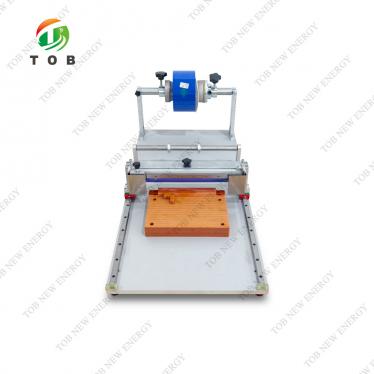
Manual Film Wrapping Machine for Prismatic Cells (TOB-MBFW-300) — A manually operated insulation film wrapping workstation for prismatic aluminum-shell cells. Complements the TOB-SFCA-300 by providing a flexible, low-cost wrapping solution for low-volume production, prototype builds, or rework, where an automatic machine is not justified.
-
If you are interested in our products and want to know more details,please leave a message here,we will reply you as soon as we can.

 subscribe to us