Chinese
 français
 Deutsch
 italiano
 español
 português
 Nederlands
 日本語
 한국의




- Home
- >
- Battery Tester
- >
- Battery and Supercapacitor Safety Tester
- >
- Salt Spray Test Chamber
Categories
Hot Products
Loading...
Salt Spray Test Chamber
Brand:
TOB NEW ENERGYitem no.:
TOB-CS-120order(moq):
1 setPayment:
L/C, T/Tproduct origin:
Chinashipping port:
XIAMEN
Salt Spray Test Chamber 600L for ASTM B117 and ISO 9227 - TOB-CS-120
600 L chamber, 1200 x 1000 x 500 mm test zone in 5 mm PVC, pneumatic cover on a water seal, test room to 50 ℃ and saturated barrel to 63 ℃
Product Overview and Ideal Applications
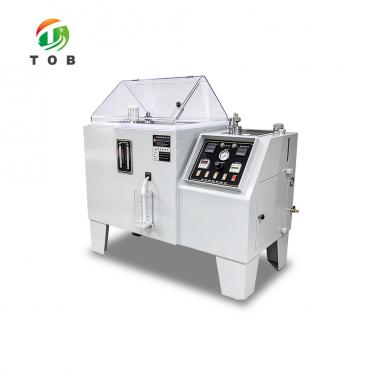
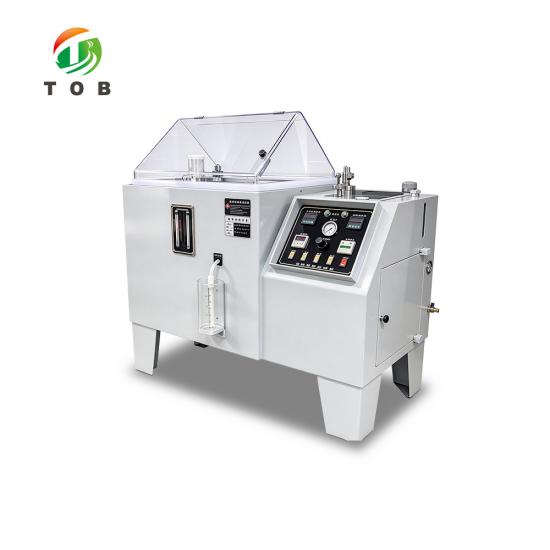
TOB-CS-120 is a 600 L salt spray test chamber built for corrosion testing rather than for storage: a 1200 x 1000 x 500 mm test zone in 5 mm PVC, a pneumatic cover seated on a water seal, and two temperatures held independently - the test room at up to 50 ℃ and the saturated barrel at up to 63 ℃, so the mist that reaches the specimen is already at the temperature the standard asks for.
The chamber is specified against ASTM B117, ISO 9227, JIS H8502 and IEC 60068-2-11, so a result obtained here can be reported against whichever of them a drawing names. Beyond paints, plating, anodic treatment and rust-prevention oils, the same chamber is used in battery work: cell cans, module housings, busbar plating and welded joints are checked for salt-spray corrosion before a design is released. For incoming checks on the separator side, see the Gurley air permeability tester for lithium-ion battery separator.
Control is deliberately plain. Two microcomputer controllers hold the chamber and the barrel, a button-set timer runs from 1 second to 9999 hours, and the panel shows set value, actual value, elapsed time and total working time. Nothing tries to run a program, because a salt spray test is one long continuous soak, not a cycle - the machine's job is to hold the conditions steady for a week and let the specimens do the talking.
- Coatings, plating, anodic treatment and rust-prevention oils tested to ASTM B117 or ISO 9227.
- Battery cell cans, module housings and busbar plating checked before a design release.
- Incoming inspection where a supplier's corrosion claim has to be reproduced in house.
- Long runs: the timer goes to 9999 hours, so a 720 hour test is a setting, not a workaround.
- Not a cyclic corrosion chamber - the spray is continuous - and not for specimens larger than the 1200 x 1000 x 500 mm zone.
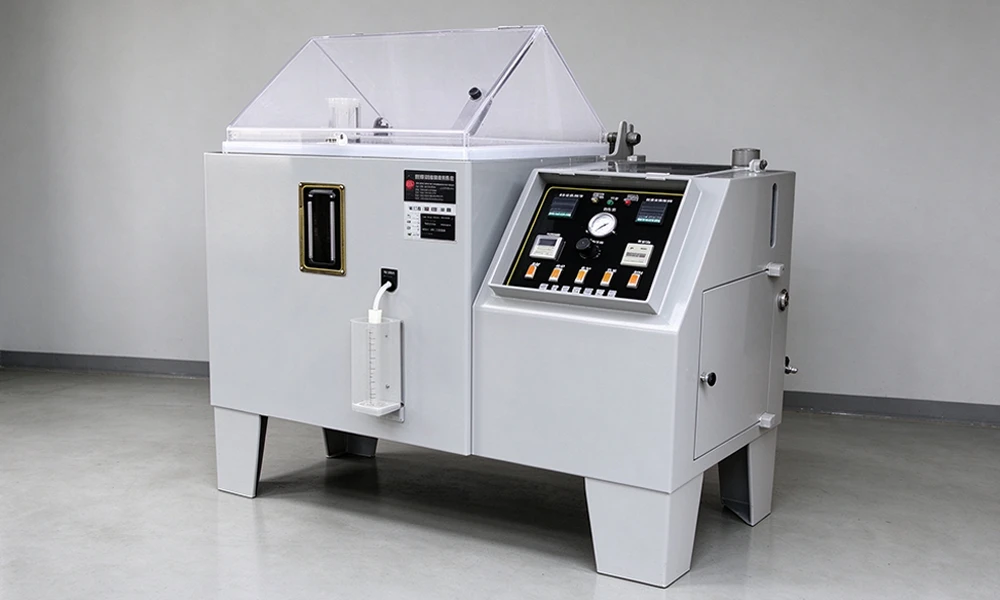
The chamber in a laboratory: cover closed on its water seal, control cabinet alongside at the same height for one-person operation.
Tell us your application, required specifications, quantity, and delivery country. Our engineer will confirm the suitable product or configuration.
Complete the inquiry form below and our engineer will review your requirements. Prefer email? Contact tob.amy@tobmachine.com
Complete Specifications
1. Chamber and working range
| Item | TOB-CS-120 |
|---|---|
| Volume | 600 L |
| Internal dimensions (test zone) | 1200 x 1000 x 500 mm (W x D x H) |
| Overall dimensions | 2100 x 1250 x 1400 mm |
| Weight | about 180 kg |
| Max power / max current | 3 kW / 15 A |
| Test room temperature | RT to 50 ℃ |
| Saturated barrel temperature | RT to 63 ℃ |
| Relative humidity in the chamber | 85% R.H. minimum |
| Heating rate | Test room RT to 50 ℃ within 60 min; barrel RT to 63 ℃ within 60 min |
| Test method | Continuous spray |
2. Temperature and spray control
| Parameter | Value | What it means in a test |
|---|---|---|
| Temperature resolution | 0.1 ℃ | The smallest step the controller can hold and display |
| Temperature deviation | ± 2 ℃ or less | Distance between set point and what the sensor reads |
| Temperature uniformity | 1 ℃ | Spread across the working volume, which is what makes two specimens comparable |
| Temperature fluctuation | ± 0.5 ℃ or less | Movement around the set point over time |
| Spray amount | 1 to 2 mL per 80 cm² per hour | Collected for at least 16 hours and averaged, not read from a single hour |
| Spray pressure | 1.00 ± 0.01 kgf/cm² | Held downstream of the saturated barrel |
| pH of the test liquid | NSS 6.0 to 7.0; AASS 3.0 to 3.1 | Checked before the solution goes into the reservoir |
| pH of the collected mist | NSS 6.5 to 7.2; AASS 3.1 to 3.3 | Checked on the collection, which is the number a report quotes |
| Control time | 1 s to 9999 h, settable | One continuous run covers 480 h, 720 h or longer without resetting |
3. Power, environment and installation
| Item | Requirement |
|---|---|
| Power supply | AC 220 V, single phase with earth; voltage fluctuation within ± 10%; frequency 50 Hz; TN-S or TT system |
| Earthing | Earth resistance below 4 Ω |
| Isolation | A dedicated air switch or breaker for the tester, independently controlled by the user |
| Operating environment | 5 to 30 ℃, 85% R.H. or less; level floor without vibration; away from heat sources and flammable or explosive materials; ventilated, no direct sunlight; clean, low-dust area |
| Storage environment | 0 to 45 ℃ |
| Clearance | 600 mm minimum at the left, right and rear; 800 mm minimum at the front |
| Access for delivery | Check the doorway, passage and lift dimensions against the 2100 x 1250 x 1400 mm package before the order ships |
The clearance figures are working space, not decoration: the cover lifts and the barrel and reservoir need to be reached for filling and draining.
Chamber Structure and Sealing
The body is 5 mm imported PVC (Taiwan Nan Ya), a material chosen because it survives the salt fog itself: a steel chamber lined with coating eventually becomes the specimen. The same PVC is used for the cover, which carries an acrylic observation window of the same thickness, so the specimens can be seen without breaking the seal.
The cover is pneumatic and seats on a water seal rather than a gasket. That matters more than it sounds: a salt spray chamber that leaks corrosive gas into the room is a safety problem before it is an accuracy problem, and a water seal holds at the pressure the mist is generated at. The cover is formed at a 100° angle so that condensation runs down to the walls instead of dripping onto the specimens, which is the difference between a clean result and a set of water marks that read as corrosion.
Inside, the sample holder is a flat indexing frame with an adjustable angle, arranged so that specimens sit with the tested face down and the mist settles on them the same way on every run. The pressure barrel is SUS304 stainless steel, insulated, and the supplement barrel carries a hidden water level gauge so the level can be read without opening anything. The control cabinet is integrated with the chamber in a left-right arrangement, with water and electricity physically separated so a leak cannot reach the electrical box.
- Body and cover: 5 mm imported PVC, durable to 85 ℃; acrylic window in the cover.
- Sealing: pneumatic cover closure plus a water seal, no corrosive gas leakage into the room.
- Specimen fixture: flat indexing frame, adjustable angle, mist-side-down placement, batch loading across the full zone.
- Pressure barrel: SUS304, insulated, high-pressure resistant.
- Layout: control cabinet integrated left and right of the chamber; water and electric paths separated.
Spray, Air Supply and Demist
Salt solution is drawn up, atomised and delivered as a uniform fog rather than sprayed at a target. The nozzle is made of glass, a material that does not corrode and does not grow a crystalline beard the way a metal orifice does; that is why the chamber can run for days without a blocked nozzle stopping the test. The spray tower is adjustable, so the fog can be aimed and the fall pattern evened out across the 1200 x 1000 mm zone.
Air is regulated in two stages. Compressed air first comes down to 2 kgf/cm² and passes into the saturated barrel, where it picks up moisture and heat; the second stage trims the line to the 1.00 ± 0.01 kgf/cm² spray pressure. That two-stage arrangement is what makes the spray pressure independent of whatever the compressor is doing that morning.
Collection is the part that decides whether the result is quotable. Two 80 cm² funnels sit at the middle quarter of each side of the chamber, and both drain to a measuring cylinder at the front under the outer box, so a reading is taken from what actually fell on the working area rather than from a single point near the nozzle.
Demist exists because the chamber cannot be opened safely while it is full of fog. A pressure-balance demist device works automatically once the pipe is connected; a manual demist button is pressed before the cover is opened, so the operator is not leaning into a cloud of salt mist to reach the specimens.
Control, Heating and Water Supply
Two microcomputer controllers work independently: one holds the test room, one holds the saturated barrel. Both take PT100 platinum sensors, both are set by button, and both display set value and actual value side by side. The control mode is described as anti-integral saturated PID with BTC balanced temperature control, which in practice means the controller works to avoid overshoot as the chamber approaches the set point instead of switching hard at the threshold.
Heating is by vapour through a titanium alloy heating tube under PID control. Titanium is used for the same reason as the glass nozzle: the heating element lives in the salt path, and anything less resistant becomes a consumable.
Water supply has two paths. The chamber and the pressure barrel can be filled manually or automatically from a connected water pipe, and the reservoir for the salt solution is an inner hidden barrel filled by hand, so the operator knows exactly how much solution went in. Drainage is by a manual valve. If the supply water is high in impurities, a filter should be fitted at the inlet.
The panel carries the indicator lights that matter in daily use - water shortage, over-temperature, test end, spraying and demisting - together with the two temperature controllers, the timer, an hour meter for total working time and a pressure gauge. The distribution cabinet holds the solenoid valve, over-temperature protector, spray adjust valve and the switches for water addition, spraying, demisting and the cooling fan.
Standards Compliance
The chamber is built against four families of salt spray standard. A buyer should quote the one their drawing names, because the pH ranges, temperatures and collection rates differ slightly between them and the chamber is set to match the standard in use rather than to a single fixed recipe.
| Standard | Edition quoted | What it governs |
|---|---|---|
| GB/T 2423.17 / IEC 60068-2-11 | 2008 / 1981 | Salt mist test for electronic and electrical products |
| ASTM B117 | 2009 | Operating practice for salt spray (fog) apparatus |
| JIS H8502 | as quoted | Salt spray test methods for metallic coatings |
| GB/T 10125 / ISO 9227 | 2012 / 2006 | Corrosion tests in artificial atmospheres - salt spray tests |
ISO 9227 and GB/T 10125 are technically aligned, so a result obtained to one is normally reportable against the other; ASTM B117 remains the reference most North American drawings quote.
Key Engineering Characteristics
- 600 L working volume in 5 mm PVC. The chamber body is the same material as the test environment, so it does not become the corroding part.
- Pneumatic cover on a water seal. Corrosive gas stays inside; the cover opens and closes without a gasket being compressed by hand.
- Two temperatures held separately. Test room to 50 ℃, saturated barrel to 63 ℃, with fluctuation of ± 0.5 ℃ or less at either.
- Spray quantified, not estimated. 1 to 2 mL per 80 cm² per hour, collected in two 80 cm² funnels and averaged over at least 16 hours.
- Glass nozzle and adjustable tower. No crystallisation blockage, and a fall pattern that can be evened out across the zone.
- Two-stage air regulation. 2 kgf/cm² into the saturated barrel, 1.00 ± 0.01 kgf/cm² at the spray, independent of compressor drift.
- Water and electricity separated. The control cabinet sits beside the chamber, not under it, so a leak cannot reach the electrics.
- Safety chain as standard: limit over-temperature and water shortage on both chambers, dry-burn protection on the heater, drainage abnormality, earth leakage, overload and short circuit.
Why the Salt Spray Test Still Decides Approval
A salt spray result is a warranty argument compressed into a week. Nobody can leave a coated bracket on a jetty for five years to find out whether it holds, so the industry accelerates the environment and reports hours: 96, 240, 480, 720. When a customer asks why your housing failed in the field and a competitor's did not, the first document they will look for is the salt spray report, and it either exists against a named standard or it does not.
That is also why chamber uniformity carries more weight than any single specification line. Two specimens tested in the same run are supposed to have seen the same fog at the same temperature; if the zone has hot corners or a dry patch behind the tower, the comparison the test was meant to settle turns into a comparison of where the parts were hung. A stated uniformity of 1 ℃ across the working volume is what makes the ranking defensible.
The tolerances look fussy until you read them as definitions. Spray of 1 to 2 mL per 80 cm² per hour, pH of 6.5 to 7.2 in the collected mist for NSS and 3.1 to 3.3 for AASS, 35 ℃ in the chamber for the neutral test - these are not preferences, they are what the standard says the test is. An instrument that drifts outside them has not run the test, it has produced a number.
Two variables sit outside the chamber and change the answer anyway. The first is the surface the coating was applied to: a profile that is too rough leaves peaks the film cannot cover, so roughness is measured and recorded before the part goes in, and the portable surface roughness tester is the instrument for that. The second is the material itself: apparent density and porosity decide how fast the electrolyte path reaches the substrate, which is why density is checked alongside corrosion data, and the true density and porosity analyzer covers that side.
The two common variants are worth separating. NSS uses a near-neutral salt solution and is the default for coatings, plating and anodic films. AASS acidifies the solution with acetic acid and is used where the service environment is acidic or where a faster ranking is wanted. This chamber is set for one or the other at a time, with the pH windows above as the acceptance band for the liquid and for the collected mist.
What the test does not do is predict service life. It ranks materials under one accelerated condition, and a result transfers to the field only as far as that condition resembles the real one. Buyers who treat hours as a lifetime number are usually disappointed later; buyers who treat them as a ranking between candidate designs get exactly what they paid for.
Installation, Operation and Safety
1. Before the chamber arrives
The machine is 2100 x 1250 x 1400 mm and about 180 kg, so the route matters as much as the room. Measure the doorway, the passage and the lift before ordering, and leave 600 mm at the left, right and rear and 800 mm at the front; the clearances are there for filling, draining and lifting the cover, not for tidiness.
- Level floor without vibration, away from heat sources and flammable or explosive materials.
- Ventilated, no direct sunlight, clean and low in dust; ambient 5 to 30 ℃ at 85% R.H. or less.
- AC 220 V single phase with earth, earth resistance below 4 Ω, and a dedicated breaker for the tester.
- A water point if automatic filling is wanted, and a floor drain or container for the drainage valve.
2. Setting up a run
- Mix and check the solution first. Measure the pH of the liquid before it goes into the reservoir, against the window of the standard in use.
- Fill both paths. Chamber and barrel by the automatic or manual route, salt reservoir by hand through the hidden barrel.
- Load with the tested face down on the indexing frame at the angle the standard requires, so mist settles rather than runs off.
- Let the collection run at least 16 hours before judging spray rate; a single hour is noise, and the average is the number that goes in the report.
- Demist before opening. Press the manual demist switch, wait, then lift the cover - never open into a full chamber.
3. Maintenance and the safety chain
The consumables are few and known: the glass nozzle, the water seal, the solution filter and the seals on the collection path. Rinse the chamber and the funnels after a long run so salt does not crystallise in the drain, keep the water seal filled, and clean the nozzle with water rather than a wire. The machine protects itself against limit over-temperature and water shortage in both chambers, dry-burning of the heater, abnormal drainage, earth leakage, overload and short circuit; a tripped protection is a finding to investigate, not a switch to reset repeatedly.
Certification, Patents and Delivery Record
1. Management system certificates
The plant that builds this chamber holds ISO 9001 certification under 3050260408100Q, issued on 8 April 2026 and valid to 7 April 2029, together with ISO 14001 (305026082585E) and ISO 45001 (305026082584HS). The certified scope covers laboratory, pilot-line and production-line equipment together with battery materials and dry electrode technology, which is the relevant span for a corrosion instrument sold into both laboratory and production environments. No CE certificate is currently held for the TOB-CS-120, but CE marking can be provided on request and is quoted together with the order.

|

|

|
ISO 9001 / 14001 / 45001 certificates of the plant; the CE position for this model is stated in the paragraph above.
2. Patents held by the founder
Dany Huang, Ph.D., founder and CEO, entered the industry in 2002 through pouch cell materials, moved through cylindrical and prismatic aluminium-shell cells, and founded TOB NEW ENERGY in 2012. As of September 2026 he holds 55 Chinese patents: 5 granted invention patents, 45 utility models and 5 published applications. The claims sit on the cell and process side rather than on test instruments, so they are quoted here as evidence of the engineering organisation behind the product, not as a claim about this chamber.
3. Research record
Our citation index holds 707 records; 70 of them name a specific TOB model, and none of the 70 names the TOB-CS-120. None of the 707 records refers to salt spray or corrosion testing either, which is worth stating plainly: this chamber is a quality instrument, and instruments are bought on standards compliance rather than on publication. What the index does show is the equipment base it was built beside.
4. Reference projects
The two projects below are not salt spray installations; neither order included this chamber. They are quoted because they show the two environments the instrument is bought into - a laboratory line where every incoming material is checked, and a production line whose stainless-steel cans and welded joints are exactly the kind of part a salt spray test is asked about. The sodium-ion battery lab line project is the first; the 32140 tabless cylindrical cell production line with stainless-steel cans is the second.

Sodium-ion battery laboratory line. |
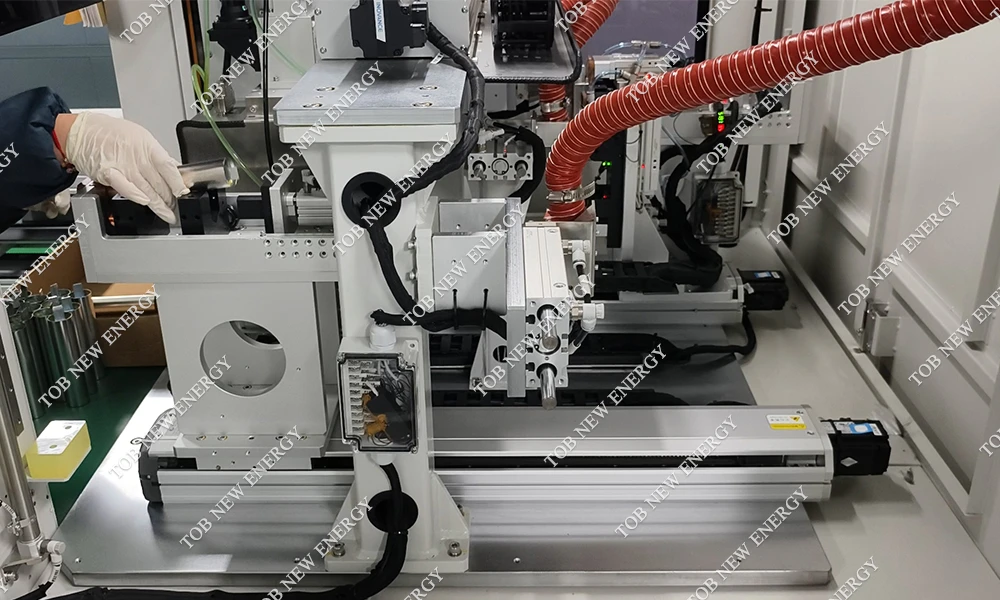
Can-bottom welding, 32140 tabless cell line. |
Engineering FAQ
Q1: What is the difference between NSS and AASS in this chamber?
NSS is the neutral salt spray test: a sodium chloride solution with the pH held between 6.0 and 7.0 before atomisation, and the collected mist landing between 6.5 and 7.2. AASS acidifies the same solution with acetic acid, so the liquid starts between 3.0 and 3.1 and the collected mist sits between 3.1 and 3.3. The chamber runs one at a time; what changes is the solution and the set points, not the machine.
Q2: Why does the collection have to run at least 16 hours?
Because hourly collection is noisy. The rate settles once the chamber is fully saturated and the nozzle has reached its steady pattern, and short readings swing well outside the 1 to 2 mL per 80 cm² per hour band for reasons that have nothing to do with the machine. Averaging over 16 hours or more gives a figure that can be defended in a report.
Q3: Can this chamber run a cyclic corrosion test?
No. The spray method is continuous, which covers ASTM B117, ISO 9227, JIS H8502 and IEC 60068-2-11 but not the dry-wet or humidity-freeze cycles used in automotive cyclic tests. If a drawing calls for cycling between salt fog, dry and humid stages, that is a different chamber and should be specified as such.
Q4: What water quality does it need?
The chamber and barrel can be fed from a water pipe automatically or filled by hand. If the supply carries noticeable impurities, fit a filter at the inlet before the water reaches the system; the standards assume the diluent does not add its own contaminants to the test.
Q5: What fits inside, and at what angle?
The working zone is 1200 x 1000 x 500 mm. Specimens sit on a flat indexing frame with an adjustable angle, tested face down, so mist settles on the surface instead of running off it. Fill the zone as far as the standard allows without letting parts shield each other, because a specimen that sits in another's shadow is not being tested.
Q6: Why is the cover pneumatic and water sealed?
A 600 L chamber full of salt fog has to keep that fog inside. The pneumatic closure gives an even clamping force around a large cover that no one could seat by hand consistently, and the water seal provides the gas-tight joint at the pressure the mist is generated. It also means the operator is not leaning over a wet gasket to close a lid.
Q7: What comes in the standard package?
Technical documents including the qualified certificate, user manual and warranty card; two bottles of NaCl; one air supply pipe; two fixture screws; two sealing silicon pieces; one water barrel set; and two measuring glass sets. Anything beyond that - a spare nozzle, extra funnels, a water filter - is quoted with the order rather than assumed.
Tell us the standard your drawing names, the specimen size and the test hours, and we will confirm the chamber configuration against it.
Email: tob.amy@tobmachine.com | Mobile phone: +86-18120715609
Reviewed by: Science Wang, Six Sigma Black Belt, Battery Lines | Last updated: 2026-11-12
If you are interested in our products and want to know more details,please leave a message here,we will reply you as soon as we can.






 subscribe to us