Chinese
 français
 Deutsch
 italiano
 español
 português
 Nederlands
 日本語
 한국의




- Home
- >
- Battery Tester
- >
- Battery and Supercapacitor Safety Tester
- >
- Temperature Humidity Test Chamber for Battery Cell Reliability Testing
Categories
Hot Products
Loading...
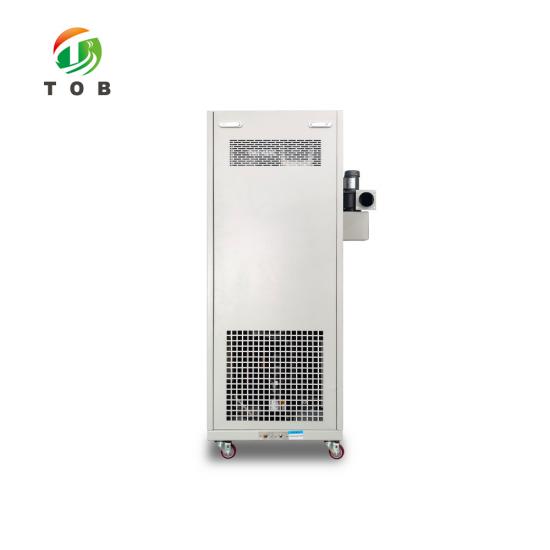
Temperature Humidity Test Chamber for Battery Cell Reliability Testing
Brand:
TOB NEW ENERGYitem no.:
TOB-TH-80Corder(moq):
1 setPayment:
L/C,T/Tproduct origin:
Chinashipping port:
XIAMEN
Temperature Humidity Test Chamber - TOB-TH-80C
80 L workspace, -40 to +150 °C and 20 to 98 %RH, with explosion-proof chains, smoke vent and tri-colour alarm for cell testing
Product Overview and Ideal Applications
A temperature humidity test chamber reproduces the climate a product will meet in service, at a temperature and humidity the laboratory can hold to a stated tolerance, so that a failure can be attributed to the product rather than to the weather. The TOB-TH-80C is an 80 litre chamber for cells, automotive parts, electrical and electronic products, components and materials. It runs high temperature, low temperature, high-low temperature cycling and damp heat profiles, either as a standards-based qualification or as continuous production screening.
It covers -40 to +150 °C and 20 to 98 %RH, with temperature held to ±0.5 °C fluctuation and ±2.0 °C deviation, humidity held to ±2 %RH fluctuation, and a temperature gradient no larger than ±1 °C across the workspace once conditions have stabilised. Heating averages 1 to 3 °C per minute and cooling 0.7 to 1 °C per minute over the full range, both non-linear and both quoted without load.
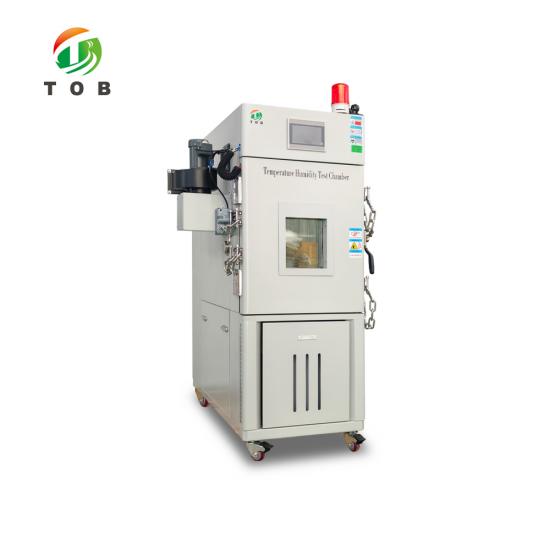
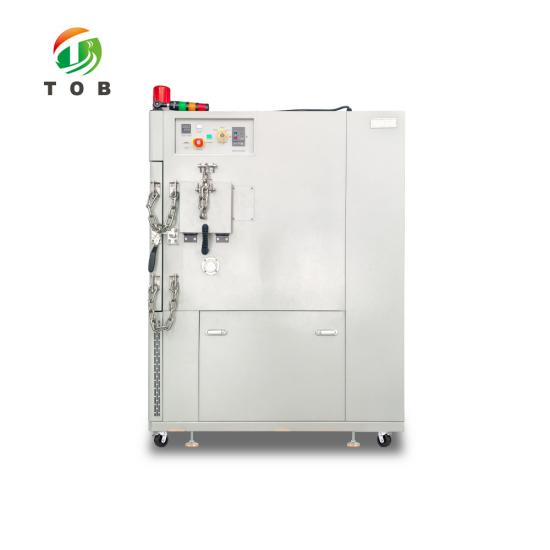
What separates this cabinet from a general-purpose climatic chamber is what happens when a cell fails. The door carries two explosion-proof chains, the chamber has a smoke exhaust port and a tri-colour alarm lamp on the panel, and a mechanical pressure balance port opens on its own once internal pressure reaches its set point, so the cabinet never has to survive the event as a sealed pressure vessel. Two insulated shelves and a single 50 mm test hole with silicone plug and stainless steel cover complete the working space.
Ideal for:
- Cell manufacturers and test laboratories running high and low temperature exposure, temperature cycling or damp heat on lithium-ion, sodium-ion and solid-state cells
- Automotive part and module validation, where a component has to survive the same profile as the vehicle it sits in
- Electrical and electronic products, components and materials tested to GB/T 2423 type-test conditions
- R&D groups screening new chemistries for capacity fade, SEI degradation and gas evolution across a temperature sweep
- Incoming and in-process quality control, where the same profile is repeated on every lot and the chamber has to hold it unattended overnight
- Materials, coatings and separator suppliers who need a controlled climate rather than a bench-top oven
This is a constant-climate chamber, not a thermal shock chamber. It travels between setpoints at 1 to 3 °C per minute when heating and 0.7 to 1 °C per minute when cooling, which is the correct speed for a qualification soak and for damp heat; it is not a two-zone air-transfer machine and it will not deliver the seconds-scale transition of a thermal shock test. If your standard calls for rapid transfer between two fixed temperatures, the temperature cycling tester for battery safety testing is the closer instrument.
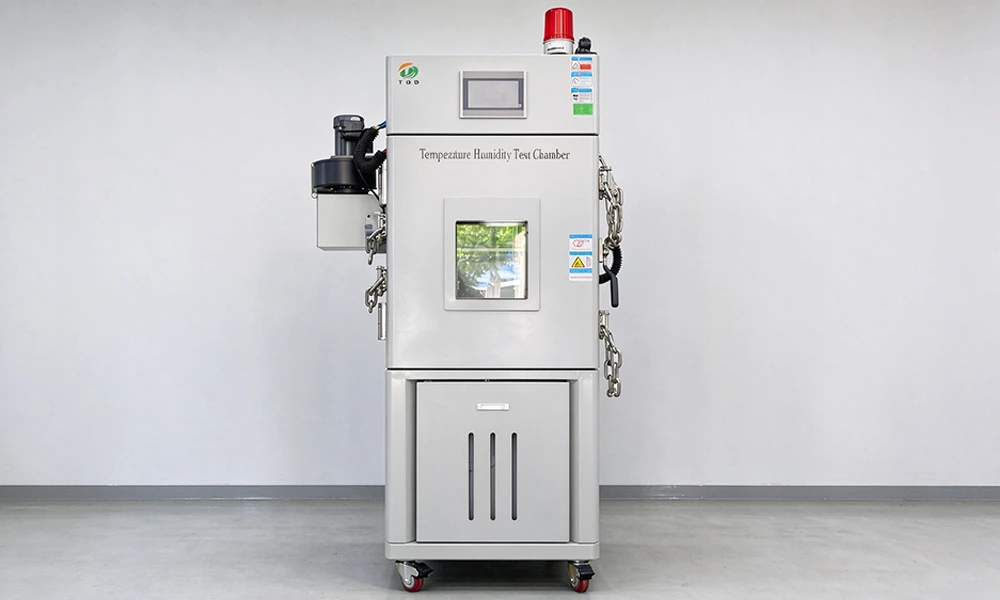
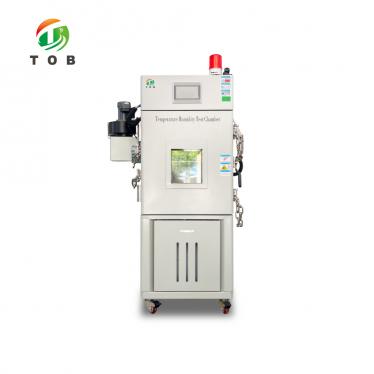
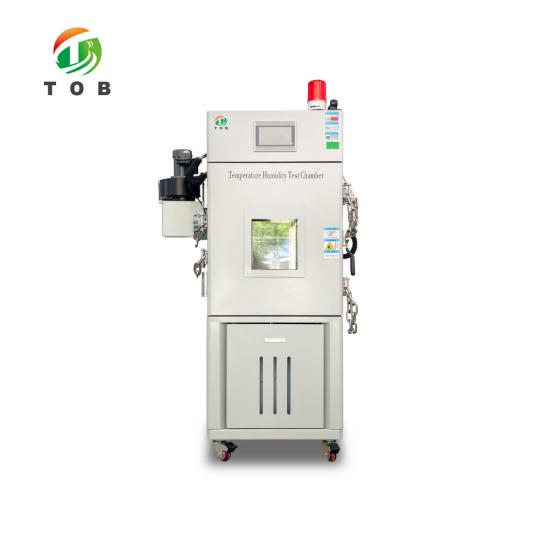
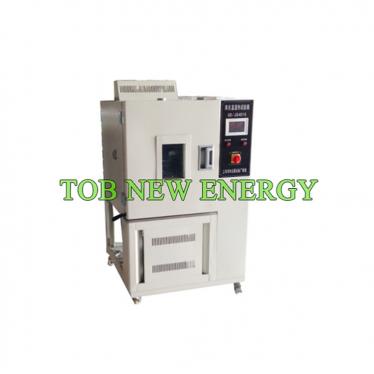
TOB-TH-80C on the test floor: 650 mm wide, 1650 mm high and 1270 mm deep, carried on four lockable casters.
Complete Specifications
The tables below are the chamber as it is built, not a catalogue summary. Capacity and utility figures come first, then temperature, then humidity, then construction, then the standards the profiles are drawn from. Every rated figure is quoted under the test conditions stated in the first table - an empty workspace, no specimen weight and no specimen heat load - because a chamber that reaches a setpoint with 20 kg of cells inside it and one that reaches it empty are two different machines.
1. Capacity, Dimensions and Utilities
| Parameter | Value |
|---|---|
| Effective volume | 80 L |
| Inner dimensions | 400 mm (W) x 500 mm (H) x 400 mm (D) |
| Overall dimensions | 650 mm (W) x 1650 mm (H) x 1270 mm (D) |
| Net weight | 350 kg |
| Noise level | ≤ 70 dB(A) |
| Power supply | 220 V, 50 Hz, single phase, 4.85 kW |
| Cooling method | Air cooled |
| Rated test conditions | Ambient 5 to 30 °C, ambient humidity 10 to 85 %RH, empty workspace: no specimen weight and no specimen heat load |
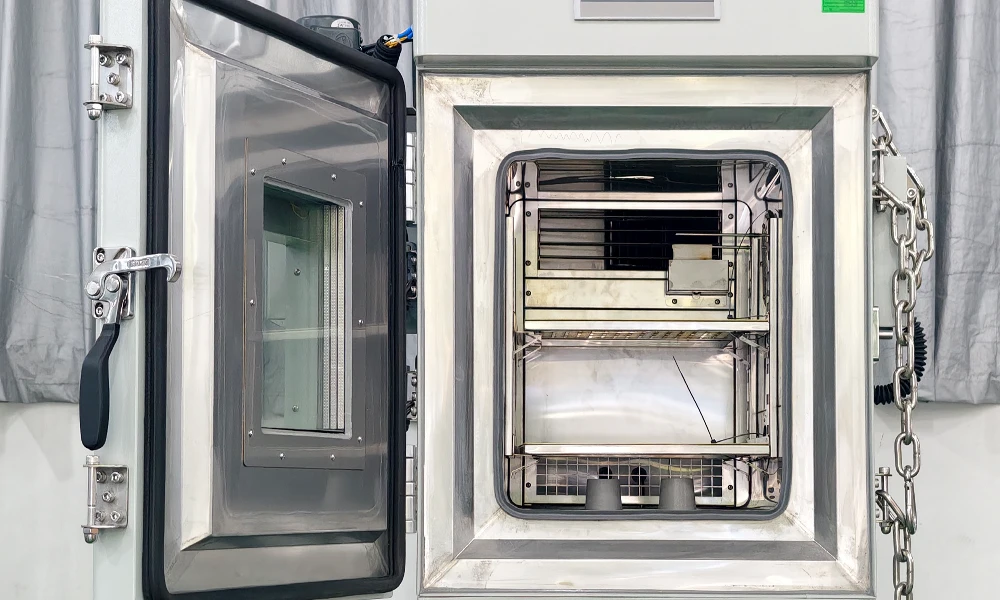
Inside the 400 mm wide, 500 mm high, 400 mm deep workspace: 1.0 mm SUS 304 walls, two insulated shelves rated above 20 kg each, and the supply plenum that feeds air down through the load.
2. Temperature Performance
| Parameter | Value |
|---|---|
| Display resolution | 0.01 °C |
| Temperature range | -40 to +150 °C, controllable over the whole range |
| Adjustable control precision | ±0.1 °C |
| Fluctuation | ≤ ±0.5 °C - the change at any one point over a stated period, after conditions have stabilised |
| Deviation | ≤ ±2.0 °C - the gap between the highest or lowest measured temperature and the nominal setpoint, after stabilisation |
| Gradient | ≤ ±1 °C - the largest difference between the mean temperatures of any two points in the workspace, after stabilisation. The current test-method revision expresses this as a temperature gradient, replacing the uniformity figure used in older datasheets |
| Heating rate | 1 to 3 °C per minute, full-range average, non-linear, no load |
| Cooling rate | 0.7 to 1 °C per minute, full-range average, non-linear, no load |
3. Humidity Performance
| Parameter | Value |
|---|---|
| Display resolution | 0.1 %RH |
| Humidity range | 20 to 98 %RH, controllable over the whole range |
| Adjustable control precision | ±0.1 %RH |
| Fluctuation | ≤ ±2 %RH, after conditions have stabilised |
| Deviation | Above 75 %RH: ≤ +2 / -3 %RH. Up to 75 %RH: ≤ ±5 %RH. Both after stabilisation |
| Humidification water | Pure water or purified tap water with insulation resistance above 50 MΩ |
| Water tank | 20 L built in, automatic refill to the humidifier, level gauge and low-level alarm |
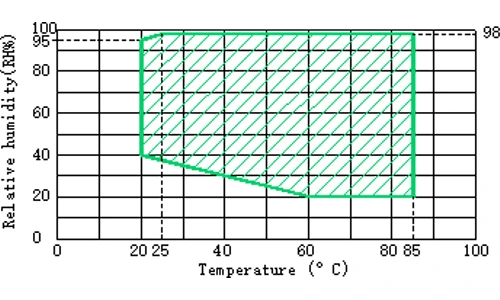
The temperature and humidity control zone of the TOB-TH-80C: 20 to 98 %RH held across the usable temperature span, not a single 85/85 point.
4. Construction and Materials
| Item | Specification |
|---|---|
| Support structure | Steel frame |
| Outer shell | Cold-rolled steel sheet, powder coated and baked at high temperature |
| Inner chamber | 1.0 mm SUS 304 stainless steel throughout |
| Insulation | 100 mm polyurethane (PU) foamed insulation |
| Door | Single leaf, single window |
| Observation window | Multi-layer vacuum glass, 380 mm (W) x 450 mm (H), electrically heated with automatic adjustment against frost and condensation |
| Interior lighting | LED lamp mounted inside the observation window |
| Shelves | 2 layers, electrically insulated, average load above 20 kg per layer |
| Test hole | One 50 mm diameter port on the side, with silicone plug and stainless steel cover |
| Pressure balance port | Mechanical, unpowered and maintenance free; opening pressure adjustable on site; opens automatically to equalise inside and outside pressure |
| Door seal | Imported silicone gasket on the door frame, single continuous seal |
| Casters | 4 adjustable casters with locking function, for levelling and positioning |
| Controller panel | Touch controller, power switch, lighting switch, over-temperature protector, RS-485 or LAN interface |
| Explosion protection | Explosion-proof chains, smoke exhaust port, tri-colour alarm lamp |
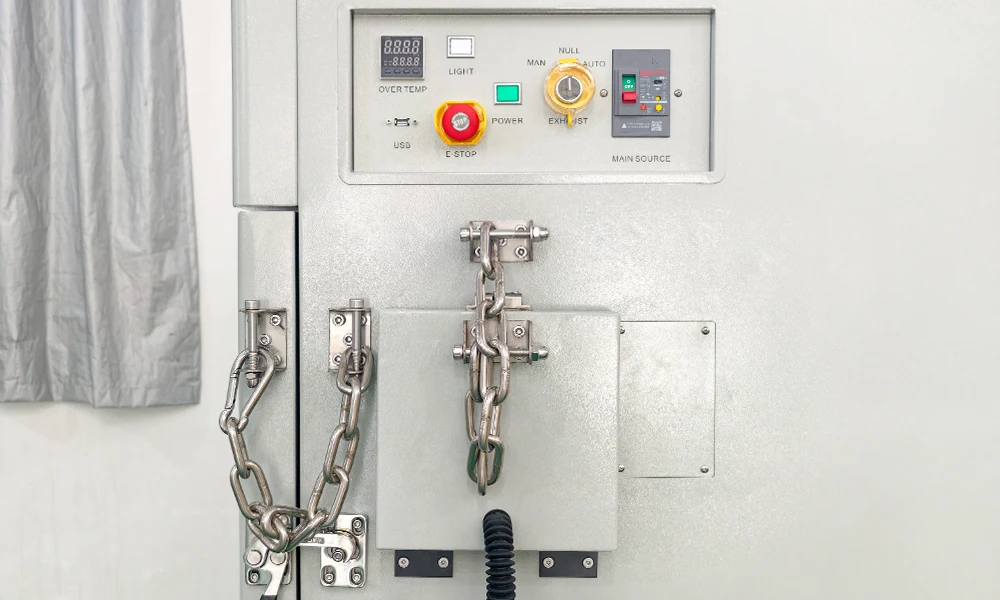
The right-hand panel carries the TFT touch controller, the power and lighting switches, the over-temperature protector and the RS-485 port; the explosion-proof chains are mounted beside it at the door edge.
5. Standards the Profiles Are Drawn From
| Standard | Test covered |
|---|---|
| GB/T 2423.1-2008 | Test A: Cold |
| GB/T 2423.2-2008 | Test B: Dry heat |
| GB/T 2423.3-1993 | Test Ca: Damp heat, steady state |
Overall dimensions are approximate and are confirmed against the final drawing before shipment. Inner dimensions are the clear working volume; allow for the plenum depth behind the rear panel and for door swing in front. The standards listed are the profile sources quoted in the datasheet - if your qualification runs to IEC 60068-2-1, -2-2, -2-30 or to a customer-specific profile, send it with the enquiry and we will confirm whether the chamber holds it.
Electrical and Mechanical Components
The parts below decide how long the chamber stays inside its tolerance band, and how quickly it recovers after a door opening or a load change. Where the datasheet names a brand it is printed; where it does not, the cell is left empty rather than filled with a guess.
| Component | Specification | Brand or model |
|---|---|---|
| Compressor | Hermetic, air cooled, R404A | Bock or equivalent |
| Refrigerant | R404A | - |
| Condenser | High-efficiency shell-and-tube type | - |
| Heat exchanger | High-efficiency plate type (ST) | SWEP, Sweden |
| Evaporator | Multi-section, hydrophilic film fin, thickened fin stock | - |
| Heating element | Stainless steel finned tube, nickel-chromium alloy wire | - |
| Heating and humidification switching | SSR solid state relay, contactless switching from the controller output | - |
| Humidifier | Electric element steam generator, 20 L built-in tank, low-water alarm and dry-burn protection, removable for cleaning | - |
| Circulating fan | Multi-blade centrifugal impeller, aluminium blades rated for high and low temperature | - |
| Fan motor | Low-pressure asynchronous motor | Taiwan brand |
| Air volume control | Variable frequency drive, speed set by the controller output | - |
| Humidity measurement | PT100 dry bulb sensor | - |
| Controller | TFT true-colour LED LCD touch screen | Brand controller |
| Communication | RS-485 standard, LAN optional | - |
| Door gasket | Silicone rubber strip | Imported |
| Casters | 4 adjustable casters with locks | - |
| Protection devices | Independent adjustable over-temperature protector, no-fuse breaker, heater over-temperature switch, compressor overload and overheat, compressor high and low pressure, system over-current, humidifier over-temperature switch, low-water protection | - |
To meet delivery requirements the supplier reserves the right to substitute a component with an equivalent-grade part, provided the rated performance in the tables above is unchanged. Tell us at enquiry stage if your own qualification or spare-parts policy fixes a brand, and it will be confirmed in the order specification.
Why a Failing Cell Changes the Chamber Specification
Most environmental chambers are bought for products that fail politely: a plastic housing yellows, a solder joint cracks, a display fogs. A lithium-ion cell does not fail politely. Above a certain temperature it starts an exothermic chain that vents electrolyte as flammable gas, and inside a sealed 80 litre box that gas has nowhere to go. The cabinet then becomes the pressure vessel, and the door - the largest unsupported panel on the machine - becomes the weakest point. Every mechanical feature listed under explosion protection exists because of that sequence, not because a catalogue needed a bullet list.
The two explosion-proof chains are the first layer. They hold the door against a pressure pulse instead of letting it swing open into the room, which is the difference between a vented cell and a projectile. The smoke exhaust port is the second: it gives the gas a defined path out of the workspace at a controlled point rather than through the door seal. The tri-colour lamp on the panel is the third, and it is the one that matters for overnight runs - the chamber is usually unattended when a cell goes, and a lamp that can be read from across the laboratory is worth more than a log entry nobody is watching.
The pressure balance port works in the other direction, and it is the feature most often left out of a cheap cabinet. A damp heat profile from 20 °C to 85 °C and 85 %RH changes the pressure inside the workspace continuously as the air heats and as water vapour is injected. Without a balance port the door seal absorbs that load, and the seal is a wear item: it hardens, it takes a set, and a chamber that passed its validation in year one starts leaking humidity at the corners in year three. The port here is mechanical and unpowered, its opening pressure is adjustable on site, and it needs no maintenance schedule of its own.
Gradient is the number to read carefully when comparing datasheets. Older sheets quote a uniformity figure, taken as the spread between the hottest and coldest point at one moment; current test-method revisions replaced it with a temperature gradient, which compares the mean temperature of any two points over a period. The two are not interchangeable, and a supplier who switched methods without saying so can appear to have improved a chamber that has not changed. The TOB-TH-80C quotes ±1 °C gradient together with ±2.0 °C deviation, so both the spatial spread and the offset from setpoint are on the page.
The +150 °C ceiling is there for the parts of a qualification that are not cell storage. Cell datasheets usually stop at 60 to 85 °C, but a module or a pack-level programme often includes a dry-out step, a pre-conditioning bake, or the high-temperature leg of an automotive profile that sits above 100 °C. A chamber rated to 130 °C has to be run flat out to reach 120 °C, with no margin left for recovery after a door opening; the extra 20 °C here is headroom, not a headline.
Key Engineering Characteristics
- Full-range control, no dead band at the ends. -40 to +150 °C and 20 to 98 %RH are quoted as controllable across the whole span, with adjustable control precision of ±0.1 °C and ±0.1 %RH, rather than as a narrow band in the middle of the range.
- Contactless switching on heat and humidity. The controller drives both the heater and the humidifier through SSR solid state relays. There is no contactor arcing on every switch cycle, which matters on a profile that modulates for days, and the switching resolution is fine enough to hold ±0.5 °C fluctuation rather than hunting around the setpoint.
- Hydrophilic film evaporator for dehumidification. Dehumidification is done by cooling, not by desiccant: air passes an evaporator below its dew point and the water drops out. The fin stock carries a hydrophilic coating, so condensate slides off instead of bridging the fin gaps, which is where a plain aluminium coil loses efficiency as the gaps fill.
- Variable air volume, not a fixed fan. Supply is from a top plenum down through the load, with return at the bottom, and the impeller speed is set by a frequency drive from the controller. Air volume is therefore a parameter that can be matched to how tightly the workspace is packed, which is the practical lever on gradient.
- 100 mm PU insulation and a heated window. The wall build is 100 mm of foamed polyurethane between a 1.0 mm SUS 304 liner and a powder-coated steel shell. The observation window is multi-layer vacuum glass with electric heating that adjusts automatically, so it stays clear at -40 °C and at 85 %RH instead of frosting on the inside or condensing on the outside.
- Two independent over-temperature devices. The controller has its own limit, and a separate adjustable temperature protector cuts the heater independently. One device protects the profile; the other protects the specimen when the controller misreads.
- Water quality is a specified input, not an afterthought. The humidifier asks for water with insulation resistance above 50 MΩ, and the 20 L tank has a level gauge and a low-level alarm with automatic refill. Scale and conductivity are the two failure modes that turn a humidity spec into a service call.
Operating Recommendations, Maintenance and Safety
1. Before and during a run
- Check the water first. Fill the 20 L tank with pure water or purified tap water, confirm the level gauge reads above the low-level line, and confirm the supply meets the 50 MΩ insulation resistance the humidifier asks for. The low-level alarm protects the heater, not the experiment.
- Load to the stated limit: keep the specimen within 2/5 of the inner volume and within 2/5 of any shelf area. Beyond that the air cannot circulate as designed and the ±1 °C gradient is no longer the number you are running to.
- Route sensor leads and power cables through the 50 mm test hole, then refit the silicone plug and the stainless steel cover. An open test hole is a permanent humidity leak and it will show up as a humidity deviation long before anyone finds the cause.
- Set the independent over-temperature protector above the profile maximum and below the temperature at which the specimen is damaged. It is a separate device from the controller, and setting it to the same value as the setpoint defeats the redundancy.
- Let the chamber stabilise before starting the soak clock. Fluctuation, deviation and gradient are all quoted after stabilisation; a timer started at the moment the setpoint is entered measures the pull-down, not the test.
- Record the room conditions. The ratings assume 5 to 30 °C and 10 to 85 %RH around the cabinet, and an air-cooled chamber in a 35 °C room will not deliver its quoted cooling rate.
2. Maintenance and safety
- Humidifier. Drain and clean it on a fixed schedule. Scale is the usual cause of a humidity response that gets slower month by month, and it is visible long before it becomes a fault code.
- Water tank and supply. Refill with the specified water quality, and do not leave the tank dry for long periods. A dry tank with the humidifier enabled is what the low-water protection exists for.
- Condenser. Keep the air-cooled condenser fins clear of dust. A blocked condenser shows first as a longer cooling time and only later as a high-pressure trip.
- Door seal. Wipe the silicone gasket and the door frame, and check for hardening or a set at the corners. A leaking seal costs humidity and puts the pressure balance port to work on every cycle.
- Test hole and pressure balance port. Confirm the plug is fitted after every run, and check that the balance port opens freely. It is mechanical and unpowered, which also means nothing reports it if it sticks.
- Casters and levelling. Lock all four casters before a run. A chamber that can roll is a chamber that can move a door seal out of alignment.
- After a cell event. Do not open the door immediately. Let the chamber ventilate through the smoke exhaust port, confirm the panel lamp state and the controller log, then open with the room ventilated and the appropriate PPE. Treat the residue as contaminated material, not as a failed sample.
Two instruments usually sit next to this chamber in a cell safety line: the TOB-8102 temperature control battery short circuit tester for the electrical abuse case, and the TOB-SKT-10 battery mechanical shock tester for the mechanical one. Between them they cover the three abuse categories that most cell qualification programmes run before a design is released.
Engineering FAQ
Q1: Cell datasheets usually stop at 60 or 85 °C. Why pay for +150 °C?
Because the chamber is rarely used at its ceiling, and that is the point. A cabinet rated to 130 °C asked to hold 120 °C is running at its limit, with nothing in reserve to recover after a door opening, and a longer pull-down before every high-temperature leg. The 20 °C of headroom is what lets the same unit also run a dry-out step, a pre-conditioning bake, or the high-temperature portion of a module or automotive profile that sits above 100 °C. If your programme never exceeds 85 °C, the ceiling is not the reason to buy this chamber - the explosion protection and the gradient are.
Q2: There is only one 50 mm test hole. Is that enough for my wiring?
One 50 mm port carries a realistic bundle of thermocouple, sense-lead and load cable, provided the bundle is built as a bundle with a sealed gland rather than fed through loose. If your setup needs separate power and measurement feed-throughs, say so at enquiry stage: the port count is fixed in the datasheet, and adding a second port is a build-time decision, not a field modification. The plug and the stainless steel cover are supplied with the single port as standard.
Q3: The old sheet said uniformity. This one says gradient. Which is better?
Neither is better; they measure different things and the test-method revision changed the definition. Uniformity compared the hottest and coldest point at a single moment, which is sensitive to where the sensor sits and to how recently the door was opened. Gradient compares the mean temperatures of any two points over a period, which is stable enough to compare one chamber with another. The trap is a datasheet that quietly switches method and looks to have improved. Here the gradient is ±1 °C and the deviation is ±2.0 °C, both stated, so you can map the figures onto whichever definition your own standard uses.
Q4: Can it hold 85 °C / 85 %RH for weeks?
85 °C and 85 %RH sit inside both rated ranges, 20 to 98 %RH and -40 to +150 °C, and the humidity deviation at that point is quoted as ≤ +2 / -3 %RH, which is the tighter of the two bands. What determines whether it holds for weeks is not the specification but the water: the tank has to be refilled with water at the specified quality, the humidifier has to stay free of scale, and the room has to stay inside 5 to 30 °C and 10 to 85 %RH. Long damp heat runs are a consumable-and-maintenance question, not a capability question.
Q5: What actually happens if a cell vents inside the chamber?
The gas leaves the cell, the pressure in the workspace rises, the mechanical balance port opens at its set pressure and the smoke exhaust port gives the gas a defined path out. The two explosion-proof chains hold the door rather than letting the pressure pulse throw it open. The tri-colour lamp on the panel signals the event to the room, and the independent over-temperature protector cuts the heater if the release also raises temperature. The chamber is designed to contain the event and stay serviceable, not to be a pressure vessel or a fire test rig - if your protocol requires a fire-suppression system or gas scrubbing, that is a different specification and it should be raised before the order.
Q6: Do I need the LAN option, or is RS-485 enough?
RS-485 is enough for one chamber talking to one PC or to a lab data logger, and it is the standard interface on the panel. LAN is the option to take when the chamber has to sit on a shared network with several instruments, when the profile and the log have to land in a central system without a dedicated PC, or when the unit is remote enough that someone will want to look at it without walking to it. Decide it at order stage - the interface is specified with the controller, and retrofitting means changing the panel.
Send us the cell format, the load you intend to put inside the 80 litres, and the standard or customer profile you are qualifying to, and we will tell you whether the shelf layout and the single test hole are enough, or whether the build needs a second port before it leaves the factory.
tob.amy@tobmachine.com | +86 181 2071 5609
Reviewed by: Science Wang, Six Sigma Black Belt, Battery Lines | Last updated: 2026-10-23
If you are interested in our products and want to know more details,please leave a message here,we will reply you as soon as we can.

 subscribe to us