Chinese
 français
 Deutsch
 italiano
 español
 português
 Nederlands
 日本語
 한국의




- Home
- >
- Coin Cell Equipment
- >
- Lab Coater
- >
- 800mm Stroke Lab Slot Die Coating Machine
Categories
Hot Products
Loading...

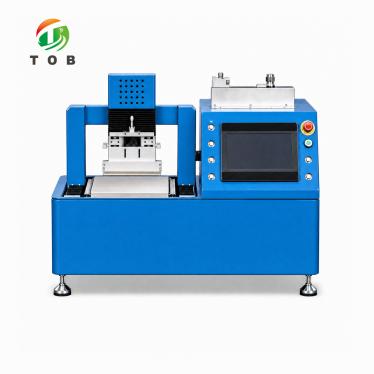
800mm Stroke Lab Slot Die Coating Machine
Brand:
TOB NEW ENERGYitem no.:
TOB-EFCA800X100order(moq):
1 setPayment:
L/C, T/Tproduct origin:
Chinashipping port:
XIAMEN
800mm Stroke Lab Slot Die Coating Machine - TOB-EFCA800X100
800 mm of travel at 100 mm of coating width, on a vacuum plate heated to 150 °C
Product Overview and Ideal Applications
The TOB-EFCA800X100 is a flat-bed slot die coater built around one long, narrow pass. A stainless steel die travels 800 mm over a vacuum-held substrate while a high precision syringe pump feeds slurry into it, so a wet film of constant thickness is laid down on a sheet rather than on a moving web. It is a research instrument for high temperature film work: ceramic thin films, crystal and special nano films, and battery electrode coatings.
The machine is four subsystems working from one controller: the die, the heated vacuum plate, the feeding system and the PLC. The plate is an aluminium vacuum chuck 885 mm long, held flat and heated from room temperature to 150 °C by a digital controller at ±2 °C. The die gap is set with a micrometer over 0 to 5 mm, coating speed is 0 to 120 mm/s set steplessly on the touch screen, and dry film thickness falls in the 10 to 250 μm band. Stroke and width are the two numbers that define the model: 800 mm of travel, 100 mm of coating.
Ideal for:
- Ceramic thin films, where a green layer has to be cast flat over a long sample and dried without cracking
- Crystal and special nano thin films that need a repeatable wet thickness in the micrometre range over a strip, not a square
- Battery electrode slurries on copper or aluminium foil, including LFP, where 0 to 120 mm/s is set for that rheology
- Long-strip samples, where the 800 mm stroke lets one pass cover a specimen that a 300 mm machine would have to coat in two
- Solid-state and sulfide systems run inside a glovebox, where the whole machine has to fit an antechamber and be operated through ports
- Labs that need to change slurry viscosity from one week to the next without changing machine, using the shim set rather than a new die
This is a research coater, not a production line. It lays one film per pass on a stationary sheet, and the 100 mm width is a deliberate limit: a narrow die keeps slurry demand, edge bead and drying stress inside what a laboratory can control. If your samples are square and under 300 mm, the shorter TOB-EFCA300X200 slot die coating machine coats the same chemistry at 200 mm width and is the cheaper way to get there.
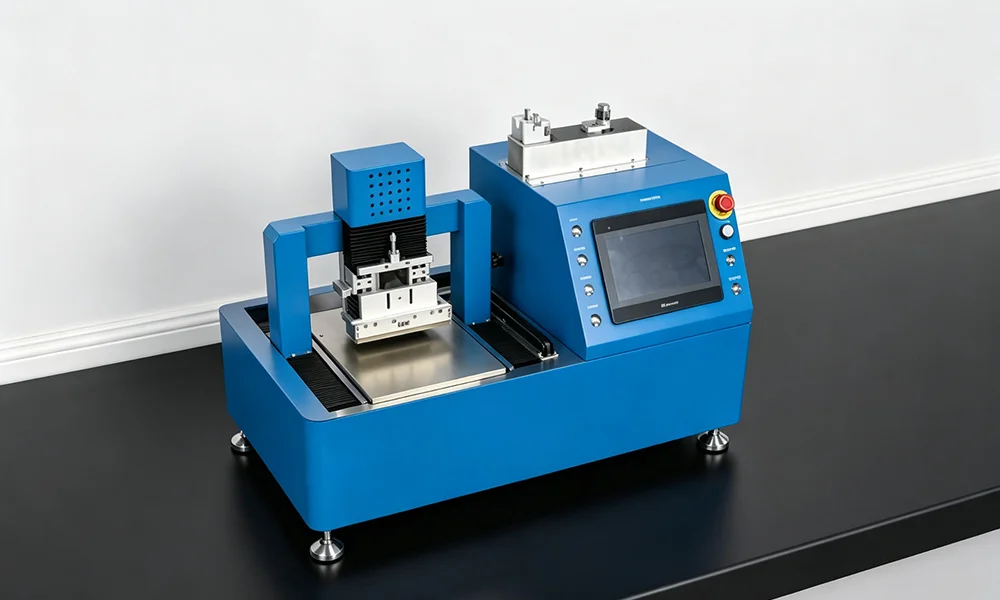
TOB-EFCA800X100 on a battery laboratory bench: 1100 mm long, 600 mm wide and 800 mm high, with the 885 mm vacuum plate running front to back under the die.
Complete Specifications
One model, three tables: what the die does, what the plate does, and what the machine needs from the room. Every figure below is a quoted rating, not a best case - the coating speed is stated for an LFP slurry because speed and slurry rheology are not separable.
1. Coating and Die
| Parameter | TOB-EFCA800X100 |
|---|---|
| Coating method | Slot die coating, flat bed |
| Effective stroke | 800 mm |
| Coating width | 100 mm |
| Coating speed | 0 to 120 mm/s, quoted for an LFP slurry |
| Coating drive | Servo motor; speed set steplessly on the touch screen |
| Dry film thickness | 10 to 250 μm |
| Coating accuracy | ±3 μm (optional 1 μm dial indicator) |
| Die adjustment | Micrometer adjustment |
| Die to plate distance | 0 to 5 mm, adjustable |
2. Plate, Heating and Feeding
| Parameter | TOB-EFCA800X100 |
|---|---|
| Vacuum plate | Aluminium vacuum plate |
| Vacuum plate size | L 885 mm x W 150 mm x H 29 mm |
| Substrate fixing | Vacuum hold |
| Vacuum source | External, supplied by the user |
| Maximum substrate heating | Room temperature to 150 °C |
| Temperature control | Digital display controller, ±2 °C |
| Feeding method | High precision syringe pump, capacity selectable |
| Shims | Multiple thickness options, to suit different slurry viscosities |
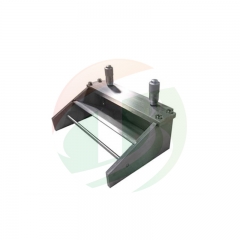
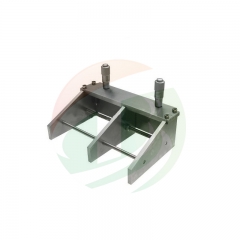
| Die material | High performance stainless steel |
3. Utilities and Physical Data
| Parameter | TOB-EFCA800X100 |
|---|---|
| Power supply | 220 V / 50 Hz |
| Power | 4 kW |
| Weight | 200 kg |
| Dimensions | L 1100 mm x W 600 mm x H 800 mm |
| Control | PLC with large touch screen; stroke, speed and temperature set as parameters |
External dimensions are approximate and are confirmed against the final drawing before shipment. The vacuum pump is not part of the machine: the vacuum source is external and has to be provided on site. Coating speed is quoted for an LFP slurry because a low-viscosity solvent system and a high-solids aqueous slurry do not run at the same speed through the same die gap.
Electrical and Mechanical Components
The parts that decide whether the film stays inside ±3 μm are listed below by function. Brand and model for the servo drive, the PLC, the syringe pump and the controller are fixed in the order specification; they are not printed here as a catalogue claim.
| Component | As supplied |
|---|---|
| Coating die | High performance stainless steel slot die, 100 mm coating width, with a selectable shim set |
| Die adjustment | Micrometer adjustment over a 0 to 5 mm die-to-plate gap |
| Motion | Servo motor drive, 800 mm travel, stepless 0 to 120 mm/s |
| Vacuum plate | Aluminium plate, L 885 mm x W 150 mm x H 29 mm |
| Heating | Plate heater, room temperature to 150 °C, digital controller at ±2 °C |
| Feeding | High precision syringe pump, capacity selectable, integrated with the controller so feed rate and stroke start together |
| Control | PLC with a large touch screen; stroke, speed and plate temperature set as parameters |
To meet delivery requirements the supplier reserves the right to substitute a component with an equivalent-grade part, provided the rated performance in the tables above is unchanged. Tell us at enquiry stage if your own qualification or spare-parts policy fixes a brand, and it will be confirmed in the order specification.
Key Engineering Characteristics
- Large-area plate heating, held at ±2 °C. The whole 885 mm plate is heated, not a zone in the middle, so a film laid down at the start of the pass dries under the same conditions as one laid down at the end. The ceiling is 150 °C with a digital controller.
- Servo-driven stroke at stepless speed. The die is carried by a servo motor and the speed is set anywhere in 0 to 120 mm/s from the touch screen. Hand drawing ties wet thickness to how fast the operator happens to push; that is why two people produce two different samples from one slurry.
- Micrometer die gap over 0 to 5 mm. Die-to-plate distance is set on a micrometer rather than by feel, and ±3 μm coating accuracy is quoted with an optional 1 μm dial indicator for labs that want to read the gap rather than trust the scale.
- Vacuum hold from an external source. Substrates are held flat with no tape and no clamps, so nothing touches the wet edge. The vacuum source is external, which is also what makes a glovebox installation practical.
- Stainless steel die for aggressive chemistries. The die is high performance stainless steel, which matters when the slurry is solvent-based, acidic or contains a binder that attacks aluminium.
- A shim set instead of a second die. Wet thickness is set by shim thickness as much as by gap, so a viscosity change is answered by changing a shim rather than by buying another die. Multiple thickness options are available with the machine.
- Feeding tied to motion on one PLC. The syringe pump is integrated with the controller, so feed rate and stroke start as one action. A pump started by hand half a second before the die moves leaves a bead at the leading edge.
Why an 800 mm Stroke at 100 mm Width
Stroke and width are two independent decisions, and this machine takes both of them to an extreme that suits a particular kind of sample. The 800 mm stroke exists for specimens longer than the 300 mm family can cover in one pass. The 100 mm width exists because a narrow film is easier to dry evenly, wastes less slurry per trial and keeps edge bead inside what a laboratory can trim by hand. Together they make a long, narrow strip machine - not a scaled-up version of the square-plate coaters, and not a substitute for one.
Length changes the plate, and the plate changes the power. The vacuum chuck here is 885 mm long against 385 mm on the 300 mm models, so the heater has more than twice the area to hold at ±2 °C, and the mass that has to stay flat while it expands is correspondingly larger. That is where the 4 kW and the 200 kg come from: the 300 mm machines run 2.5 kW at 110 kg. A long plate that is not heated evenly puts a thickness gradient into the film along the stroke, which is exactly the defect a slot die is bought to avoid.
A narrower die also changes the feeding problem. At 100 mm wide, the volumetric demand per unit of speed is half of what a 200 mm die asks for at the same wet thickness, so the pump has to be accurate at low flow rather than merely large. That is why the machine carries a high precision syringe pump with selectable capacity and why the shim set matters more here than on a wide die: the same slurry that runs clean through a 200 mm slot can starve or streak through a 100 mm one if the gap is set by habit instead of by viscosity.
Holding a long foil flat is a vacuum problem, not a clamping problem. Over 885 mm, a copper foil with roll memory will bridge if it is only held at the edges, and the die will ride over that bridge and leave a thin streak the length of the pass. The plate holds the substrate by vacuum and the source is external, which lets the lab size the pump to the substrate: a thin foil needs less flow than a rigid ceramic green tape, and a glovebox installation usually wants the pump outside the box.
The limitation is equally clear. One pass covers 800 mm by 100 mm, so the maximum area per film is 0.08 m², and anything wider than 100 mm has to be coated in lanes or on a different machine. If your work is square samples under 300 mm, the extra stroke is mass you move on every pass without using it. The honest split is: long strips and narrow electrodes here, square plates on the 300 mm family, and continuous web production on a roll-to-roll line.
Operating Recommendations, Maintenance and Safety
1. Before and during a coating run
- Wipe the plate and the die face with a soft cloth and alcohol. A single dried slurry flake under the die shows up as a longitudinal stripe for the whole 800 mm.
- Lay the substrate on the vacuum plate, switch the vacuum on and check that the sheet is flat to all four edges before going further. Over 885 mm a curled foil bridges in the middle even when the corners look sealed.
- Set the die-to-plate gap on the micrometer, anywhere in 0 to 5 mm, and lock it.
- Fit the shim that matches the slurry viscosity and fill the syringe pump to the capacity you need. Changing shim after the die is hot is a two-person job that should not be a two-person job.
- Enter stroke and speed on the touch screen. Both are stepless, so the number written in the lab book is the number the machine runs.
- Bring the plate to temperature and let the controller settle before the pass. The film thickness you get depends on the plate being at setpoint when the die arrives, not when it leaves.
2. Maintenance and safety
- Cleaning. Wipe frequently with a soft cloth dampened with alcohol and keep the plate and the die clean. Dried slurry is the most common cause of a streak that looks like a die fault.
- Lubrication. Oil the moving parts so the carriage keeps running smoothly; a dry guide shows up first as a speed ripple and then as a thickness wave.
- Long idle periods. Clean the moving surfaces, then spray them with anti-rust oil before the machine is stored.
- Fasteners. Check screws, nuts, pins and other fasteners on a schedule. A loosened fastener on a coating machine is both a quality risk and a personal-injury risk.
- Hands out of the stroke. During operation never put hands or any other part of the body into the moving area or the working danger zone. One operator only - two people on one machine is how the second person gets hit by the first person's start command.
- No unauthorised dismantling. External technicians and personnel who are not designated by the customer must not take the machine apart. Service is by arrangement with us.
Two other members of this family sit outside the page: the TOB-EFCB300X200 dual layer slot die coating machine for two wet layers in one pass, and the TOB-JYCM-800 lab slot die coater, which also travels 800 mm but carries a 200 mm wide plate in a much lighter 70 kg frame.
Engineering FAQ
Q1: Why pair an 800 mm stroke with only 100 mm of coating width?
Because the two numbers answer different questions. The stroke is set by the longest specimen you need to coat in a single pass; the width is set by the widest film your drying and handling can support. A long narrow strip is the shape of a lot of real work - electrode strips cut for a coin cell or a small pouch, ceramic tapes for a bend test, nano films characterised along one axis - and it is a shape that square-plate coaters handle badly, because they force you to coat area you then throw away.
Q2: What does a shim change, and how many do I need to start with?
A shim sets the slot opening inside the die, which together with the die-to-plate gap and the coating speed fixes the wet film thickness. On a 100 mm wide die the slot is short enough that the shim, rather than the pump, becomes the first control on thickness: too thin a slot starves a high-viscosity slurry and leaves streaks, too thick a slot floods the bead at the leading edge. Start with the shim range that covers your lowest-viscosity slurry and add the thicknesses you actually use - the set is a running stock, not a one-off purchase.
Q3: Why is the vacuum source external instead of built in?
Three reasons, all practical. A pump inside the frame adds vibration next to the die, and vibration is thickness noise. It adds heat into a machine that is already heating a plate to 150 °C. And for a glovebox installation, a pump outside the box is the only arrangement that does not put a motor and its exhaust into the atmosphere you are trying to keep clean. The trade-off is that the vacuum line and the pump become part of your setup, so specify the pump when you specify the machine.
Q4: Why 4 kW here when the 300 mm models need 2.5 kW?
Because the plate is the load. The vacuum plate on this machine is 885 mm long against 385 mm on the 300 mm models, so the heated mass and the radiating area are both more than doubled, and the machine also carries it at 200 kg against 110 kg. The extra power is doing pull-down and recovery, not raising the ceiling - both families stop at 150 °C. If your profiles mostly sit at 60 to 80 °C, the power difference is not what you will notice; if you cycle the plate between room temperature and 100 °C several times a day, it is.
Q5: The plate is 150 mm wide and the die 100 mm. What happens in the 25 mm either side?
The plate is wider than the coating so that the substrate can overhang the coated band on both sides, which is what lets the vacuum seal against bare foil instead of against wet slurry. It also means the edge bead sits inside the plate rather than at its rim, so slurry does not run down the side of the chuck. The 25 mm margin is not wasted area to be coated - it is the sealing land.
Q6: Which machine do I need - this one or the 300 mm model?
Start from the sample, not the specification. If your longest specimen is under 300 mm and under 200 mm wide, the 300 mm machine coats it with more usable width, less mass to heat and a lower price. Take the 800 mm stroke when a single pass has to cover a specimen that would otherwise be coated in two overlapping runs, because the overlap seam is a defect that no amount of care removes. Send the length, the width and the slurry, and the choice usually makes itself.
Send us the slurry, the wet thickness you are aiming for, and the length and width of your largest sample, and we will confirm the shim set, the pump capacity and whether the 800 mm stroke leaves enough margin at both ends of the pass.
tob.amy@tobmachine.com | +86 181 2071 5609
Reviewed by: Science Wang, Six Sigma Black Belt, Battery Lines | Last updated: 2026-10-23
Previous:
Lab Slot Die Coater with 800mm Stroke For Battery Electrode CoatingNext:
High Precision Slot Die Coating Machine
If you are interested in our products and want to know more details,please leave a message here,we will reply you as soon as we can.

 subscribe to us