Chinese
 français
 Deutsch
 italiano
 español
 português
 Nederlands
 日本語
 한국의




- Home
- >
- 18650 Battery Pack Assembly Equipment
- >
- Battery Pack Welding Machine
- >
- Gantry Fiber Laser Welding Machine
Categories
Hot Products
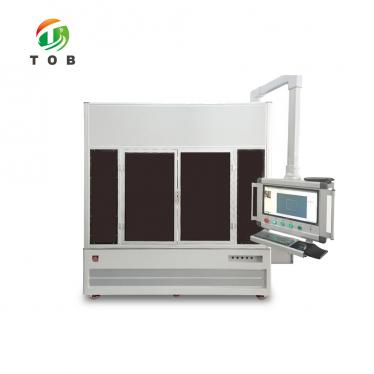
Loading...
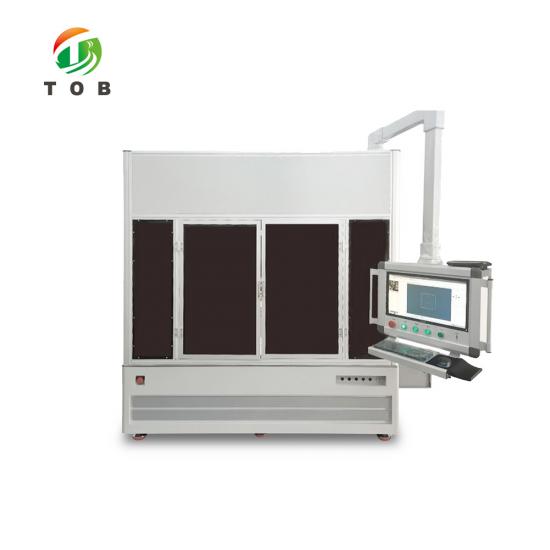
Gantry Fiber Laser Welding Machine
Brand:
TOB NEW ENERGYitem no.:
TOB-XD4000Worder(moq):
1setPayment:
L/C,T/Tproduct origin:
Chinashipping port:
XIAMEN
Gantry Fiber Laser Welding Machine - TOB-XD4000W
4000 W continuous fiber laser for aluminium and copper, on an 800 x 600 x 400 mm gantry with ±0.05 mm positioning
Product Overview and Ideal Applications
The TOB-XD4000W is a gantry machine built around a 4000 W continuous fiber laser, and the two halves of that sentence both matter. The laser is a 1070 nm source chosen for high-reflection metals - aluminium and copper - that turn most of a lesser beam back at the optics instead of into the joint. The gantry is a self-designed frame running on precision guides with high-response servo drives, moving that laser across an 800 x 600 x 400 mm envelope at ±0.05 mm positioning accuracy and up to 60 m/min in rapid.
For battery work that combination covers the welds that decide pack yield: aluminium and copper busbars across a module, nickel tabs, prismatic cell top lids and filling ports, and the current-collector joints on tabless cylindrical designs. Because the envelope takes a whole module tray rather than one cell, a single fixture can hold the part while the gantry indexes between seams and the scanner head does the fast beam motion inside each seam. The machine runs from 380 V, draws no more than 22 kW, and is rated IP54 for a production floor rather than a clean room.
Ideal for:
- Aluminium and copper busbar welding inside a module or pack, including dissimilar Al-to-Cu joints
- Prismatic cell top lid and filling port sealing, where the seam has to be gas-tight
- Nickel and aluminium tab welding on cylindrical and pouch cells, including multi-layer tab stacks
- Current-collector welding on tabless cylindrical cells, where the joint runs the full disc
- Module frames, end plates and pack hardware that need a long, repeatable seam rather than a spot
- Pilot lines and process development, where the welding program has to be saved, recalled and re-run on the next build
It is a production welding machine, not a laser marker and not a hand-held unit. The 4000 W beam is quoted for aluminium up to 3 mm in direct fusion, so thick-section deep-penetration work belongs to a different class of laser; and because the head is a scanner on a moving gantry, the useful comparison is with a fixed-head galvo welder, which cannot reach past its own scan field. If your welding happens at cell level rather than module level - a top lid seam, for instance - the laser welding machine for prismatic cell top lid and filling port sealing is built for exactly that joint.
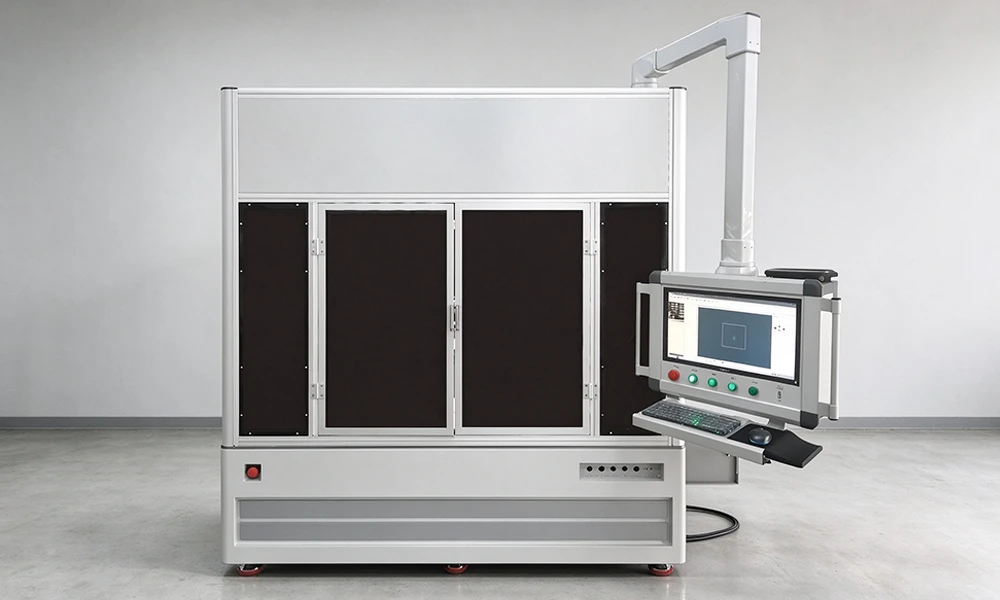
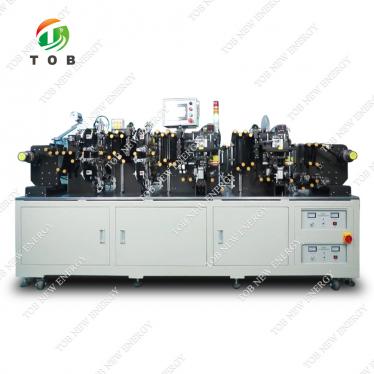
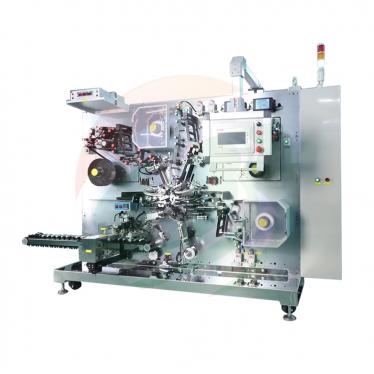
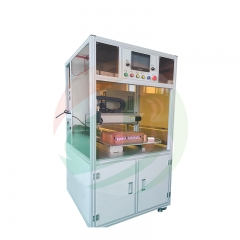
The complete machine: profile-built outer cover with three viewing windows, and the industrial PC on a swing arm so the program can be run from the fixture side.
Complete Specifications
Three tables, in the order you need them to judge fit: what the frame can reach and how accurately, what the laser does when it gets there, and what the room has to supply. Figures are the quoted ratings for this model.
1. Gantry and Motion
| Item | Specification |
|---|---|
| Overall machine dimensions | 2200 x 2000 x 2400 mm |
| Chiller dimensions | 1455 x 885 x 645 mm |
| Maximum processing size | 800 x 600 mm |
| Maximum workpiece height | 400 mm |
| Effective travel, X / Y / Z | 800 / 600 / 400 mm |
| Positioning accuracy, X / Y / Z | ±0.05 mm on all three axes |
| Repositioning accuracy, X / Y / Z | ±0.05 mm on all three axes |
| Rapid positioning speed, X / Y / Z | 60 / 60 / 15 m/min |
| Protection class | IP54 |
2. Laser
| Item | Specification |
|---|---|
| Operating mode | Continuous / modulation |
| Laser power | 4000 W |
| Wavelength | 1070 nm |
| Fiber core diameter | 50 μm |
| Fiber length | 15 m |
| Laser mode | YVO4 |
| Beam quality | Less than 0.373 (m²) |
| Maximum modulation frequency | Continuous |
| Adjustable power range | 10 to 100 % |
| Cooling method | Water cooled |
| Operating temperature | 25 °C |
| Long-term operation stability (24 h) | Good |
| Focal length F | 400 mm |
| Adjustable focal point range | -5 to +5 mm |
| Rated power (total machine) | ≤ 22 kW |
3. Working Environment
| Item | Requirement |
|---|---|
| Working temperature | 10 to 35 °C |
| Relative humidity | 30 to 80 % |
| Environment | Well ventilated; no impact load within 5 m of the machine |
| Supply voltage | 380 V |
| Supply frequency | 50 Hz |
| Earthing | Direct earthing |
Machine and chiller dimensions are quoted as overall envelopes and include the outer cover. Positioning and repositioning accuracy are both ±0.05 mm, which is the figure a fixture design has to work to, not the figure a weld seam will see.
Electrical and Mechanical Components
This machine is an assembly of bought-in optical and control hardware on a frame we build ourselves. The list below is the one that goes into the order specification, brands included, because on a 4000 W laser the source and the head are the two parts a buyer is really judging.
| Component | Model / function | Specification | Brand |
|---|---|---|---|
| Galvo laser welding head | Main body structure | Standard, with air-blowing kit | Shenzhen ZBTK |
| Chiller | Chiller main body | Dual-temperature, dual-control, standard filter element | SANHE TONGFEI |
| Gantry frame | Working range of gantry structure | L 800 x W 600 x H 400 mm, profile-constructed outer cover | Self-made |
| Laser | 4000 W source | 1070 nm, RS232 interface, 15 m optical fiber cable, 50 μm core diameter | Raycus |
| Drive motor | Servo motor | Standard, with photoelectric limit switch | Jiemeikang; limit switch Huayifeng |
| Welding software | Control system | DA multi-function welding control software | Self-made |
| Industrial PC | Standard | Industrial control computer, DELL 19-inch industrial monitor | Advantech; monitor Dell |
| Vision system | Vision | Automatic visual recognition | Hikvision |
| Focusing system | Focusing | Automatic recognition focusing | Panasonic |
| Dust removal system | VX220 | Fume extraction at the weld zone | Villo |
To meet delivery requirements the supplier reserves the right to substitute a component with an equivalent-grade part, provided the rated performance in the tables above is unchanged. Tell us at enquiry stage if your own qualification or spare-parts policy fixes a brand, and it will be confirmed in the order specification.
Welding at cell level rather than module level? Two machines in the same family do that joint: the laser welding machine for cylindrical tabless battery current collectors and the laser welding system for prismatic cell sealing.
Why a Moving Gantry With a Scanner Head
A scanner head on its own is fast but short-sighted: the beam is steered by mirrors, and the further it is steered from the centre of the field, the larger the spot and the more the focus plane bends. Past a certain angle the weld stops being the weld you programmed. That field limit, not the laser power, is what stops a fixed-head galvo welder from covering a battery module.
Putting the head on a gantry solves it by splitting the job. The gantry moves the whole head from seam to seam across 800 x 600 mm at up to 60 m/min, and the scanner traces each seam while the head is still, so the beam always works near the centre of its field where the spot is smallest and the focus is flat. Neither mechanism has to do the other's work.
That split is also why the frame matters more than it looks. A head that accelerates to 60 m/min and stops within ±0.05 mm puts a load into the structure every cycle, and any flex shows up as a seam that drifts on the last module of the shift. The gantry here is designed and built in-house on precision guides with high-response servo drives and photoelectric limit switches, which is the part of the machine we can control completely.
The laser choice follows the metal, not the other way round. Aluminium and copper reflect most of a 1070 nm beam when cold, so the source has to deliver both power and brightness: 4000 W through a 50 μm core, with the power adjustable from 10 to 100 %, is quoted for direct fusion of aluminium up to 3 mm. The air-blowing kit on the head is not an accessory for comfort - it keeps spatter off the optics, which is what actually ends the life of a welding head.
Vision recognition and automatic focusing then take the last variable out of the operator's hands. The machine finds the seam and the focal plane itself, so the fixture only has to locate the part, not measure it to a hundredth of a millimetre. On a module with dozens of identical seams, that is the difference between a program that runs all shift and one that needs re-teaching after every fixture change.
Key Engineering Characteristics
- 4000 W continuous fiber laser, 40 % electro-optical efficiency. Forty per cent is the source's own conversion figure, so 4000 W of beam takes roughly 10 kW of electrical input; the 22 kW machine rating covers the chiller, the drives and the controls on top of that.
- Aluminium up to 3 mm in direct fusion. Quoted for aluminium sheet without filler, which is the joint most battery busbar and tab designs actually need.
- ±0.05 mm positioning and repositioning on all three axes. The same figure on X, Y and Z, so a fixture designed to one axis is valid on the others.
- 60 m/min rapid in X and Y, 15 m/min in Z. Fast enough that indexing between seams is not the cycle-time bottleneck on a module with many short welds.
- Galvo head carried by the gantry. The scanner works near the centre of its field at every position, so spot size and focal plane stay constant across the full 800 x 600 mm area.
- Vision recognition and automatic focusing. Hikvision vision and a Panasonic focusing system locate the seam and the focal plane, so part-to-part variation is absorbed by the machine instead of the fixture.
- Dual-temperature, dual-control chiller. The laser and the optics are cooled to their own setpoints, which is what keeps a 4000 W source stable over a full shift.
- IP54 enclosure with fume extraction. Rated for a production floor, with a Villo VX220 removing the process fume at the weld zone rather than letting it settle on the optics.
- Programs that can be saved and recalled. Seam geometry comes in from multiple file formats, and a proven program is stored against the part so the next build starts from a known result.
Operating, Safety and Maintenance
1. Before and during a run
- Confirm the supply before anything else: 380 V, 50 Hz, direct earthing, and 22 kW available to the machine on its own circuit.
- Check the chiller: water level, both temperature setpoints (laser and optics), and the filter element. A chiller that is short of water shows up first as a power derate, not as an alarm.
- Inspect the protective window on the head for spatter, and confirm the air-blowing kit is working before the first weld of the shift.
- Load the fixture and check the part against the envelope: within 800 x 600 mm, and no feature above 400 mm.
- Call up the saved program for that part, or import the seam geometry and set power within 10 to 100 %, focal position within -5 to +5 mm, and the weld speed. Run vision recognition and automatic focusing rather than typing offsets.
- Weld the first part, inspect the seam, and only then save the program under the part number so the next build starts from a known result.
2. Safety and maintenance
- The beam is not eye-safe at any distance. Keep the enclosure closed and interlocked while welding, wear the specified laser safety glasses, and never look into the head or a reflected path from the fiber or the optics.
- Keep the fume extraction running. The Villo VX220 removes process fume at the weld zone; welding with it off coats the optics and puts metal fume into the room.
- Do not defeat the photoelectric limit switches. They are the machine's travel protection, and a gantry that runs past its limit at 60 m/min does not stop gracefully.
- Service the chiller on a schedule. Change the filter element, keep the water clean, and check that both loops hold their setpoints. Temperature drift is the most common cause of a weld that worked last week and does not work now.
- Check the protective window every shift. Spatter on the window changes the focus; the air-blowing kit slows it down, it does not make it unnecessary.
- Keep the room inside its envelope. 10 to 35 °C, 30 to 80 %RH, well ventilated, no impact load within 5 m of the machine, and the frame directly earthed.
- Only trained operators, no unauthorised modification. Power settings, focal range and interlocks are part of the machine's safety case, not operator preferences.
Engineering FAQ
Q1: Can it weld 3 mm aluminium without filler wire?
Yes - the 4000 W source is quoted for direct fusion of aluminium up to 3 mm, which is the thickness range most busbar and tab designs work in. Above that, the limiting factor stops being this machine and becomes the class of laser altogether: thick-section aluminium wants a different source, and no amount of programming on a 4000 W fiber laser changes that.
Q2: Copper reflects 1070 nm - why use this wavelength at all?
Because at room temperature every practical wavelength reflects off copper; the difference is how quickly the metal absorbs once it starts to melt. A 1070 nm source with high brightness and 4000 W of power gets through that initial phase, and the air-blowing kit keeps the optics clean while it does. What it will not do is behave like a 1070 nm welder on steel - copper is a process to be developed on your own joint, and we would rather prove it on a sample of your busbar than on a generic coupon.
Q3: Do I need a fixture built to ±0.05 mm?
No. ±0.05 mm is what the machine holds, not what the part has to hold. Vision recognition finds the seam and automatic focusing finds the focal plane, so the fixture has to locate the part repeatably, not measure it. Building a fixture to a hundredth of a millimetre would cost more than the accuracy buys.
Q4: Can one machine do both lid sealing and busbar welding?
Within the envelope, yes: both are welds inside 800 x 600 x 400 mm, and both are stored as programs. What changes is the fixture and the cycle time. If one of those joints becomes the constraint on a high-volume line, a machine built around that single joint - a dedicated lid or sealing system - will outrun a general gantry, and the two are usually run side by side rather than one instead of the other.
Q5: What does the chiller need from my building?
Floor space of 1455 x 885 x 645 mm, ventilation, and a water circuit that you fill and keep clean. It is a dual-temperature, dual-control unit, so the laser and the optics each hold their own setpoint; the filter element is a consumable and should be treated as one.
Q6: Can it run on 220 V single phase?
No. The machine is specified for 380 V at 50 Hz with direct earthing and a total draw of no more than 22 kW. Plan the supply and the earthing before the machine arrives; a 4000 W laser on an inadequate supply derates or trips, and neither is a warranty matter.
Send us the joint cross-section, the metals and the cycle time you need, and we will tell you whether 4000 W is the right source before you commit to a fixture.
Email: tob.amy@tobmachine.com | Tel / WhatsApp: +86 181 2071 5609
Reviewed by: Science Wang, Six Sigma Black Belt, Battery Lines | Last updated: 2026-10-29
Previous:
Automatic Spot Welding 18650 Cells Single Side Spot Welding MachineNext:
Electric Intelligent Transistor Spot Welder 10000A | TOB-550D-10000A
If you are interested in our products and want to know more details,please leave a message here,we will reply you as soon as we can.

 subscribe to us