Chinese
 français
 Deutsch
 italiano
 español
 português
 Nederlands
 日本語
 한국의




- Home
- >
- Dry Electrode Film Solution
- >
- High Speed Disperser for Dry Electrode Fibrillization Research
Categories
Hot Products
Loading...
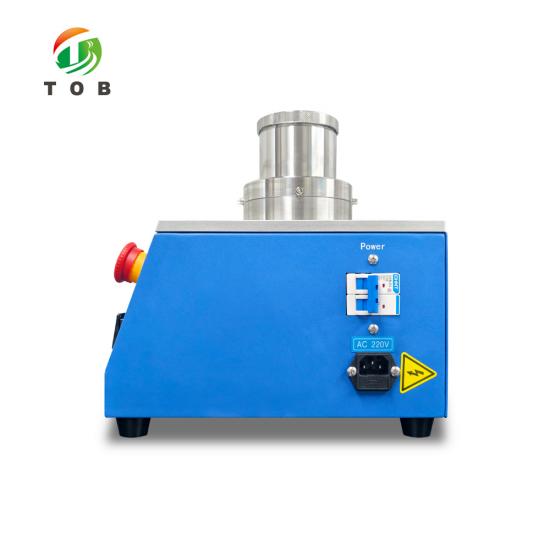
High Speed Disperser for Dry Electrode Fibrillization Research
Brand:
TOB NEW ENERGYitem no.:
TOB-GSXW-300order(moq):
1 setPayment:
L/C,T/Tproduct origin:
Chinashipping port:
XIAMEN
High Speed Disperser for Dry Electrode Fibrillization Research - TOB-GSXW-300
A sealed 300 ml tank, a four-blade shearing head and 100 to 10,000 rpm: the step where PTFE turns into fibre and dry electrode powder becomes a film that can be pressed
Product Overview and Ideal Applications
Dry electrode processing removes the solvent step and moves the whole job onto dry mixing. Active material, conductive carbon and a PTFE binder go into the tank as powders, and the shear has to pull the PTFE into a fibre network that wraps the particles; without those fibres the mix stays sandy and no press turns it into a free-standing film. TOB-GSXW-300 is built for that step: a 300 ml stainless tank, a four-blade head 64 mm across, and 100 to 10,000 rpm giving a tip speed of up to 33.49 m/s.
The tank and head lift out as one unit and wash together, so one formulation does not carry over into the next. At 10 kg and 250 x 295 x 430 mm the machine passes a 360 mm glovebox antechamber, which makes it usable for sodium-ion, solid-state and lithium-metal mixes that cannot meet air. Speed and time are set on the touch screen, the timer runs 0 to 300 s, and the same two numbers reproduce the batch.
Fibrillization comes before film forming, so this is the front of a dry electrode line rather than a stand-alone blender; the pages linked below cover the mill that sizes the powder and the film formers that take the mix afterwards. It is a formulation screening tool: 300 ml answers whether a recipe can be fibrillated at all, and throughput is a question for the film forming stage.
Ideal for:
- PTFE binder fibrillation in dry electrode research
- dry electrode formulation screening at 300 ml
- sodium-ion, solid-state and lithium-metal mixes
- dry electrode work carried out inside a glovebox
- labs building a dry electrode line step by step
Tell us the formulation, the binder content and the batch size you work at. Our engineer will confirm whether 300 ml covers your screening range and how the mix should be transferred into the glovebox.
Complete the inquiry form below and our engineer will review your requirements. Prefer email? Contact tob.amy@tobmachine.com.
Complete Specifications
Every figure below belongs to TOB-GSXW-300. The first table is the shearing duty that decides whether the binder fibrillates; the second is the tank and what touches the material; the third is electrical supply and the fourth is the footprint that decides whether the machine goes into a glovebox.
1. Shearing duty and timing
| Item | Value | Note |
| Speed | 100 to 10,000 rpm, adjustable | Set on the touch screen |
| Maximum tip speed | 33.49 m/s | At 10,000 rpm with the 64 mm head |
| Dispersing head diameter | D64 mm | Four-blade shearing head |
| Mixing time | 0 to 300 s, adjustable | Countdown shown on screen |
2. Tank and material contact
| Item | Value | Note |
| Tank volume | Max 300 ml | Working charge set by the bulk density of the mix |
| Tank material | Stainless steel, polished | Washed as a complete unit |
| Head and tank | Integrated, one piece to remove | Lid seats on the tank rim, sealed |
| Shaft sealing | Bearing plus wear-resistant seal ring | Keeps powder in and air out |
3. Electrical supply
| Item | Value | Note |
| Power supply | Single phase AC 220 V ±10% | 110 V available as a custom option |
| Frequency | 50 / 60 Hz | |
| Power | 750 W | High speed drive motor |
4. Footprint, weight and glovebox access
| Item | Value | Note |
| Dimensions | L250 x W295 x H430 mm | Height excludes the tank when lifted out |
| Weight | 10 kg | One person can move it |
| Glovebox access | Passes a 360 mm antechamber | Confirmed by the envelope above |
5. Operating environment
| Item | Value | Note |
| Ambient temperature | 25 ± 3 °C recommended | Room temperature stability affects repeatability |
| Humidity | 30 to 90 %RH | Sealed tank keeps the mix isolated from the room |
| Environment | Free of vibration and electromagnetic interference |
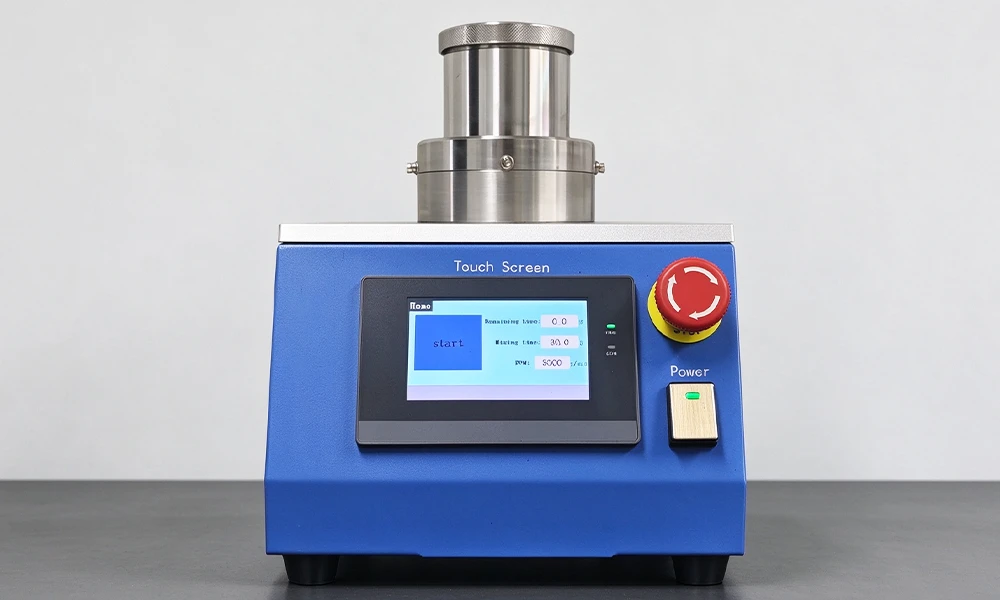
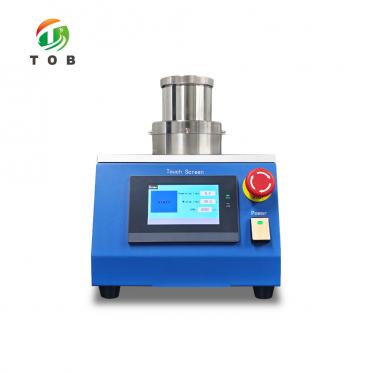
TOB-GSXW-300 with the sealed tank in place: touch screen, speed and time set per recipe, and an emergency stop within reach.
Construction and Wetted Parts
The machine is two pieces: a base that holds the drive and the controls, and a tank assembly that drops onto it. Nothing between them is threaded through a hose or a shaft coupling that has to be undone by hand, so the tank comes off in one lift and the material stays in the tank instead of travelling through the machine.
The tank is stainless steel, polished inside, with the four-blade head mounted on the base of the vessel rather than on a shaft lowered through the lid. That arrangement is what makes the assembly washable as one object and what removes the usual dead zone under the blades: there is no gap between head and wall for powder to sit in between batches.
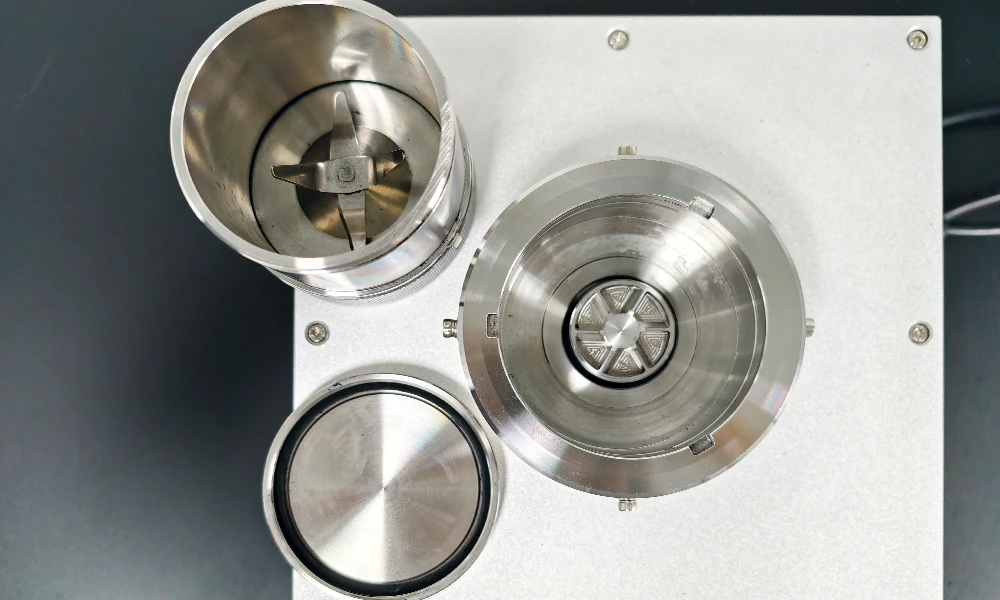
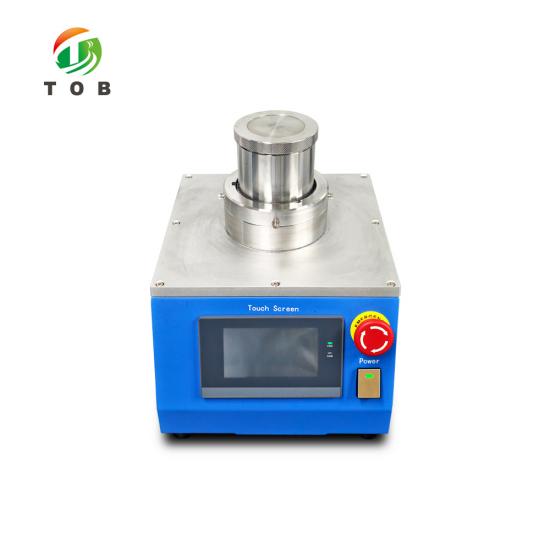
Tank, lid and the splined drive seat on the base: the vessel seats onto the drive and the head turns inside it, with no shaft passing through the lid.
The drive seat is splined, so the tank locates in one orientation and cannot be forced on at an angle. The shaft runs in a bearing with a wear-resistant seal ring, which does two jobs at once: it keeps the powder inside the vessel and it keeps room air out. For a dry electrode mix the second job matters more than the first, because a PTFE-based mix that picks up moisture before pressing will not fibrillate the same way twice.
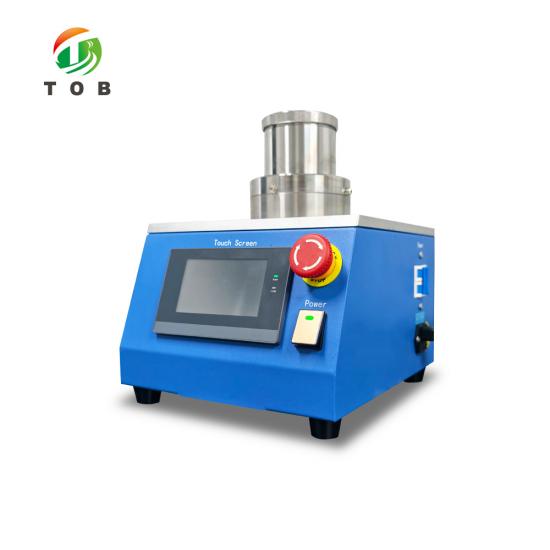
The lid seats on the tank rim and closes the vessel for the run. In normal use the lid stays on while the head turns, the material is charged and discharged with the tank off the drive, and the whole assembly is washed between formulations. The control face carries the touch screen, a green power button and a red emergency stop, all on the front panel where an operator standing at the bench can reach them without leaning over the tank.
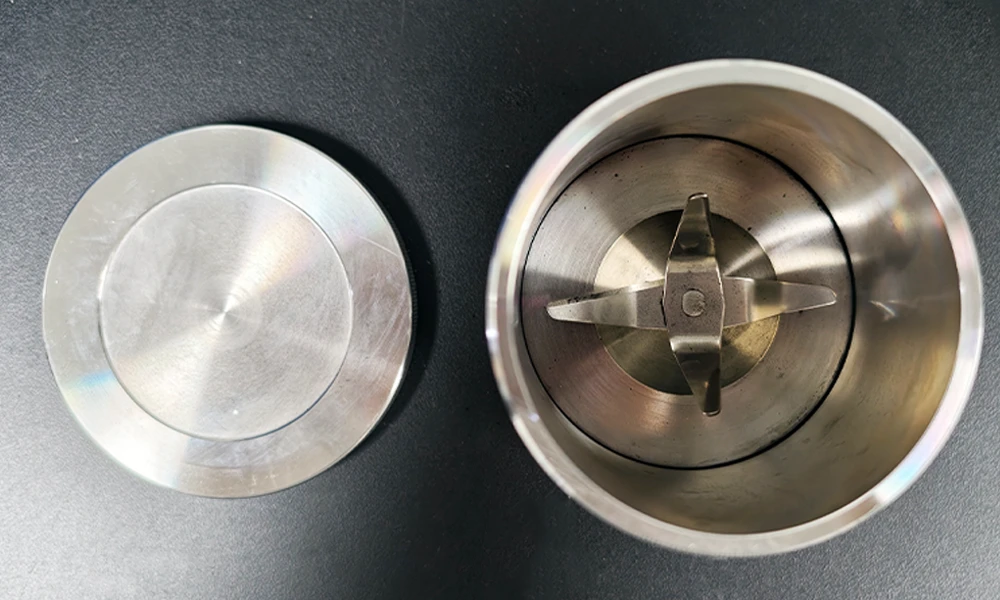
The four-blade head sits on the base of the vessel, 64 mm across, with the sealing lid beside it. Blade tips run close to the wall, which is where the shear comes from.
Key Engineering Characteristics
- Shear is set as tip speed, not as a number on the dial. The 64 mm head at 10,000 rpm reaches 33.49 m/s. That is the figure that decides whether PTFE fibrillates, and it is the reason the speed range is quoted to the top end rather than as a comfortable middle.
- A sealed vessel rather than an open bowl. Dry electrode powders are hygroscopic and the binder is sensitive to moisture pickup, so the run happens with the lid on and the shaft sealed by a bearing and a wear ring.
- The tank is the handling container. Charge it, run it, lift it off, wash it, and the material never has to be tipped from one vessel into another between mixing and the next process step.
- Built to go through a glovebox port. 10 kg and an envelope of 250 x 295 x 430 mm fit a 360 mm antechamber, so the machine can live inside the inert atmosphere instead of the mix being carried in and out.
- Two numbers make a recipe repeatable. Speed and time are entered on the screen and counted down; a colleague can reproduce the batch without watching someone else work.
- 750 W of drive in a bench-top frame. The motor is sized for short, high-load runs at the top of the speed range, which is how fibrillization is actually done, rather than for hours of gentle stirring.
None of these points are about making the machine look like a production unit. They are the four things that decide whether a 300 ml trial tells you anything about the formulation: enough shear, no moisture, no carry-over between batches, and the ability to run where the material has to live.
Why Fibrillization Needs Shear, Not Just Mixing
In a dry electrode mix, the active material and the conductive carbon are hard particles that do not change shape. The PTFE binder is the only component that deforms, and the whole process rests on one behaviour: under sufficient shear, PTFE particles are drawn out into fibres of sub-micron diameter. Those fibres bridge between particles and form a network that holds the electrode together when it is pressed.
A mixer that only blends will give you a uniform grey powder and nothing else. The particles are evenly distributed but still separate, the PTFE is still in lumps, and the press has nothing to bind with. The film either fails to form or forms with cracks and a density that varies along its length. This is the failure mode that makes people conclude dry electrodes do not work, when what actually happened is that the mix was never fibrillated.
The variable that governs fibrillation is the shear rate at the blade tip, which is why blade diameter and rpm have to be read together. A small head at high rpm and a large head at low rpm can show the same number on the display and behave completely differently. On this machine the head is 64 mm and the top speed is 10,000 rpm, which is where the 33.49 m/s figure comes from.
There is a window rather than a single right answer. Under-shear leaves the binder as particles; over-shear drives the material temperature up, over-fibrillates the binder and produces clumps that press into a brittle or uneven film. Where that window sits depends on the PTFE grade, the binder fraction, the carbon type and the loading, so it has to be found by trial. That is the argument for 300 ml and a timer in seconds: six formulations in an afternoon costs less than one batch on a production line.
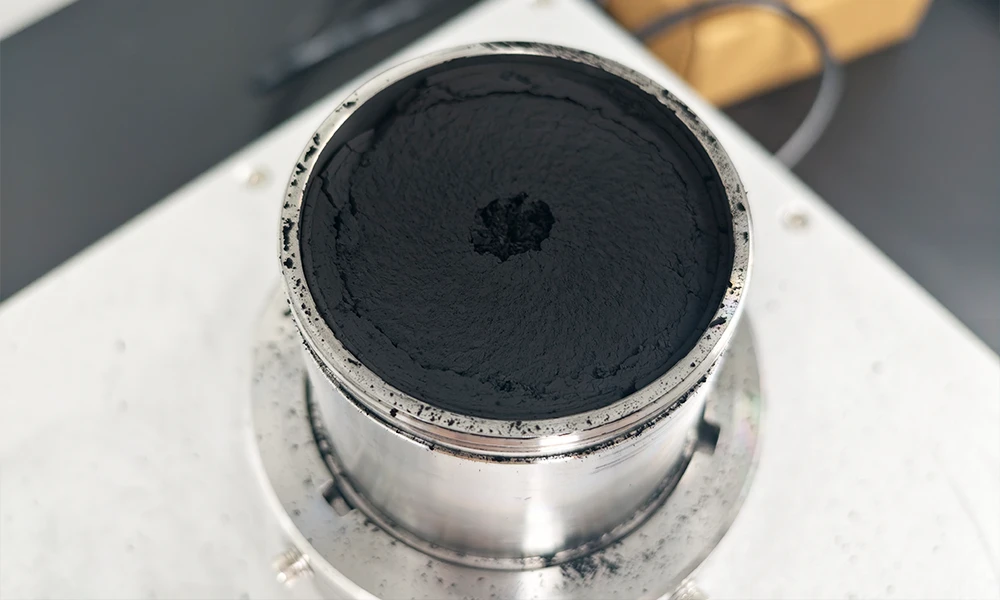
A dry electrode mix after fibrillation in the 300 ml tank: the material holds together as a soft, fibrous mass rather than running as separate powders.
What comes out of the tank is not yet an electrode. It is a fibrillated mix that can be pressed into a free-standing film, and the film forming step is where thickness and porosity are set. Read Laboratory Jet Mill for Dry Electrode Powder for the sizing step that comes before mixing, and Lab Dry Electrode Film Forming Machine for the step immediately after.

Setting Up, Maintenance and Safety
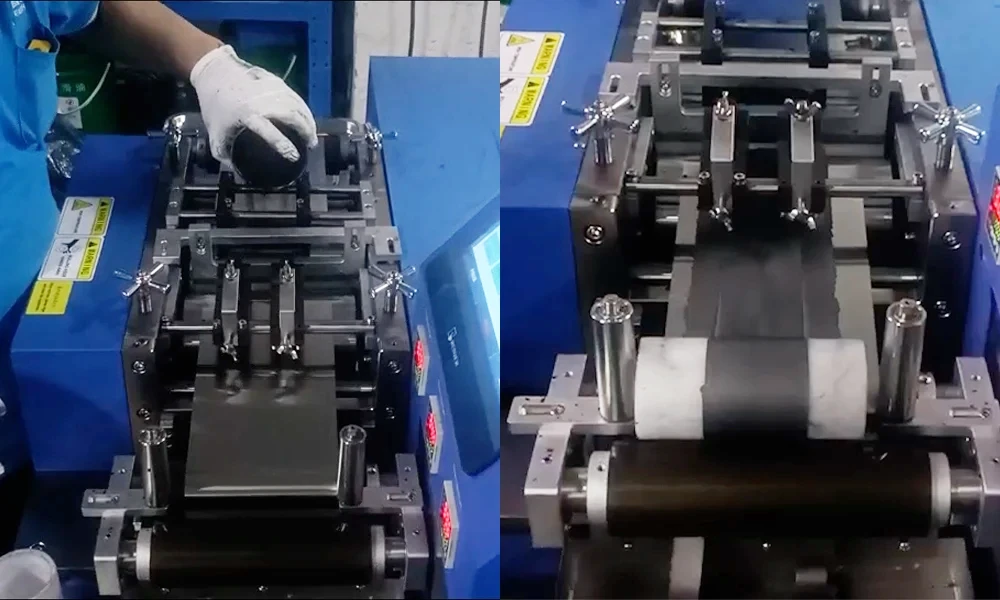
Running the machine is two settings and one judgement call. The two settings are speed and time, entered on the touch screen and counted down in front of you; the judgement call is when to stop, and that is made by looking at the material rather than at the clock. What follows covers the sequence, the cleaning routine that keeps one batch comparable with the next, and the safety rules that matter on an open bench-top machine.
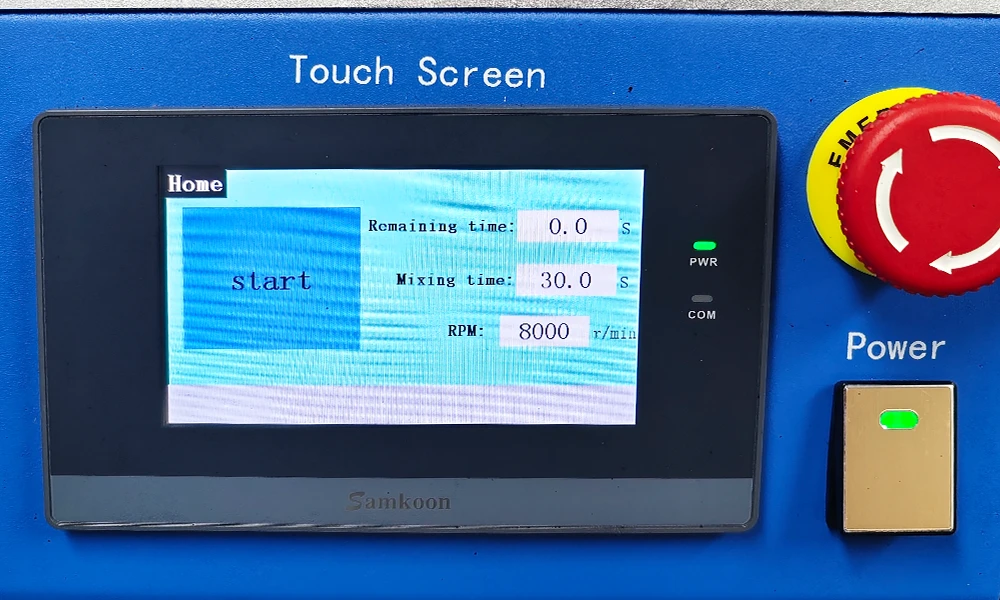
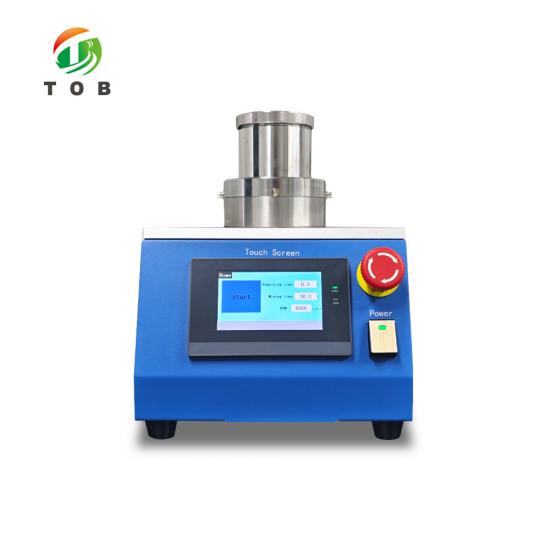
The control face: countdown timer, preset time, running speed and the start key on the touch screen, with the emergency stop and power button beside it.
1. Setting a run
Charge the dry mix into the tank and seat the tank on the splined drive. Close the lid. On the touch screen, set the running speed and the mixing time, then press start; the screen shows the countdown and the running speed for the whole run. The timer runs 0 to 300 s, so a long run is built from repeated cycles rather than from one continuous period, which also gives the material a chance to cool between passes.
Start conservatively. Run a short cycle, lift the tank, and look at the material: a mix that is still loose powder has not fibrillated, while one that climbs the wall as a coherent soft mass has. The right window is the shortest cycle that gives a mix which holds together, because running longer than that adds heat without adding strength.
2. Cleaning and maintenance
Wipe the tank and the head before every run and keep them clean; a few milligrams of the previous formulation carried into the next batch is enough to change a result. Use a soft cloth with alcohol for routine cleaning, and keep the moving parts clean so that the drive turns freely. Lubricate the moving parts at the intervals in the manual.
Check screws, nuts and pins on a regular schedule for looseness. If the machine is to stand unused for a long period, clean the moving surfaces, dry them and apply a rust-preventive oil before putting it away.
3. Safety
Never put a hand or any object into the tank or near the head while the machine is running. Keep the lid closed during a run. Only one person operates the machine at a time, because a second person reaching in while the first is at the controls is how most laboratory injuries of this kind happen. Do not let staff outside the designated team dismantle the machine; service work belongs with authorised personnel.
Certification, Patents and Research Record
1. CE marking: what the certificates actually cover
Two CE certificates held by TOB cover mixing equipment: M.2024.206.C00024 under the Low Voltage Directive 2014/35/EU and M.2024.206.C00045 under the Machinery Directive 2006/42/EC and the EMC Directive 2014/30/EU, both issued by CAC Conformity Assessment Center d.o.o. in Zagreb. Both certificates describe the product as a planetary vacuum mixer and list 22 model designations in the TOB-XFZH, TOB-ZKJB, TOB-PVM, TOB-SVM, TOB-QVM, TOB-XJB, TOB-SF and TOB-XHL families.
TOB-GSXW-300 is not in that list, so this page does not claim CE marking for it. If the machine is to be installed in the European Union, raise it at the enquiry stage and the certification route for this model will be confirmed before the order rather than after arrival.
2. Management system certificates
The company operates under ISO 9001:2015 (certificate 3050260408100Q), ISO 14001:2015 (305026082585E) and ISO 45001:2018 (305026082584HS). These cover the design and manufacture of the equipment and the environment it is built in, not the performance of any individual machine.
3. Patents in dry electrode processing
TOB holds granted and published patents along the dry electrode route, including CN118315678A for a dry electrode film forming and substrate laminating line, CN218887233U for a dry electrode film roll forming machine, CN218887274U for a film laminating and extending mechanism and CN221343111U for a composite film forming device. These cover the forming, rolling and laminating stages that follow mixing. The fibrillation step itself is not the subject of those claims, and this page does not suggest otherwise.
4. Academic record
The closest published work in the TOB citation index is at the category level rather than the model level: Solvent-Free Manufacturing of Lithium Iron Phosphate Cathodes via Binder Fibrillation for Li-Ion Batteries, Energy Technology, 2025, DOI 10.1002/ente.202500649, by Ruifeng Zhou, Hui Ling Ong, Yong-Qing Fu, Mohamed Mamlouk and Chuan Cheng. It works on the same mechanism this machine is built around, binder fibrillation in a solvent-free cathode, using equipment of this type.
For transparency on the numbers: the index holds 707 publications, 70 of them name a TOB model explicitly, and TOB-GSXW-300 is named in none of them. A machine launched now cannot claim a citation record, and this page does not invent one.
5. Where dry electrode work has been delivered
The nearest delivered project is the Dry Electrode Supercapacitor Production Line, which covers the same solvent-free route from powder to film. Laboratory lines for sodium-ion and pouch cell work are listed on the project pages linked from the pages below.
Engineering FAQ
Where does TOB-GSXW-300 sit in a dry electrode line?
After powder sizing and before film forming. The mill reduces the active material and carbon to a consistent particle size, this machine fibrillates the PTFE binder so the mix holds together, and the film former presses that mix into a free-standing electrode. Skip the fibrillation step and the film former has nothing to work with.
Why not use a planetary mixer or a kitchen blender?
A planetary mixer is designed to homogenise a slurry; its kneading action distributes particles but does not reach the shear rate that draws PTFE into fibres. A blender produces a local high shear zone but cannot be sealed against moisture and is not built for repeatable speed and time. The distinction is not quality but mechanism: only shear at the blade tip fibrillates the binder, and the 64 mm head at 10,000 rpm is sized to deliver it.
How much material fits in 300 ml?
The tank volume is 300 ml; the charge is set by the bulk density of your mix, and the practical limit is the point where the head still turns freely and the powder can move. As a working rule, weigh out a charge that leaves the head clear and the wall uncovered at the top, then treat that as your standard batch for the formulation. A fibrillated dry electrode mix is much lighter than its powder precursors, so the same tank holds fewer grams after fibrillation than the ingredients weighed before it.
Can it be used inside a glovebox?
Yes. At 10 kg and 250 x 295 x 430 mm it passes a 360 mm antechamber, so it can be transferred into an inert atmosphere and operated there. The sealed tank and the shaft seal mean the mix is protected during the run itself, which is the part that matters for sodium-ion, solid-state and lithium-metal formulations.
How long should one batch run?
Start short and extend. Run a cycle, open the tank and look at the material: loose powder means under-fibrillated, a coherent soft mass means the window has been reached, and a hot, clumped or greasy mix means the run went too far. The timer allows 0 to 300 s per cycle, and repeated cycles with a pause between them are usually better than one continuous run because the material cools in between.
Is TOB-GSXW-300 CE marked?
Not under the certificates listed above: M.2024.206.C00024 and M.2024.206.C00045 name 22 mixing models and TOB-GSXW-300 is not among them. If you need CE marking for a European installation, tell us at the enquiry stage so the route is confirmed with the quotation.
Send us the formulation you are working on, the binder type and the batch size you screen at. We will tell you whether 300 ml covers it and how the fibrillated mix should be transferred to the film forming step.
Email: tob.amy@tobmachine.com | Mobile phone: +86-18120715609
Reviewed for technical accuracy by Dany Huang, founder of TOB New Energy and author of the dry electrode process notes on this site. Read Dry Electrode Preparation Solution for the full route and dry electrode film forming machine for battery r&d for the next step.
Previous:
Supercapacitor Dry Electrode Sheets for SaleNext:
Laboratory Jet Mill for Dry Electrode Powder
If you are interested in our products and want to know more details,please leave a message here,we will reply you as soon as we can.

 subscribe to us