Chinese
 français
 Deutsch
 italiano
 español
 português
 Nederlands
 日本語
 한국의




- Home
- >
- Coin Cell Equipment
- >
- Coin Cell Disc Cutter
- >
- Manual Coin Cell Electrode Disc Cutting Machine
Categories
Hot Products

Loading...


Manual Coin Cell Electrode Disc Cutting Machine
Brand:
TOB NEW ENERGYitem no.:
TOB-CP60order(moq):
1 setPayment:
L/C,T/Tproduct origin:
Chinashipping port:
XIAMEN
Manual Coin Cell Electrode Disc Cutting Machine - TOB-CP60
Precision disc cutter with standard and customized punching die, from diameter 8mm to 24mm, for coin cell lab research
Product Overview and Ideal Applications
The TOB-CP60 is a manual coin cell electrode disc cutting machine used for punching electrode and separator discs from a coated foil or dried electrode sheet with a customized cutting die. It ships with a standard φ14mm punching die, and dies from φ8mm to φ24mm can be chosen.
Operation is manual, and the unit measures 110mm × 150mm × 235mm and weighs about 6kg, so it can be moved between benches in a coin cell lab. The punching thickness covers 0.005-0.5mm for both electrode and separator, and the same cutter cuts both, so one tool produces the electrode disc and the separator disc for the same cell.
The resulting discs can be used as the electrode and separator discs of split test cells and coin cells for battery research.
Ideal for:
- Punching electrode discs and separator discs for CR2016, CR2025, CR2032 and CR2450 coin cells
- Electrode and separator in the 0.005-0.5mm thickness window
- Producing discs for split test cells as well as coin cells
- Labs that need interchangeable dies from φ8mm to φ24mm on one manual cutter
- Not for: continuous roll-to-roll electrode slitting, or electrode and separator outside the 0.005-0.5mm thickness window or outside the φ8-24mm die range

Where the Disc Cutter Fits in the Coin Cell Workflow
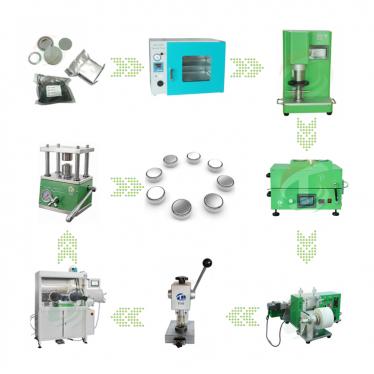
Punching is the step that turns a coated electrode sheet and a roll of separator into the discrete discs that go inside a coin cell. The TOB-CP60 sits between electrode preparation and cell assembly:
- The electrode slurry is mixed and cast onto the current collector, then dried and calendered.
- The dried electrode sheet and the separator are punched into discs with the TOB-CP60, using the cutting die matched to the cell format.
- The electrode disc, the separator disc and the counter electrode are stacked and assembled into the coin cell, then crimped.
- The assembled cell is cycled on a battery test system.
The published studies listed further down this page describe exactly these neighbouring steps, and name the TOB equipment used at each one.

Key Engineering Characteristics of TOB-CP60
- Manual operation: the cutter is operated by hand, and at about 6kg and 110mm × 150mm × 235mm it can be moved between benches in a coin cell lab.
- Interchangeable cutting dies: the standard configuration is a φ14mm punching die, and dies from φ8mm to φ24mm can be chosen, so the same cutter covers several coin cell formats.
- 25mm punching stroke: the punch travel is 25mm, which is the figure quoted for this machine.
- Electrode and separator in one tool: the cutter handles 0.005-0.5mm electrode and separator, and it can cut both, so the electrode disc and the larger separator disc for one cell come off the same machine.
- Discs for coin cells and split test cells: the punched discs can be used as the electrode and separator discs of split test cells and coin cells for battery research.
- Documented in peer-reviewed literature: the model number appears in 4 scientific records that also describe the punching step in their experimental procedure; the full list is set out below.
- Support: one year limited warranty with lifetime support.


Complete Specifications
1. Machine Specifications
| Parameter | Specification |
|---|---|
| Machine model | Disc cutter for coin cell electrode punch TOB-CP60 |
| Operating | Manual |
| Punching size | Standard configuration : φ14mm punching die, φ8-24mm can be chosen |
| Punching stroke | 25mm |
| Punching thickness | 0.005-0.5mm electrode and separator |
| Dimension | 110mm × 150mm × 235mm |
| Weight | About 6kg |
| Warranty | One Year limited warranty with lifetime support |
2. Advantages
| Advantage | On this machine |
|---|---|
| Simple operation | Manual punching with a customized cutting die; no programming step is required |
| Light weight | About 6kg, with a footprint of 110mm × 150mm × 235mm |
| Can both cut electrode and separator | The same cutter handles 0.005-0.5mm electrode and separator, so one tool produces both discs for a cell |
Cutting Die Selection: Matching Dies to Your Coin Cell Format
The disc diameter comes from the cutting die, not from the machine, so the die list is the part of the order that has to be right. The die sets below are the ones stated for each cell format.
Choosing Dies for CR2016, CR2025 and CR2032
For CR2016, CR2025 or/and CR2032 coin cell batteries, at least three cutting dies are needed:
| Cutting die | Diameter | Used for |
|---|---|---|
| A | 15mm | Electrode disc |
| B | 16mm | Electrode disc |
| C | 19 mm | Separator, so that it fully separates the electrodes |

Choosing Dies for CR2450
For CR2450 coin cell, the 20mm cutting die can be used for cutting electrode discs and the 23mm cutting die for the separator disc:
| Cutting die | Diameter | Used for |
|---|---|---|
| For electrode discs | 20mm | Cutting electrode discs |
| For the separator disc | 23mm | Cutting the separator disc |
Die Range and Customization
The standard configuration is a φ14mm punching die, and dies from φ8mm to φ24mm can be chosen. If your cell format calls for a diameter outside the die sets listed above, give the target disc diameter when you request the quotation so that the die list is fixed together with the machine.

Practical Operating Recommendations
- Fix the die list before the order is placed: the disc diameter comes from the cutting die rather than from the machine, so state the target disc diameters together with the machine model. The standard configuration is a φ14mm punching die, and dies from φ8mm to φ24mm can be chosen.
- Keep the separator die larger than the electrode dies: for CR2016, CR2025 and CR2032 the quoted set uses 15mm and 16mm for the electrodes and 19mm for the separator, the larger die being specified so that the separator fully separates the electrodes.
- Stay inside the quoted thickness window: the machine is specified for 0.005-0.5mm electrode and separator, so check the caliper of your dried electrode sheet against that range before punching a batch.
- Cut both discs of a cell on the same tool: because the cutter handles electrode and separator, the two discs that go into one cell can be produced on one machine, which keeps the disc pairs consistent across a batch.
- Treat it as a bench instrument: at about 6kg and 110mm × 150mm × 235mm with manual operation, the cutter can sit on a bench and be moved between benches in a lab.
Engineering FAQ
Q1. Which cutting dies do I need for CR2032 coin cells?
A. For CR2016, CR2025 or/and CR2032 coin cell batteries, at least three cutting dies are needed: a 15mm die, a 16mm die and a 19mm die. The 19mm die is the separator die, specified so that the separator fully separates the electrodes.
Q2. My cell format is CR2450. Does the die set change?
A. Yes. For CR2450 coin cell, the 20mm cutting die can be used for cutting electrode discs and the 23mm cutting die for the separator disc.
Q3. Can one machine cut both the electrode and the separator?
A. Yes. "Can both cut electrode and separator" is one of the stated advantages of the TOB-CP60, and the punching thickness of 0.005-0.5mm covers both electrode and separator.
Q4. What electrode and separator thickness can the TOB-CP60 punch?
A. 0.005-0.5mm, quoted for electrode and separator.
Q5. What disc diameter does the machine produce?
A. The diameter is set by the cutting die. The standard configuration is a φ14mm punching die, and dies from φ8mm to φ24mm can be chosen.
Q6. What is the punching stroke?
A. 25mm.
Q7. Can the punched discs be used in split test cells as well as coin cells?
A. Yes. The resulting discs can be used as the electrode and separator discs of split test cells and coin cells for battery research.
Q8. What warranty applies to the machine?
A. One year limited warranty with lifetime support.
TOB-CP60 in Scientific Literature
The TOB-CP60 is named by model number in 4 scientific records, which also describe how it was used in their experimental procedure.
- 4 records covering 4 distinct studies
- 4 peer-reviewed journal articles and 0 preprint versions; author institutions span 8 countries
| Publication platform | Article | First author and institutions | Country | How the TOB-CP60 is cited |
|---|---|---|---|---|
|
Advanced Science (Wiley) 2025, 12(32), e04717 DOI 10.1002/advs.202504717 |
An in‐depth Study of the Solid Electrolyte Interphase Compositional Evolution in Sodium‐Ion Batteries: Unravelling the Effects of a Na Metal Counter Electrode on the SEI |
Jack R. Fitzpatrick et al. The Faraday Institution; Imperial College London; Uppsala University |
United Kingdom; Sweden | A hydraulic punch (TOB-CP60, TOB New Energy) was used to punch out 12 mm diameter electrode discs from the foil. |
|
ChemSusChem (Wiley) 2024, 18(6), e202402233 DOI 10.1002/cssc.202402233 |
Resource‐Efficient Electrodes with Metallized Woven‐Glass‐Grid Current Collectors for Lithium‐Ion Batteries |
Yen‐Ming Li et al. TU Bergakademie Freiberg; Fraunhofer-Institute for Wind Energy Systems (IWES); TU Dresden |
Germany | Anode and cathode discs with diameters of 16 mm and 15 mm were then cut using an electrode cutter (TOB-CP60, Xiamen TOB New Energy Technology) and finally calendered vertically by application of a pressure of (25–83) MPa (Table S1) using a mechanical press (MP150, Maassen GmbH). |
|
Journal of Inorganic and Organometallic Polymers and Materials (Springer) 2024, 34(10), 4780-4787 DOI 10.1007/s10904-024-03135-y |
Antimony Trisulfide with Graphene Oxide Coated Titania Nanotube Arrays as Anode Material for Lithium-ion Batteries |
Tauseef Anwar et al. University of Education Lahore; COMSATS University Islamabad; Toyota Research Institute of North America; University of California Irvine; Dubai Electricity and Water Authority (DEWA); University of Agriculture, Faisalabad; Yunnan University; University of Sargodha; Huanggang Normal University; University of Glasgow; UET Lahore |
Pakistan; United States; United Arab Emirates; China; United Kingdom | The coated foil was cut into electrode of 6 mm diameter which was cut by Disk Cutter (Xiamen TOB New Energy Co ltd China TOB CP60). |
|
Journal of The Electrochemical Society (ECS) 2024, 171(10), 100520 DOI 10.1149/1945-7111/ad8483 |
Wet-Chemical Synthesis of a Protective Coating on NCM111 Cathode: The Quantified Effects of Washing, Sintering and Coating |
Liga Maskova et al. Riga Technical University |
Latvia | Electrode punching and weighing Electrodes with a diameter of 10 mm were punched out from the dried electrode sheets using a manual electrode disc cutter (TOB New Energy TOB-CP60). |
The same studies also name other TOB equipment at neighbouring steps of the coin cell workflow.
In the Advanced Science study the slurry was cast onto aluminium foil with an automatic film coating machine (TOB-VFC-150) before the electrode discs were punched out of it.
In the Journal of The Electrochemical Society study the punched cathode was stacked with the separator and lithium foil and the coin cell was closed and pressed with a hydraulic coin cell press (TOB-MR-120).
In the Journal of Inorganic and Organometallic Polymers and Materials study the assembled coin cells were cycled on a battery testing system (TOB-CT4008).
Further TOB items named in the same papers: a vacuum mixer (TOB-ZKJB-150), a commercial LiCoO2 coated cathode electrode (TOB-ELECTRODE-LICOO2) and an analytical balance (TOB-FA.1204B).
Compiled October 2026 from a Google Scholar keyword search screened for an explicit TOB-CP60 mention. Preprints are identified as such and have not necessarily completed peer review.
Packing

You May Also Need
-
Manual Disc Cutter for Electrode - the sibling manual electrode cutter, for comparing the disc-cutter options before choosing the die set.
-
Hydraulic Manual Coin Cell Crimper - the crimping step that follows punching in the coin cell workflow, and the press named in one of the studies below.
Reviewed by: Pinery Gong, Battery Assembly & Yield Process | Last updated: 2026-10-16
If you are interested in our products and want to know more details,please leave a message here,we will reply you as soon as we can.




 subscribe to us