Chinese
 français
 Deutsch
 italiano
 español
 português
 Nederlands
 日本語
日本語 한국의
한국의




- Home
- >
- Pouch Cell Assembly Equipment
- >
- Pouch Cell Sorting Machine
- >
- OCV Tester for Lithium-Ion Pouch Cells
Categories
Hot Products
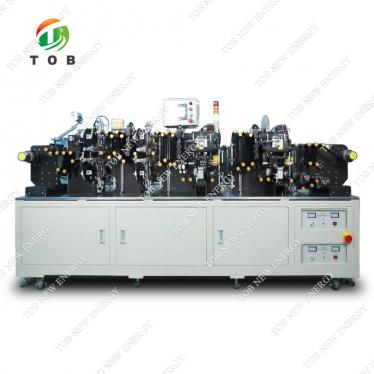
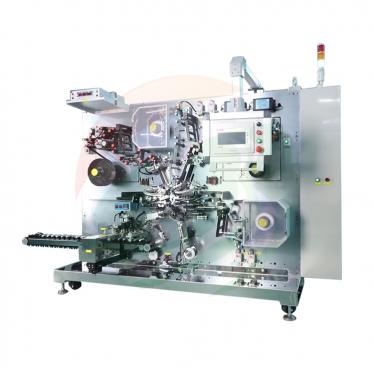
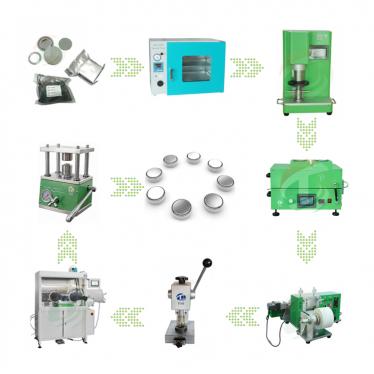
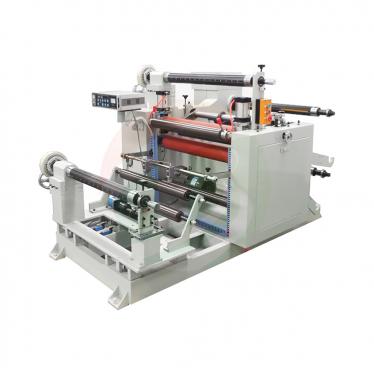
Loading...
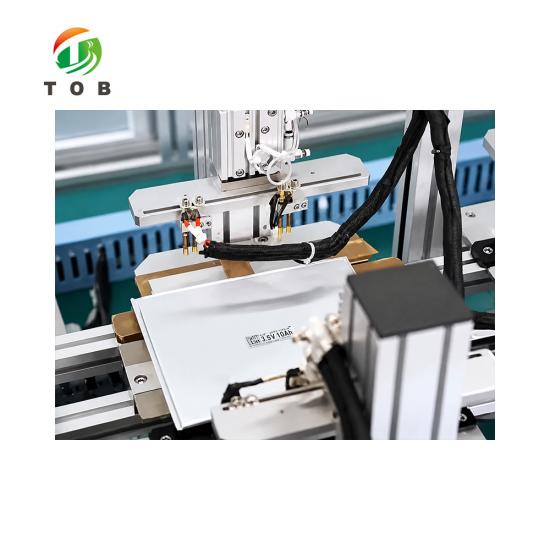
OCV Tester for Lithium-Ion Pouch Cells
Brand:
TOB NEW ENERGYitem no.:
TOB-MCH-250order(moq):
1Payment:
L/C,T/Tproduct origin:
Chinashipping port:
XIAMEN
OCV Tester for Lithium-Ion Pouch Cells - OCV1, OCV2, and OCV3 Testing with Automatic Sorting - TOB-MCH-250
Product Overview and Ideal Applications
The TOB-MCH-250 is an OCV tester designed for OCV1, OCV2, and OCV3 testing of lithium-ion pouch cells. The machine measures the open-circuit voltage (OCV) and internal resistance of cells after edge-folding, tests the insulation resistance between the aluminum-plastic film and the tabs, binds every measurement to the cell barcode, and sorts the cells by the test result - on an in-line (straight-through) layout that integrates into a production flow.
The machine is built for cells that arrive on a plastic tray (blister box). Cells are picked from the tray by the lower plastic-tray robot and transferred to the cell lifting mechanism, which advances them station by station through the barcode scanner, the OCV and insulation testing section, and the grading mechanism; the tray-transfer robot manages the trays, and the unloading robot places sorted cells into their categories - 10 categories for OK cells and 1 category for NG cells. Measurement uses probes that automatically contact the cell's positive and negative tabs as well as the insulation resistance between the aluminum-plastic film and the tabs; OCV measurement is performed by a HIOKI BT3562A tester, and insulation testing by a ST5520.
Incoming material compatibility covers folded pouch cells from 100 to 230 mm in main body width, 100 to 265 mm in length, 4 to 12 mm in thickness, and tab length from 10 to 30 mm - compatible with both single-fold and double-fold configurations, and with single-side and double-side tab configurations. Cells are accepted across a 0-5 V voltage range and a 0-1,000 mΩ internal resistance range. Barcode scanning runs at a 99.9% success rate, with compatibility for barcodes on both the front and back sides of the cell.
Data handling is central to the machine: under the automatic test of the tester, all test data is automatically recorded and bound to the corresponding barcode, and data can be saved to the local computer or uploaded to the MES. The software also accepts formation or test-cabinet statistics (capacity, energy, etc.) copied via USB flash drive; based on the corresponding barcode data, the software automatically aligns the imported new data with each barcode and appends it to the matching data column - so the OCV records, the production data, and the grading result stay together per cell.
Ideal for:
- Pouch cell manufacturers running OCV1, OCV2, and OCV3 test rounds in the production flow, with every round recorded against the cell barcode.
- Production lines that require automatic sorting of OK cells into 10 categories with NG cells collected separately.
- Manufacturing operations that need test data saved locally and/or uploaded to the MES for traceability.
- Lines that operate with plastic tray (blister box) logistics and require in-line tray handling with buffering through the machine.
- Cell formats within the folded-cell range of 100-230 mm width, 100-265 mm length, and 4-12 mm thickness, in single-fold or double-fold, single-side or double-side tab configurations.
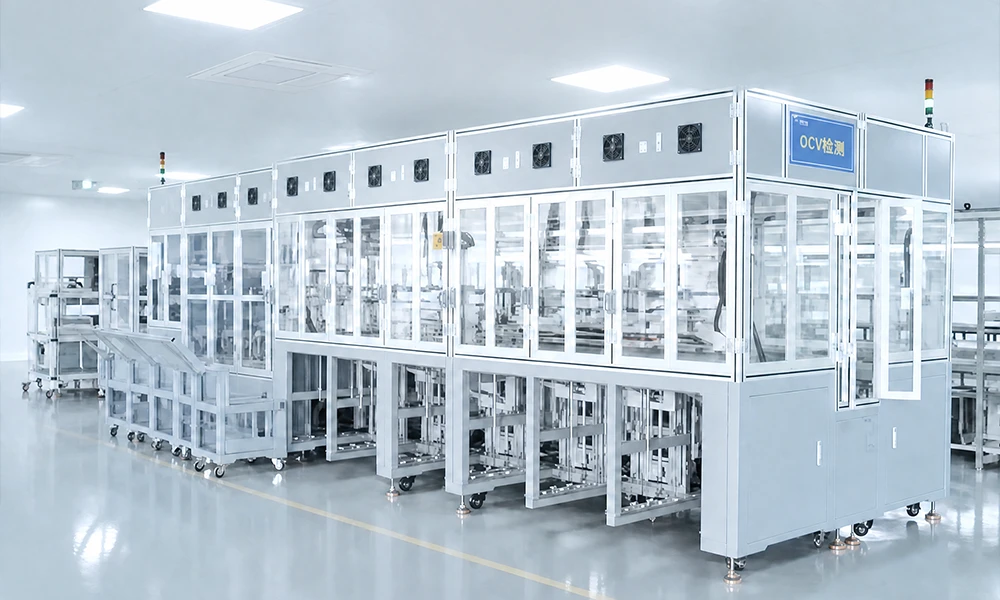
Where OCV Testing Fits in Pouch Cell Production
In pouch cell production, open-circuit voltage testing is performed in rounds at defined points of the flow. In a common line arrangement, these rounds are measured after formation (OCV1), after aging (OCV2), and at the final inspection before shipment (OCV3). Between the rounds the cells rest, and the behavior of the open-circuit voltage over time is one of the indicators used to identify cells with abnormal self-discharge behavior - which is why each round must be recorded against the individual cell and compared with the previous rounds, rather than being collected as batch statistics alone.
The TOB-MCH-250 supports this multi-round logic directly in its software: when testing OCV2, after scanning the barcode and testing, the cursor automatically jumps to the data column on the right side of the OCV1 data row, and the OCV2 value is entered automatically - so the OCV1 and OCV2 values of the same cell sit side by side in one data sheet. Formation or test-cabinet statistics (capacity, energy, etc.) can be copied via USB flash drive to the OCV tester's data table, and the software automatically aligns the imported data by barcode and appends it to the matching column and row.
Along with OCV and internal resistance, the machine tests the insulation resistance between the aluminum-plastic film and the tabs - a check of the electrical integrity of the pouch packaging - using the ST5520 insulation tester. The combined data set (OCV, internal resistance, insulation) provides the input for the pass/fail judgment and for grading:
- Judgment criteria can be pre-entered into the software; when the tester records the current test data, it automatically determines whether the cell passes or fails. Failed cells trigger an alarm and are automatically picked out.
- Grading standards (up to 10 grading factors, with NG as a separate grade) can be pre-entered; during the last scan-and-test round, configured by the operator as the final test round, the tester automatically calculates the cell's grade and sorts it into the corresponding group.
Where the equipment is purchased without the NG-picking robot or the grading-picking-and-placing robot, the same information is used for manual operation: operators pick out failed cells based on the alarm information, and pick and place cells into zones according to the grade information.
Machine Layout and Working Flow
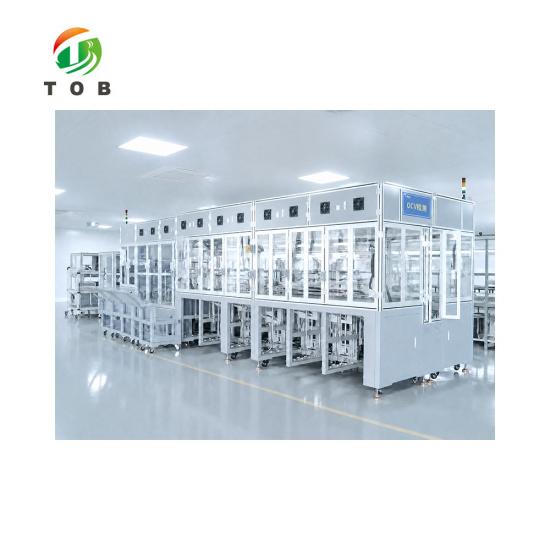
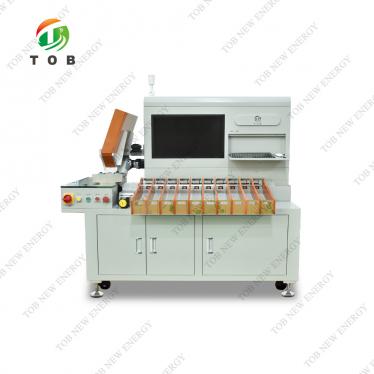
The overall equipment layout adopts an in-line (straight-through) configuration. The actual equipment outline dimensions are approximately L 4,800 x W 1,600 x H 2,000 mm (subject to actual size), and the final layout is based on the actual dimensions.
The working flow runs as follows:
- Tray infeed: full plastic trays are placed at the pick-up position, where they are buffered in a stack; a lifting motor and tray positioning mechanism present the trays for picking.
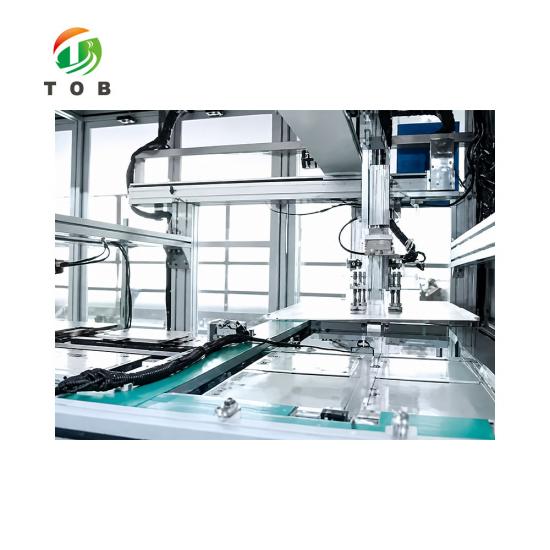
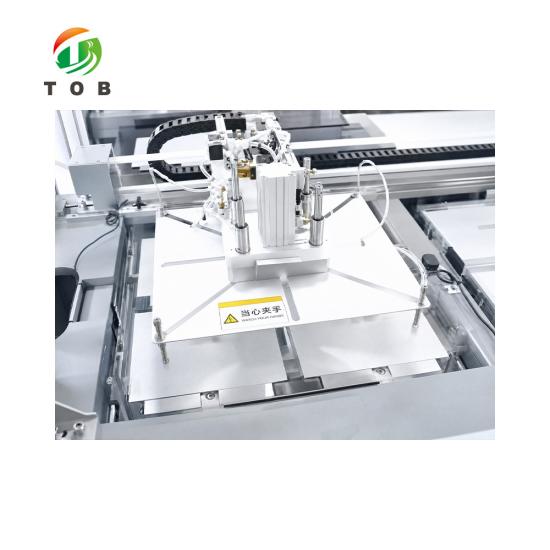
- Cell transfer: the lower plastic-tray robot uses XY-axis modules with a Z-axis pneumatic cylinder to vacuum-pick the cells from the tray and place them at the lifting mechanism's loading position. The loading station is equipped with an automatic positioning mechanism.
- Cell transport: the cell lifting mechanism advances the cells progressively to the next station; the stepper motor controls the single-step distance and translates one pitch, and a pneumatic cylinder lifts the cell height. Each cell placement position has vacuum suction to prevent displacement during transfer.
- Barcode scanning: the barcode scanner (KEYENCE SR1000) reads the cell barcode, compatible with barcodes on both the front and back sides of the cell, at a 99.9% scanning success rate.
- OCV and insulation testing: probes automatically contact the cell's positive and negative tabs and test the insulation resistance between the aluminum-plastic film and the tabs. All test data is automatically recorded and bound to the corresponding barcode; data can be saved locally or uploaded to the MES.
- Grading and sorting: the grading mechanism positions the cells by grade - 10 categories for OK cells and 1 category for NG cells. Each group of sorted cells is placed in a plastic tray with an independent lifting function, capable of buffering a stack of at least 300 mm in height. A dedicated positioning mechanism at the sorting/unloading station prevents tray position offset.
- Tray management: the tray-transfer robot stacks empty plastic trays on top of full trays, and the unloading robot completes the automatic unloading cycle.
The equipment is enclosed with doors on the upper frame; all equipment doors are equipped with door switches, and opening a door pauses the equipment and triggers an alarm.
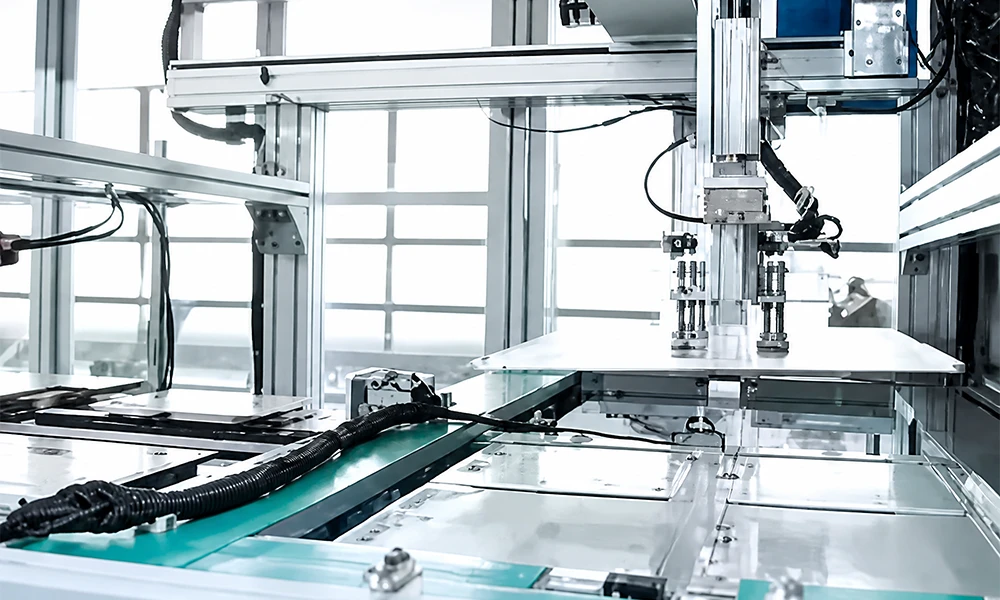
Functional Description of Each Unit
1) Plastic-Tray Infeed Mechanism
- Consists of a full-tray placement platform, a full-tray pick-up position, a full-tray positioning mechanism, a full-tray lifting mechanism, an empty-tray placement position, an empty-tray positioning mechanism, and an unloading robot.
- The full-tray lifting mechanism uses pneumatic cylinders, guide plates, and guide shafts. The full trays are placed at the pick-up position and can buffer a stack of full trays.
- The pick-up position consists of a lifting motor, sensors, and a tray positioning mechanism. The pick-up robot waits to vacuum the cells and place them at the downstream loading station.
- The empty-tray placement position is similar to the pick-up mechanism.
2) Lower Plastic-Tray Robot
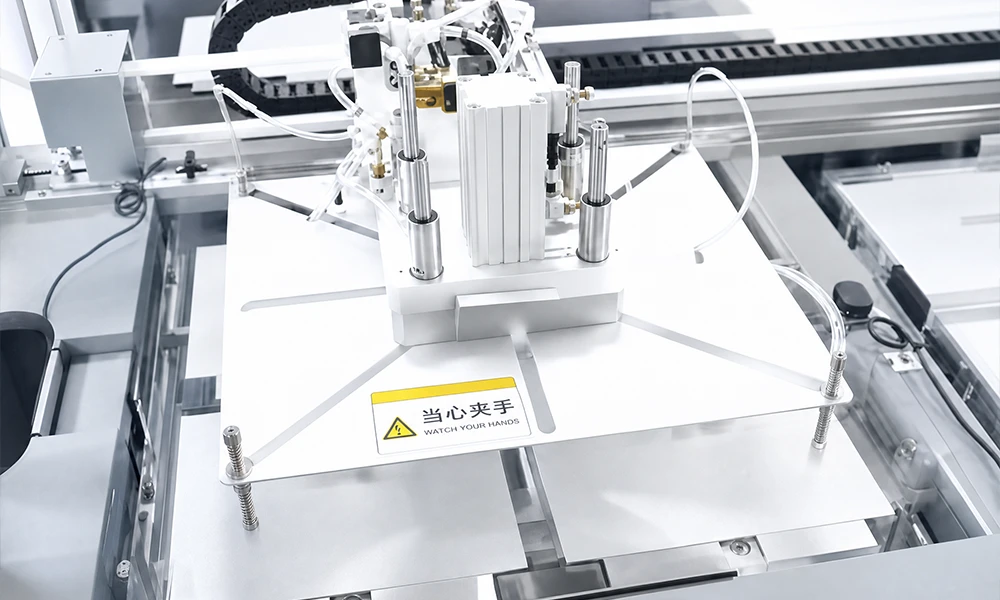
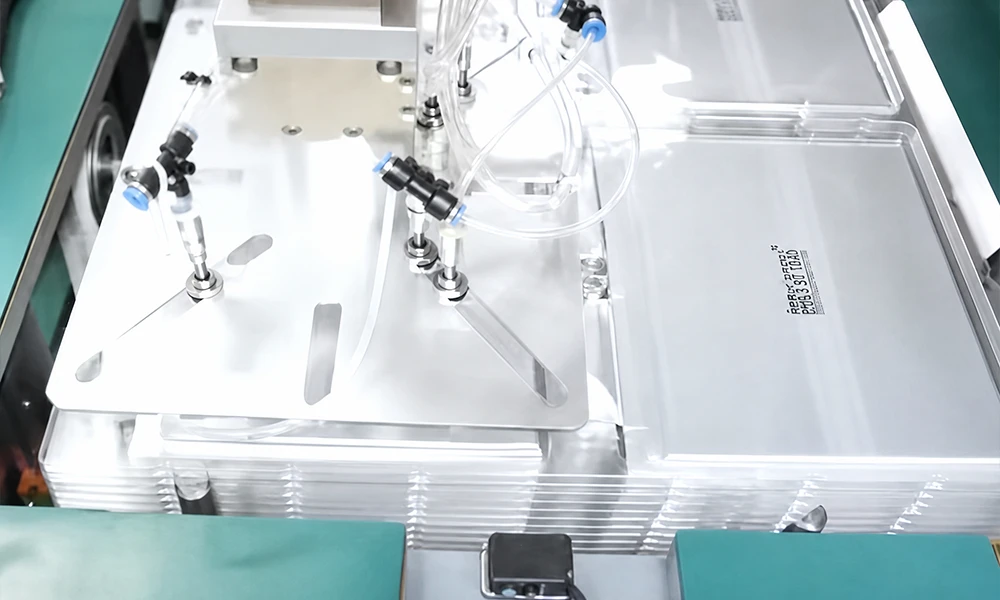
- Uses XY-axis modules for horizontal movement, with a Z-axis pneumatic cylinder to raise/lower for vacuum-picking cells and trays.
- Transfers cells from the plastic tray to the lifting mechanism's loading position.
- After all cells in a single plastic tray have been picked, the empty tray is vacuum-picked and transferred to the empty-tray placement mechanism.
3) Cell Lifting Mechanism
- Consists of linear guides, a pneumatic cylinder, a stepper motor, a synchronous belt, sensors, a cell-fixture support plate, and a cell positioning mechanism.
- Cells are progressively transferred to the next station, with every two cells sharing one lifting cylinder.
- Each cell placement position has a vacuum suction feature to prevent cell displacement during transfer.
- Support plates are provided on both sides of the lifting mechanism to carry the cells.
4) Barcode-Scanning Mechanism
- Consists of a barcode scanner and a scanner bracket.
- Compatible with barcodes on both the front and back sides of the cell.
- Scanner model: KEYENCE SR1000.
5) OCV / Insulation Testing
- Consists of test probes, a tester, a test bracket, a pneumatic cylinder, guide shafts, and linear bearings.
- Testing is compatible with both single-side and double-side tab configurations.
- Test data is bound to the cell barcode, recorded locally, or uploaded to MES.
6) Grading Mechanism
- Consists of a lifting motor, a lifting fixture, through-beam sensors, and side stoppers.
- OK cells are graded into 10 categories; NG cells occupy 1 category; the empty-tray position occupies 1 slot.
- OK cells are placed in plastic trays; NG cells are stacked.
7) Tray-Transfer Robot
- Consists of servo motors, synchronous pulleys, synchronous belts, pneumatic cylinders, and suction cups.
- It stacks empty plastic trays on top of full trays.
8) Overall Equipment
- The lower frame is welded from iron square tubing, with a painted outer surface.
- The upper frame uses aluminum-alloy profiles and transparent acrylic panels as doors.
- All equipment doors are equipped with door switches; opening a door pauses the equipment and triggers an alarm.
Key Engineering Characteristics of the TOB-MCH-250
- OCV1 / OCV2 / OCV3 Testing Bound to the Cell Barcode: The machine is designed for the three OCV test rounds of pouch cell production. All test data is automatically recorded and bound to the corresponding barcode, with the OCV2 value aligned automatically to the OCV1 data row - so each cell's voltage history builds up round by round in a single data sheet.
- HIOKI BT3562A and ST5520 Test Instruments: OCV measurement uses a HIOKI BT3562A tester, and insulation testing uses a ST5520. The voltage measurement range is 0-100 V with 1 mV resolution and a basic accuracy of ±0.01% rdg. ±3 dgt.; the test response time is 10 ms.
- Probe Contact on Tabs plus Insulation Check: Testing uses probes that automatically contact the cell's positive and negative tabs as well as the insulation resistance between the aluminum-plastic film and the tabs. The flat-head probe is gold-plated with a service life of 50,000 cycles, a contact resistance of 1 mΩ, and a rated current of 100 A.
- Automatic Sorting into 10 OK Categories and 1 NG Category: Cells are sorted into categories based on the test data - 10 categories for OK cells and 1 category for NG cells - by the automatic unloading robot. Where the machine is purchased without the picking robots, the alarm and grade information supports manual pick-out and zone sorting.
- Tray Logistics with High Buffering Capacity: The infeed handles full trays and empty trays through dedicated positions and positioning mechanisms; sorted cells are placed in plastic trays with an independent lifting function that buffer a stack of at least 300 mm in height. The loading station and the sorting/unloading station both have automatic positioning mechanisms, and the tray-transfer robot stacks empty trays on top of full trays.
- Broad Folded-Cell Compatibility: Incoming cells: 100-230 mm main body width, 100-265 mm length, 4-12 mm thickness, 10-30 mm tab length - in both single-fold and double-fold configurations, and with single-side and double-side tab configurations. Voltage range 0-5 V; internal resistance range 0-1,000 mΩ.
- Reliable Barcode Identification: The barcode-scanning mechanism uses a KEYENCE SR1000 scanner with a 99.9% scanning success rate and compatibility for barcodes on both the front and back sides of the cell.
- In-Line Layout with Defined Production Figures: The machine adopts an in-line (straight-through) layout, approximately L 4,800 x W 1,600 x H 2,000 mm (subject to actual size). Mechanical production capacity is 10 PPM (depends on manual loading speed and test time), operated by 1 person, with a yield rate of ≥ 99.5% and equipment availability (OEE) of ≥ 95%.
- Integrated Component Set and Data Output: The control set includes a Mitsubishi PLC, Weintek touch screen, Omron / Keyence sensors, HIWIN linear slides and rails, Panasonic servo motors and vacuum gauge, and Schneider low-voltage electrical parts; the industrial PC is supplied by Advantech or EVOC. Data can be saved to the local computer or uploaded to the MES.
- Safety and Calibration Provisions: Door switches pause the equipment and trigger an alarm when a door is opened. The testers are sent to a third-party metrology institute for inspection once per year, and the equipment paint color follows the color card provided by the customer (or International Warm Gray 1C).
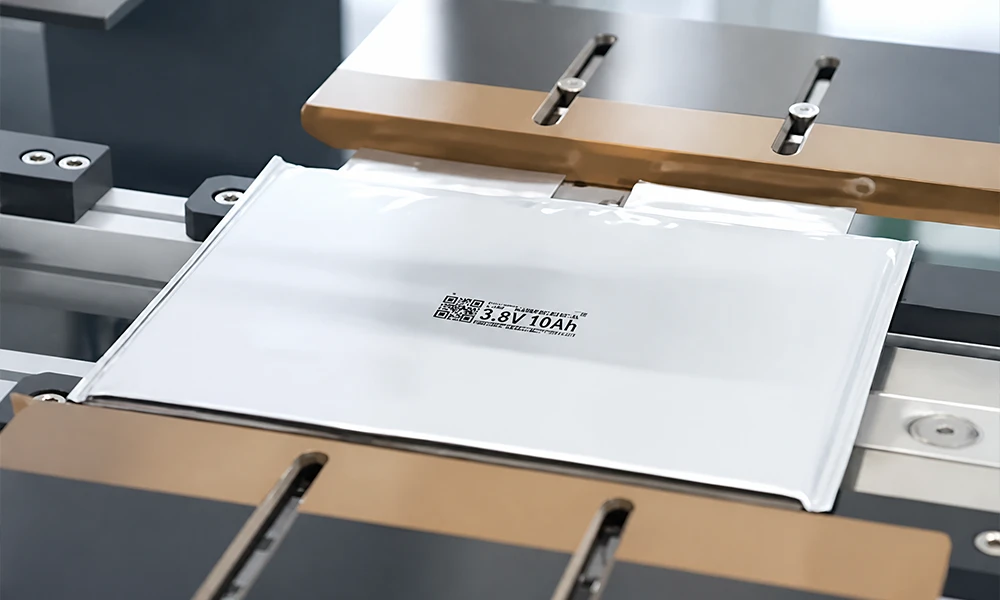
Complete Technical Specifications
1. Equipment Function and Incoming Material Specifications
1.1 Equipment functional requirements
The machine is designed for OCV1, OCV2, and OCV3 testing of lithium-ion pouch cells.
1.2 Incoming material specifications
1) Cell under test: cells after edge-folding. The cell dimensions and specifications are as follows:
| Item (Folded Cell) | Symbol | Min. (mm) | Max. (mm) | Reference Cell |
|---|---|---|---|---|
| Cell main body width | W | 100 | 230 | / |
| Cell length | L | 100 | 265 | / |
| Tab length | L2 | 10 | 30 | / |
| Cell thickness | T | 4 | 12 | / |
2) The incoming cells are compatible with both single-fold and double-fold, as well as single-side and double-side tab configurations.
3) Voltage range: 0-5 V
4) Internal resistance range: 0-1,000 mΩ
5) Plastic tray (blister box) specifications: outer length 460 mm, width 420 mm; row and column pitches vary by model (max./min. dimensions to be provided TBD).
2. Line Layout and Key Technical Parameters
The overall equipment layout adopts an in-line (straight-through) configuration.
Barcode scanning success rate: 99.9%.
Testing uses probes that automatically contact the cell's positive and negative tabs as well as the insulation resistance between the aluminum-plastic film and the tabs. Under the automatic test of the tester, all test data is automatically recorded and bound to the corresponding barcode. Data can be saved to the local computer or uploaded to the MES.
Automatic unloading by robot: cells are sorted into categories based on different test data - 10 categories for OK cells and 1 category for NG cells.
| Item | Specification |
|---|---|
| OCV tester | HIOKI BT3562A is used for OCV measurement |
| Insulation tester | ST5520 is used for insulation testing |
| Voltage measurement range | 0-100 V, resolution 1 mV, basic accuracy ±0.01% rdg. ±3 dgt. |
| Resistance measurement range | Above 3 kΩ, accuracy ±0.5 mV |
| Internal resistance | 0.001 mΩ, basic accuracy ±0.5% rdg. ±5 dgt. |
| Test response time | 10 ms |
| Sorting categories | 10 categories for OK cells; 1 category for NG cells |
| Tray buffering | Each group of sorted cells is placed in a plastic tray with an independent lifting function, capable of buffering a stack of at least 300 mm in height |
| Loading station | Equipped with an automatic positioning mechanism |
| Lifting mechanism | Stepper motor controls the single-step distance and translates one pitch; a pneumatic cylinder lifts the cell height |
| Positioning at the sorting/unloading station | A dedicated positioning mechanism is provided to prevent tray position offset |
| Equipment paint color | Color card provided by the customer (or International Warm Gray 1C) |
| Test probe type | Flat-head probe, service life 50,000 cycles, contact resistance 1 mΩ, rated current 100 A, gold-plated probe surface |
| Tester calibration | Sent to a third-party metrology institute for inspection, once per year |
| Equipment outline dimensions | Approx. L 4,800 x W 1,600 x H 2,000 mm (subject to actual size); the final layout shall be based on the actual dimensions |
3. Test Items
- After barcode scanning, the OCV and internal resistance of the cell are tested; the values are automatically matched to the cell barcode and entered automatically.
- When testing OCV2, after scanning the barcode and testing, the cursor automatically jumps to the data column on the right side of the OCV1 data row, and the OCV2 value is entered automatically.
- Formation or test-cabinet statistics (capacity, energy, etc.) can be copied via USB flash drive to the OCV tester's data table. Based on the corresponding barcode data, the software can automatically align the imported new data with each barcode and append it to the matching data column.
- Judgment criteria can be pre-entered into the OCV tester software. When the OCV tester records the current test data, it automatically determines whether the cell passes or fails. Failed cells will trigger an alarm and be automatically picked out (if the equipment is purchased without an NG-picking robot, operators must manually pick out failed cells based on the alarm information).
- Grading standards (up to 10 grading factors, with NG as a separate grade) can be pre-entered into the OCV tester software. During the last scan-and-test round (configured by the operator as the final test round), the OCV tester automatically calculates the cell's grade and sorts it into the corresponding group (if the equipment is purchased without a grading-picking-and-placing robot, operators must manually pick and place cells into zones according to grade information).
4. Equipment Parameters
| Parameter | Value |
|---|---|
| Equipment power supply (provided by buyer) | AC 380 V ±10% / 50 Hz; power approx. 5 kW |
| Equipment air supply (provided by buyer) | 0.5-0.7 MPa, 3.6 m³/h |
| Vacuum source (provided by buyer) | -85 kPa, 15 m³/h |
| Mechanical production capacity | 10 PPM (depends on manual loading speed and test time) |
| Operating personnel | 1 person |
| Yield rate | ≥ 99.5% |
| Equipment availability (OEE) | ≥ 95% |
5. Main Equipment Components
Remark: For delivery reasons, the supplier has the right to select components of other brands of equivalent grade according to market supply, without prior notice to the customer.
| No. | Component Category | Brand 1 | Brand 2 |
|---|---|---|---|
| 1 | PLC | Mitsubishi | / |
| 2 | Pneumatic components | Airtac | / |
| 3 | Solenoid valve | Airtac | / |
| 4 | Touch screen | Weintek | / |
| 5 | Sensor | Omron | Keyence |
| 6 | Linear slide & rail | HIWIN | / |
| 7 | Vacuum gauge | Panasonic | / |
| 8 | Servo motor | Panasonic | / |
| 9 | Low-voltage electrical parts | Schneider | / |
| 10 | Tester | HIOKI | / |
| 11 | Barcode scanner | Keyence | / |
| 12 | Industrial PC | Advantech | EVOC |
6. Wear Parts List
| No. | Name | Quantity | Unit Price (CNY) | Replacement Cycle (days) | Remarks |
|---|---|---|---|---|---|
| 1 | Fuse | 2 | 5 | 3 | / |
| 2 | Flat-head probe | 2 | 120 | 7 | Gold-plated |
| 3 | Sawtooth-head probe | 2 | 120 | 7 | Gold-plated |
| 4 | Suction cup | 10 | 10 | 5 | / |
| 5 | Suction-cup fitting | 4 | 80 | 5 | / |
7. Model-Change Tooling List
| No. | Tooling Name | Quantity | Unit Price (CNY) | Lead Time (days) | Material | Remarks |
|---|---|---|---|---|---|---|
| 1 | Side stopper bar | 16 | 50 | 5 | Bakelite | Drawing to be provided |
| 2 | Bottom stopper bar | 16 | 50 | 5 | Bakelite | Drawing to be provided |
| 3 | Cell support plate | 8 | 150 | 10 | AL6061 | Drawing to be provided |
Practical Operating Recommendations
- Verify incoming cells before setup: confirm the folded cell dimensions against the compatibility ranges (main body width 100-230 mm, length 100-265 mm, thickness 4-12 mm, tab length 10-30 mm), the fold configuration (single-fold or double-fold), and the tab layout (single-side or double-side). Confirm the voltage (0-5 V) and internal resistance (0-1,000 mΩ) ranges of the cells being handled.
- Confirm the tray format and tooling: the plastic tray (blister box) outer dimensions are 460 x 420 mm, and the row and column pitches vary by model - obtain the tray pitch data and prepare the model-change tooling (side stopper bars, bottom stopper bars, cell support plates) before each changeover.
- Support barcode quality: the scanning success rate is 99.9% with the KEYENCE SR1000 scanner. Maintain barcode print quality on the cells and check reading performance when a new cell format is introduced, especially where barcodes are placed on the front or back side of the cell.
- Care for the probes: the flat-head gold-plated probes carry a rated current of 100 A with a contact resistance of 1 mΩ and a service life of 50,000 cycles. Follow the wear parts list for the replacement cycle (7 days for both flat-head and sawtooth-head probes) and keep spares in stock.
- Set up judgment criteria and grading standards in advance: enter the pass/fail criteria and the grading standards (up to 10 grading factors, with NG as a separate grade) into the software, and confirm which scan-and-test round is configured as the final test round for automatic grade calculation.
- Handle data flow carefully: decide whether data is saved locally, uploaded to the MES, or both. When importing formation or test-cabinet statistics via USB, verify the automatic barcode alignment on a sample batch before relying on it in production.
- Utilities: the buyer provides the power supply (AC 380 V ±10% / 50 Hz, power approx. 5 kW), the air supply (0.5-0.7 MPa, 3.6 m³/h), and the vacuum source (-85 kPa, 15 m³/h). Verify stable supplies before starting production.
- Plan manpower and buffers: the machine is designed for 1 operator at a mechanical capacity of 10 PPM (depends on manual loading speed and test time); the tray buffering height of at least 300 mm supports continuous flow through the machine.
- Schedule calibration: the testers are sent to a third-party metrology institute for inspection once per year; plan the calibration into the maintenance calendar.
- Keep the safety functions active: opening any equipment door pauses the equipment and triggers an alarm. Do not bypass the door switches during operation.
- Paint finish: the equipment is painted to the color card provided by the customer (or International Warm Gray 1C).
Engineering FAQ
Q1: What is the TOB-MCH-250 designed for?
The machine is designed for OCV1, OCV2, and OCV3 testing of lithium-ion pouch cells. It measures OCV and internal resistance, tests the insulation resistance between the aluminum-plastic film and the tabs, binds all data to the cell barcode, and sorts cells into categories based on the test data - 10 categories for OK cells and 1 category for NG cells.
Q2: Which cell sizes and configurations can the machine handle?
Incoming cells are cells after edge-folding, with a main body width of 100-230 mm, a length of 100-265 mm, a tab length of 10-30 mm, and a thickness of 4-12 mm. The machine is compatible with both single-fold and double-fold configurations, as well as single-side and double-side tab configurations. The voltage range is 0-5 V, and the internal resistance range is 0-1,000 mΩ.
Q3: Which test instruments and probes are used?
OCV measurement uses a HIOKI BT3562A tester, and insulation testing uses a ST5520. The test probe is a flat-head probe with a gold-plated surface, a service life of 50,000 cycles, a contact resistance of 1 mΩ, and a rated current of 100 A. The testers are calibrated once per year at a third-party metrology institute.
Q4: How does the machine sort cells?
The automatic unloading robot sorts cells into categories based on the test data: 10 categories for OK cells and 1 category for NG cells. OK cells are placed in plastic trays, and NG cells are stacked. Where the equipment is purchased without the picking robots, operators manually pick out failed cells based on the alarm information and pick and place cells into zones according to grade information.
Q5: How is test data managed?
Under the automatic test, all test data is automatically recorded and bound to the corresponding barcode. Data can be saved to the local computer or uploaded to the MES. When testing OCV2, the cursor automatically jumps to the data column on the right side of the OCV1 data row, and the OCV2 value is entered automatically. Formation or test-cabinet statistics can be copied via USB flash drive, and the software automatically aligns the imported data with each barcode and appends it to the matching data column.
Q6: What are the measurement specifications?
The voltage measurement range is 0-100 V with 1 mV resolution and a basic accuracy of ±0.01% rdg. ±3 dgt. The resistance measurement range is above 3 kΩ with an accuracy of ±0.5 mV; the internal resistance value is 0.001 mΩ with a basic accuracy of ±0.5% rdg. ±5 dgt. The test response time is 10 ms.
Q7: What utilities does the equipment require?
The buyer provides the equipment power supply (AC 380 V ±10% / 50 Hz, power approx. 5 kW), the equipment air supply (0.5-0.7 MPa, 3.6 m³/h), and the vacuum source (-85 kPa, 15 m³/h).
Q8: What is the production performance of the machine?
The mechanical production capacity is 10 PPM (depends on manual loading speed and test time), operated by 1 person, with a yield rate of ≥ 99.5% and equipment availability (OEE) of ≥ 95%. The overall layout is an in-line (straight-through) configuration with an approximate outline of L 4,800 x W 1,600 x H 2,000 mm (subject to actual size).
Q9: How are the trays and buffering handled?
The plastic trays arrive with cells and move through the machine on the tray infeed and tray-transfer mechanisms. Sorted cell groups are placed in plastic trays with an independent lifting function, capable of buffering a stack of at least 300 mm in height. Dedicated positioning mechanisms are provided at the loading station and the sorting/unloading station, and the tray-transfer robot stacks empty plastic trays on top of full trays.
Q10: What safety features are provided?
All equipment doors are equipped with door switches; opening a door pauses the equipment and triggers an alarm. The equipment also includes standard grounding and low-voltage protection components, and the control system provides fault prompts and fault cause descriptions on the screen during normal operation.
Ready to add automated OCV1 / OCV2 / OCV3 testing and sorting to your pouch cell line? Request a quotation for the TOB-MCH-250 with your folded cell dimensions, plastic tray specification, and sorting requirements, and specify whether the NG-picking and grading-picking robots are required. Our engineers can advise on the line layout and the data integration with your MES.
tob.amy@tobmachine.com| +86 181 2071 5609
You May Also Need
-
Manual OCV Multi-Functional Sorting Machine for Pouch Cell - A manual OCV multi-functional sorting machine for pouch cells. A lower-automation OCV sorting solution from the TOB range for laboratories, pilot lines, and low-volume production; compare it with the fully automated TOB-MCH-250 when planning OCV testing capacity.
-
Semi-Automatic OCV Sorting Machine for Pouch Cell - A semi-automatic OCV sorting machine for pouch cells. Complements the TOB-MCH-250 where a semi-automatic configuration better matches the production volume, staffing, or line layout.
-
8+1 Channels OCV Sorting Machine for Prismatic Cells - An OCV sorting machine with 8+1 channels for prismatic cells. Complements the TOB-MCH-250 when the product to be tested is a prismatic (square) cell rather than a pouch cell.
If you are interested in our products and want to know more details,please leave a message here,we will reply you as soon as we can.

 subscribe to us