Chinese
 français
 Deutsch
 italiano
 español
 português
 Nederlands
 日本語
日本語 한국의
한국의




- Home
- >
- Cylindrical Cell Assembly Machine
- >
- Battery Formation and Grading Machine
- >
- 5V6A Needle-Bed Cylindrical Cell Formation and Grading System with Energy Feedback
Categories
Hot Products
Loading...
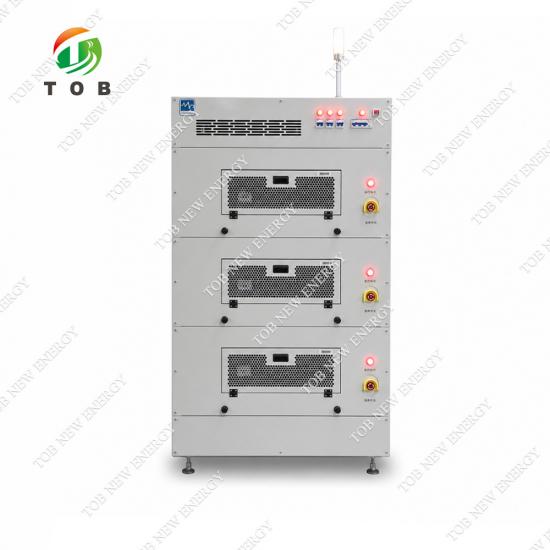
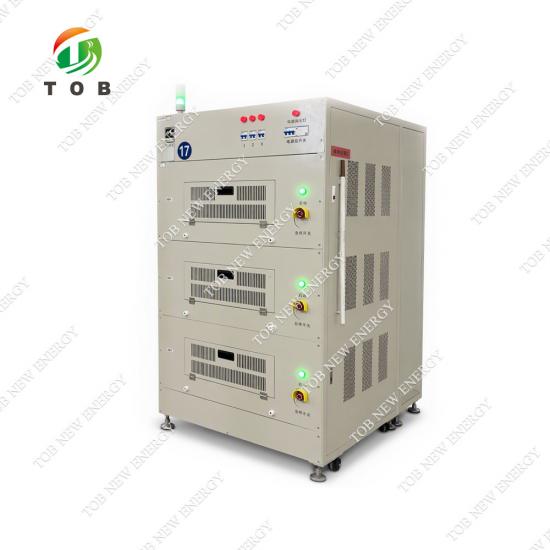
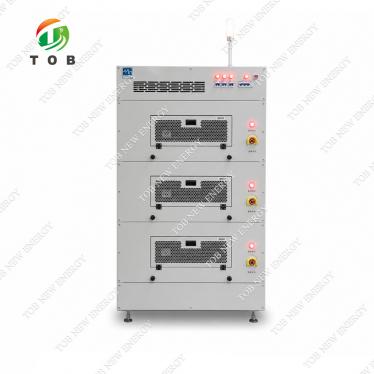
5V6A Needle-Bed Cylindrical Cell Formation and Grading System with Energy Feedback
Brand:
TOB NEW ENERGYitem no.:
TOB-INVP-V5C6D6order(moq):
1setPayment:
L/C,T/Tproduct origin:
Chinashipping port:
XIAMEN
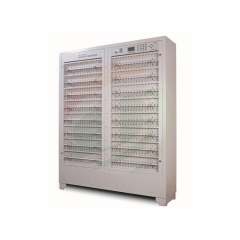
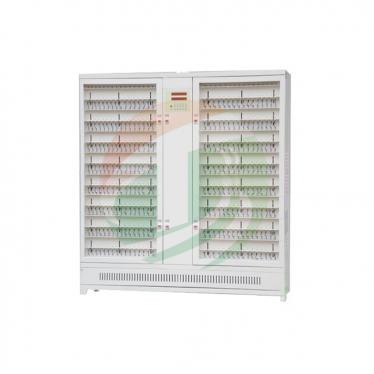
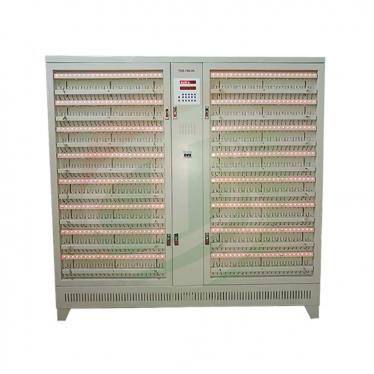
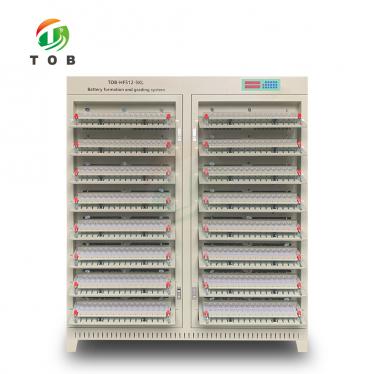
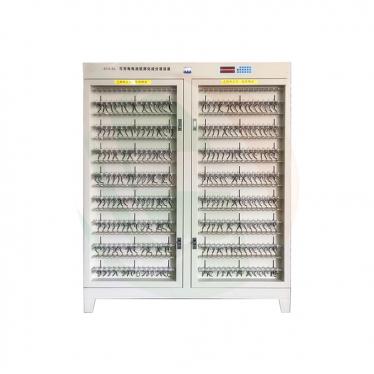
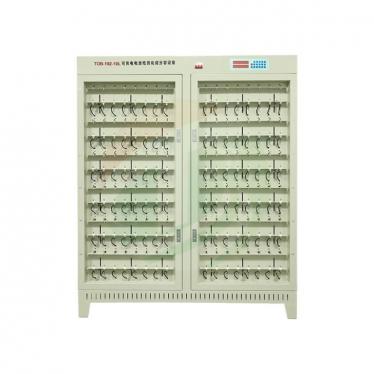
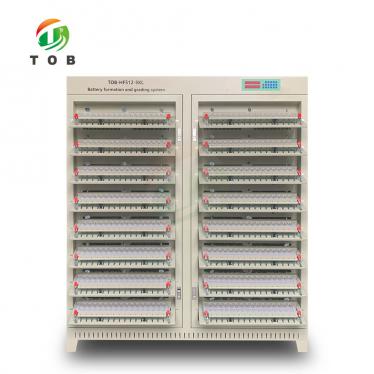
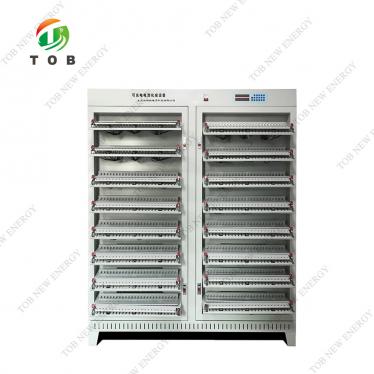
TOB-INVP-V5C6D6 5V6A Needle-Bed Cylindrical Cell Formation and Grading System with Energy Feedback
Product Overview and Ideal Applications
The TOB-INVP-V5C6D6 is a 5V6A needle-bed cylindrical cell formation and grading system with an energy-feedback architecture. It is engineered for the precision-controlled formation (first charge), capacity grading, and electrical testing of lithium-ion cylindrical cells, combining the accuracy required for reliable cell classification with a substantial reduction in energy consumption compared with conventional discharge-through-resistor systems.
The system adopts a two-stage modular structure. The first stage is a high-efficiency rectifier module that converts three-phase AC mains into a regulated DC bus with a high power factor (>0.99 at rated conditions) and low current distortion (total harmonic distortion of the input current, THDI, below 5 %). The second stage is a bank of independent DC modules, each controlling a single cell channel. Every channel is powered by its own constant-current/constant-voltage source, giving independent, high-precision control over each cell under test. Because the rectifier stage is shared while the DC stage is per-channel, the architecture provides both configuration flexibility and the electrical isolation needed for reliable multi-cell testing.
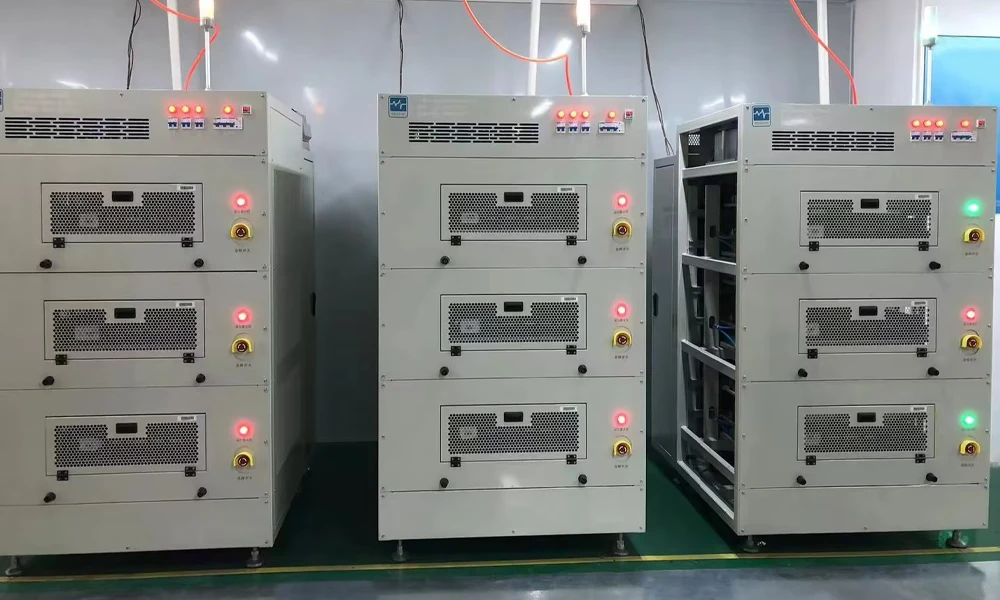
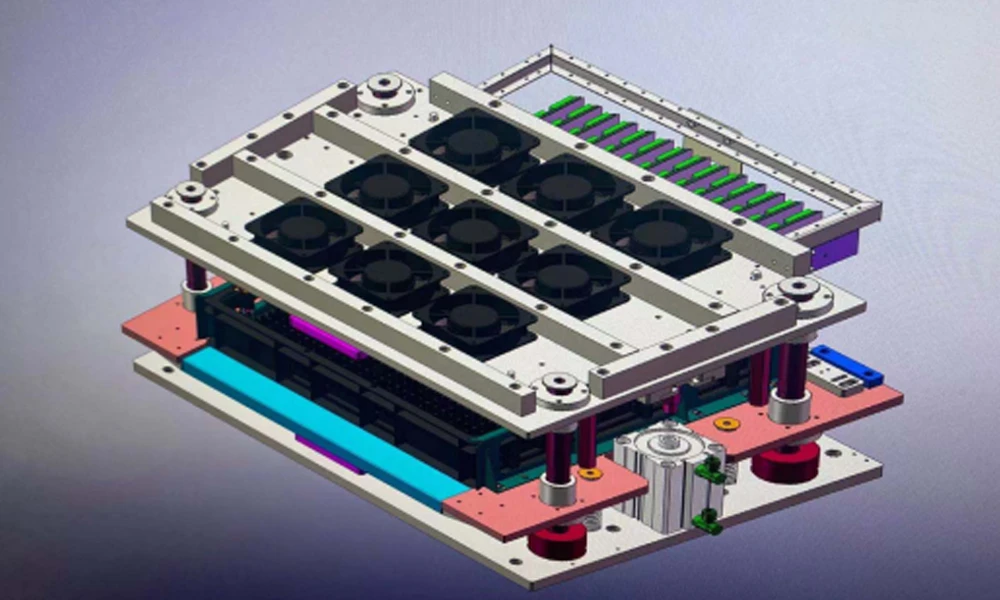
The needle-bed mechanism is the defining feature of the TOB-INVP-V5C6D6. Each cell is contacted by a spring-loaded three-pin probe assembly (identical three-pin components on both the upper and lower probes) with a rated contact resistance of not more than 10 mΩ on a clean cell surface. The needle bed is driven by a dual-cylinder pneumatic system, with each layer moving independently, so that the entire bank of probes can be lifted and lowered for fast cell loading and unloading. This design is specifically configured for 32600 and 32900 cylindrical cells, which are loaded in a 16×16 tray (256 cells per layer). The cabinet houses three layers, giving 768 channels per cabinet.
During operation, the TOB-INVP-V5C6D6 discharges cells through a bidirectional inverter that returns the recovered energy to the factory AC grid. The overall energy-feedback efficiency exceeds 65 % under rated conditions, and the charging efficiency exceeds 70 %, so the system consumes approximately 50 % of the electricity of a conventional non-regenerative system under the same test conditions. Because the discharge power is not dissipated as heat inside the laboratory, the ambient temperature of the production area is lowered by 5–15 °C, further reducing the load on the facility's air-conditioning system.
Ideal for:
- Cylindrical lithium-ion cell manufacturers performing formation, grading, and electrical testing of 32600 and 32900 cells in high-volume production.
- Energy-storage and EV battery plants that must minimise the electricity cost and heat load associated with the formation and grading step.
- Pilot and small-scale production lines needing a modular, high-channel-count system with independent per-channel control and flexible process programming.
- Quality-control departments that require full traceability, barcode integration, and a documented protection and alarm logic for unattended long-duration operation.
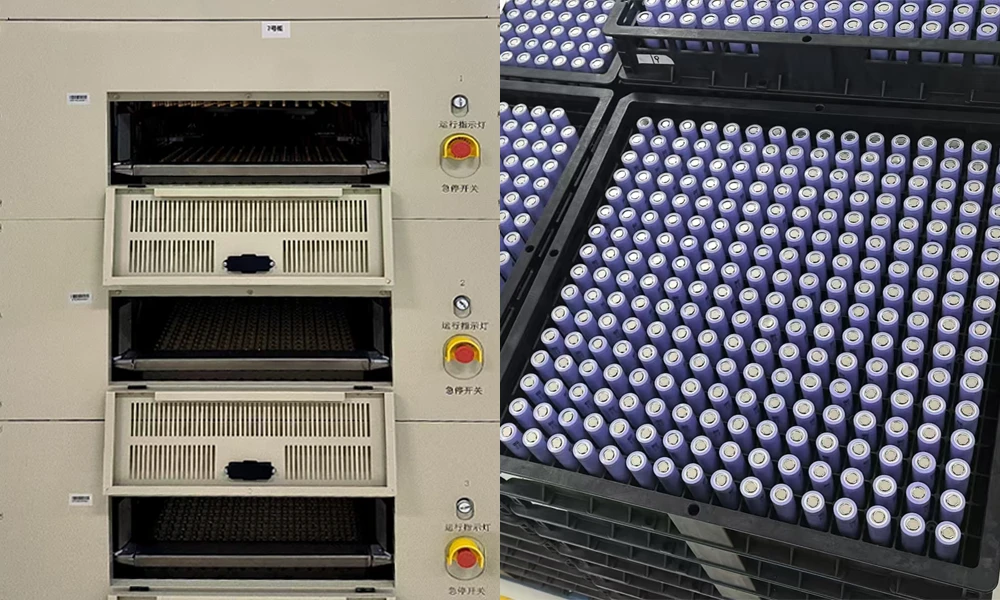
Where Formation and Grading Fit in Cylindrical Cell Production
In the manufacturing chain for a cylindrical lithium-ion cell, the formation and grading step occurs after cell assembly (winding, insertion into the can, tab welding, electrolyte filling, and cap sealing) and before the finished cell is sorted into packs or shipped. The sequence is:
- Cell assembly – The jellyroll is inserted into the steel can, tabs are welded, electrolyte is filled, and the cap is crimped.
- Formation (the TOB-INVP-V5C6D6's role) – The first charge is applied under a precisely programmed current/voltage profile, forming the solid-electrolyte interphase (SEI) on the anode and activating the cell chemistry.
- Grading – The cell is discharged and recharged to measure its actual capacity, energy, and internal resistance. Cells are then sorted into capacity bins.
- Final inspection and packaging – OCV check, visual inspection, and packing.
The TOB-INVP-V5C6D6 performs both formation and grading in a single handling cycle: the cell is placed in the needle bed once and remains there through the entire programmed sequence. The 256-cell tray is loaded into each layer, the dual-cylinder mechanism lowers the needle bed onto the cells, and the process runs unattended under the protection and monitoring logic described below.
Because each of the 768 channels is independently controlled and monitored, a single cell that develops an anomaly does not affect the rest of the batch. The channel's protection parameters—set individually for each step type (CC charge, CV charge, CC discharge, rest)—terminate the test of that cell while the remaining channels continue their program.
How the Energy-Feedback Formation and Grading System Works
The TOB-INVP-V5C6D6 uses a two-stage power architecture and a bidirectional inverter to recover the energy released during cell discharge.
- Power flow during charge: Three-phase AC mains (380 V ± 15 %, 50 Hz ± 10 %) enters the rectifier stage, which converts it into a regulated DC bus with a power factor above 0.99 and a total input current harmonic distortion below 5 %. Each channel's DC module draws from this bus and regulates the charge current to the cell under constant-current or constant-voltage control. The charging efficiency exceeds 70 % (measured at 380 V AC mains with the battery fully loaded during discharge). The energy available for charging is drawn from the grid plus the energy recovered from cells that are simultaneously discharging.
- Power flow during discharge: When a cell is discharged, the per-channel DC module first boosts the cell voltage onto the internal DC bus. The bidirectional inverter then converts this DC energy into AC, synchronises it with the factory mains, and feeds it back onto the local AC distribution network. The recovered energy is preferentially consumed by other equipment on the same bus—including cells that are charging in other channels—and any surplus is returned to the wider grid. The overall energy-feedback efficiency exceeds 65 % under rated conditions (measured at 380 V AC mains with the battery fully loaded during discharge).
- Distributed digital signal processing: The system processes all measurement and control signals at the lowest hardware level rather than transmitting raw analog signals over long cable runs. Each channel's current and voltage are digitised locally and transmitted as digital data to the central controller. This distributed architecture minimises electromagnetic interference and significantly improves the sampling and control precision.
- Industrial DSP control: An industrial-grade high-performance DSP serves as the main control chip, providing the processing power and reliability required for a 768-channel system running unattended for long periods. The DSP coordinates the per-channel DC modules, the rectifier stage, the bidirectional inverter, the needle-bed pneumatic actuators, and the communication with the host computer.
Key System Capabilities
- Two-Stage Modular Architecture with Independent Channel Control - The rectifier stage (shared) and the DC module stage (per-channel) separate the functions of bulk AC-to-DC conversion from per-cell current/voltage regulation. This design provides high rectifier efficiency, low input current distortion, and independent high-precision control of each channel. A fault in one DC module does not affect the others.
- Significant Energy Savings and Lower Factory Heat Load - Under the same conditions, the power consumption of the TOB-INVP-V5C6D6 is 50 % of that of a conventional system, and the ambient temperature of the production area can be reduced by 5–15 °C. Both figures are direct consequences of the energy-feedback discharge path: instead of dissipating the discharge energy as heat in a resistor bank, the inverter returns it to the grid. Lower ambient temperature also reduces the load on the facility's air-conditioning system, creating a compounding energy saving.
- Low Grid Harmonics (THDI < 5 %) - The rectifier stage is designed to draw current with a total harmonic distortion below 5 %, far better than the distortion produced by conventional thyristor-based charging rectifiers. This reduces the interference with other equipment on the factory grid and may avoid the need for external harmonic filters.
- Multi-Level Software and Hardware Protection - Separate protection parameters and methods can be configured for every step type (CC charge, CV charge, CC discharge, rest, etc.). If any anomaly occurs during the test, the affected channel is terminated promptly. A wide range of protection functions is provided: grid voltage/frequency over-limit, battery reverse connection, voltage/current upper and lower limits, capacity limits, temperature monitoring, tray-position detection, abnormal air pressure, smoke alarm, and an emergency stop button. Several of these protections trigger the needle bed to open automatically and pause the run; the system can then resume from the interruption point without restarting the entire process.
- 768 Channels per Cabinet (3 Layers × 256 Channels) - Each cabinet houses three needle-bed layers, each accommodating a 16×16 cell tray (256 cells), giving a total of 768 channels per cabinet. One host computer can control up to six cabinets.
- Unattended Operation with Comprehensive Monitoring - The system is designed for long-duration, unattended operation. Temperature monitoring is provided at up to 8 detection points per layer; if over-temperature is detected, the needle bed opens automatically and the run pauses, with the temperature sampled and logged to the operation interface. Communication interruption for more than 1 minute automatically pauses the channels, and the process resumes once communication is restored.
- Flexible Process Programming and Grading Conditions - The control software supports CC charge, CV charge, CC-CV charge, CC discharge, and rest steps, with up to 5000 cycles. Grading conditions can be based on capacity (step-termination capacity, platform capacity), time (step-termination time, platform time), voltage (current voltage, step-end voltage), or MPV. Custom grading conditions can be added on request.
- Full Traceability with Barcode Integration and Local Database - Necessary data is written into a local database; combined with the barcode input function, the history of every cell can be traced. Each channel retains the most recent 5 test records, and the barcode scan function allows direct retrieval of the historical data for a given barcode. Data can be exported in Excel format.
- Pre-Test (Contact Check) Function - The operator can set charge current and time parameters to perform a needle-bed contact test before the main process begins. If the number of channels with poor contact exceeds a user-set limit, the needle bed automatically lifts and the run does not proceed; otherwise, the normal process begins. This function prevents the waste of a full formation run caused by one or more channels with poor probe contact.
- Power-Down Continuation - If the computer or the equipment suddenly loses power, the system can manually resume the process from the state at the moment of power loss when the equipment is next started, avoiding the loss of an in-progress batch.
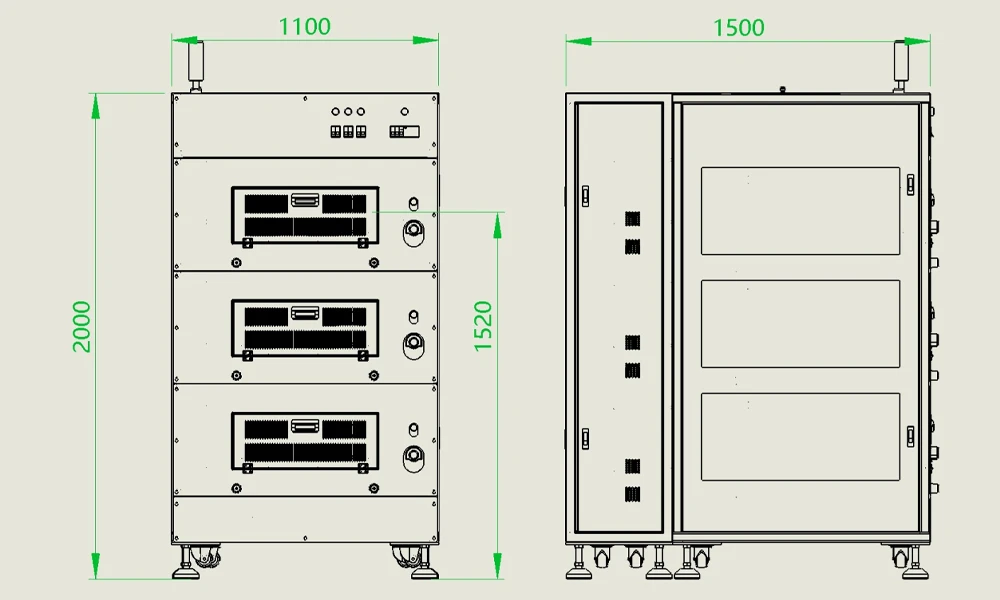
Complete Technical Specifications
Product Configuration
|
Component
|
Model | Remarks |
| Needle-Bed Cylindrical Cell Formation and Grading System | TOB-INVP-V5C6D6 | Cabinet includes the mid-level controller |
| PC Computer (optional, customer-supplied) | – | 500 GB HDD 7200 rpm, memory ≥4 GB, CPU i5 processor, Win7 32-bit or below, ≥1 standard serial port, ≥2 network ports |
Technical documentation and software language: Chinese and English (extensible); machine exterior identification in Chinese and English (extensible).
Volume and Weight
| Model | H × W × D (mm) | Net Weight (kg/cabinet) | Gross Weight (kg/cabinet) | Remarks |
| TOB-INVP-V5C6D6 | 2000 × 1100 × 1500 | 1500 | 1700 | Integrated one-piece structure; dual-cylinder push structure; each layer moves independently |
Noise, Lightning and Protection Class
| Item | Specification |
| Noise | < 70 dBA, tested per IEC 62040-3; sound level meter per IEC 804 Type I, accuracy better than ±0.5 dB |
| Lightning Protection | IP20 |
| Protection Class | IP20 |
Safety Compliance
| Sales Region | Safety Standard | Certification Body | Remarks |
| Mainland China | GB 4943-2001 | Passed internal company review |
Cooling method: Forced air cooling; 9 fans per layer; air is drawn out from the top.
Electrical Characteristics
Basic Electrical Parameters
| Parameter | Specification |
| Distribution Capacity | 28.8 kW |
| Model | TOB-INVP-V5C6D6 |
| Number of Channels | 256 channels per layer, 768 channels per cabinet |
| Control Computer | Each computer can control 6 units |
| Mains Input Method | Three-phase, 5-wire |
| Mains Voltage Range | 380 Vac ± 15 % |
| Mains Frequency | 50 Hz ± 10 % |
| Power Factor | > 0.99 (condition: full configuration, rated grid voltage, full-load charge or discharge) |
| Inrush Current | 10 A |
| Current Harmonic Content (THDI) | < 5 % |
| Battery-Side Rated Power | 30 W |
| Battery-Side Voltage | Charge 0–5 V, discharge 2–5 V |
| Charge Current | 20 mA – 6 A |
| Discharge Current | 20 mA – 6 A |
| Current Rise Time (90 % load) | 50 ms |
| Channel Start-Up Time (90 % load) | 50 ms |
| Charge Efficiency | > 70 % (380 V AC mains, battery full-load discharge) |
| Overall Feedback Efficiency | > 65 % (380 V AC mains, battery full-load discharge) |
| Battery-Side Impedance | > 100 kΩ |
| Storage | Conforms to GB/T 4798.1-2005 |
| Panel Display | LED |
| Maximum Withstand Input Voltage | 450 Vac, 1 hour (static) |
| Power Module MTBF | 30,000 hours |
| Communication Interface | Ethernet 10 M |
| Operating Temperature | 0–45 °C |
Accuracy Parameters
| Item | Accuracy |
| Battery Current Accuracy | ± (0.05 % FS + 0.05 % RD) |
| Battery Voltage Accuracy | ± 3 mV |
| Battery Current Resolution | 0.1 mA |
| Battery Voltage Resolution | 0.1 mV |
| Time | 1 s |
| Noise and Ripple | 50 mV (Vpp) |
| Calibration Cycle | Current: 6 months; Voltage: 6 months |
Probes and Tray
| Item | Parameter |
| Probes | Three-pin structure; upper and lower pins use identical three-pin assemblies; service life > 10,000 cycles; probe contact resistance ≤ 10 mΩ (cell surface clean and oil-free) |
| Tray | Dedicated 16×16 tray for 32600/32900 cells (per customer's official drawing); external dimensions 780 mm (W) × 780 mm (L) × 120 mm (H) (per customer's official drawing); channel spacing 45 × 45 mm (per customer's official drawing) |
| Temperature Uniformity | Maximum difference among temperature sampling points within the same tray ≤ 3 °C (same process and same cell model simultaneously; cell-to-cell variation excluded) |
| Temperature Probe Accuracy | ± 2 °C; resolution 0.1 °C |
Environmental Conditions
| Item | Parameter |
| Ambient Temperature | 23 ± 5 °C |
| Humidity | 30 % – 75 % |
| Atmospheric Pressure | 750 ± 30 mmHg |
| Compressed Air | ≥ 0.5 MPa |
Protection Functions and Logic
| Protection Item | Logic Description | Handling Method |
| Grid Voltage Over-Limit | Grid voltage above maximum or below minimum; inverter stops running; equipment locks | Requires power-off restart |
| Grid Frequency Over-Limit | Grid frequency above maximum or below minimum; inverter stops running; equipment locks | Requires power-off restart |
| Battery Reverse Connection | Battery voltage detected below the set protection value; channel locks and cannot start | After the reverse connection is corrected, manually re-send |
| Global Protection Parameters | Battery reverse connection protection; voltage lower-limit protection; voltage upper-limit protection; current upper-limit protection | |
| CC Charge Protection Parameters | Abnormal voltage trend; abnormal charge current fluctuation; abnormal voltage fluctuation; charge voltage time setting; abnormal charge voltage rise speed | |
| CV Charge Protection | Abnormal current trend; abnormal charge current fluctuation; abnormal voltage fluctuation | |
| CC Discharge Protection | Abnormal voltage trend; abnormal discharge current fluctuation; abnormal voltage fluctuation; abnormal discharge voltage fall speed | |
| Capacity Limit | Capacity exceeding the set value during a step | Jump to the next step |
| Temperature Monitoring | 8 temperature detection points per layer; on over-temperature, the needle bed opens automatically and the run pauses; temperature is sampled periodically, displayed on the operation interface, and recorded automatically | Jump to next step or pause; can resume from the interruption point without restarting |
| Tray Position Detection | Checked before channel start and during operation | Automatically open the needle bed and pause; can resume from the interruption point |
| Abnormal Air Pressure Protection | Checked during operation | Automatically open the needle bed and pause; can resume from the interruption point |
| Smoke Alarm | Checked during operation | Automatically open the needle bed and pause; can resume from the interruption point |
| Emergency Stop Button | On emergency stop, the needle bed opens automatically | Automatically open the needle bed and pause; can resume from the interruption point |
| Power-Down Protection | On prolonged communication interruption exceeding 1 minute, the channels pause automatically; after communication is restored, the current process can continue |
Basic Functional Capabilities
| Function | Content | Remarks |
| Grading Condition Setting | Capacity condition: step-termination capacity, platform capacity; Time condition: step-termination time, platform time; Voltage: current voltage, step-end voltage; MPV | Custom grading conditions can be added per customer request |
| User Authority | Administrator: view and modify processes, manage engineer permissions; Engineer: view and modify processes; Operator: view processes | |
| Step Setting Conditions | CC-CV charge (set current value, constant-voltage value, current cut-off condition; capacity and time limits settable); CC discharge (set current value, voltage limit condition; capacity and time limits settable); Rest (time limit settable); Loop (up to 5000 cycles); CC charge (set current value, voltage limit condition; capacity and time limits settable); CV charge (set constant-voltage value, current limit condition; capacity and time limits settable) | |
| Data Monitoring | Displays the current, voltage, charge/discharge capacity, running step process, and current step name of each channel | Data can be exported in Excel format |
| Channel Safety Protection Log | When a channel stops due to protection, the software records the event and its cause | |
| Power-Down Continuation | If the computer or equipment suddenly loses power, the system manually resumes from the state at the moment of power loss on next start | |
| Local Database | Necessary data written to a database; combined with barcode input, enables traceability of every cell | Most recent 5 historical records per channel |
| Barcode Scanning | Direct query of the historical data corresponding to a barcode | |
| Pre-Test Function | User can set charge current and time parameters for a needle-bed contact test; if the number of channels with poor contact exceeds the set upper limit, the needle bed lifts automatically; otherwise, the normal process begins |
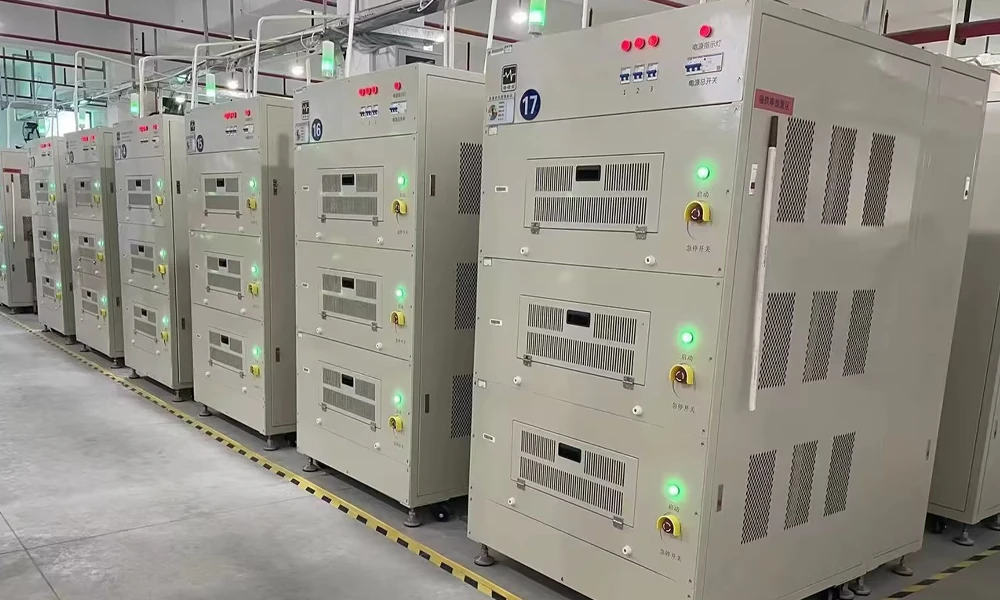
Practical Operation and Maintenance Recommendations
- Tray and probe alignment: Ensure that the 16×16 tray is correctly seated and aligned with the needle bed before lowering. The three-pin probe assemblies must be clean and free of oxide or oil; the rated contact resistance of 10 mΩ is only achievable on a clean cell surface. Periodically inspect and clean the probe tips.
- Compressed air supply: The dual-cylinder needle-bed mechanism requires a compressed air supply of at least 0.5 MPa. A clean, dry, regulated supply is essential for consistent needle-bed movement. Check the air pressure daily and ensure that the abnormal-air-pressure protection is enabled.
- Grid connection: The system draws three-phase 380 V AC (5-wire) and is sensitive to grid voltage and frequency. Verify that the mains supply is within the specified ±15 % voltage and ±10 % frequency ranges. The system's protection logic locks the inverter if the grid exceeds these limits; a power-off restart is then required.
- Ambient environment: The specified operating environment is 23 ± 5 °C, 30–75 % RH, and 750 ± 30 mmHg atmospheric pressure. Keep the cabinet in a well-ventilated area; the forced-air cooling system draws air out from the top, so the space above the cabinet must be kept clear.
- Calibration: The current and voltage calibration cycle is 6 months each. Calibration is performed via software; a certified reference meter is required. Keep calibration records for audit purposes.
- Data backup: Although each channel retains the most recent 5 test records and the local database stores the necessary traceability data, it is recommended to back up the database and the Excel-exported results to a network drive or server at the end of each production shift.
- Emergency procedures: Familiarise all operators with the emergency stop button. In the event of a smoke alarm, the needle bed opens automatically and the run pauses; the affected area should be inspected before resuming.
Engineering FAQ
Q1: What is the difference between the "energy-feedback" architecture of the TOB-INVP-V5C6D6 and a conventional formation cabinet?
In a conventional cabinet, the energy released during cell discharge is dissipated as heat in a resistor bank. This not only wastes the energy but also heats the production area, increasing the load on the air-conditioning system. The TOB-INVP-V5C6D6 instead routes the discharge energy through a bidirectional inverter back onto the factory AC grid, where it is consumed by other loads. This architecture reduces electricity consumption to 50 % of a conventional system and lowers the ambient temperature by 5–15 °C under the same conditions.
Q2: How many cells can one cabinet process per cycle, and how many cabinets can one computer control?
Each cabinet contains 3 layers × 256 channels = 768 channels, so 768 cells can be processed simultaneously. One host computer can control up to 6 cabinets, giving a single-computer capacity of 4,608 channels. The recommended configuration depends on the data-communication bandwidth and the complexity of the process programs.
Q3: What cell types can the TOB-INVP-V5C6D6 test?
The standard configuration is dedicated to 32600 and 32900 cylindrical cells, using a 16×16 tray with 45 × 45 mm channel spacing. The needle-bed, tray, and probe configuration are tooled per the customer's official drawing. Other cylindrical formats can be accommodated by supplying the corresponding tray and probe tooling; contact TOB with your cell drawing.
Q4: How does the pre-test (contact check) function work, and why is it important?
Before the main formation process begins, the operator can configure a short charge with a defined current and time. The system measures the contact of each channel during this pre-test. If the number of channels with poor contact (high resistance) exceeds a user-set upper limit, the needle bed lifts automatically and the run does not start. This prevents a situation where a full formation batch is ruined by a single tray with misaligned cells or dirty probes—a costly error that would otherwise only be discovered after the process had run for hours.
Q5: What happens if the communication between the host computer and the cabinet is interrupted during a run?
If the communication interruption lasts more than 1 minute, the channels automatically pause. Once communication is restored, the current process can be continued from the interruption point. In the event of a complete power loss, the power-down continuation function allows the operator to manually resume the process from the state at the moment of power loss when the equipment is next started.
Q6: How is the temperature monitoring distributed, and what does it protect?
Each needle-bed layer can be configured with up to 8 temperature detection points. During operation, the temperature is sampled periodically, displayed on the operation interface, and automatically recorded. If over-temperature is detected, the needle bed opens automatically and the run pauses. This protects both the cells (which could be damaged by excessive temperature during formation) and the equipment (probes, modules, and wiring). The run can be resumed from the interruption point without restarting the whole process.
Ready to reduce the electricity cost and heat load of your cylindrical cell formation and grading operation while gaining 768 channels of independent, high-precision control? Request a quotation for the TOB-INVP-V5C6D6, specifying your cell model, tray drawing, and host-computer configuration. Our formation-system engineers can provide a technical proposal and an energy-saving estimate based on your production profile.
tob.amy@tobmachine.com | +86 181 2071 5609
You May Also Need
- Hot Press Machine for Lithium Pouch Cell Formation — Applies controlled heat and pressure during pouch cell formation to improve electrode‑separator interfacial contact, extrude gas, and stabilise the SEI layer. Complements the TOB-INVP-V5C6D6 by preparing cells with consistent, high‑quality interfaces before electrical formation and grading.
- Negative Pressure Formation Machine for Prismatic Cell — A dedicated formation system for prismatic cells that operates under negative pressure to suppress gas swelling during SEI formation. Extends the energy‑efficient, high‑precision formation capability of the TOB-INVP-V5C6D6 to prismatic formats with stricter gas‑management requirements.
- 5V1A Cylindrical Cell Forming and Grading Machine — A compact, lower‑current formation and grading system for cylindrical cells. Ideal for laboratory‑scale or small‑batch testing where the high channel count and energy‑feedback architecture of the TOB-INVP-V5C6D6 are not required.
If you are interested in our products and want to know more details,please leave a message here,we will reply you as soon as we can.

 subscribe to us