Chinese
 français
 Deutsch
 italiano
 español
 português
 Nederlands
 日本語
 한국의




- Home
- >
- Cylindrical Cell Assembly Machine
- >
- Cylindrical Cell PVC Shrink Wrap Machine
- >
- Automatic Battery Shrink Wrap Machine for 46 Series Cells
Categories
Hot Products
Loading...
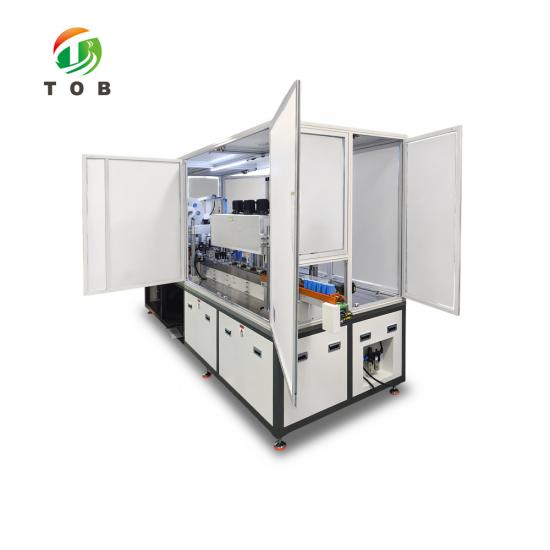
Automatic Battery Shrink Wrap Machine for 46 Series Cells
Brand:
TOB NEW ENERGYitem no.:
TOB-AFC-46-C1order(moq):
1 setPayment:
L/C,T/Tproduct origin:
Chinashipping port:
XIAMEN
Automatic Battery Shrink Wrap Machine for 46 Series Cells - TOB-AFC-46-C1
One chain sleeves, punches the positive pad and shrinks 4680, 4695 and 46120 cells, on a 70 to 71 mm sleeve roll and a frame sized for the 46 mm can
Product Overview and Ideal Applications
4680, 4695 and 46120 cells share one dimension and differ in another: all three are 46 mm across, and they stand 80, 95 and 120 mm tall. The diameter is what changes the machine. A sleeve that has to close around a 46 mm can is 70 to 71 mm flat, roughly twice the 33.5 to 34 mm that wraps a 21700, and every part that touches the sleeve follows from that number: the unwinder, the guide rods, the rotary cutter stroke, the chain pitch and the length of the tunnel.
TOB-AFC-46-C1 runs the whole sequence on one chain. A cell drops onto a magnetic seat, is indexed to the sleeving station where a measured length of PET or PVC is cut and pushed over the can, then to the pad punch where a positive insulation disc is cut from tape and dropped into place, past a presence check that ejects a cell without a pad, through a second positioning station, into a hot-air tunnel where the sleeve shrinks onto the can, and out to manual collection. Nothing is handled by hand between the first station and the last.
This is not the 21700 model fitted with a larger fixture. The frame is 3750 x 1400 x 2100 mm against 2750 x 930 x 1900 mm, the sleeve path and cutter are sized for a roll twice as wide, and the tunnel is longer because a taller can spends more time under the same heat. Capacity stays at 900 cells a day, on much larger cells.
Ideal for:
- 4680, 4695 and 46120 cells sleeved, padded and shrunk in one pass
- steel-case cylindrical cells held on magnetic seats
- lines that must hold the positive wrap to 3 mm
- PET or PVC sleeve on rolls up to 420 mm outside diameter
- output of 900 cells a day and above, with one operator at the outfeed
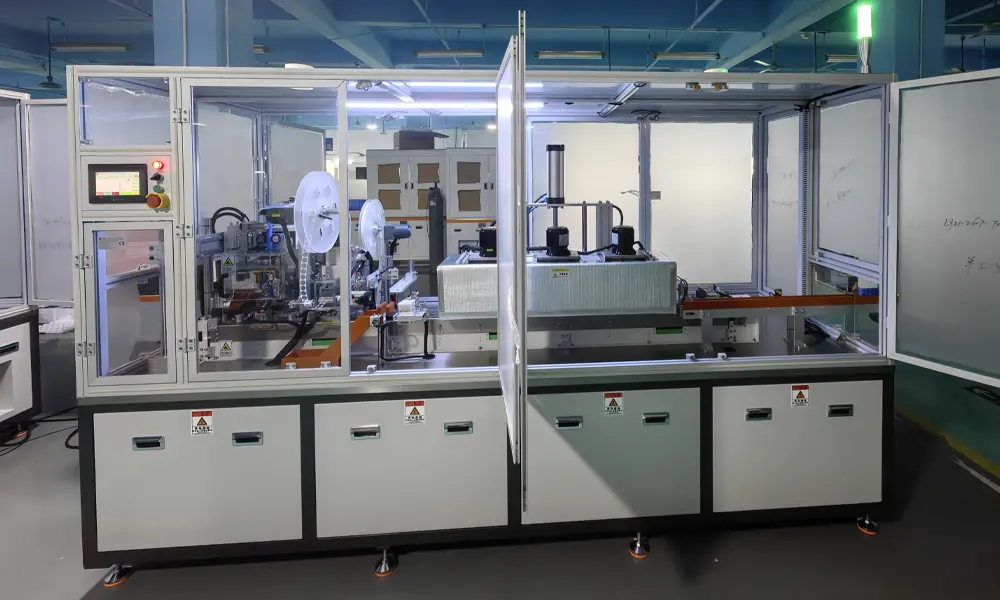
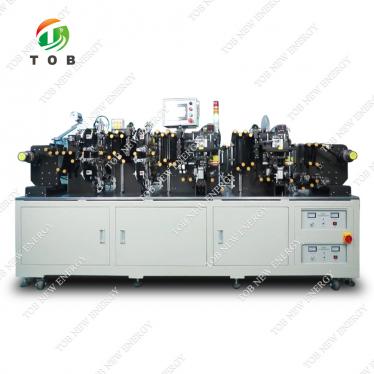
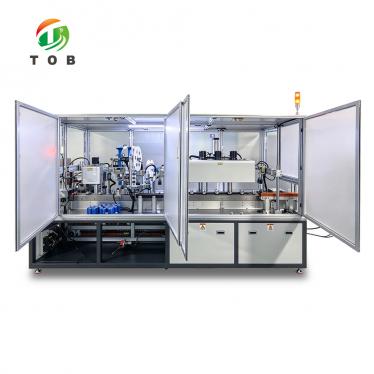
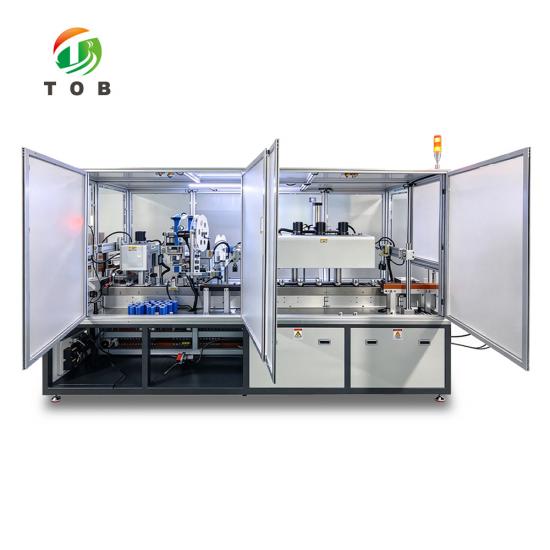
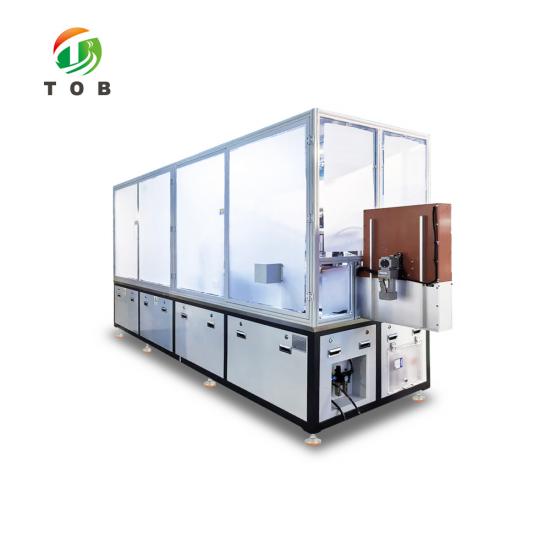
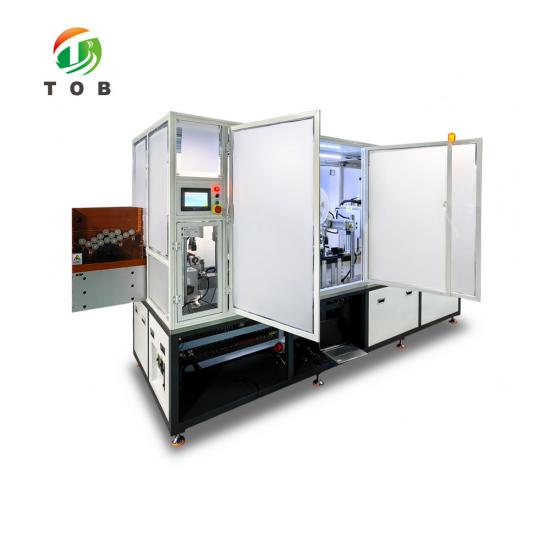
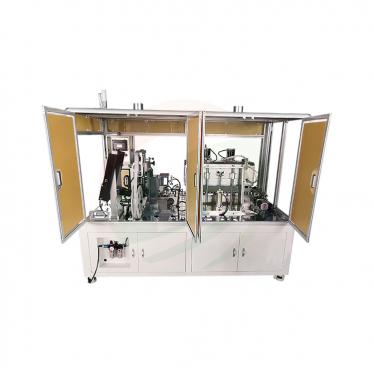
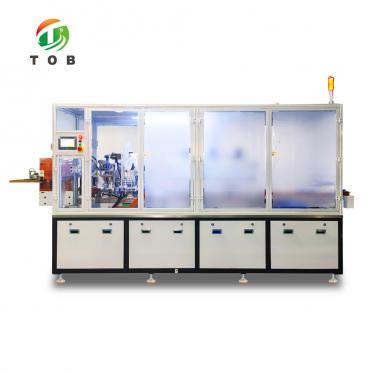
TOB-AFC-46-C1: three and a quarter metres of chain under a full mechanical guard, with the sleeve roll, pad tape roll and shrink tunnel in line.
Tell us the cell you run, 4680, 4695 or 46120, and the sleeve material you have qualified. Our engineer will confirm the sleeve width, the wrap dimensions and whether the tunnel needs a different length for your can height.
Complete the inquiry form below and our engineer will review your requirements. Prefer email? Contact tob.amy@tobmachine.com.
Complete Specifications
Two of these tables decide whether the machine suits your cell and the rest decide whether it suits your building. The sleeve table is the one to read first: a 70 to 71 mm roll is what a 46 mm can needs, and a 33.5 to 34 mm roll from a 21700 line will not work here.
1. Capacity and quality
| Item | Value | Note |
| Capacity per day | 900 cells or more | Rated, not measured |
| Capacity per minute | 2 cells or more | 2 per minute is 900 across a 7.5 hour shift |
| Product pass rate | 98% or more | Finished cells |
| Yield | 99% | Scrap caused by the machine only |
| Availability | 95% or more | Downtime caused by the machine only |
| Guard | Fully enclosed mechanical guard | Whole machine |
2. Sleeve, pad and wrap
| Item | Value | Note |
| Sleeve material | PET or PVC | Heat-shrink tube |
| Sleeve roll outer diameter | 420 mm max | |
| Sleeve width | 70.0 to 71.0 mm | Flat width as supplied, for a 46 mm can |
| Sleeve thickness | 0.05 to 0.15 mm | |
| Sleeve cut accuracy | ±0.7 mm | Rotary ring cutter, stepper driven |
| Insulation pad | Punched from tape, placed on the positive end | Presence checked before the tunnel |
| Positive end wrap | 3 mm, +0.95 / -0.90 mm | As specified on the drawing |
| Negative end wrap | 2.5 mm, +1 / -1 mm | As specified on the drawing |
| Top and bottom wrap width | 1.5 to 2.5 mm | After shrinking |
3. Tunnel and heat
| Item | Value | Note |
| Tunnel temperature | 0 to 180 °C, adjustable | Set to the shrink result you need |
| Air movement | Recirculating hot air, distributed along the tunnel | Cells rotate on the chain as they pass |
| External surface temperature | Below 50 °C | Insulated outer panels |
4. Envelope and utilities
| Item | Value | Note |
| Dimensions (L x W x H) | 3750 x 1400 x 2100 mm | Actual dimensions are adjusted to the final configuration |
| Power | 7 kW | |
| Supply | 220 / 380 to 400 V AC, three phase four wire plus earth, 50 Hz | |
| Voltage fluctuation | Less than ±10% | |
| Compressed air | 6 bar | Dry and filtered at the inlet |
| Structure | Aluminium and stainless steel, or plated for corrosion resistance | Ergonomic layout |
5. Control system and components
| Item | Brand / specification | Note |
| PLC | Mitsubishi / Panasonic / Keyence | Fixed at order |
| Pneumatic components | SMC / FESTO | Cylinders, valves, FRL |
| HMI | Chinese and English interface | Language set at order |
| Sleeve cutter | Rotary ring cutter, stepper driven, bush guided | Cut accuracy ±0.7 mm |
| ISO | ISO 9001: 3050260408100Q ISO 14001: 305026082585E ISO 45001: 305026082584HS | Management system certificates |
The Ten Stations on the Chain
A cell enters the machine as a bare can and leaves it sleeved, padded and shrunk, without being picked up and put down in between. The sequence below is the order the stations sit in on the chain, and each of them does one thing to the cell before passing it on.
Cells are loaded at the infeed and drop onto the magnetic seats on the chain. The chain indexes them forward one pitch at a time: sleeve on, pad in, pad checked, height set, position corrected, shrink, out. A cell that fails the pad check is ejected before it reaches the tunnel rather than being found later in the collection box.
1. Sleeving: unwind, feed, cut and place
The sleeve station holds the roll, releases a measured length, cuts it square and pushes it over the can. A servo-driven unwind and guide rods keep the flat sleeve on centre as it comes off a roll up to 420 mm in diameter; the cut is made by a rotary ring cutter driven by a stepper motor and guided by a bush, which is where the ±0.7 mm cut accuracy comes from. The tube is then positioned for height in two stages so the wrap at the top and bottom ends lands where the drawing says.
The cell itself is held by a V-block driven by a cylinder, so the can is centred before the sleeve descends over it. When a roll runs out, the new roll is joined to the old one with tape and the line keeps running; nothing has to be re-threaded through the guide path for every roll.
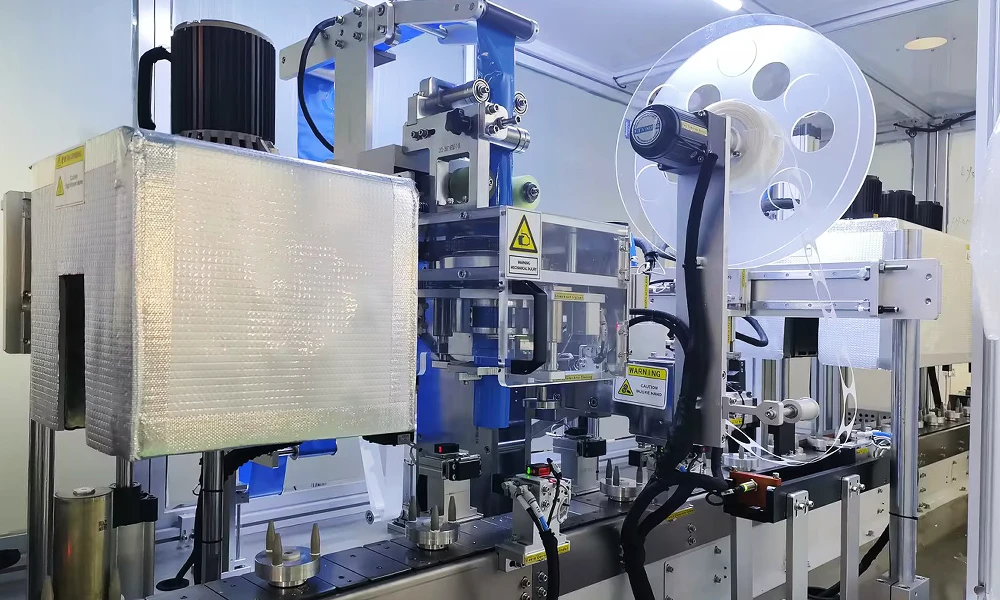
The sleeving station: a 420 mm sleeve roll on the unwind, the stepper-driven rotary cutter in its guard, and the V-block that centres the can below it.
2. Pad punching and placement
The positive insulation pad is not a bought-in part. It is punched out of tape inside the machine and dropped straight onto the positive end of the cell: the tape unwinds, a stepper pulls it forward by one pitch, a pneumatic die cuts a disc, and the spent tape is wound onto a take-up spool. Because the pad is cut fresh for each cell, there is no bin of loose discs to deplete and no chance of the wrong pad being loaded.
Immediately after placement the cell passes a presence check. A cell with no pad, or with a pad sitting off centre, is rejected before the tunnel; finding that defect after shrinking means scrapping a finished cell instead of a bare can.
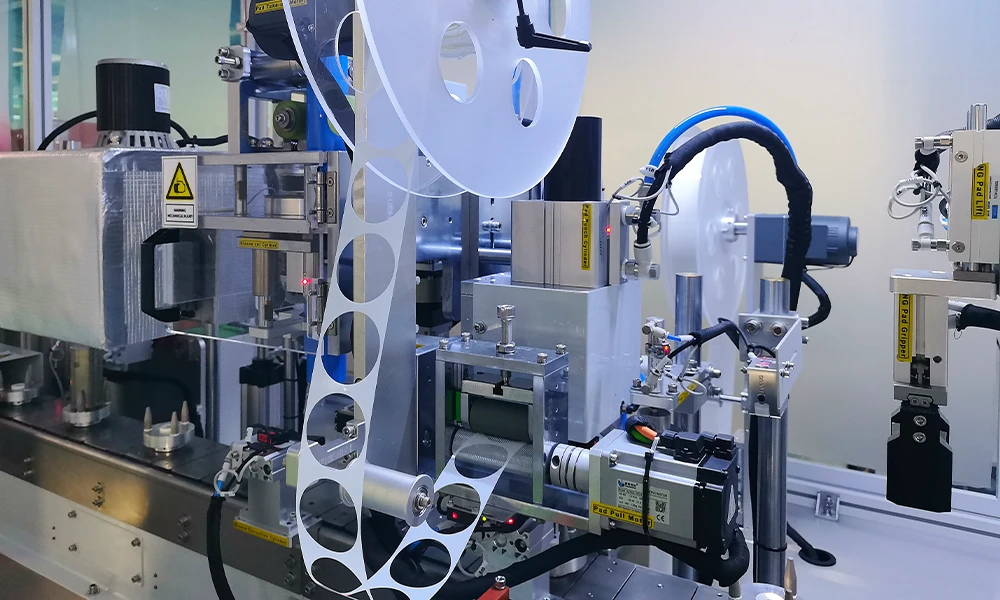
The pad station: tape off the roll, a pneumatic die cutting one disc per cell, and the punched tape running on to the take-up spool.
3. Position correction before the tunnel
Between the pad check and the tunnel there is a station whose only job is to correct the position of the cell on its magnetic seat, so the magnet grips the bottom centre of the can. That matters more on a 46 mm cell than on a 21700: the surface the magnet has to hold is larger and the sleeve hangs further below the seat, so a cell sitting off centre will let the bottom wrap ride against the magnet and curl. Correcting the position first is cheaper than rejecting curled cells afterwards.
4. Shrinking in the tunnel
Inside the tunnel, recirculating hot air is distributed along the length of the chamber and the cells rotate continuously as the chain carries them through. Rotation is what keeps the shrink even around a can this size: a stationary cell shrinks on the side facing the airflow first, and the sleeve ends up tighter on one side, which shows as a seam or a wrinkle. Air temperature is set between 0 and 180 °C and held to what the sleeve needs, and the outer panels stay below 50 °C so nobody is burned leaning past the machine.
5. Chain and magnetic seats
The transport is a chain and sprocket set driven by a stepper, with a magnetic seat on every link plate. The magnet is what carries the cell through the stations without a gripper: it holds the can upright, lets the sleeve drop over it, and keeps it vertical through the tunnel. Because the holding force is magnetic, the arrangement suits steel-case cells; if your cells are not magnetic, say so at the enquiry and the handling is reviewed before the machine is configured.
Drives, Cutter and Pneumatics
The control architecture is deliberately conventional, because a machine that runs two cells a minute for years is better served by parts a local electrician can replace than by a novel architecture. The PLC is Mitsubishi, Panasonic or Keyence, fixed when the order is placed; pneumatics are SMC or FESTO; and the HMI runs a Chinese and English interface set at order.
The one place where the specification is unusually specific is the cutter. It is a rotary ring cutter driven by a stepper motor and guided by a bush, not a guillotine. A straight blade on a sleeve this wide tends to pull the tube as it cuts, and the resulting end is a fraction of a millimetre off square; a ring cutter that rotates around the tube cuts without dragging it, which is how the ±0.7 mm figure is held on a 70 to 71 mm sleeve.
Key Engineering Characteristics
- The sleeve path is built for a 70 to 71 mm roll. Guide rods, cutter stroke and unwind tension are set for the wide sleeve, which is the part a 21700 machine cannot be adapted to by changing a fixture.
- Two-stage height positioning. The sleeve is set for height before and after the pad goes in, so the top and bottom wrap land on the drawing rather than being trimmed later.
- A pad check that acts before the tunnel. Rejecting a pad-less cell at the bare-can stage costs one can; finding it after shrinking costs the can, the sleeve and the tunnel time.
- Position correction ahead of the shrink. The magnet is made to grip the bottom centre of the can, which is what keeps the bottom wrap off the seat and stops curl on a tall cell.
- Rotation through the tunnel. Cells turn as they travel, so the shrink is even around the circumference instead of being strongest on the airflow side.
- Full mechanical guard. The whole machine is enclosed, with the HMI and the emergency stop on the outside where an operator can reach them without opening a panel.
Why the 46 Format Redesigns the Machine, Not Just the Tooling
A heat-shrink sleeve is supplied flat and has to close around a cylinder, so its flat width is set by the circumference it has to cover. A 46 mm can has a circumference of about 145 mm, which puts the flat sleeve at 70 to 71 mm; a 21 mm can has a circumference of about 66 mm, which puts its sleeve at 33.5 to 34 mm. That single relationship is why the two machines in this family share a process but not a sleeve path.
Doubling the sleeve width changes more than a guide setting. The unwind has to carry twice the web tension without stretching the tube, the guide rods have to spread wider and hold a wider flat without letting it twist, and the cutter has to travel twice as far per cut while still finishing square within ±0.7 mm. On top of that, a 4680 can stands 80 mm tall, a 4695 stands 95 mm and a 46120 stands 120 mm; at the same two cells a minute, a taller can needs a longer tunnel to absorb the same heat, which is one of the reasons the frame is a metre longer than the 21700 model.
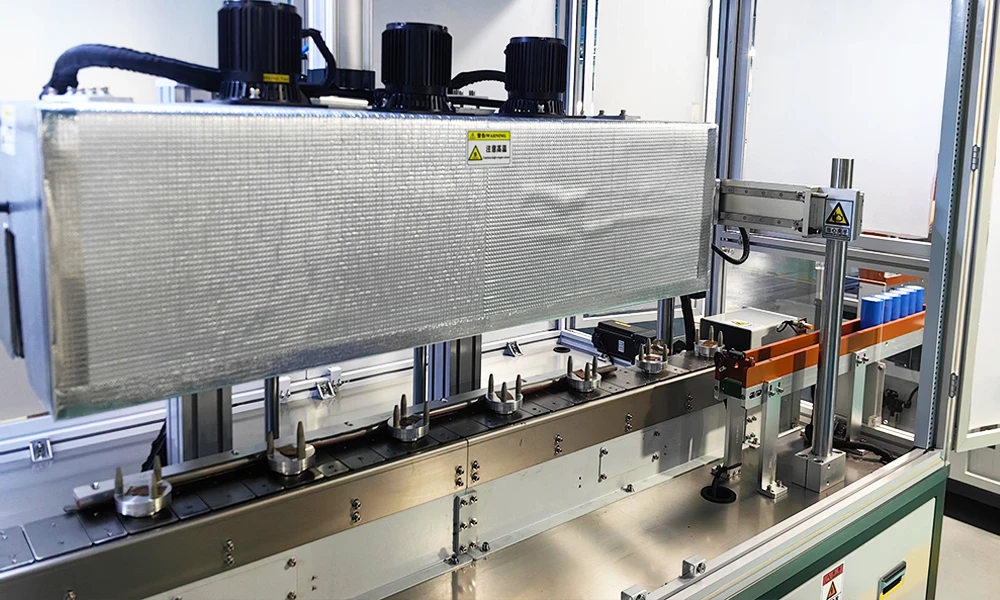
The tunnel over the chain: recirculating fans along the top, cells turning on their seats as they pass, and the first shrunk cells visible at the far end.
The wrap dimensions are where the larger format shows up as a quality risk rather than a mechanical one. A 3 mm positive wrap on a 46 mm end face covers a smaller share of that face than the same 3 mm would on a 21 mm can, so the tolerance of +0.95 / -0.90 mm leaves less visual margin. That is why the position correction station sits directly before the tunnel and why the sleeve is set for height twice: the wrap is decided before the heat arrives, not corrected after it.
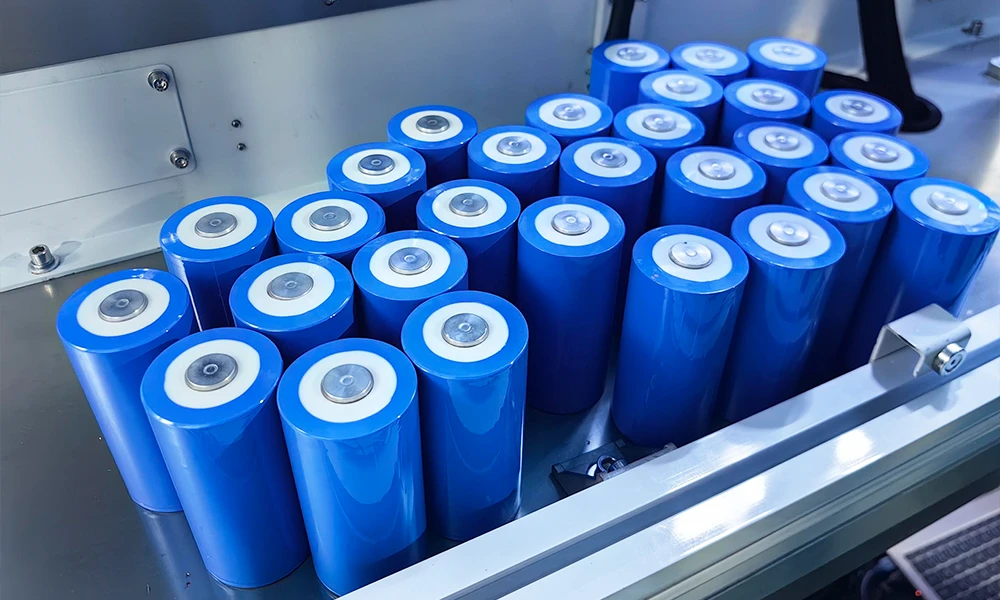
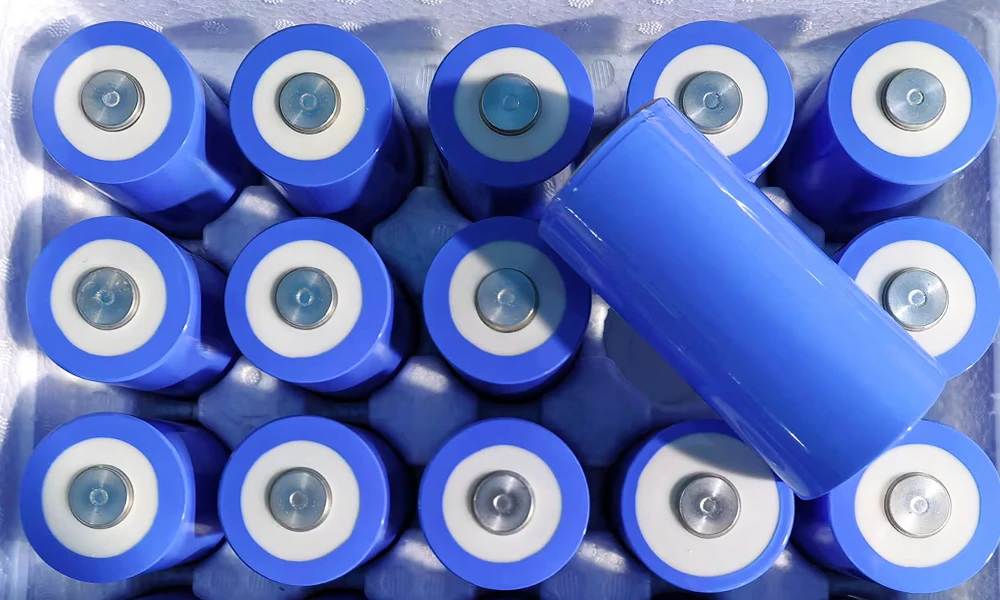
The result, when the three settings agree, is a cell where the sleeve sits flat to the can at both ends and the pad is centred on the positive terminal. The two photographs below are finished 4680 cells from this machine, one loose and one packed in a blister tray.
|
|
| Finished 4680 cells: the pad centred on the positive terminal, the sleeve flat to the can and the wrap even at the top edge. | The same cells in a blister tray at the outfeed, ready for the next assembly step. |
How This Differs from the TOB-AFC-21700-C1
The two machines are in the same family and the questions that reach us are always the same: what actually changes, and can one machine do both. The table answers the first; the answer to the second is no, because the sleeve width decides the tooling and the sleeve width follows the can diameter.
| Item | TOB-AFC-21700-C1 | TOB-AFC-46-C1 |
| Cell format | 21700 | 4680, 4695, 46120 |
| Sleeve flat width | 33.5 to 34.0 mm | 70.0 to 71.0 mm |
| Machine L x W x H | 2750 x 930 x 1900 mm | 3750 x 1400 x 2100 mm |
| Capacity | 900 cells a day, 2 a minute | 900 cells a day, 2 a minute |
| Pass rate / yield / availability | 98% / 99% / 95% | 98% / 99% / 95% |
| Sleeve cut accuracy | ±0.7 mm | ±0.7 mm |
| Tunnel range | 0 to 180 °C | 0 to 180 °C |
| Power | 7 kW | 7 kW |
Everything below the sleeve in that table is the same, and that is intentional: the tunnel curve, the pad punch, the position correction and the chain logic were proven on the smaller format first. What changes is the sleeve path, the chain pitch and the length of the frame. The 21700 version is described in full on Automatic Battery Shrink Wrap Machine for 21700 Cells, if you need to compare the two at cell level.
Changeover, Quality Checks and Safety
All three cells in the 46 family take the same sleeve width, so moving between 4680, 4695 and 46120 is a question of how tall the cell stands and where the wrap lands rather than a change of tube. The seats and the height settings for the formats you run are confirmed against your cell drawing when the order is placed, and the change parts ship with the machine rather than being quoted later.
The checks that matter at start-up are the ones you cannot see from the HMI. A first-off cell should be measured at both ends: the positive wrap against 3 mm with +0.95 / -0.90 mm, the negative wrap against 2.5 mm with +1 / -1 mm, and the top and bottom wrap against 1.5 to 2.5 mm. Cut length belongs in the same check, since a sleeve cut long or short moves the wrap even when the height setting is right.
Safety on this machine is mostly a matter of not defeating the guard. The whole machine is enclosed in a mechanical guard, the emergency stop and the HMI are on the outside where they can be reached without opening a panel, and the tunnel panels are insulated so the outer surface stays below 50 °C. The chain keeps indexing while the machine is in automatic mode, so hands and tools stay outside the guard until the drive is stopped, not merely paused.
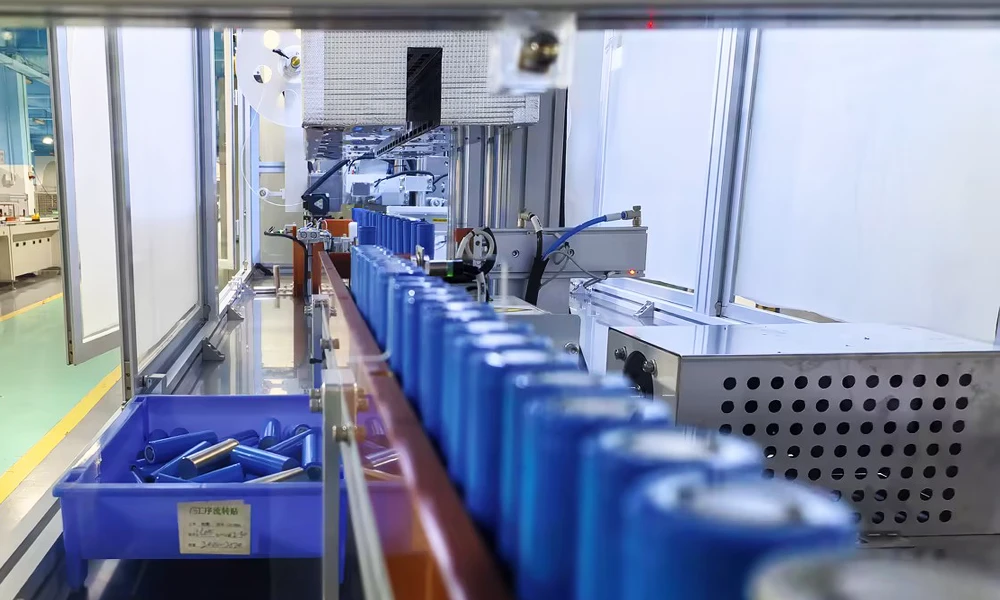
At the outfeed: sleeved and shrunk cells arrive in step and are collected by hand into the tray below.
Certification, Patents and Research Record
1. CE marking: what the certificate actually covers
The CE files held for this machine family are M.2024.206.C00042 under the Low Voltage Directive 2014/35/EU and M.2024.206.C00063 under the Machinery Directive 2006/42/EC with the EMC Directive 2014/30/EU, issued through CAC for a product described as a PVC shrinking machine. The model column reads TOB-RS4015, TOB-AFC-C1, TOB-AFC-C2 and TOB-TMD-A26.
It names the family designation TOB-AFC-C1, not the 46-qualified TOB-AFC-46-C1 on this page. If your project requires CE marking, we can provide it: the certificate is arranged for the configuration you order rather than claimed as already held for this model, so tell us at the enquiry stage and it is quoted with the machine. That also settles how the nameplate will read, which is a better place to settle it than at customs.
2. Management system certificates
ISO 9001:2015 (3050260408100Q), ISO 14001:2015 (305026082585E) and ISO 45001:2018 (305026082584HS). The 9001 certificate was issued on 8 April 2026 and runs to 7 April 2029; 14001 and 45001 cover the same plant. These describe the factory that builds the machine, not the machine itself, which is why they are listed apart from the CE files.
3. Patents
The company holds 55 Chinese patents. None of them is drawn on sleeve wrapping, pad punching or shrink tunnels, so nothing in the patent portfolio is offered here as protection for this machine. The engineering on this page rests on the mechanism described above, not on a patent claim.
4. Academic record
Our citation index holds 707 peer-reviewed records on equipment of this kind, 70 of which name a TOB model. None of the 707 names TOB-AFC-46-C1. Sleeving and shrinking are packaging steps that papers rarely document by machine model, so rather than borrow a citation from another machine to fill this space, this page states the number as it is.
5. Where this class of machine is used
TOB delivered a 32140 tabless cylindrical cell production line with stainless steel cans in Europe, a cylindrical line where sleeving and shrinking close the assembly. Lines for other formats are listed on the project pages linked from the pages below.
Engineering FAQ
Can one machine run 4680, 4695 and 46120?
Yes. All three are 46 mm in diameter and take the same 70 to 71 mm sleeve, so the tube and the cutter do not change; what changes is the height the cell stands at and where the wrap lands. The seat and height parts for the formats you actually run are confirmed against your cell drawing at order, and the machine ships with the change parts for those formats.
How is it different from the 21700 machine?
Three things, and only three. The sleeve is 70 to 71 mm instead of 33.5 to 34 mm because the can is 46 mm instead of 21 mm; the frame is 3750 x 1400 x 2100 mm instead of 2750 x 930 x 1900 mm because the sleeve path, chain pitch and tunnel are all longer; and the cells it handles are 4680, 4695 and 46120. Capacity, cut accuracy, tunnel temperature, wrap dimensions and power are identical.
Why is the sleeve 70 to 71 mm?
Because a flat sleeve has to close around the circumference of the can. A 46 mm diameter gives a circumference of about 145 mm, so the sleeve is supplied at about half of that, 70 to 71 mm. A 33.5 to 34 mm roll from a 21700 line has a circumference of about 68 mm and will not close around a 46 mm can at all.
What holds the cell while the sleeve shrinks?
A magnetic seat on each chain plate. Before the tunnel, a position correction station re-seats the cell so the magnet grips the bottom centre of the can; without that correction the bottom wrap can ride against the seat and curl. Because the holding force is magnetic, the arrangement suits steel-case cells; if your cells are not magnetic, say so at the enquiry so the handling can be reviewed.
What happens if a cell leaves the pad station without a pad?
It is rejected before the tunnel. The pad is punched inside the machine and placed on the positive end, and a presence check follows immediately; a cell that fails is ejected at that point, while it is still a bare can with a sleeve on it rather than a finished cell that has been through the heat.
Is TOB-AFC-46-C1 CE marked?
The certificates M.2024.206.C00042 and M.2024.206.C00063 name TOB-AFC-C1, TOB-AFC-C2, TOB-RS4015 and TOB-TMD-A26, not TOB-AFC-46-C1 itself. If you need CE marking, we can provide it for the configuration you order: raise it at the enquiry stage and it is quoted with the machine, together with how the nameplate will read.
Send us your cell drawing and the sleeve you have qualified. We will confirm the seat and height parts for your format, the wrap dimensions at both ends, and whether the tunnel length suits your can height.
Email: tob.amy@tobmachine.com | Mobile phone: +86-18120715609
Reviewed for technical accuracy by Science Wang, Six Sigma Black Belt, Battery Lines. For the sleeve and pad steps on a smaller format, read Heat Shrinking Machine for 18650 Cylindrical Battery and Supercapacitor, and for prismatic cells see Prismatic Cell Insulation Film Wrapping Machine TOB-SFCA-300.
If you are interested in our products and want to know more details,please leave a message here,we will reply you as soon as we can.






 subscribe to us