Chinese
 français
 Deutsch
 italiano
 español
 português
 Nederlands
 日本語
日本語 한국의
한국의




- Home
- >
- Battery Materials
- >
- Cylindrical Cell Casing Material
- >
- PET Insulation Spacer Roll for Cylindrical Cell Cap
Categories
Hot Products
Loading...
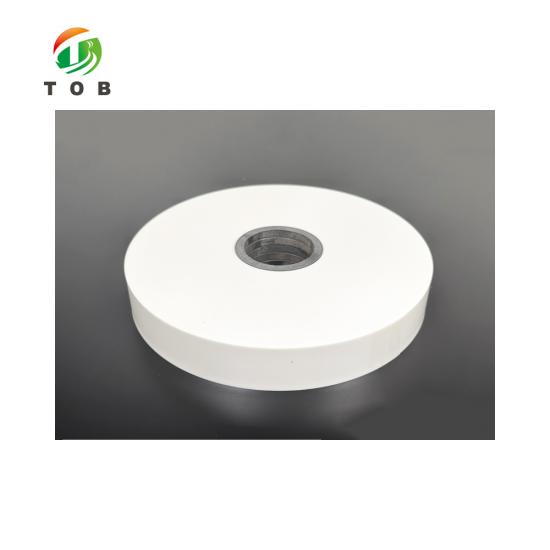
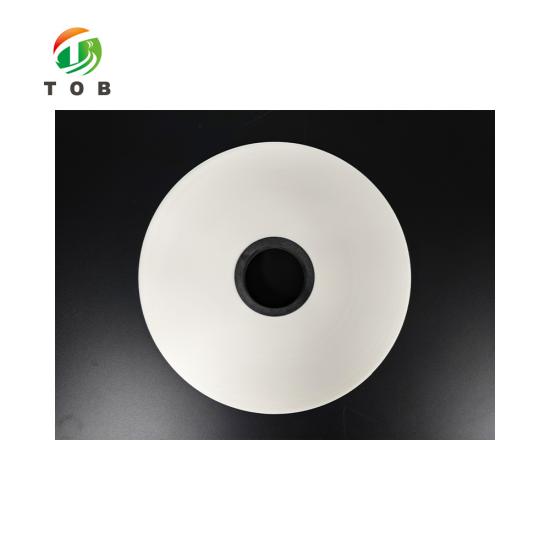
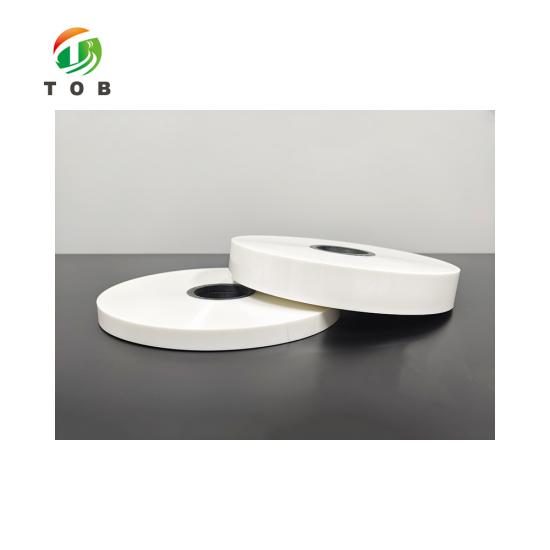
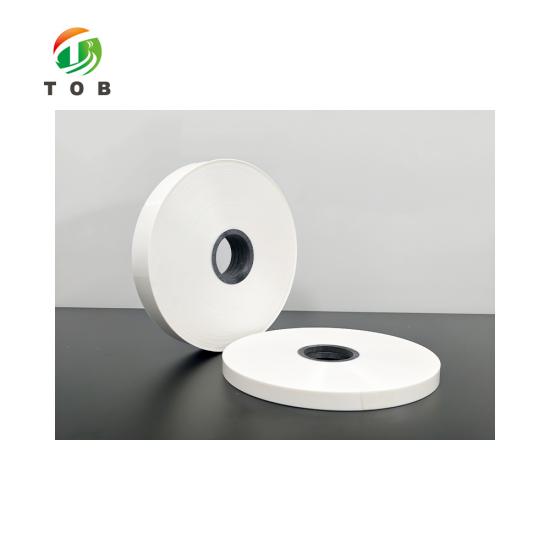
PET Insulation Spacer Roll for Cylindrical Cell Cap
Brand:
TOB NEW ENERGYitem no.:
TOB-Cy-Spacerorder(moq):
1Payment:
L/C,T/Tproduct origin:
Chinashipping port:
XIAMEN
PET Insulation Spacer Roll Material for Cylindrical Cell Cap Insulation
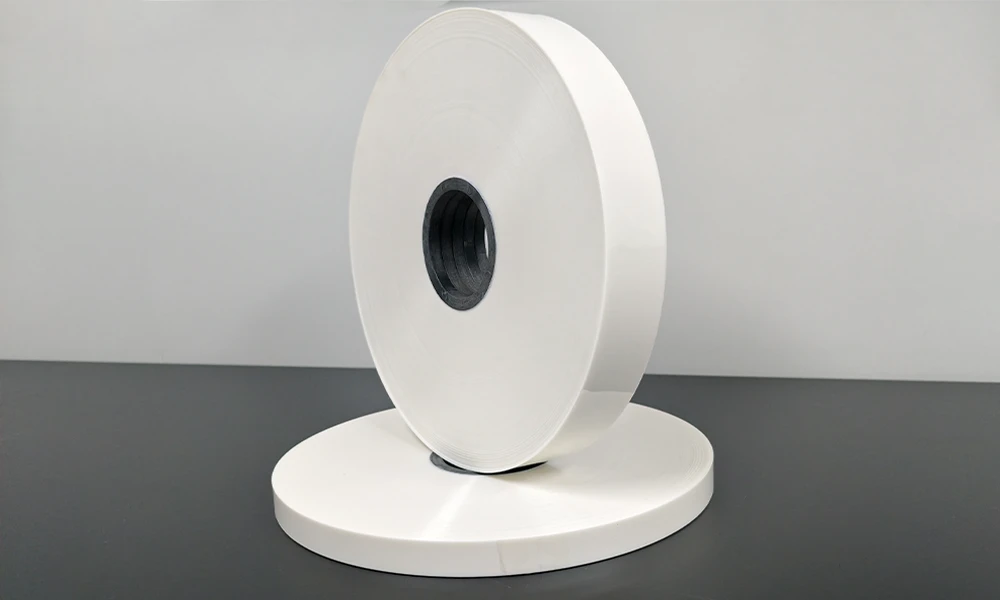
The TOB-Cy-Spacer is a PET (polyethylene terephthalate) roll material produced for the manufacture of cap insulation spacers used on finished cylindrical lithium-ion cells. It is supplied as a roll of 0.25 ± 0.02 mm PET sheet, not as pre-cut, ready-to-use spacers. To use the material, the cell manufacturer or pack assembler first slits the roll to the required width and then die-cuts or punches it into annular ring spacers with the inner and outer diameters specified for the target cell model. These ring spacers are then placed onto the positive cap of a finished cylindrical cell before the PVC heat-shrink packaging step.
In the final packaging stage of cylindrical cell production, the ring spacer is applied to the cap of a completed, formed, and graded cell, and the cell is then covered with PVC heat-shrink tubing that laps onto and holds the ring in place. This completes the external insulation of the cell top. The TOB-Cy-Spacer roll is therefore an upstream raw material for the cell-finishing operation, positioned before the slitting, die-cutting, and ring-application processes.
The cap insulation ring produced from this roll serves several functions at the finished-cell and pack level:
- Top terminal electrical isolation: On a cylindrical cell, the steel or aluminum can body is typically the negative terminal and the cap is the positive terminal. The ring spacer on the cap, held in place by the PVC film, insulates the cap-to-can transition region from conductive objects—such as nickel strips, busbars, cell holders, or BMS components in a battery pack—preventing unintended contact and short circuits during pack assembly and in service.
- Short-circuit protection during pack tab welding: During battery pack assembly, nickel strips are spot-welded to cell terminals. A weld placed near the cap edge, or a misaligned welding head, can bridge the cap (positive) and the can body (negative). The cap insulation ring provides a protective barrier that reduces this risk—a widely used anti-short design in cylindrical cell packs.
- Protection of the PVC heat-shrink film: The cap edge and its crimped step have relatively hard corners. Without a spacer, these edges can cut or pierce the PVC heat-shrink film during shrinking, handling, or transportation. The PET ring covers this step region and provides a smooth seat for the heat-shrink film, preventing tearing and preserving the external insulation layer.
- Neat, complete finished-cell appearance: The PVC heat-shrink film terminates cleanly against or around the ring at the cell top, producing a regular, professional finish.
Ideal for:
- Cylindrical lithium-ion cell manufacturers that produce cap insulation rings in-house by slitting and die-cutting roll material, then apply the rings during the PVC heat-shrink packaging of finished cells.
- Battery pack assemblers that receive bare cylindrical cells, die-cut cap insulation rings from roll material, and apply them before heat-shrink packaging.
- Contract cell-packaging and finishing operations that process cylindrical cells and require an economical roll-form source for cap insulation spacers.
- Manufacturers producing finished cylindrical cells in 18650, 21700, 26650, 32140, and similar formats where a cap insulation ring is part of the standard external packaging.
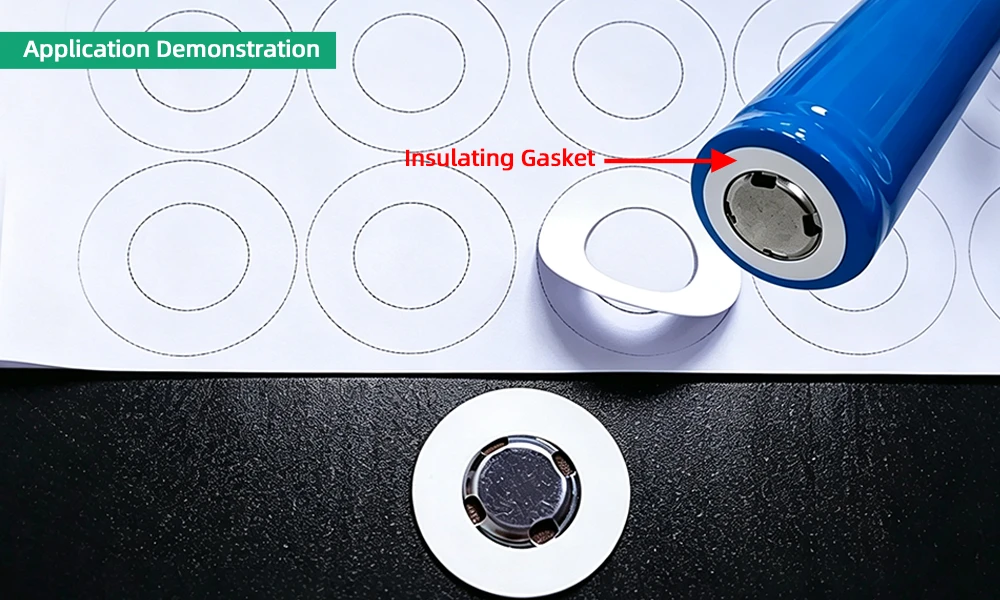
Where the Cap Insulation Ring Fits in the Finished-Cell Packaging Process
The TOB-Cy-Spacer roll is used in the cell finishing and packaging stage of cylindrical battery production. The material itself sits upstream of the actual ring application: the roll must first be converted into ring spacers before it can be placed on the cell. The complete process sequence is:
Step 1 — Slitting the roll: The TOB-Cy-Spacer roll is slit to the width required by the die-cutting tooling. Because the roll width is customizable, it can be matched to the target ring outer diameter and the layout of the punching die, minimizing material waste.
Step 2 — Die-cutting the ring spacers: The slit sheet is punched or die-cut into annular rings with the inner and outer diameters specified for the target cell cap. The inner diameter is set so that the ring clears or seats around the cap's center feature as required by the cell design; the outer diameter is set so that the ring covers the cap-to-can transition region and seats cleanly under the PVC film. Precision dies are recommended to produce burr-free, concentric rings.
Step 3 — Ring application: The die-cut ring is placed concentrically onto the positive cap of a finished cell. The ring lies flat on the cap, and its position is maintained during the subsequent packaging step.
Step 4 — PVC heat-shrink packaging: A PVC heat-shrink tube is slipped over the cell body and heated so that it shrinks tightly around the can. The film laps onto and holds the ring in place at the cell top, completing the external insulation of the cap-to-can transition region.
Step 5 — Pack assembly: The finished, PVC-wrapped cells are then assembled into packs, where the cap insulation ring provides the short-circuit protection barrier described above.
Because the TOB-Cy-Spacer is a raw material rather than a finished spacer, the material properties that matter most are those that support both the downstream conversion process and the final in-service function:
- Clean, defect-free sheet surface ensures that die-cut rings are free of stains, scratches, burrs, and embedded particles that would appear as defects under the transparent PVC film or contaminate the finished cell surface.
- Precise thickness control (0.25 ± 0.02 mm) provides the stiffness needed for the die-cut rings to lie flat and stay seated on the cap during handling and heat shrinking, while remaining thin enough not to interfere with the cell's fit in battery holders.
- Electrical insulation (volume resistivity ≥ 1.0 × 10¹³ Ω·m) ensures that the finished ring reliably isolates the cap region from conductive pack structures.
- Thermal stability (no deformation, melting, or softening at 150 °C) ensures that the ring does not warp or shrink away from its position when the PVC heat-shrink film is heated during packaging.
- Controlled shrinkage (≤ 3 % longitudinal, ≤ 2 % transverse after 30 min at 150 °C) keeps the ring concentric on the cap through the heat-shrink process.
- Electrolyte corrosion resistance (no color change or swelling after 24 h immersion) confirms the material's stability even if the ring contacts electrolyte traces during handling.
Technical Specifications
| Item | Unit | Standard Value | Test Instrument / Method |
| Material | / | PET | Gas chromatograph |
| Appearance (surface) | / | White, no stains, no stretching, no damage, smooth surface, dust-free, no obvious scratches, no burrs | Visual inspection |
| Width | mm | Customizable | Randomly take 1 m length for measurement |
| Thickness | mm | 0.25 ± 0.02 | Randomly take 1 m length for measurement |
| Core Inner Diameter | mm | 76 ± 0.5 | Caliper |
| Corrosion Resistance | h | No color change and no swelling after 24 h electrolyte immersion | Immerse in electrolyte for 24 hours |
| Shrinkage (longitudinal) | % | ≤ 3 | Heat in a high-temperature chamber at 150 °C for 30 min |
| Shrinkage (transverse) | % | ≤ 2 | Heat in a high-temperature chamber at 150 °C for 30 min |
| High-Temperature Resistance | °C | No deformation, no melting, no softening at 150 °C | Heat in a high-temperature chamber at 150 °C for 30 min |
| Volume Resistivity | Ω·m | ≥ 1.0 × 10¹³ | Resistance tester |
Material and Application Information
| Parameter | Specification |
| Chemical Composition | Polyethylene terephthalate (PET) |
| Application | PET roll material for cylindrical lithium-ion cells. The PET sheet is cut into ring-shaped spacers according to the battery model and dimensions, and the ring is placed onto the cylindrical cell cap for insulation protection before PVC heat-shrink packaging |
| Shelf Life | 1 year from production date (unopened, at −15–45 °C, relative humidity ≤ 95 %) |

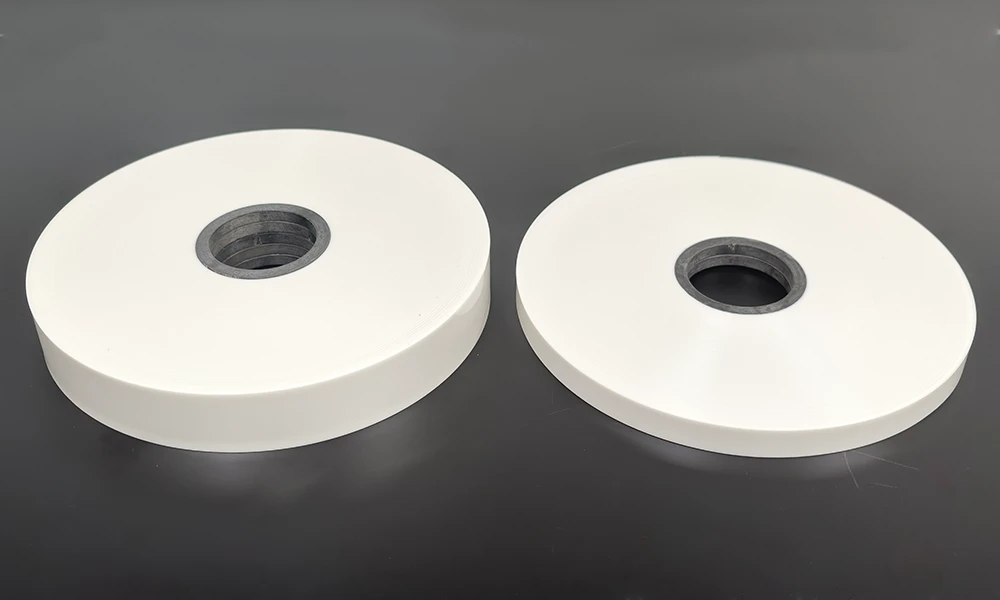
Key Engineering Characteristics of the TOB-Cy-Spacer Roll
- Battery-Grade PET in Roll Form - The TOB-Cy-Spacer is supplied as a continuous PET sheet roll on a 76 ± 0.5 mm inner-diameter core, making it compatible with standard roll-handling, slitting, and die-cutting equipment. This roll form allows the manufacturer to convert the material into ring spacers of any required geometry, matching each cell model's cap dimensions.
- Customizable Width for Efficient Die-Cutting - The roll width is customizable, allowing the manufacturer to match the sheet width to the die layout and minimize scrap during ring punching. The width is verified by measuring a random 1 m length, and the thickness of 0.25 ± 0.02 mm is controlled to the same tolerance.
- Reliable Electrical Insulation (Volume Resistivity ≥ 1.0 × 10¹³ Ω·m) - The high volume resistivity confirms that die-cut rings produced from this roll are genuine electrical insulators. Applied on the cell cap and held in place by the PVC film, they isolate the cap-to-can transition region from conductive pack components, preventing external short circuits.
- Thermal Resistance up to 150 °C — Survives the Heat-Shrink Step - The material shows no deformation, melting, or softening after 30 minutes at 150 °C. This is the decisive property for the final application: the PVC heat-shrink film is heated to shrink around the cell, and the ring must withstand that same heat without warping or lifting off the cap.
- Controlled Thermal Shrinkage (≤ 3 % longitudinal, ≤ 2 % transverse) - After 30 minutes at 150 °C, the material shrinks no more than 3 % longitudinally and 2 % transversely. This dimensional stability keeps the die-cut ring concentric on the cap during the heat-shrink process, so the insulation coverage is not compromised by thermal contraction.
- Electrolyte Corrosion Resistance (24 h Immersion) - The material shows no color change and no swelling after 24 hours of electrolyte immersion. Although the ring is applied externally on the finished cell, this resistance confirms the material will not degrade or discolor if it contacts electrolyte traces during handling or in electrolyte-vapor environments.
- Clean, Defect-Free Surface - The roll is specified as white, stain-free, un-stretched, undamaged, smooth, dust-free, and free of obvious scratches and burrs. A clean sheet surface is essential because die-cut rings inherit the sheet quality: any surface defect in the roll would appear on the finished ring under the transparent PVC film and could introduce particles onto the finished cell surface.
Packaging, Handling, Storage, and Shelf Life
The following requirements apply to the packaging, transport, and storage of the TOB-Cy-Spacer PET roll material, as specified by the manufacturer.
Packaging and Labeling
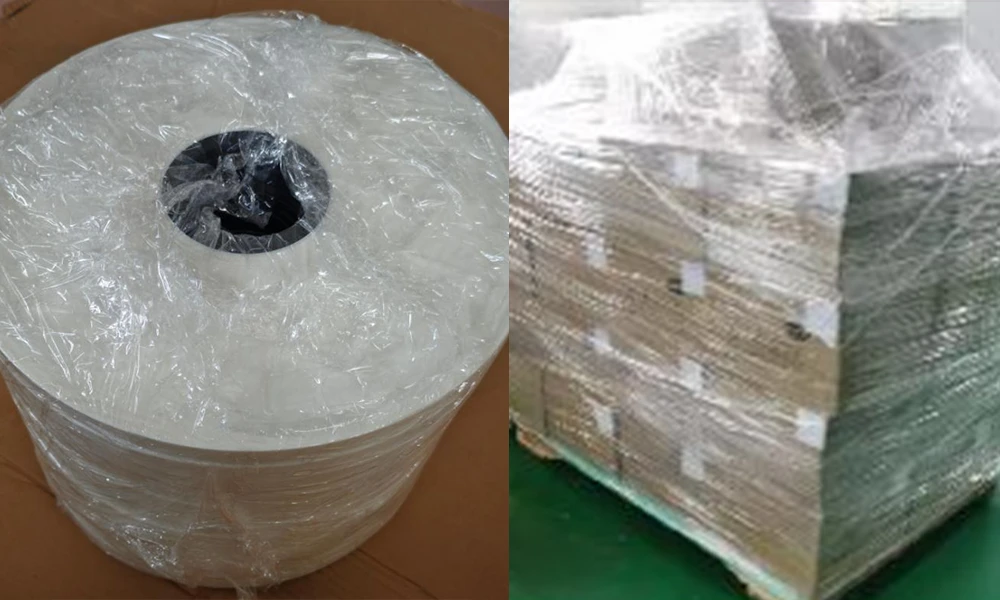
- Packaging method is mutually agreed between the parties; the general packaging method is: inner box packaging + pallet packaging (no more than 45 boxes per pallet).
- The product is packaged by wrapping film + carton + pallet. The product packaging is sealed, and an inspection report is enclosed in the package.
- Outer packaging label content: material name, specification, material code, quantity, production date, manufacturer name, RoHS marking, etc.
- On the same pallet, the production date and batch shall be consistent; only one pallet may contain a mixed batch at the tail end.
Handling
- The material shall be handled with care during transport, avoiding large impacts and vibration, and avoiding inverted placement and heavy stacking.
Storage and Protection
- The storage environment shall be clean and dry, with moisture-proof measures taken.
- During transport and storage, avoid direct sunlight, fire, and rain.
Shelf Life
- Temperature: −15 to 45 °C, relative humidity ≤ 95 %.
- Unopened: shelf life is 1 year from the production date.
Recommended Downstream Conversion Practice
The following guidance describes how the TOB-Cy-Spacer roll is typically converted into cap insulation rings and applied in cylindrical cell finishing:
- Slitting: Slit the roll to the width required by your die-cutting tooling. The 76 ± 0.5 mm core inner diameter fits standard roll-holding shafts on slitting and punching equipment. Keep the sheet clean and dust-free during slitting to preserve the surface quality.
- Ring die-cutting: Punch the sheet into annular rings with the inner and outer diameters specified for your cell cap. The inner diameter is set so that the ring clears or seats around the cap's center feature as required by the cell design; the outer diameter is set so that the ring covers the cap-to-can transition region and seats cleanly under the PVC film. Use precision dies to produce burr-free, concentric rings.
- Ring application: Place the die-cut ring concentrically onto the cap of the finished cell. Ensure the ring lies flat and is free of dust or debris before the heat-shrink step.
- PVC heat-shrink packaging: Slip the PVC tube over the cell and apply heat. The film shrinks around the can and laps onto the ring, holding it in place at the cell top. Because the PET material withstands 150 °C without deformation and with limited shrinkage, the ring maintains its position and geometry during this step.
- Cleanliness: Perform the slitting, die-cutting, and ring application in a clean, dry environment to keep the finished-cell surface free of particles and to maintain a professional appearance.
Engineering FAQ
Q1: Is the TOB-Cy-Spacer a ready-to-use insulation spacer, or a raw material?
The TOB-Cy-Spacer is a PET roll material (roll stock), not a ready-to-use spacer. To use it, the cell manufacturer or pack assembler must first slit the roll to width and then die-cut or punch it into annular ring spacers with the required inner and outer diameters for the target cell cap. Only after this conversion is the ring applied to the cell.
Q2: What is the role of the PET ring on a finished cylindrical cell cap?
The ring produced from this roll is an external insulation spacer applied to the positive cap of a finished cylindrical cell before PVC heat-shrink packaging. It insulates the cap-to-can transition region at the cell top, preventing external short circuits when the cell is installed in a pack or contacts conductive components. The PVC heat-shrink film holds the ring in place and completes the top insulation.
Q3: Is this ring used inside the cell or outside the cell?
The ring is used outside the finished cell. It is applied onto the cap of a completed, formed, and graded cell during the final packaging stage, before PVC heat-shrink wrapping. It is not an internal component of the cell construction, and it should not be confused with internal insulating parts.
Q4: Why is the 150 °C thermal resistance important for this application?
The PVC heat-shrink film is heated during packaging to shrink tightly around the cell. The PET ring is present on the cap during this heating step, so it must withstand the heat-shrink temperature without deforming, melting, or softening. The 150 °C resistance—with shrinkage limited to ≤ 3 % longitudinal and ≤ 2 % transverse—ensures the ring holds its position and geometry through the heat-shrink process.
Q5: What cell formats is this material suitable for, and how do I determine the ring dimensions?
The material is suitable for cylindrical lithium-ion cells that require a cap insulation ring in their finished-cell packaging, including 18650, 21700, 26650, 32140, and similar formats. The roll width is customizable, and the ring inner/outer diameter is determined by the die-cutting tooling based on the specific cell cap drawing. TOB can advise on the appropriate roll configuration and slit width for your cell model.
Q6: How should the PET roll be stored to maintain its shelf life?
Store the roll in a clean, dry environment at −15 to 45 °C with relative humidity ≤ 95 %, protected from direct sunlight, fire, and rain. Handle the roll with care, avoiding impact, vibration, inverted placement, and heavy stacking. Under these conditions and with the packaging unopened, the shelf life is 1 year from the production date.
Q7: Does the material contain any restricted substances?
The outer packaging carries a RoHS marking, indicating that the material complies with the Restriction of Hazardous Substances directive. The material is PET (polyethylene terephthalate), a non-toxic polyester widely used in battery external insulation applications.
Ready to source a battery-grade PET insulation spacer roll for die-cutting cap insulation rings for your cylindrical cell finishing line? Request a quotation for the TOB-Cy-Spacer with your required slit width and roll quantity, or contact our battery materials engineers for guidance on matching the roll to your ring geometry and die-cutting process.
tob.amy@tobmachine.com | +86 181 2071 5609
You May Also Need
▶ 18650 Cylinder Cell Case — Cylindrical cell cases for 18650-format cells. Complements the TOB-Cy-Spacer by supplying the cell hardware whose finished-cell cap is insulated with PET rings produced from this roll.
▶ 26650 Cylinder Battery Case — Cylindrical cell cases for 26650-format cells. Complements the TOB-Cy-Spacer for larger cylindrical formats requiring cap insulation rings during finishing.
▶ 4680 Cell Cans Materials — Cell can materials for the 4680 large cylindrical format. Complements the TOB-Cy-Spacer by providing the large-format can hardware that is finished with cap insulation rings and PVC packaging.
Previous:
14500 Cylinder Cell Case KitNext:
4680 Cell Cans Materials
If you are interested in our products and want to know more details,please leave a message here,we will reply you as soon as we can.

 subscribe to us