Chinese
 français
 Deutsch
 italiano
 español
 português
 Nederlands
 日本語
 한국의




- Home
- >
- Pouch Cell Assembly Equipment
- >
- Pouch Cell Short Testing Machine
- >
- Aluminum Laminated Film Short Circuit Tester
Categories
Hot Products
Loading...
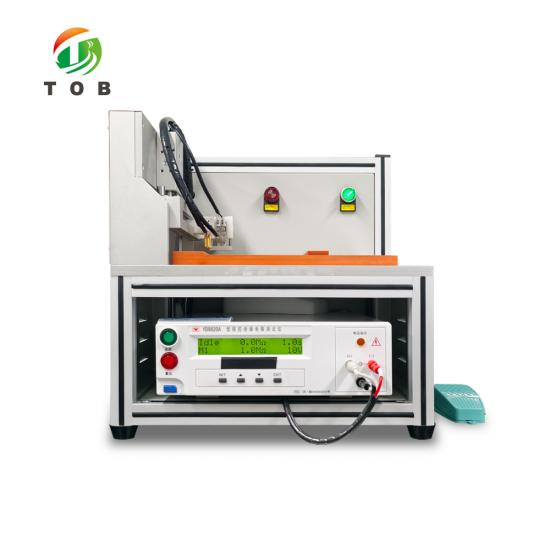
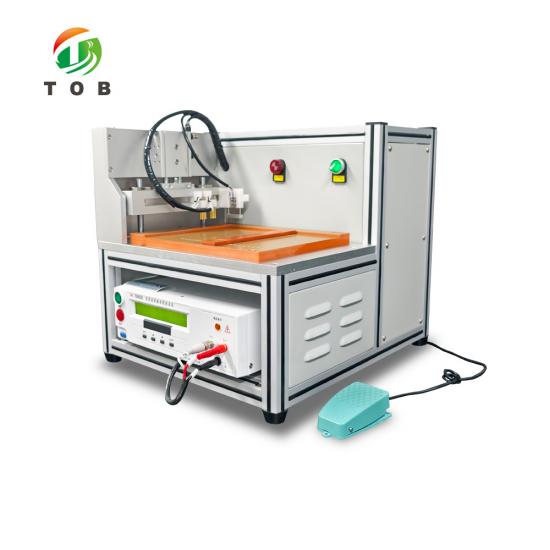
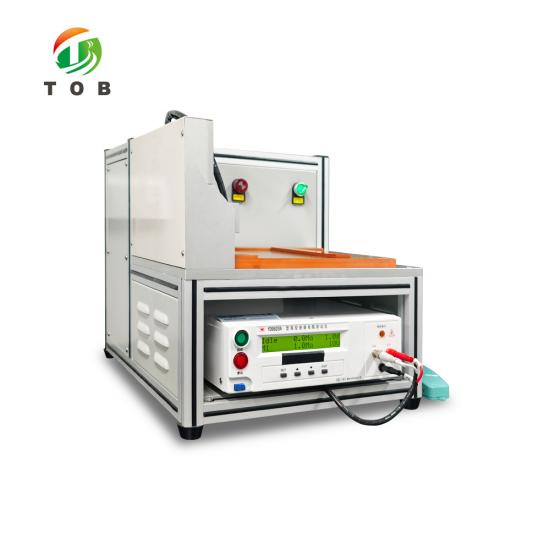
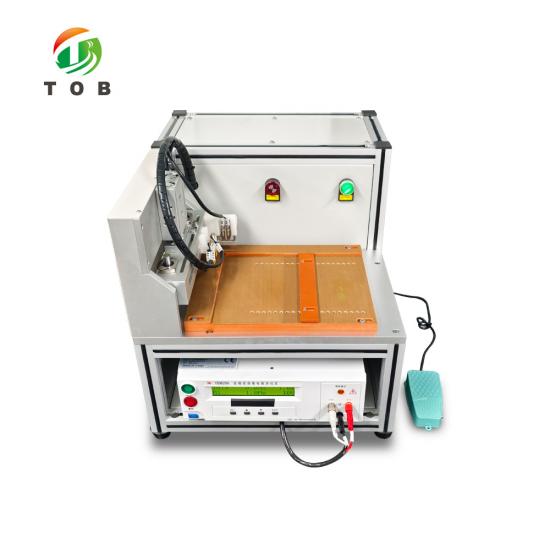


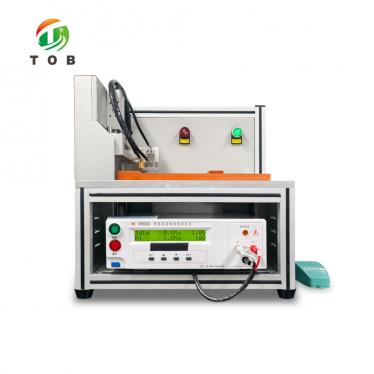
Aluminum Laminated Film Short Circuit Tester
Brand:
TOB NEW ENERGYitem no.:
TOB-ADT-001order(moq):
1setPayment:
L/C, T/Tproduct origin:
Chinashipping port:
XIAMEN
Aluminum Laminated Film Short Circuit Tester for Pouch Cell - TOB-ADT-001
Three-point insulation test between the cell tabs and the aluminum layer of the laminated film, after top-side sealing and before electrolyte filling
Product Overview and Ideal Applications
A pouch cell is wrapped in a three-layer laminated film: nylon outside, aluminum foil in the middle, a CPP hot-seal layer inside. The seal is made by melting that inner layer, and if the sealing temperature runs high or the pressure is uneven, the CPP is thinned or breached. The aluminum then sits bare against a tab, and a cell that passes every other inspection carries a short circuit into filling. TOB-ADT-001 is the instrument that finds it while the cell is still dry.
The test is a three-point measurement, not a single continuity check: one probe on the positive tab, one on the negative tab, one on the aluminum layer of the film itself, with the Yangzi YD9820A tester reading between them. A sound cell reads in the megohm range and above in both directions; a breached seal reads low and is rejected before electrolyte is wasted on it. The machine sits directly downstream of auto top and side sealing machine for pouch cell work and upstream of filling.
Throughput is quoted at 600 cells per hour and above, with cells up to 200 x 200 x 12 mm. Probes adjust in position, the locating plate adjusts to the cell, and the prick device contacts the film through its outer surface without preparing a sample. At 530 x 450 x 465 mm and 30 kg it sits on a bench, which is what makes a 100 percent check practical rather than a sampling one.
- Pouch cell lines running a 100 percent check between top-side sealing and filling.
- Cells up to 200 x 200 x 12 mm, including a formed pocket and its tabs.
- Seal parameter studies: proving a new temperature or pressure before it enters the SOP.
- Incoming checks on film and on sealed cells from a supplier.
- Not a cell-level hipot or over-charge test, and not a substitute for the final insulation check.
Tell us your application, required specifications, quantity, and delivery country. Our engineer will confirm the suitable product or configuration.
Complete the inquiry form below and our engineer will review your requirements. Prefer email? Contact tob.amy@tobmachine.com
Complete Specifications
1. Machine and process
| Item | TOB-ADT-001 |
|---|---|
| Process position | After top-side sealing, before electrolyte filling |
| What is tested | Insulation between the positive tab, the negative tab and the aluminum layer of the laminated film |
| Test points | Three: positive tab, negative tab, film |
| Maximum cell size | 200 x 200 mm, thickness up to 12 mm |
| Throughput | 600 cells per hour and above |
| Probe position | Adjustable in X and Y to suit tab spacing |
| Overall dimensions | 530 (W) x 450 (D) x 465 (H) mm |
| Weight | 30 kg |
| Air pressure | 0.4 to 0.8 MPa |
| Cell handling | Manual load and unload onto the test bed |
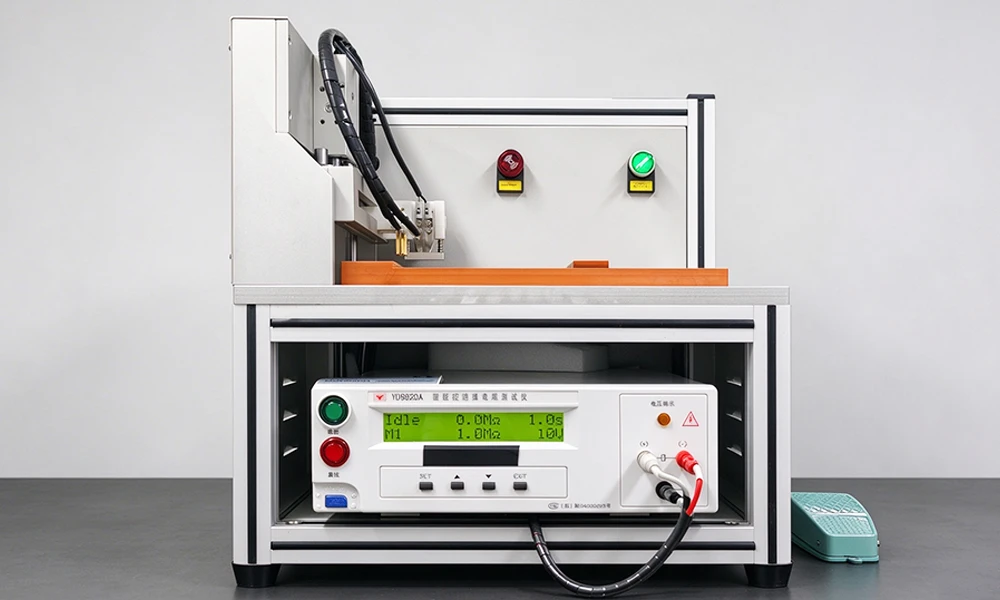
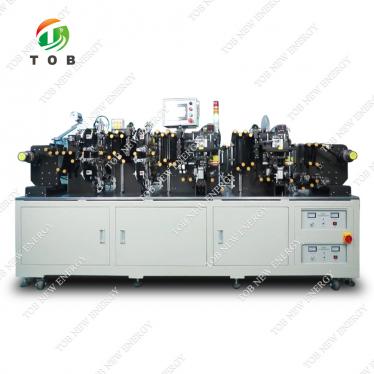
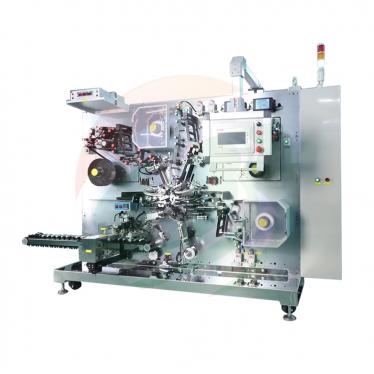
The tester as delivered: test bed and probe head on the left, instrument and control box below, safety plate between the operator and the probes.
2. Insulation tester: Yangzi YD9820A
The measuring instrument is a Yangzi YD9820A programmable insulation resistance tester, integrated into the control box rather than supplied as a separate bench unit. Its specification is what sets the resolution of the verdict, so it is listed in full below.
| Parameter | YD9820A |
|---|---|
| Set test voltage | 10 to 1000 V |
| Open-circuit output | ± 1% of set voltage, ± 1 V |
| Voltage display accuracy | ± 1% |
| Resistance range | 1×10³ to 1×10¹² Ω (1 kΩ to 1 TΩ) |
| Resistance accuracy below 10 GΩ | ± 3%, ± 3 digits |
| Resistance accuracy at 10 GΩ and above | ± 8%, ± 3 digits |
| Range control | Automatic or manual |
| Measurement mode | Continuous or remote single shot |
| Display | Voltage: four significant digits; resistance: four or five significant digits |
| Test speed | About 5 to 6 measurements per second |
| Sorting preset | 0 to 999999 MΩ, one grade, five groups in memory (0 = no sorting) |
| Sorting output and buzzer | Pass / fail judgement, buzzer selectable pass / fail / off |
| Zeroing | Open-circuit zero |
| Interface | Sorting output (pass / fail); remote control input optional |
| Warm-up | About 15 minutes to reach rated accuracy |
| Instrument power / weight | 220 V (1 ± 10%), 50 Hz (1 ± 5%); 40 W or less; about 5 kg |
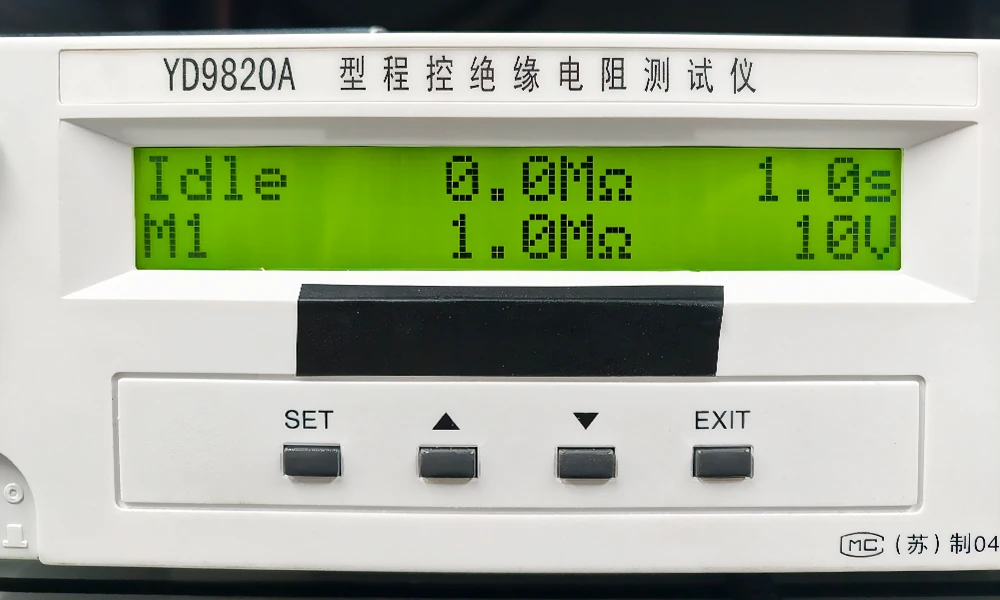
The YD9820A mounted in the control box: voltage and resistance on the display, sorting threshold set by button.
The voltage is settable from 10 V, which matters for thin CPP layers: a test that is too high can itself puncture a sound seal and create the defect it was looking for.
3. Supply and utilities
| Item | Requirement |
|---|---|
| Power supply | Single phase AC 220 V, 50 Hz, converted internally to 24 V DC |
| Compressed air | 0.4 to 0.8 MPa, dry and oil-free |
| Bench | Level surface able to take 30 kg plus the cells; the machine is loaded by hand from the front |
How the Three-Point Test Finds a Seal Defect
A single continuity check between a tab and the film cannot tell you where the problem is, and it cannot tell the difference between a real breach and a probe that simply failed to make contact. Three points fix that: the instrument measures tab-to-film for the positive side, tab-to-film for the negative side, and tab-to-tab, so a low reading on one pair and a clean reading on the others points at one seal edge rather than at the whole cell.
Contacting the film is the awkward part, because the outer surface is nylon. The prick device is there for exactly that: it makes a defined contact through the outer layer at a position the operator chooses, instead of asking someone to hold a probe against a smooth, slippery pouch by hand. A safety plate sits between the operator and the probe head, and the head only comes down under air pressure once the cell is in place.
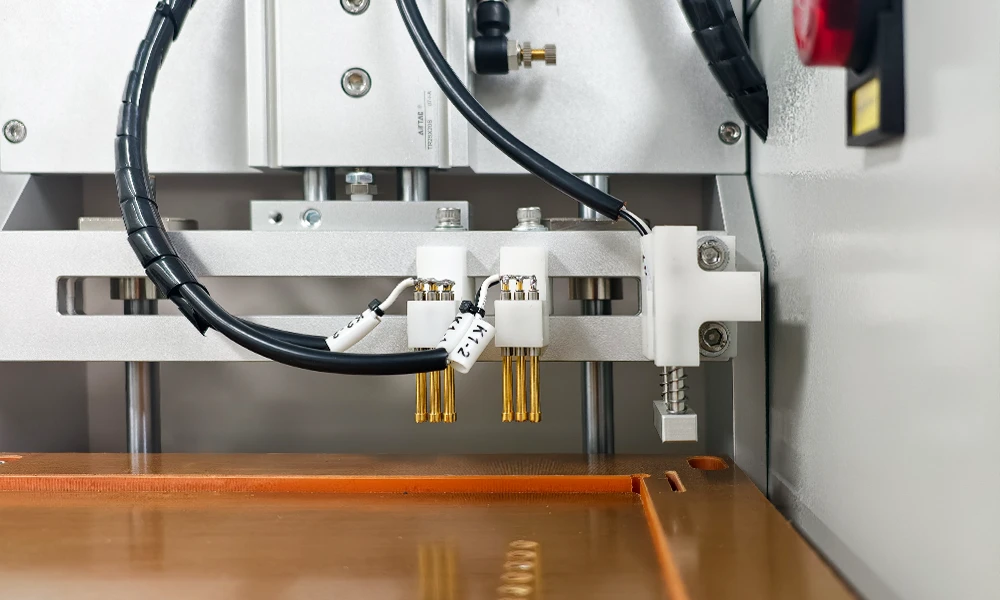
The probe groups: each one is adjustable in position, so the same head covers a small phone cell and a 200 mm pouch without a change part.
Repeatability comes from the locating plate, not from the operator's eye. The plate is set to the cell outline once, the cell drops into the same position every time, and the probe positions stay where they were set. That is what allows the test to run at 600 cells per hour by hand: the operator loads against a stop rather than aiming at a tab.
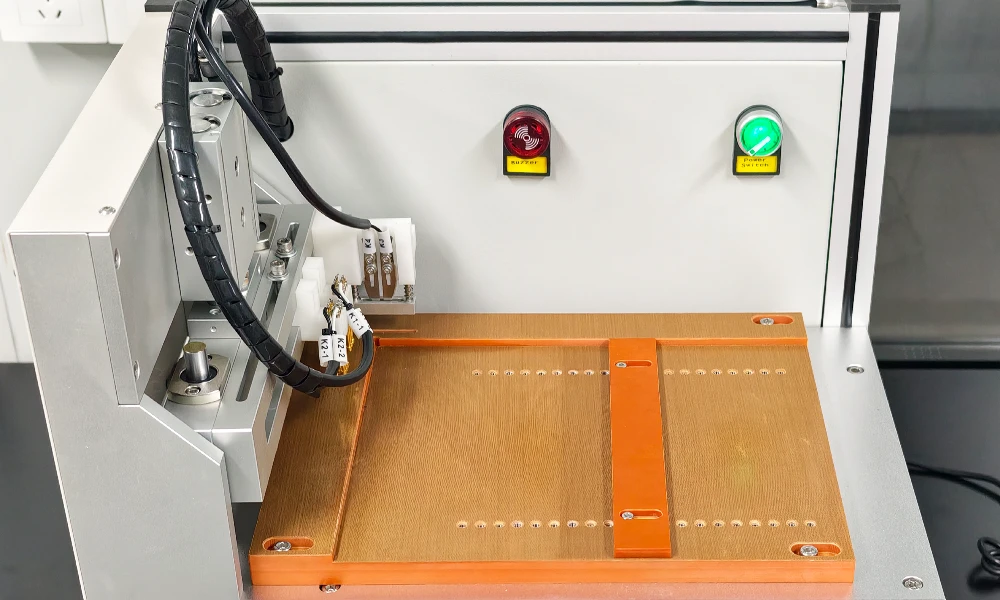
The test bed with its adjustable limit: the cell seats against the plate, the probes land on the tabs, and the verdict appears on the instrument.
The verdict itself is a sorting signal. The YD9820A compares the reading against a preset threshold and outputs pass or fail, with a buzzer that can be set to sound on failure only - the setting most lines use, because a buzzer that sounds on every good cell stops being heard after the first hour.
Configuration and Spare Parts
The machine is supplied as a complete inspection station rather than as a frame with a place to bolt an instrument. The eight items below are what makes it one unit.
- Test bed device - the platform the cell seats on, with the locating plate.
- Prick device - makes electrical contact through the nylon outer layer of the film.
- Safety protection plate - stands between the operator and the descending probe head.
- Adjustable locating plate - sets the cell position and therefore the repeatability.
- Guide device - keeps the head travelling straight as it comes down.
- Control electric box - houses the instrument and the pneumatic controls.
- One set of testing instruments - the Yangzi YD9820A, wired into the box.
- Spare parts list - the consumables below, quoted with the machine.
| No. | Part | Brand | Model | Qty |
|---|---|---|---|---|
| 1 | Solenoid valve | AirTAC | 4V210 | 1 |
| 2 | Intermediate relay | Chint / Schneider | 8-pin | 20 |
| 3 | Fuse | Hugong | 5 A | 1 |
| 4 | Push button | Ergong | 22 mm | 1 |
| 5 | Prick blade | In house | Made to drawing | 1 |
| 6 | Probe | - | PH-5H | 10 |
Key Engineering Characteristics
- Three points instead of one continuity check. Positive tab to film, negative tab to film and tab to tab, so a low reading points at one seal edge rather than at the whole cell.
- Test voltage from 10 V to 1000 V. The low end matters: a thin CPP layer can be punctured by a test that is too energetic, and a tester that creates defects is worse than none.
- 1 kΩ to 1 TΩ measurement with a pass / fail output. The instrument sorts against a preset threshold and drives a buzzer, so the verdict does not depend on the operator reading a display.
- Prick device for the nylon face. Contact is made through the outer layer at a chosen point, without preparing a sample or holding a probe by hand against a slippery pouch.
- Adjustable probes plus a locating plate. The cell seats against a stop and the probes stay where they were set, which is what makes 600 cells per hour possible with manual loading.
- Bench format. 530 x 450 x 465 mm and 30 kg, running on single phase 220 V and 0.4 to 0.8 MPa air, so it can stand at the end of a sealing machine instead of in a separate bay.
- Safety plate and air-operated descent. The head comes down only when the cell is seated, and the operator's hands stay behind the guard.
- Instrument integrated, not loose. The YD9820A is wired into the control box, so the reading, the threshold and the reject signal are one system rather than a bench meter someone has to watch.
Why This Test Sits Between Sealing and Filling
Top-side sealing is a heat and pressure operation, and its failure mode is quiet. The CPP layer is the thinnest of the three, and a few degrees too hot or a gap in the sealing bar thins it until the aluminum underneath is exposed. Nothing looks different. The seal is visually intact, the cell passes its dimensional check, and the fault only declares itself after electrolyte is inside - at which point the cell is scrap, and in the worst case it is a cell that failed after shipping.
Testing before filling changes the economics rather than the physics. A dry cell that fails is a cell plus a piece of film; a filled cell that fails is a cell, the film, the electrolyte, the formation cycle and the labour around all three. On a line running hundreds of cells an hour, catching seal breaches at the dry stage is one of the cheapest quality gates available, which is why the step is normally a 100 percent check rather than a sample.
The measurement is an insulation resistance, so the question is where to put the threshold. Too low and a marginal seal passes; too high and sound cells are rejected because a dry CPP surface reads lower than a fully wetted one. The usual approach is to set it from your own population: measure a few hundred good cells, look at the distribution, and place the limit well below the lowest good reading but far above a genuine breach, which reads orders of magnitude lower.
This step does not replace the hipot test that comes later in the line. A battery cells hipot hot press and short circuit tester works on the assembled cell at higher voltage and checks the finished insulation system; this machine checks the seal interface while the cell is still open at the filling port. Running both is normal, and they catch different defects.
What the instrument cannot do is tell you where along the seal the breach sits, or how strong the seal is. It gives a verdict, not a diagnosis. When a batch starts failing, the next steps are a seal strength peel test and a look at the sealing bar profile - the tester tells you that something changed, not what.
Operating Notes and Safety
1. Before a run
- Warm the instrument up. About 15 minutes is needed before the YD9820A is inside its rated accuracy; a first reading taken cold is a number, not a measurement.
- Zero on open circuit with the probes clear of everything, then set the test voltage and the pass / fail threshold for the cell type in front of you.
- Check the air. 0.4 to 0.8 MPa dry air, and a head that descends and returns smoothly without dragging.
- Set the locating plate to the cell outline and confirm all three probes land on metal, not on film or on air.
2. During operation
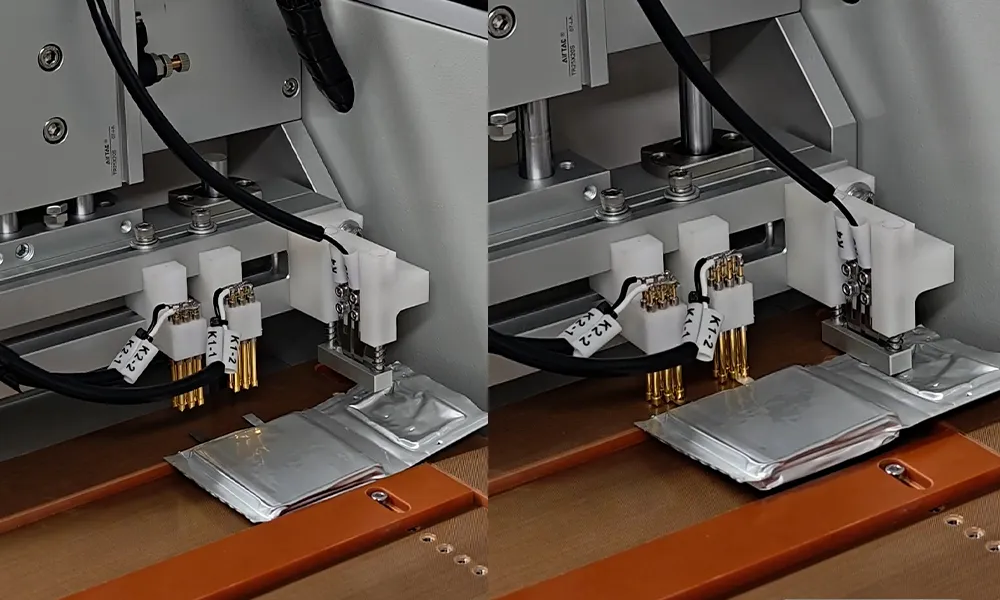
The same cell before the probes descend and with the head in contact - the sequence the interlock enforces.
Load the cell against the stop, keep hands behind the safety plate, and let the head come down on its own. Read the verdict from the sorting signal rather than from the display, and put a reject in a separate box immediately - a failed cell that goes back into the good tray is the exact failure this machine exists to prevent. At 600 cells per hour there is roughly six seconds per cell, so the handling sequence has to be one motion, not three.
3. Maintenance
- Probes (PH-5H, ten supplied) are the consumable: a blunted or dirty tip reads high and produces false passes. Replace on schedule rather than on failure.
- Prick blade is in-house made; keep it sharp and replace it when contact becomes unreliable.
- Air circuit: keep the filter and regulator clean, and check the 4V210 solenoid valve for sticking, which shows up as a head that descends slowly.
- Instrument: re-zero on open circuit at the start of each shift; the readings drift with temperature more than the specification suggests.
Previous Version and What This Upgrade Changed
The model code did not change, but the machine did. The build now supplied carries a programmable insulation tester instead of the analogue unit used before, in a smaller and lighter frame, with a stated throughput and a higher air-pressure floor. The two photographs below are the previous version: they are kept because they are the only record of that cabinet and its instrument, and because they have been part of this page since January 2024.
| Item | Previous version | Current build |
|---|---|---|
| Insulation tester | YD2661A, analogue display | YD9820A, programmable, sorting output |
| Overall dimensions | 250 x 500 x 400 mm (as published) | 530 x 450 x 465 mm |
| Weight | about 50 kg | 30 kg |
| Maximum cell size | 300 x 200 mm | 200 x 200 x 12 mm |
| Air pressure | listed as 2.0.4-0.8 MPa on the earlier sheet | 0.4 to 0.8 MPa |
| Throughput | not stated | 600 cells per hour and above |
| Test points | 3 | 3 (unchanged) |
A walk-through of the previous build is embedded below. The machine in the video is the earlier cabinet with the analogue instrument, kept because it shows how the test was run before the upgrade - not as a description of the current build.
Video recorded on the previous build, before the 2026 upgrade.
Two stills from the same period follow. A video does not show the instrument panel clearly enough to read the model number, and that number - YD2661A - is the clearest evidence of what changed.

Previous version: the earlier cabinet, two units side by side. |

Previous version: YD2661A analogue instrument, now replaced by the YD9820A. |
Photographs of the previous build, retained for reference. Current delivery is the version specified in the tables above.
Certification, Patents and Delivery Record
1. Management system certificates
The plant building this tester holds ISO 9001 certification under 3050260408100Q, issued on 8 April 2026 and valid to 7 April 2029, together with ISO 14001 (305026082585E) and ISO 45001 (305026082584HS). No CE certificate is currently held for the TOB-ADT-001, but CE marking can be provided on request and is quoted together with the order.

|

|

|
2. Patents held by the founder
Dany Huang, Ph.D., founder and CEO, entered the industry in 2002 through pouch cell materials, moved through cylindrical and prismatic aluminium-shell cells, and founded TOB NEW ENERGY in 2012. As of September 2026 he holds 55 Chinese patents: 5 granted invention patents, 45 utility models and 5 published applications. The claims sit on the cell and process side - electrode structures, formulations and gas handling - rather than on this instrument.
3. Research record
Our citation index holds 707 records and 70 of them name a specific TOB model; none names the TOB-ADT-001. Two records do concern short circuit behaviour in cells, but they cite TOB as a supplier of equipment and materials to the authors' own work, not this tester, so they are not quoted here as evidence for it. An instrument of this kind is bought on its measurement specification and its place in a line, not on publication.
4. Reference projects
Neither project below ordered this tester; they are quoted because they are the two pouch-cell environments where a seal-to-fill inspection step belongs. The projects for lithium ion pouch cell lab scale line building in Brazil is a laboratory line built end to end, and the 20MWh automated high-flexibility Li-ion and Na-ion pouch cell mass production base is the production end of the same range.

Laboratory pouch cell line, Brazil. |

Formation workshop, 20MWh pouch cell base. |
Engineering FAQ
Q1: What does the tester actually measure?
Insulation resistance between three points: the positive tab, the negative tab and the aluminum layer of the laminated film. A sound cell shows a high resistance between each tab and the aluminum, because the CPP layer separates them. A seal that has been overheated shows a low resistance, because the aluminum is exposed and touching a tab.
Q2: Why three points when two would do?
Because two points cannot separate a bad seal from a bad contact. With the third point, a low reading on the positive side and a clean reading on the negative side points to one seal edge; a low reading on both points to the film itself or to the way the cell is sitting. Three measurements turn a verdict into a direction.
Q3: What test voltage should we set?
Start low. The instrument goes down to 10 V, and for thin CPP layers that is worth using: a voltage high enough to break down a sound seal manufactures the defect the test is looking for. Most lines settle on a value between the two extremes after measuring a population of good cells and confirming the reading is stable and far above the reject threshold.
Q4: Can it tell us where along the seal the breach is?
No. It gives a pass or fail for the cell, not a location. Locating the defect means opening the seal and looking, which is a destructive check on a sample rather than an inline test on every cell. Use the tester to hold the line, and sectioning or a peel test to diagnose a batch that starts failing.
Q5: What should happen to a failed cell?
It leaves the line immediately, into a separate reject box, before anything else is done to it. A failed cell that is put back into the good tray is the one failure mode this machine cannot protect against, and at six seconds per cell it happens easily if the reject box is not within reach.
Q6: Does it replace the hipot test after filling?
No, they bracket the process. This machine checks the seal interface while the cell is dry and open; a hipot tester checks the finished cell at higher voltage once it is assembled and filled. Both are normal on a pouch line, and they fail for different reasons.
Q7: What air supply and consumables does it need?
Dry, oil-free compressed air at 0.4 to 0.8 MPa, single phase 220 V, and consumables that are cheap and known: PH-5H probes (ten supplied), the in-house prick blade, and the 4V210 solenoid valve. Probes are the item that wears first, and a worn probe reads high, which shows up as false passes rather than as an obvious fault.
Tell us the film structure, the tab layout and the cells per hour you need to check, and we will confirm the probe arrangement and the test voltage window.
Email: tob.amy@tobmachine.com | Mobile phone: +86-18120715609
Reviewed by: Science Wang, Six Sigma Black Belt, Battery Lines | Last updated: 2026-11-12
If you are interested in our products and want to know more details,please leave a message here,we will reply you as soon as we can.




 subscribe to us