Chinese
 français
 Deutsch
 italiano
 español
 português
 Nederlands
 日本語
 한국의




- Home
- >
- Coin Cell Equipment
- >
- Lab Coater
- >
- Automatic Five Station Dip Coater
Categories
Hot Products
Loading...
Automatic Five Station Dip Coater
Brand:
TOB NEW ENERGYitem no.:
TOB-PTL-OV5Porder(moq):
1 setPayment:
L/C,T/Tproduct origin:
Chinashipping port:
XIAMEN
Automatic Five Station Constant Temperature Dip Coater - TOB-PTL-OV5P
Five liquid stations with automatic changeover, one lifting position holding up to two substrates, 1 to 200 mm/min, chamber to 100 °C
Product Overview and Ideal Applications
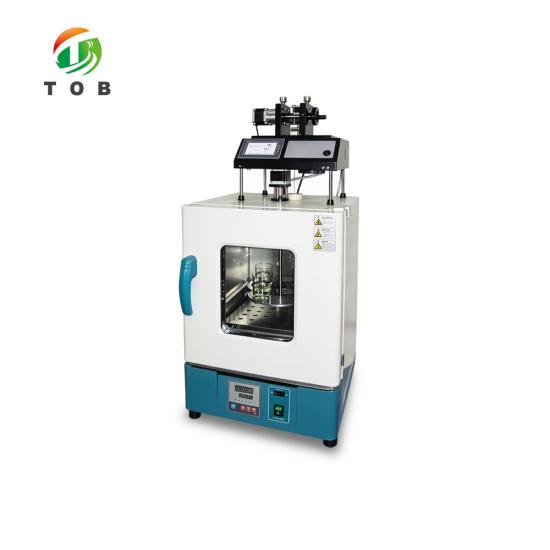
The TOB-PTL-OV5P is a laboratory dip coater built around a 30 litre constant temperature chamber. Inside the chamber, five 150 ml beakers stand in a circular holder; above them hangs a single lifting position that carries one or two substrates. The lifting head is driven by a high precision stepper motor through a PLC program, set from a 4.3 inch colour touch screen: withdrawal speed from 1 to 200 mm/min, stroke from 1 to 75 mm, immersion depth up to 60 mm, dwell and drying times from 1 to 999 seconds each, and 1 to 20 dipping cycles. The chamber runs from room temperature to 100 °C on its own two-row PID controller, so the dip, the dwell and the drying can all happen in the same temperature field.
The five stations are the reason this model exists. On a single cup dip coater, a multilayer film built from different liquids means stopping the run, lifting the sample out, swapping the beaker, and starting again, five times over, and every one of those interruptions is a chance for the film to dry unevenly or pick up dust. Here the five liquids are loaded once, before the door is closed, and the machine changes station itself between passes. The sample stays on the same fixture, in the same thermal environment, for the whole sequence. That is what makes a five-layer film from five different liquids a routine run rather than an exercise in hand timing.
In battery research the machine earns its place at the small end of the process. The substrate clamp takes coupons up to 75 mm by 25 mm by 2.5 mm and the lifting load is capped at 100 g, which is the size of a current collector foil strip, a separator coupon or a small electrode plate rather than a production electrode. That is the scale at which a new coating chemistry, a surface treatment or a multilayer stack gets screened before anyone commits a slot die to it, and it is the scale at which you want five different liquids available without opening the chamber.
What the machine does not do is equally worth stating. It is a dip coater, so the film forms from a liquid that wets the substrate and drains under gravity: it is the right tool for sol-gel, for layer-by-layer assembly and for thin liquid-phase films, and the wrong tool for a viscous electrode slurry that has to be metered at a fixed wet thickness. It coats coupons, not webs. And its chamber stops at 100 °C, which is the ordinary drying range and not a firing temperature.
Ideal for:
- Multilayer films built from up to five different liquids on the same substrate, run without breaking the chamber atmosphere
- Battery material screening on coupons: current collector foil strips, separators and small electrode plates at 75 by 25 mm
- Sol-gel and layer-by-layer deposition where each layer needs a different precursor and a defined dwell time
- Temperature-sensitive formulations that have to be dipped and dried at a controlled temperature rather than at room temperature
- Method development in a university or institute lab, where the run has to be reproducible enough to be written into a paper
This is one of four dip coaters in the catalogue, and the differences are real rather than cosmetic. If five liquids are not needed and a single station will do, the lab dip coater film coating machine is the smaller, lighter entry point. If the process needs to go well above 100 °C, the high temperature dip coating machine reaches 1000 °C and is a different class of furnace. And if the coating is a metered slurry rather than a draining liquid film, dip coating is the wrong process altogether: that is the territory of the lab slot die coater with 800 mm stroke or the dual layer slot die coating machine. The comparison table further down sets the four dip coaters side by side.
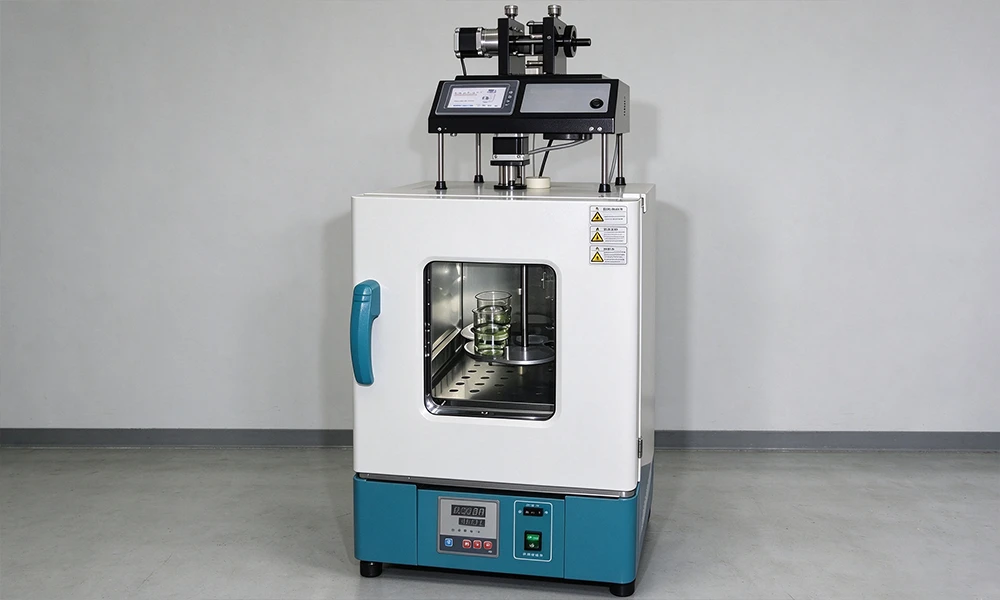
The lifting head and its touch screen sit on top of the 30 litre chamber; the chamber's own PID controller and the mains switch are on the base, which is why the machine needs two sockets rather than one.
Complete Specifications
The machine is two units in one frame: a lifting head on top and a constant temperature chamber underneath, each with its own controller and its own mains lead. The tables are the datasheet, reproduced without rounding.
1. Lifting Unit and Stations
| Item | Specification |
|---|---|
| Product name | Automatic five station constant temperature dip coater |
| Model | TOB-PTL-OV5P |
| Type | Program controlled, constant temperature, with heated chamber |
| Lifting unit supply | DC 24 V, 3.75 A; AC 100 to 240 V power adapter supplied as standard |
| Lifting unit power | 50 W |
| Drive | High precision stepper motor, PLC program control with suspended wire transmission to damp vibration |
| Withdrawal speed | 1 to 200 mm/min |
| Stroke | 1 to 75 mm |
| Effective immersion depth | 60 mm or less |
| Dwell time | 1 to 999 s |
| Drying time | 1 to 999 s |
| Number of dips | 1 to 20 cycles |
| Lifting positions | 1, taking 1 to 2 substrates in the same clamp |
| Liquid stations | 5, holding five different liquids at the same time, with automatic station changeover controlled by the program |
| Beaker size | 60 mm diameter, 150 ml |
| Beaker tray load | 3000 g in total, 500 g per station |
| Substrate size range | 75 mm long by 25 mm wide by 2.5 mm thick |
| Maximum lifting load | 100 g or less |
| Display and control | 4.3 inch colour touch screen |
| Overall size | 455 mm long by 500 mm wide by 1060 mm high |
| Weight | Approximately 45 kg including the chamber |
2. Constant Temperature Chamber
| Item | Specification |
|---|---|
| Temperature range | Room temperature to 100 °C |
| Control and setting | Two-row LED display with PID control, four soft-touch keys for setting |
| Heating timer | 0 to 9999 minutes or hours |
| Heating power | 0.8 kW |
| Rated current | 3.6 A |
| Supply | AC 220 V, 50/60 Hz; an AC 110 V 50/60 Hz chamber can be supplied to order |
| Internal size and volume | 310 mm by 310 mm by 310 mm, 30 litres |
| External size | 455 mm long by 500 mm wide by 723 mm high |
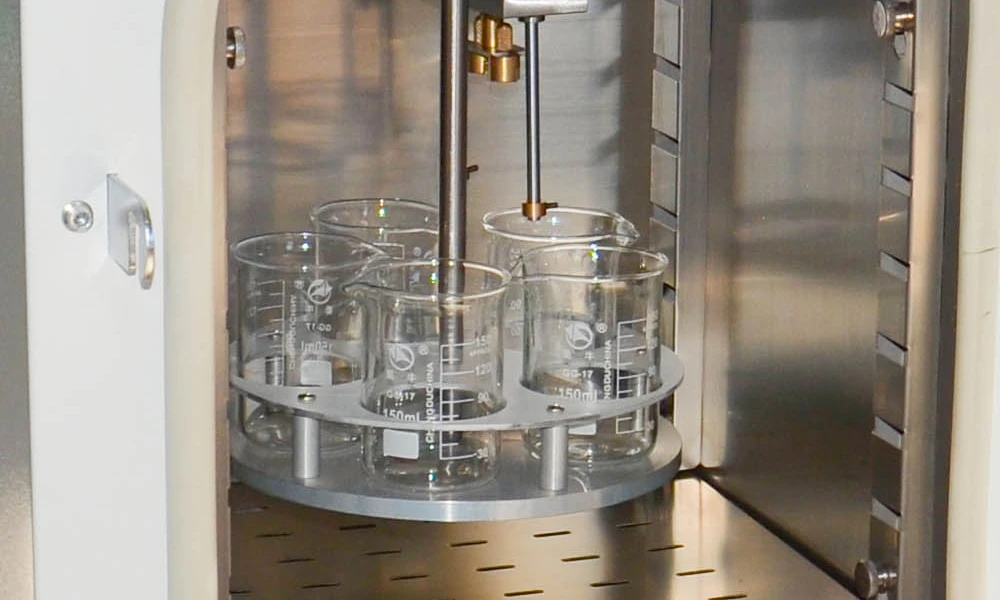
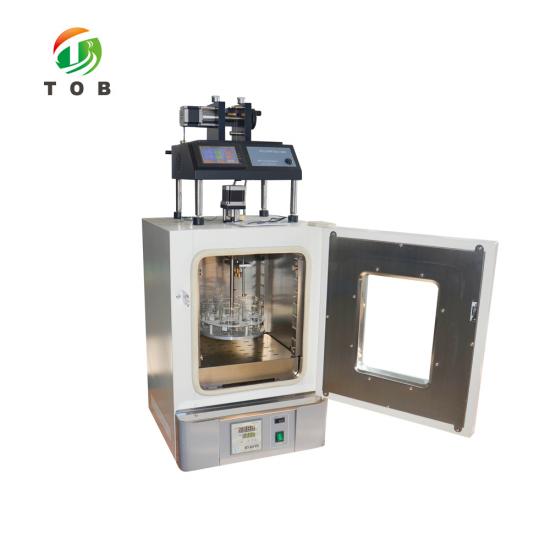
Inside the chamber: the five beakers arranged in a circular holder on the base, the sample fixture hanging above them, and the perforated floor that lets the heated air circulate.
Reading the two power figures: the lifting head is rated at 50 W while its adapter is marked DC 24 V 3.75 A, which is a capacity of about 90 W. That is headroom in the adapter, not a mistake in the rating; the head does not draw 90 W. The nameplate on the rear of the machine is the figure that governs the actual supply.
3. Installation, Power and Standard Accessories
| Item | Requirement |
|---|---|
| Power outlets | Two AC 220 V 50/60 Hz national standard 10 A three-pole sockets, properly earthed, one for the lifting head adapter and one for the chamber |
| Site conditions | 25 °C plus or minus 15 °C, 55 percent RH plus or minus 10 percent, dust free, vibration free, no flammable, explosive or corrosive gas |
| No. | Standard accessory | Quantity |
|---|---|---|
| 1 | Coating fixture | 1 set |
| 2 | Beaker, 150 ml | 5 pieces |
| 3 | Lifting wire | 3 pieces |
Choosing Between the Four Dip Coaters in This Range
Four dip coaters in one catalogue is a good problem for a buyer only if the differences are stated plainly, so they are stated here. They are not variations on one machine: the smallest weighs 17 kg, the largest 75 kg, and the substrate they accept differs by a factor of five in each direction.
| Item |
TOB-PTL-OV5P this page |
TOB-PTL-MMB02-200 | TOB-PTL-MMB01 | TOB-PTL-MM02 |
|---|---|---|---|---|
| Liquid stations | 5, automatic changeover | 1 | 1 | 1 |
| Substrate size | 75 x 25 x 2.5 mm | up to 400 x 230 mm, 1 to 10 mm thick | 75 x 25 x 2.5 mm | 75 x 25 x 2.5 mm |
| Maximum lifting load | 100 g | 5.5 kg | 100 g | 100 g |
| Lifting stroke | 1 to 75 mm | 1 to 270 mm | effective dip 60 mm | effective dip 60 mm |
| Effective immersion depth | 60 mm or less | 200 mm or less | 60 mm | 60 mm |
| Withdrawal speed | 1 to 200 mm/min across the range | |||
| Dipping cycles | 1 to 20 | |||
| Heated chamber | 30 L, room temperature to 100 °C | 500 x 450 x 550 mm inside, room temperature to 200 °C at plus or minus 1.5 °C | room temperature to 100 °C | none |
| Chamber heating power | 0.8 kW | 2.5 kW | 850 W | not applicable |
| Control interface | PLC with 4.3 inch colour touch screen | PLC with stepper and lead screw | single chip keypad | colour touch screen |
| Overall size | 455 x 500 x 1060 mm | 636 x 680 x 1520 mm | not stated | 320 x 260 x 560 mm |
| Weight | about 45 kg with chamber | about 75 kg with chamber | not stated | 17 kg |
The decision reduces to two questions. First, how big is the substrate? If it is a coupon of 75 by 25 mm, three of the four machines will hold it, and the choice then turns on liquids and temperature. If it is a 400 by 230 mm plate or a part weighing more than 100 g, only the MMB02-200 will lift it, and no amount of station count makes up for that. Second, do you need more than one liquid in the same run? If the answer is one liquid, this model's five stations are paid for and never used, and a single station machine does the same job; if the answer is three to five liquids, the other three machines cannot do the run at all without someone standing there changing beakers.
The temperature question sits between those two. If the film has to be dried above 100 °C, this model and the MMB01 are both out of scope and the MMB02-200, at 200 °C with plus or minus 1.5 °C control, is the only one in the range that will do it. If the drying is ordinary solvent removal in the 60 to 100 °C band, the 30 litre chamber here is enough and the smaller heater is a smaller load on the lab supply.
Why Five Stations Change What You Can Make
Dip coating is a simple idea with an unforgiving execution. A substrate goes into a liquid, comes out at a controlled speed, and the film thickness is set by how fast it drains. Everything that matters for reproducibility happens in the seconds after the substrate leaves the liquid, and anything that disturbs the substrate in those seconds, including the hand that is changing a beaker, shows up in the film.
A multilayer stack from different liquids multiplies that problem by the number of layers. On a single station machine the operator has to lift the sample clear, open the chamber, swap a 150 ml beaker for the next one, close the chamber, wait for the temperature to settle, and start the next pass. Each swap is a chance to bump the fixture, and each one opens the chamber to the room. Five stations remove the swaps: the beakers are loaded before the door is closed, and the program selects the next liquid without the sample or the thermal field being disturbed.
This is what makes certain experiments practical rather than merely possible. Layer-by-layer assembly, where the substrate alternates between a polycation and a polyanion bath with a rinse in between, is a five-station job by nature; done by hand it is an afternoon of beaker juggling for one sample. Sol-gel stacks where each layer has a different precursor and a different dwell time are the same story. If the value of the experiment is in comparing layer sequences, the machine has to change liquids faster and more repeatably than a person can.
The clamp is worth a paragraph of its own, because it is where five stations and one lifting position meet. One clamp holds one or two substrates, at 75 by 25 mm and no more than 100 g in total. Two substrates in the same clamp is not two experiments: it is a duplicate, and duplicates are what let you separate a real process effect from substrate-to-substrate noise. If you need more than two, the constraint is the lifting load rather than the station count.
In a battery lab the useful size is a coupon. A current collector foil strip, a separator sample or a small electrode plate all fit inside the 75 by 25 mm window and weigh far less than 100 g, which is why a five-station machine of this size belongs in materials screening rather than in production. The point of screening is to run enough variants to see a trend; being able to load five liquids and walk away is how a screening matrix gets finished in a week instead of a month.
What five stations do not do is dry between layers on their own schedule. The dwell time and the drying time are per pass, from 1 to 999 seconds each, and they are the same numbers for every pass in the program; if layer two needs a longer dry than layer one, that has to be handled by running the layers as separate programs or by accepting one setting for the whole stack. Nor do five stations mean five different temperatures: there is one chamber and one setpoint. Both limits are worth knowing before a five-layer recipe is promised to a supervisor.
Vibration is the last variable and the one that is easiest to lose. The head drives the substrate through a suspended wire rather than a rigid coupling, and the chamber sits on the same frame, so the film is formed in the same thermal environment it dries in. Put the machine on a bench that also carries a centrifuge and none of that helps; the installation conditions ask for a vibration-free site for a reason.
Key Engineering Characteristics
- Five liquid stations, one closed-door run. The beakers are loaded before the door is shut and the program changes station itself, so a five-layer stack from five liquids never breaks the thermal field or the fixture position.
- One clamp, one or two substrates. Two in the same clamp is a duplicate pair run under identical conditions, which is how a substrate-to-substrate difference is separated from a process effect.
- Speed, stroke, dwell and dry set independently. 1 to 200 mm/min, 1 to 75 mm, and 1 to 999 seconds each for the immersion dwell and the drying pause, repeated for 1 to 20 cycles.
- A 30 litre chamber with its own controller. Room temperature to 100 °C on a two-row PID with four keys, independent of the lifting program, so the chamber can be at temperature before the first dip.
- Suspended wire drive. The substrate hangs from a wire rather than a rigid coupling, which isolates it from motor and gear noise during the withdrawal that sets the film thickness.
- Limits that come from the mechanics, not from software. 100 g on the clamp, 60 mm immersion, 500 g per beaker station and 3000 g on the tray; exceeding any of them changes the film rather than triggering an alarm.
- 45 kg on a 455 by 500 mm footprint. One person can move it, and it fits a normal laboratory bench without a dedicated frame.
Operating Sequence, Safety and Maintenance
1. One Five Station Run, Step by Step
- Switch on the chamber and bring it to the drying temperature. The chamber controller is separate from the lifting program, so this can be done first and left to stabilise.
- Fill and place the five beakers in the circular holder. Each beaker must hold enough liquid to cover the immersion depth you are going to use, up to 60 mm, or the film will stop where the liquid ran out.
- Clamp one or two substrates in the fixture and check the total is within 100 g.
- Set the program on the touch screen: withdrawal speed, stroke, dwell time, drying time, number of cycles and the order in which the stations are used.
- Close the chamber door and start the run.
- The machine indexes to the first station, lowers the substrate, holds for the dwell time, withdraws at the set speed, pauses for the drying time, then moves to the next station. The sequence repeats until the set cycle count is reached.
- Open the door, unload the substrates, and note which station ran in which position. The layer order is the experiment; write it down at the machine rather than reconstructing it from memory.
One detail decides whether the run is worth repeating: the relationship between the liquid level and the immersion depth. The immersion depth is limited to 60 mm, the beakers are 150 ml, and a beaker filled to the brim and a beaker filled to half give different wetted lengths. Set the level deliberately, record it, and keep it the same the next time, or the film area will change between runs that are otherwise identical.
2. Safety and Site Conditions
The datasheet for this model does not list a safety device schedule, and it would be wrong to invent one, so what follows is what the specification does state plus the points that matter on any heated dip coater. The supply is two earthed 220 V sockets, one for the head adapter and one for the chamber; earthing is a stated requirement, not a recommendation. The chamber reaches 100 °C and its outer surfaces warm up with it, so the door and the window are hot to the hand during a run. The head moves whenever a program is running, and the fixture travels down into the beakers, so the rule inside the chamber is the same as on any machine with a moving axis: do not reach in while the program is active.
The site conditions are specific enough to be worth repeating as a checklist: 25 °C plus or minus 15 °C ambient, 55 percent RH plus or minus 10, dust free, vibration free, and no flammable, explosive or corrosive gas in the room. The vibration clause is the one that gets ignored and then blamed on the machine. A dip coater shares a bench with a centrifuge only until the first film with stripes in it.
3. Maintenance and What Actually Wears
The parts that wear on this machine are cheap and are mostly glass. Beakers chip at the rim, and a chipped rim is a sharp edge at exactly the height the fixture passes. Three lifting wires come with the machine, which tells you what the maker expects to be replaced first: the wire is the flexible element in the drive and it is a consumable, not a lifetime part. Keep the spare wires in the drawer rather than ordering one after a run fails.
The clamp deserves a wipe after every campaign, because dried precursor on the jaws changes the grip height by a fraction of a millimetre and the immersion depth with it. The chamber interior is stainless and needs nothing beyond keeping spills out of the perforated floor; a beaker that leaks during a run leaves liquid on the heater and the mess is easier to prevent than to clean. The adapter is a standard 100 to 240 V unit, so a failure is a swap rather than a repair.
Engineering FAQ
Q: Can one sample really go through five different liquids in a single run?
Yes, that is what the five stations are for. Load the beakers before closing the door, set the station order in the program, and the machine moves from liquid to liquid without the sample leaving the chamber. The limitation worth planning around is that the dwell time and the drying time are one pair of settings for the whole program, not one pair per layer; if layer three needs twice the drying time of layer one, either accept a single setting or split the stack across two programs.
Q: If I clamp two substrates, do I get two independent recipes?
No. The two substrates share one clamp and one program, so they are duplicates rather than independent experiments: same liquid, same speed, same dwell, same drying. That is useful, because a duplicate pair separates substrate-to-substrate variation from process variation, but it does not double your throughput of different conditions.
Q: My substrate is a 10 µm foil, not a 2.5 mm plate. Will the clamp hold it?
The fixture is dimensioned for substrates up to 75 by 25 by 2.5 mm with a lifting load of 100 g or less, and that thickness figure is the one to check against your own samples rather than assuming it is a maximum or a fixed value. A foil on its own is awkward to clamp without a carrier; the usual answer is to tape or clip the foil to a flat carrier plate that the clamp can hold, which keeps the coated face flat and the immersion depth controlled. Tell us the foil thickness when ordering and the fixture can be discussed with the machine rather than after it arrives.
Q: Can one of the five stations be a rinse instead of a coating liquid?
Yes, and for layer-by-layer work it usually is. A station is just a beaker position, so solvent, water or a rinse solution occupies it like any other liquid, and the program treats it as one more dip with its own place in the sequence. The fluids have to be compatible with the beakers and with the stainless chamber, which is why the siting conditions exclude corrosive atmospheres.
Q: What utilities does it need beyond two sockets?
None. There is no compressed air, no cooling water and no vacuum connection; the machine is two 220 V leads and a bench. That is a practical advantage in a shared lab where every other piece of equipment has already claimed the air line.
Q: The chamber stops at 100 °C. What if I need more?
Then this is the wrong model in the range, and it is better to say so than to sell around it. The MMB02-200 reaches 200 °C with plus or minus 1.5 °C control and takes substrates up to 400 by 230 mm, at the cost of a single liquid station and a much larger frame. If what you actually need is firing rather than drying, the high temperature dip coating machine linked above goes to 1000 °C and is a furnace rather than an oven.
Send your substrate size, the number of liquids in the stack and the drying temperature, and we will confirm the fixture and the station sequence before you order.
Email: tob.amy@tobmachine.com | Phone: +86 181 2071 5609
Reviewed by: Pinery Gong, Battery Assembly & Yield Process | Last updated: 2026-11-04
Previous:
Lab Coater Desktop Slot Die Coating MachineNext:
High-Temperature Dip Coating Machine up to 1000 ℃
If you are interested in our products and want to know more details,please leave a message here,we will reply you as soon as we can.

 subscribe to us