Chinese
 français
 Deutsch
 italiano
 español
 português
 Nederlands
 日本語
 한국의




- Home
- >
- Pouch Cell Assembly Equipment
- >
- Pouch Cell Pre-sealing Machine
- >
- Compact Vacuum Pre-sealing Machine for Pouch Cells
Categories
Hot Products
Loading...
Compact Vacuum Pre-sealing Machine for Pouch Cells
Brand:
TOBitem no.:
TOB-VHSX-100order(moq):
1 setPayment:
L/C,T/Tproduct origin:
Chinashipping port:
XIAMEN
Compact Vacuum Pre-sealing Machine for Pouch Cells - TOB-VHSX-100
Passes through a glovebox transfer chamber of 360 mm or more, no glass removal, 20 kg main unit, seal width 5 mm to 120 mm
Product Overview and Ideal Applications
The TOB-VHSX-100 is a bench-scale vacuum and hot-press pre-sealer for pouch cells and solid-state cells, used after electrolyte filling and soaking. The cell goes into an aluminium alloy chamber, the chamber is pumped down to an adjustable -95 kPa, and a copper sealing head closes on the aluminium-laminate edge at a set temperature, pressure and dwell. Everything is programmed from the PLC touch screen: sealing temperature from room temperature to 250 °C, pressure from 0 to 5 kg/cm², dwell from 0 to 99 seconds. A sealed, degassed pouch leaves the chamber, and the electrolyte stays where the filling put it.
The reason this machine exists in this shape is the glovebox. Most vacuum pre-sealers are built as one cabinet with the electronics inside the frame, and a cabinet that size cannot enter a dry box, so the usual answer is to take a window out, lift the machine through the opening, and reseal the glass. That is a day of work, it breaks the atmosphere you spent days establishing, and the seal you rebuild is never quite the one the factory made. This machine is 420 mm long, 300 mm wide and 230 mm high with the lid closed, and the control box is a separate 10 kg unit; both pass through a transfer chamber of 360 mm or more, so the box is never opened. If your glovebox has a large antechamber, the installation is a transfer, not a rebuild.
Splitting the machine does more than make it transportable. The main unit weighs about 20 kg and holds the chamber, the sealing head and the two cylinders; the control box weighs about 10 kg and holds the PLC, the HMI and the temperature controller. The box can sit inside the glovebox beside the machine or outside on a shelf, and the same split lets the machine run on a production line where the operator stands at a conveyor rather than at a dry box. One machine, two ways to deploy it, decided by where you put the smaller of the two boxes.
What it is not is equally worth stating. It seals one edge per cycle, up to 120 mm long, on a stack from 60 to 500 µm thick; it does not fill electrolyte, it does not do the final seal after formation, and it does not evacuate a cell that has already been sealed. It is the step between filling and formation, and the pages linked below cover the machines that do the steps on either side of it.
Ideal for:
- Pre-sealing pouch and solid-state cells after electrolyte filling and soaking, inside a glovebox or dry room
- Labs whose glovebox has a large transfer chamber and no practical way to remove a window
- Sealing trials where the dwell, the pressure and the temperature each have to be swept independently
- Pilot lines that need a pre-sealer at a station rather than a cabinet in a corner
- Cells up to 130 mm long including tabs and 130 mm wide including the gas pocket, with a seal up to 120 mm
Three neighbours in the catalogue are easy to confuse with this one, so the differences are stated here rather than left to a specification table. If the seal has to be longer than 120 mm, the 200mm length compact vacuum sealer for vacuum pre-sealing seals up to 200 mm in the same bench format. If the filling, the soaking and the pre-sealing should happen without moving the cell between machines, the vacuum electrolyte filling soaking and pre-sealing all-in-one machine combines those three steps. And if the line also needs the final seal and the diffusion step, the vacuum pre-sealing, final sealing and electrolyte diffusion three-in-one machine does all three. This page is the smallest of the four and the only one sized for a transfer chamber.
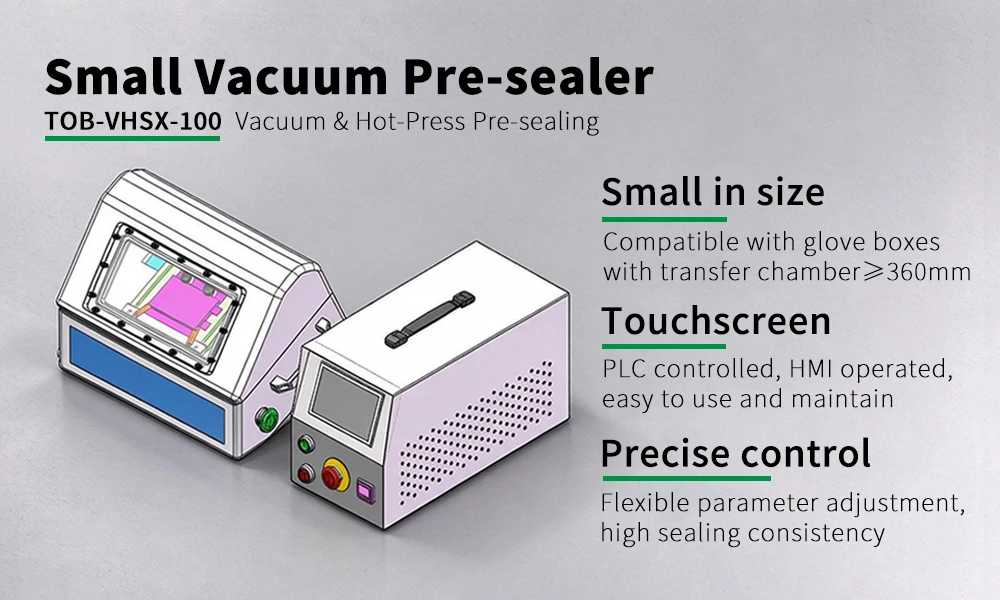
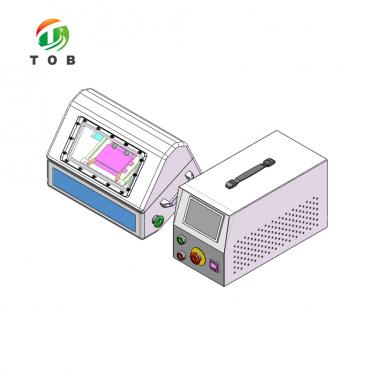
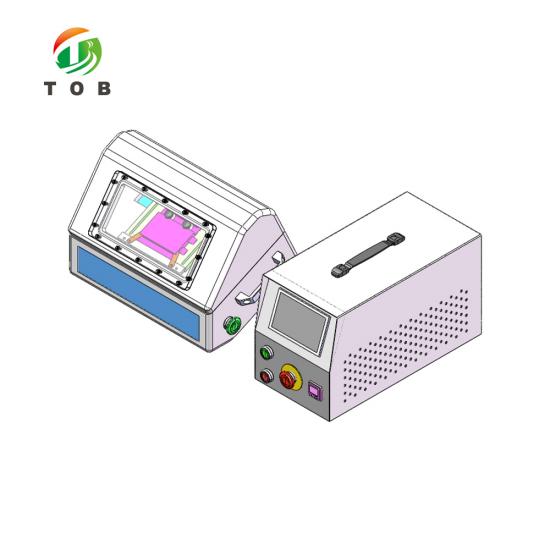
The two bodies of the machine: the 20 kg sealing unit with its chamber and viewing window on the left, and the 10 kg control box with the PLC touch screen on the right. Each passes a transfer chamber on its own.
Complete Specifications
The first table is the one to read against your own cell, because it decides whether this machine can seal it at all. Everything after that is machine detail. Values are the datasheet, reproduced without rounding.
1. Sealing Capacity at a Glance
| Item | Value |
|---|---|
| Seal width | 5 ± 0.4 mm, adjustable on request |
| Maximum seal length | 120 mm |
| Maximum cell size | 130 mm long including tabs by 130 mm wide including the gas pocket |
| Seal thickness range | 60 to 500 µm |
| Thickness uniformity | Difference between any two points of a seal below 15 µm |
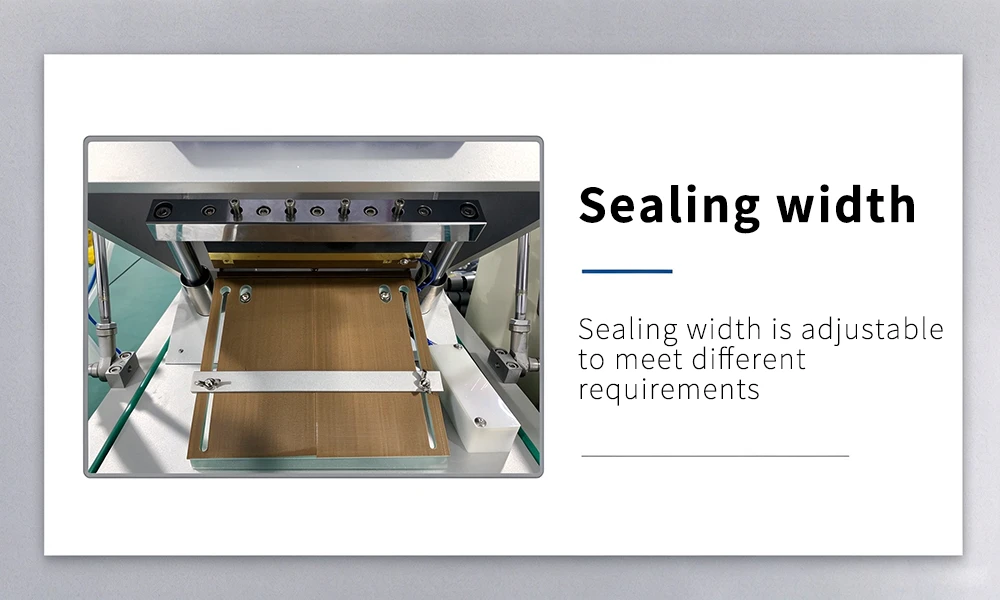
The upper sealing bar with its row of adjustment screws, the two guide sleeves that keep the faces parallel, and the copper sealing bed on the chamber floor.
2. Chamber, Sealing Head and Vacuum
| Item | Specification |
|---|---|
| Chamber | Aluminium alloy, corrosion resistant, with a viewing window for the chamber during the cycle |
| Vacuum | Adjustable to -95 kPa; the vacuum pump is supplied by the buyer |
| Sealing head temperature | Room temperature to 250 °C, adjustable |
| Temperature accuracy | ± 2 °C |
| Sealing pressure | 0 to 5 kg/cm², set on a pressure regulating valve |
| Sealing time | 0 to 99 s, adjustable |
| Sealing head material | Copper, for heat transfer at lower power |
| Head motion | Upper and lower heads driven by cylinders and guided on two linear guide sleeves, so the seal faces stay parallel |
| Lid motion | Cylinder driven, guided on a rotary guide sleeve for repeatable sealing of the chamber |
| Control | PLC with touch screen |
| Air consumption | About 0.2 L of compressed gas per seal |
| Sealing rate | 180 seals per hour or faster |
3. Power, Utilities and Footprint
| Item | Specification |
|---|---|
| Power supply | 220 V, 50 Hz |
| Heater and consumption | 300 W heating element; about 0.6 kW while heating |
| Compressed gas | 0.4 to 0.5 MPa; inside a glovebox the cylinder drive gas must be the same working gas the box uses |
| Sealing unit size | 420 mm long by 300 mm wide by 230 mm high with the lid closed |
| Control box size | 450 mm long by 220 mm wide by 265 mm high |
| Weight | About 20 kg for the sealing unit, about 10 kg for the control box |
| Transfer chamber | 360 mm or larger, so the machine enters without removing glovebox glass |
Two of these values are the buyer's responsibility rather than the machine's: the vacuum pump and the compressed gas. The pump has to reach -95 kPa at the chamber volume, and inside a glovebox the gas that drives the cylinders has to be the box gas, because anything else changes the atmosphere you are trying to protect.
Main Unit and Control Box: What Goes Where
There is no component brand table for this machine, because the datasheet does not name brands and inventing one would be worse than leaving it out. What the datasheet does specify is how the machine is divided, and that division is the most useful thing a glovebox buyer can know before ordering.
The sealing unit carries the working parts: the aluminium chamber, the upper and lower copper heads, the two linear guide sleeves that keep the heads parallel, the lid cylinder on its rotary guide, the viewing window, and the two cylinders that do the pressing. It is 420 by 300 by 230 mm and about 20 kg, and it is the only part that has to be inside the inert atmosphere.
The control box carries the PLC, the touch screen and the temperature controller: 450 by 220 by 265 mm, about 10 kg. It can stand inside the glovebox next to the machine, or outside on a shelf with the cable run through a port, or beside a conveyor if the machine is deployed on a line. Nothing in it needs the atmosphere, which is why putting it outside costs nothing and removes a heat source and a set of electronics from the box.
Three lines cross the boundary no matter where the box sits: the power lead to the sealing unit, the compressed gas line that drives the cylinders, and the vacuum line to the pump. Plan those three before the machine arrives, because a port you have to add later is a leak test you did not budget for. The viewing window is on the sealing unit itself, so the operator watches the chamber rather than the screen while the seal is made.
Key Engineering Characteristics
- Sized for a transfer chamber, not for a crane. 420 by 300 by 230 mm and about 20 kg for the working unit, 450 by 220 by 265 mm and about 10 kg for the control box. A transfer chamber of 360 mm or more takes either one, which is the whole point of the design.
- Split body, two deployments. The same machine runs inside a glovebox with the control box beside it, or on a production line with the control box at the station. Nothing about the sealing unit changes between those two lives.
- Copper sealing heads. Copper moves heat faster than steel or aluminium, so the head reaches temperature with a 300 W element and the machine draws about 0.6 kW while heating rather than holding a large block at temperature all shift.
- Two linear guide sleeves on the heads. The upper and lower heads are guided rather than floating, which is what keeps the two seal faces parallel across the 120 mm width and makes the thickness uniformity figure of 15 µm mean something.
- Every parameter separately adjustable. Temperature to 250 °C, pressure 0 to 5 kg/cm² through a regulating valve, dwell 0 to 99 s, vacuum to -95 kPa, seal width 5 mm nominal. A sealing trial is a sweep of those five numbers, and each is set on its own rather than through a fixed recipe.
- Seal consistency quoted as a number. The difference between any two points of a seal is below 15 µm. On a 60 to 500 µm stack that is the figure that predicts whether the seal holds through formation and degassing.
- Pneumatics that can live in the box. About 0.2 L of gas per seal, and the drive gas must be the same working gas the glovebox uses. At 180 seals an hour that is roughly 36 litres an hour, a figure small enough that the box purification system does not notice it.
Why the Transfer Chamber Decides the Purchase
A glovebox is not a room you walk into; it is an atmosphere you maintain. Every time the box is opened to the room, the water and oxygen you spent days removing come back in, and the purification system has to work through them again. That is why the question "will it go through the antechamber" is not a logistics detail. It is the difference between an installation that takes an afternoon and an installation that costs a week of atmosphere and a resealed window you will always wonder about.
The machines that fail this test are the ones built as a single cabinet. A pre-sealer with the PLC, the temperature controller and the pneumatics inside the same frame becomes a box of perhaps 600 by 500 by 700 mm, and no standard transfer chamber takes that. The industry answer is to remove a window, crane the machine in, and re-glaze; the seal you get the second time is made on a bench by a technician rather than in the factory jig, and it is the seal that decides whether your box holds its specification for the next five years.
What has to clear the opening here is a 300 by 230 mm cross-section on the 20 kg unit, and a 220 by 265 mm cross-section on the 10 kg control box. The 360 mm figure is the smallest transfer chamber TOB has confirmed this machine in. One piece of arithmetic is worth doing before you order: if your antechamber is a round bore rather than a rectangular door, a 300 by 230 mm rectangle needs a 377 mm circle to pass through without tilting, because that is the diagonal of the section. Measure the clear opening rather than the nominal size, and if it lands between 360 and 380 mm, send us the drawing before the order rather than after.
Splitting the machine also changes what the atmosphere has to put up with. The sealing unit brings the chamber, the copper heads and the cylinders inside; the control box brings the PLC, the touch screen and the temperature controller outside, where their heat does not load the box cooling and their electronics are not exposed to the working gas. Two bodies also mean two lifts of 20 and 10 kg instead of one lift of 30 kg, which matters when the transfer chamber is at chest height and the operator is one person.
The gas is the part buyers most often get wrong. The cylinders are driven by compressed gas at 0.4 to 0.5 MPa, and inside a glovebox that gas has to be the same working gas the box uses, not plant air. Plant air carries moisture and oxygen into the box through the exhaust of every stroke, and at 0.2 L per seal and 180 seals an hour, that is 36 litres an hour of the wrong atmosphere. Plumb the drive from the box gas supply, and the pneumatics become part of the atmosphere rather than a leak into it.
What none of this changes is the sealing job itself. One edge per cycle, up to 120 mm long, on a stack between 60 and 500 µm. A cell that needs two edges sealed needs two cycles or a different machine, and a cell wider than 130 mm including its gas pocket will not sit in this chamber at all. Those are the numbers to check against your drawing, and they are in the first table on this page rather than buried in the middle of it.
Operating Sequence, Maintenance and Safety
1. One Pre-sealing Cycle, Step by Step
- Set the sealing temperature on the touch screen and let the copper head stabilise. The controller holds ± 2 °C, and the head reaches temperature quickly because copper conducts; waiting for the reading rather than for a timer is the habit that keeps trial results comparable.
- Set the vacuum level, the sealing pressure on the regulating valve, and the dwell time. These three are the parameters a sealing trial sweeps, and each is independent of the others.
- Place the cell in the chamber with the edge to be sealed inside the 120 mm seal length, positioned so the 5 mm seal sits on the aluminium-laminate edge rather than on the electrode stack or the tab.
- Close the lid. The cylinder drives it on its rotary guide, and the chamber seals before the cycle can start.
- Pump the chamber down to the set vacuum, up to -95 kPa. The gas pocket of the cell is what this step is for: the pocket is where the electrolyte vapour and the residual air sit before the edge closes.
- The heads close and hold for the dwell. Watch through the viewing window rather than the screen; the window is there because the seal forming is the one thing worth seeing.
- Vent, open the lid, and take the cell out. Check the seal width against the 5 ± 0.4 mm nominal and, on the first cell of a new recipe, check thickness at several points against the 15 µm uniformity figure. A seal that varies across its length is a pressure or parallelism problem, not a temperature problem.
2. Maintenance
The datasheet gives four maintenance instructions and no intervals, which is honest: how often a machine needs them depends on how many seals a day it makes. Set the intervals from your own duty cycle.
- Keep it clean. Wipe the chamber, the heads and the window with a soft cloth dampened with alcohol. Electrolyte residue on a sealing face changes the seal far more than any parameter drift.
- Keep the motion lubricated. Oil the moving parts so the head and lid travel smoothly; a dry guide sleeve shows up first as a seal that is tight at one end.
- Protect it when idle. If the machine will sit unused for a long period, clean the moving surfaces and coat them with rust-preventive oil before it is stored.
- Check the fasteners. Go over the screws, nuts and pins periodically. On a machine that cycles a cylinder 180 times an hour, a loose fastener is a parallelism error before it is a safety issue.
3. Safety
The machine has three rules in its manual, and the first is the one that matters most on a bench where the operator is also wearing gloves inside a box.
- Hands out of the working area while the cycle runs. The heads and the lid are cylinder driven and the space between them is the sealing zone. Gloves make a hand larger and slower, which is why the rule is absolute rather than advisory.
- One operator per machine. Two people at one pre-sealer is how a hand ends up in the chamber when the other person starts a cycle.
- No unauthorised dismantling. External technicians and staff who have not been trained should not take the machine apart; the pneumatics and the chamber seal are both things that are easy to open and hard to restore.
Two hazards are physical rather than procedural: the head reaches 250 °C and stays hot after the cycle, and the chamber is under vacuum while it is closed. Neither is unusual for a pre-sealer, and both are the reason the machine is operated through a touch screen with the lid closed rather than by hand.
Quality System, Technology Provenance and Delivered Projects
Quality System and Certification Status
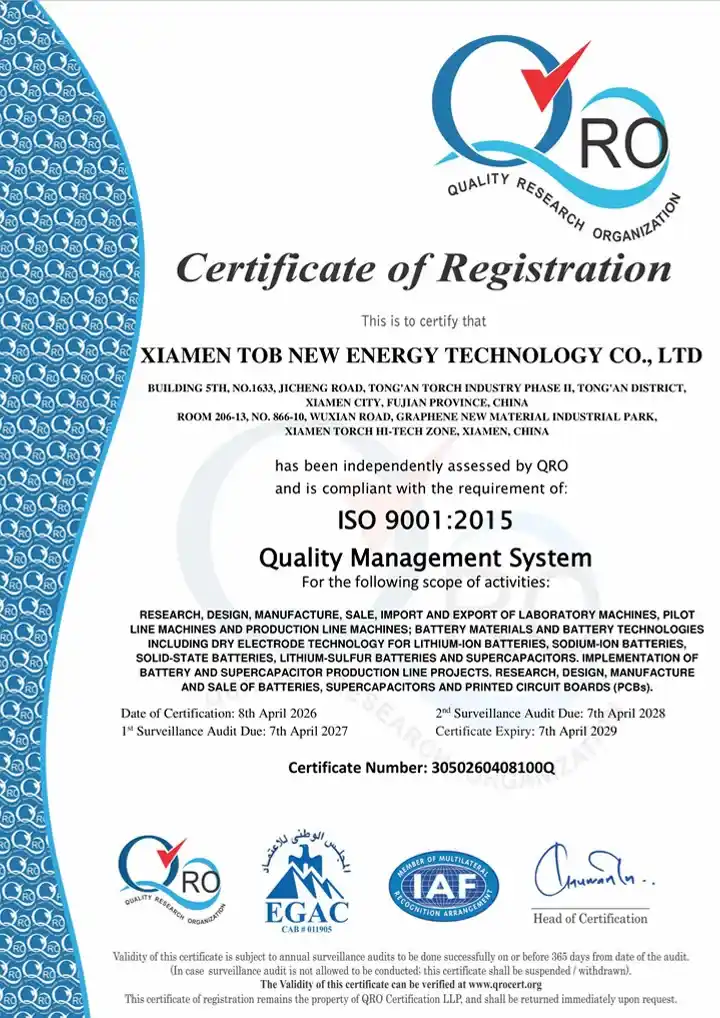
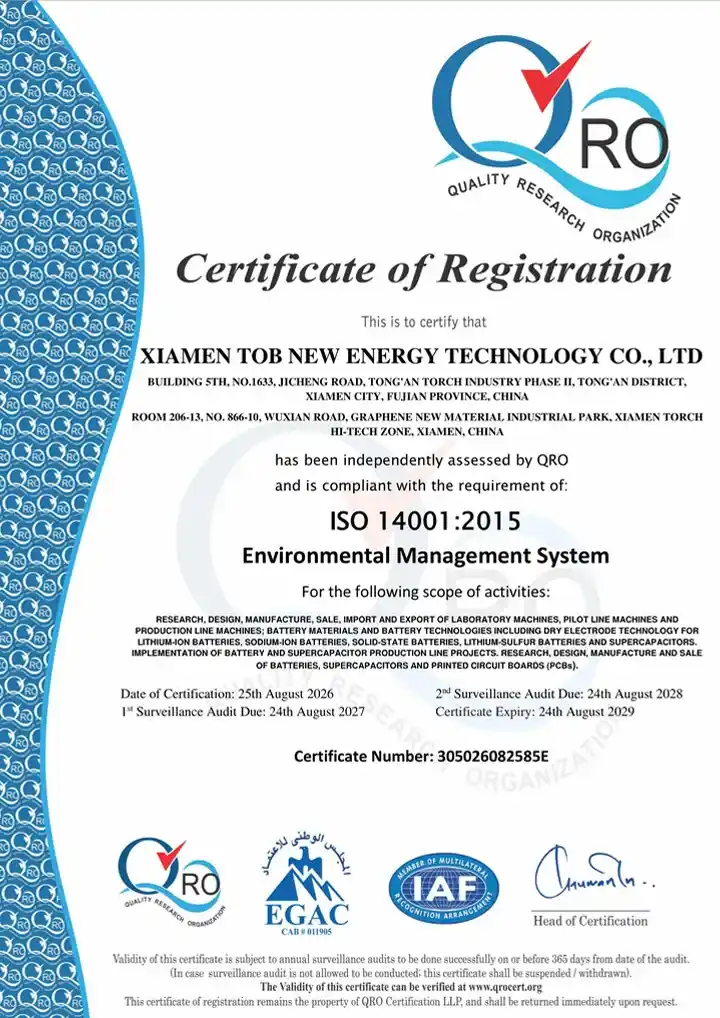
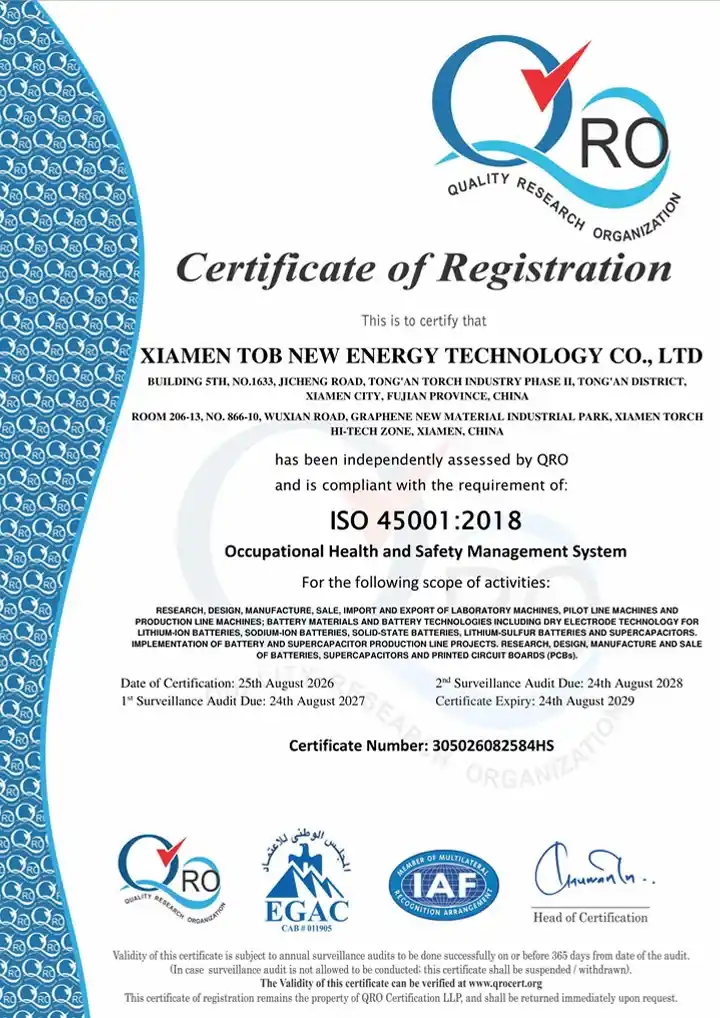
TOB NEW ENERGY holds ISO 9001 certification under certificate 3050260408100Q, dated 8 April 2026 and valid to 7 April 2029, with ISO 14001 (305026082585E) and ISO 45001 (305026082584HS) in place for environmental and occupational safety management. The certified scope covers research, design, manufacture, sale, import and export of laboratory machines, pilot line machines and production line machines, together with battery materials and battery technologies, and the implementation of battery and supercapacitor production line projects. Separately, TOB has been assessed on site by SGS (report 19520939_T) and TUV (report 493330274_T) through Alibaba.com supplier verification; those reports attest the factory and its capability, not the conformity of any individual product.
On product compliance, this model is not currently named on a CE certificate, and it is better to say that than to imply otherwise. Other machines in the range have been assessed under the Machinery Directive 2006/42/EC or under the Low Voltage and EMC Directives, depending on the machine. If CE marking is a purchasing requirement for your site, tell us before the order and we will scope the assessment with you rather than discover the gap at delivery.
|
|
|
Technology Provenance
Dany Huang, Ph.D., the founder of TOB NEW ENERGY, holds 55 Chinese patents: 5 granted invention patents, 45 utility models and 5 published applications. The portfolio sits on the cell side of the business rather than the machine side, covering cell structures, electrode formulations and gas handling, which is the knowledge that sets the process windows equipment has to meet. The register is public and can be read entry by entry: the 55 Chinese patents held by Dany Huang. None of it should be read as a patent covering the TOB-VHSX-100 itself.
Peer-Reviewed Use
TOB NEW ENERGY is named in 707 peer-reviewed papers indexed to date as the supplier of the equipment or materials used in the work, and 70 of those papers name a specific TOB model, the most frequent being the TOB-DF-160 coin cell crimper. None of them names this pre-sealer yet. What the record supports is that laboratories publishing on cell and electrode work buy TOB equipment and credit it in their methods sections, not that this particular machine has been validated in print; when a paper citing it appears, it will be listed here with its DOI.
Delivered Production Lines
TOB builds whole lines, not only single machines, and a pre-sealer is one station on a pouch cell line rather than a product sold in isolation. The two projects below are the closest reference for a buyer deciding between a bench unit and a line station. Client names are withheld under our confidentiality practice; the line type and the region are what can be verified on the project pages.

|

|
| Built in Europe; the 20 MWh automated high-flexibility pouch cell production base records what was installed. | Built in Brazil; the lithium-ion pouch cell lab scale line records what was installed. |
Engineering FAQ
Q: Will it actually pass through my glovebox antechamber?
What has to clear the opening is a 300 by 230 mm section on the 20 kg sealing unit and a 220 by 265 mm section on the 10 kg control box. A rectangular transfer chamber of 360 mm takes both without argument. If the antechamber is a round bore, measure the clear diameter rather than the nominal size: a 300 by 230 mm rectangle needs a 377 mm circle to pass through without tilting, because that is the diagonal of the section. Between 360 and 380 mm we would rather see your drawing before the order than hear about it afterwards.
Q: What gas drives the cylinders inside the box?
The working gas of the glovebox, not plant air, at 0.4 to 0.5 MPa. Every cylinder stroke exhausts its drive gas into the box, so plant air would carry moisture and oxygen straight into the atmosphere you are maintaining. Consumption is about 0.2 L per seal, roughly 36 litres an hour at 180 seals an hour, which the purification system handles without noticing.
Q: Do I need to buy a vacuum pump?
Yes. The machine reaches -95 kPa adjustable but the pump is supplied by the buyer, and it has to suit the chamber volume and the dwell you want. Most installations put a small dry pump outside the box with a line through a port, which keeps the pump's heat and exhaust out of the atmosphere.
Q: How thick a cell stack can it seal?
From 60 to 500 µm of sealed stack, with the difference between any two points of the seal held below 15 µm. That uniformity figure is the one that matters after formation: a seal that thins at one end is where the pocket opens. Seal width is 5 ± 0.4 mm nominal and can be made to your specification.
Q: Can it run on a production line instead of inside a box?
Yes. Nothing about the sealing unit needs the inert atmosphere; it is the process that does. With the control box at the station the machine seals 180 cells an hour or faster, and the same unit that was installed through an antechamber can be moved to a conveyor without modification.
Q: Does it fill the electrolyte or do the final seal?
Neither. It pre-seals after filling and soaking, and the final seal after formation is a separate step, as is the electrolyte diffusion that follows. If those steps should happen without moving the cell between machines, the all-in-one and three-in-one machines linked at the top of this page cover them; this machine is deliberately the smallest of the family because the transfer chamber is what sets its size.
Send your cell drawing, the stack thickness and the transfer chamber size, and we will confirm the seal fits and the machine passes before the order.
Email: tob.amy@tobmachine.com | Tel / WhatsApp: +86 181 2071 5609
Reviewed by: Pinery Gong, Battery Assembly & Yield Process | Last updated: 2026-11-05
Previous:
Small Size Battery Heat Sealing Machine For Glove BoxNext:
200mm Length Compact Vacuum Sealer For Vacuum Pre-sealing
If you are interested in our products and want to know more details,please leave a message here,we will reply you as soon as we can.


 subscribe to us