Chinese
 français
 Deutsch
 italiano
 español
 português
 Nederlands
 日本語
 한국의




- Home
- >
- Battery Materials
- >
- Cathode Active Material
- >
- Metal-Air Battery Electrode Customization | Aluminum, Zinc, Magnesium Air Battery Cathode
Categories
Hot Products

Loading...




Metal-Air Battery Electrode Customization | Aluminum, Zinc, Magnesium Air Battery Cathode
Brand:
TOB NEW ENERGYitem no.:
TOB-F182order(moq):
1Payment:
L/C,T/Tproduct origin:
Chinashipping port:
XIAMEN
Metal-Air Battery Electrode Customization | Aluminum, Zinc, Magnesium Air Battery Cathode - TOB-F182
A three-layer air cathode - gas diffusion layer, catalyst layer and current collector - cut to four standard drawings or to your own
Product Overview and Ideal Applications
The TOB-F182 is a metal-air battery cathode supplied as a finished sheet rather than as a slurry or a powder. It is the air electrode of an aluminum-air, zinc-air or magnesium-air cell: the face that takes oxygen from the room, reduces it, and hands the charge to the external circuit. One sheet carries the three layers behind it - a gas diffusion layer that feeds oxygen in and holds electrolyte back, a catalyst layer where the oxygen reduction reaction runs, and a current collector that carries the electrons out.
The product is a customization service as much as a part. Four drawings are held as standard, from 35 x (80 + 10) mm to 168 x (218 + 8) mm, and anything outside them is quoted against your own dimension. That matters because the cathode is usually the last component a research group fixes: the housing, the anode and the electrolyte come first, and the air side then fits whatever window is left. On the lithium-ion side, our customized battery electrode for lithium-ion cell and supercapacitor covers the same service for coated foils.
Laboratory and pilot volumes come off the same drawings; only the batch size changes. What the buyer has to settle is the format, the catalyst system and the current collector, because those three set the current the cathode can deliver before the voltage collapses. We quote against your answer, not a catalogue number, which is why the four sizes are a starting point, not a limit.
Ideal for:
- Aluminum-air, zinc-air and magnesium-air cells built around a flat air window.
- Laboratory screening across four formats on one electrolyte and one anode.
- Prototype and pilot builds that need the same cathode drawing repeated across batches.
- Projects where the electrode has to be replaced without re-laminating the gas diffusion layer in house.
- Not a drop-in for a wound cell, nor a substitute for a coated lithium-ion electrode.
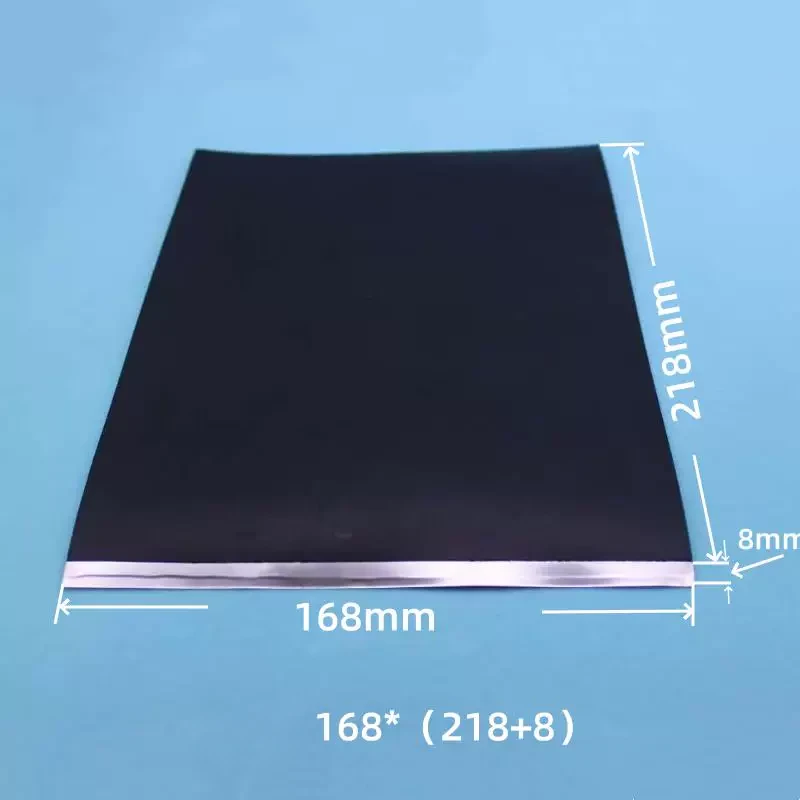
The largest of the four standard drawings, 168 x (218 + 8) mm
Tell us your application, required specifications, quantity, and delivery country. Our engineer will confirm the suitable product or configuration.
Complete the inquiry form below and our engineer will review your requirements. Prefer email? Contact tob.amy@tobmachine.com.
Complete Specifications
What follows is what is fixed and what is open. Sizes and layer sequence are fixed once the drawing is agreed; the catalyst system and the current collector are chosen per application, and both are confirmed on the quotation drawing rather than assumed here.
1. Standard Models and Sizes
| Model | 35 x (80 + 10) mm | 72 x (108 + 4) mm | 115 x (115 + 4) mm | 168 x (218 + 8) mm |
|---|---|---|---|---|
| TOB-F182 | Standard | Standard | Standard | Standard |
| TOB-M24 | Standard | Standard | Standard | Standard |
| Custom | Quoted to drawing | Quoted to drawing | Quoted to drawing | Quoted to drawing |
Both model codes are supplied against the same four drawings. Tell us which code your bill of materials uses and the quotation follows that code; a size outside the four is quoted on your drawing, including the uncoated length.
2. Electrode Construction
| Layer | Function | What fails if it is wrong |
|---|---|---|
| Gas diffusion layer | Carries oxygen from ambient air to the catalyst and holds the electrolyte back | Too open and the cell floods; too tight and it starves at high current |
| Catalyst layer | Runs the oxygen reduction reaction and sets the operating voltage | Activity shows up directly as a lower cell voltage at the same current |
| Current collector | Transfers electrons out and gives the laminate its mechanical stability | Ohmic loss adds to every reading and is easy to mistake for poor catalysis |
Layer sequence is fixed as gas side, catalyst, collector. Thickness, catalyst loading and collector type are chosen per application and stated on the quotation drawing, because they are set by the current and the electrolyte you intend to run.
3. What Is Made to Order
| Parameter | Status |
|---|---|
| Electrode width and length | Four standard drawings, or quoted to your dimension |
| Uncoated length and its position | Quoted to drawing |
| Catalyst system | Selected per application, confirmed on the quotation drawing |
| Current collector | Selected per application, confirmed on the quotation drawing |
| Batch quantity | From single research batches to pilot quantities |
| Application | Aluminum-air, zinc-air or magnesium-air |
Standard Sizes and What Changes Between Them
The four drawings are cut from the same laminate, so moving up a size changes how much current a cell can deliver without changing the chemistry underneath. Each drawing is quoted as width x (coated length + uncoated length), which is why the bracket appears: the coated face is the first figure multiplied by the coated length, and the uncoated length sits outside it. Active areas run from 2,800 mm² on the 35 mm drawing to 36,624 mm² on the 168 mm one.
The 35 mm drawing is the narrowest of the four. At a fixed current density its absolute current is the lowest of the set, which makes it the one to start from when the electrolyte volume rather than the electrode is the limiting factor in the cell, and the one that wastes least material when a catalyst system is being screened for the first time.
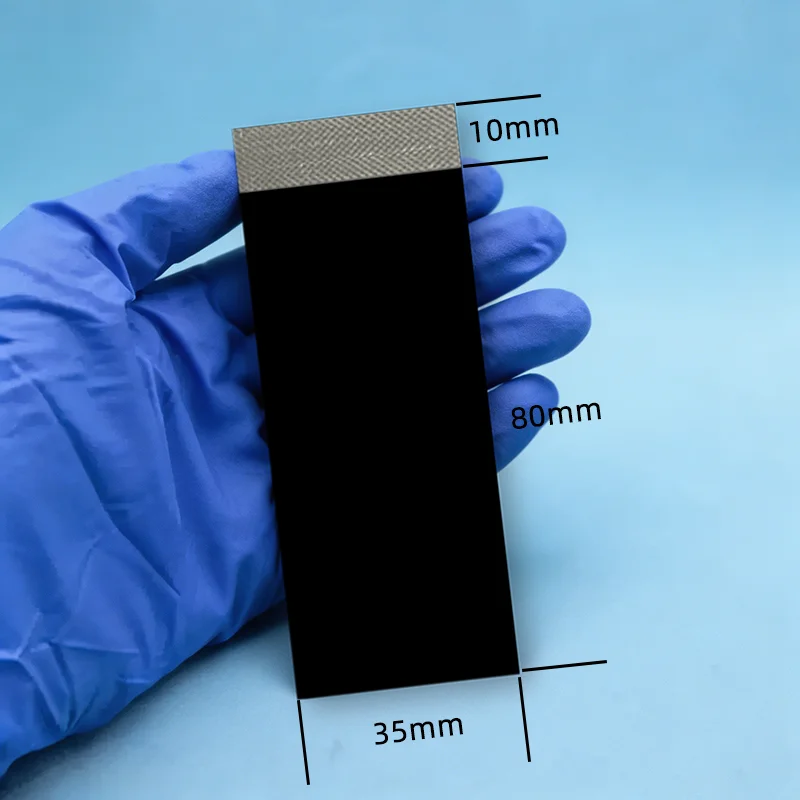
The 35 x (80 + 10) mm drawing: narrow coated face, 10 mm of uncoated length outside it.
The 72 mm drawing is the first real step up. Its active area is about 2.8 times that of the 35 mm drawing, which is enough to confirm a result at a higher total current while still keeping a batch small. Groups that screen on the 35 mm drawing usually move here for the second round, because the layer stack is identical and only the cut changes.
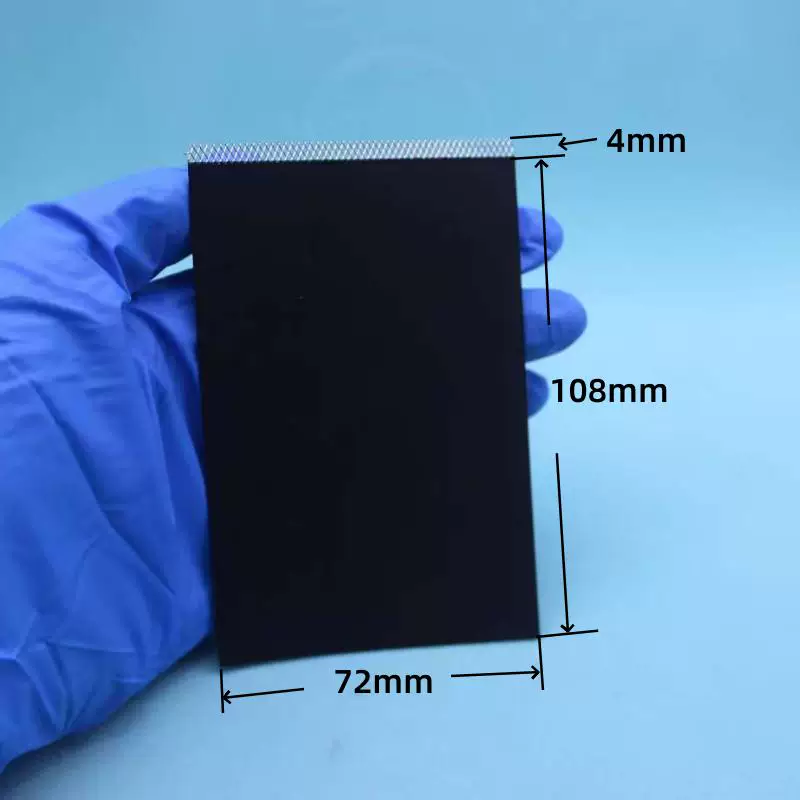
The 72 x (108 + 4) mm drawing: roughly 2.8 times the active area of the smallest, same laminate.
The 115 mm drawing is nearly square, with 4 mm of uncoated length. That shape suits a cell whose air window is square rather than a long slot, and the near-square outline keeps the current distribution more even across the face than a long narrow strip does. Its active area is about 4.7 times the smallest drawing.
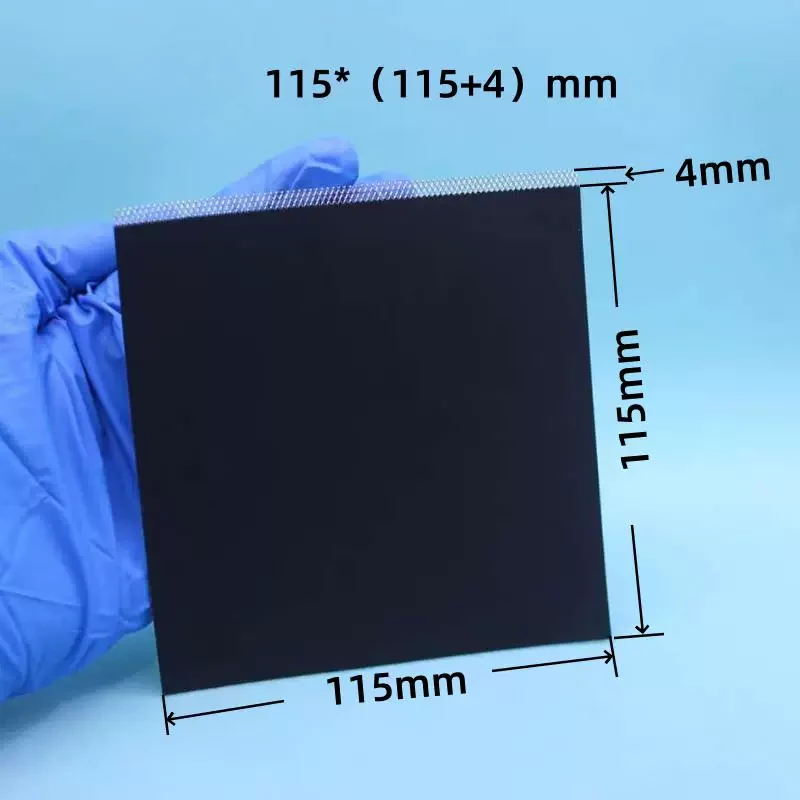
The 115 x (115 + 4) mm drawing: near-square face for a near-square air window.
The 168 mm drawing, shown at the top of this page, is the largest of the set at about 13 times the active area of the smallest, and it is the one used when a single cathode has to carry the whole current of a cell rather than be one of several in a stack. Above this size the electrode is quoted to your drawing, because beyond it the uncoated length and the collector thickness start to be set by the cell rather than by us.
How the Air Cathode Works
Oxygen does not dissolve into the electrolyte and drift to the electrode. It arrives as a gas, crosses the gas diffusion layer, and meets the electrolyte at the catalyst surface. Everything that happens next depends on that meeting point: the reaction needs gas, liquid electrolyte and solid catalyst in contact at the same time, and it is the width of that three-phase boundary, not the amount of catalyst, that usually sets the current.
The gas diffusion layer has two jobs that pull in opposite directions. It has to be open enough to feed oxygen to the catalyst at the rate the current demands, and tight enough to stop electrolyte from weeping through to the air side. An electrode that floods loses its gas path and the voltage falls at exactly the moment the current rises; an electrode that is too dry loses its ionic path and the resistance climbs instead.
The catalyst layer runs the oxygen reduction reaction. Its activity shows up as the cell voltage at a given current, so a change of catalyst system is visible in a polarisation curve before it is visible anywhere else. The current collector then has to carry that current out without adding resistance of its own, and it is also what keeps the laminate flat when the cell is clamped.
In a magnesium-air or aluminum-air cell the air side also sees the products of the anode reaction. That is why the construction is quoted per application rather than as one universal sheet: the same three layers, but the collector and the catalyst are chosen for the electrolyte and the current the cell is designed to run at. On the lithium-ion side the equivalent decision is the coating on the foil, which is what our LMFP cathode electrode on carbon coated aluminum foil is specified around.
Key Engineering Characteristics
- Three layers in one sheet. Gas diffusion layer, catalyst layer and current collector arrive already laminated, so the air side does not have to be built up in house before a cell can be assembled.
- Four standard drawings, 35 to 168 mm wide. Active area steps from 2,800 mm² to 36,624 mm² on the same laminate, so a result can be re-run at a larger size without a change of chemistry.
- Dimension quoted as width x (coated length + uncoated length). The uncoated strip is stated separately on the drawing, and it is the part the contact sits on.
- One laminate across all four sizes. A change of size is a change of cut, not a change of process, so data from one format transfers to the next.
- Aluminum-air, zinc-air and magnesium-air. The same construction serves all three chemistries; the catalyst and collector are selected against the electrolyte you run.
- Research batch to pilot batch on one drawing. Quantity changes the batch, not the specification, so a pilot build is not a re-qualification.
- Quoted against your catalyst and collector. Both are written onto the quotation drawing rather than left to a catalogue default, so what you approve is what is cut.
- Not a wound-cell component. The cathode is flat by construction; it is not intended for a jelly-rolled or cylindrical format.
Why Buy the Air Cathode as a Sheet
In a metal-air cell almost every disappointing result is blamed on the catalyst first and on the air side last. The order is usually wrong. A laminate that was pressed slightly too hard, a gas diffusion layer that took up electrolyte on one edge, a collector that was fine at low current and warm at high current: all three look like a catalyst that underperforms, and all three are invisible in the data until the electrode is cut open.
Buying the electrode as a finished sheet moves that variable out of your process. The lamination pressure, the catalyst loading and the bond to the collector are fixed once, on a line that does nothing else, and what reaches you is the same three layers every time. For a research group this is the difference between testing a chemistry and testing a hand-built electrode.
The second reason is comparability across formats. Because all four drawings come off one laminate, a result measured on the 35 mm drawing can be checked on the 115 mm drawing without the fear that the electrode changed underneath the experiment. Scale-up questions in air cathodes are usually questions about gas distribution and current density, and those are hard to answer if the material itself moved.
The third is time. Building a gas diffusion electrode in house means sourcing a GDL, choosing a catalyst ink, coating it evenly, hot pressing it to a collector and then finding out that the press was the variable. A purchased sheet removes that loop from the critical path, and it can be repeated months later when the first batch is gone.
There are cases where building your own is the better answer, and it is worth saying so: if the catalyst system you need is not one we run, or if the format is far outside the four drawings, a custom electrode programme is a longer conversation than a purchase order. For the middle ground - a known chemistry in a format that has to fit a cell you already have - the sheet is the shorter path. If what you actually need is the electrolyte-side electrode for a zinc-manganese cell rather than an air cathode, the MnO₂ electrode for zinc-manganese batteries is the equivalent page.
Handling, Storage and First-Use Checks
1. Before the first cell
- Check the drawing against the part before assembly: width, coated length and uncoated length, since the uncoated strip is what the contact sits on.
- Hold the sheet by the uncoated strip or the edge. The catalyst face should not be touched with bare hands; skin oils sit exactly where the three-phase boundary is meant to be.
- Inspect the gas side against a light for pinholes before it goes into a cell. A pinhole becomes an electrolyte leak, and an electrolyte leak becomes a flooded electrode.
- Condition the electrode to your own protocol rather than a generic one, and record what you did. The same sheet behaves differently after different wetting routines.
- Record the batch on the cell record. When a result is good, the batch number is the only thing that makes it repeatable.
2. Storage and handling
- Keep the sheets flat. A crease in the gas diffusion layer is a permanent change of gas path and cannot be pressed out.
- Keep them dry and away from solvent vapour before use; the gas side is designed to take up air, not solvent.
- Do not stack sheets face to face without an interleaf, and do not store them under weight.
- Cut or trim only if the drawing allows it: a cut edge exposes the laminate, and the exposed edge is where electrolyte creeps first.
3. If results drift between batches
- Compare polarisation curves at the same temperature and the same electrolyte before suspecting the electrode; air cathodes are unusually sensitive to how the cell is clamped.
- Look at the gas side for electrolyte staining. A stain on the air face means the electrode has been running wet, not that the catalyst has died.
- Check the contact resistance on the uncoated strip; a poor contact reads as a slow electrode.
- Keep one sheet from each batch unused as a reference. It is the only way to separate a batch problem from a cell problem later.
Certification, Patents and Delivery Record
1. Management system certificates
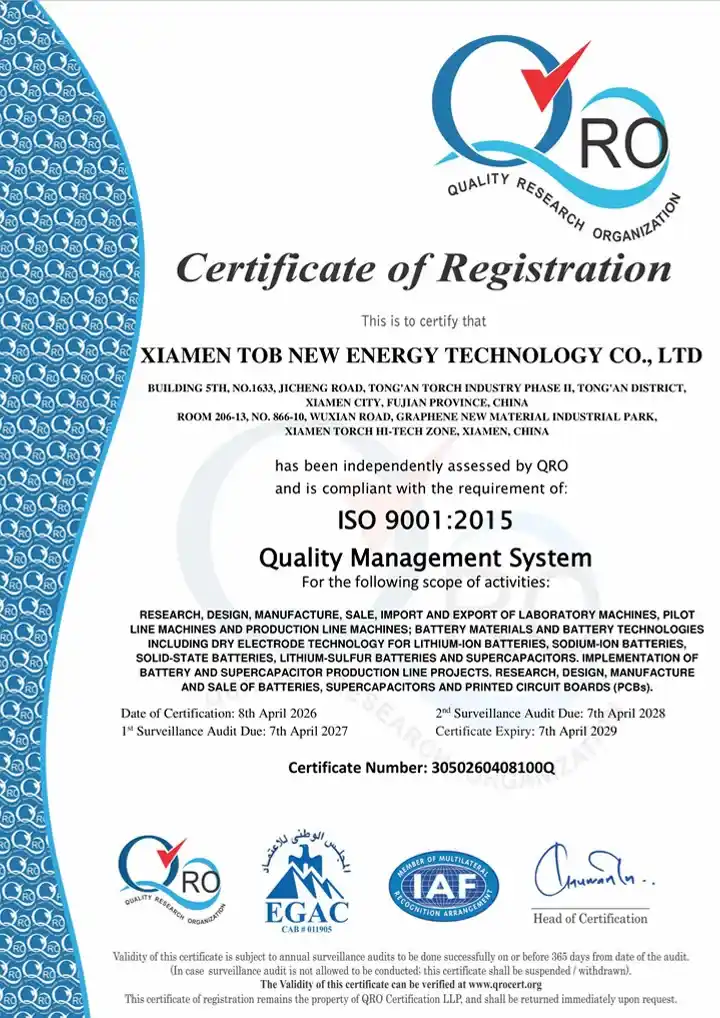
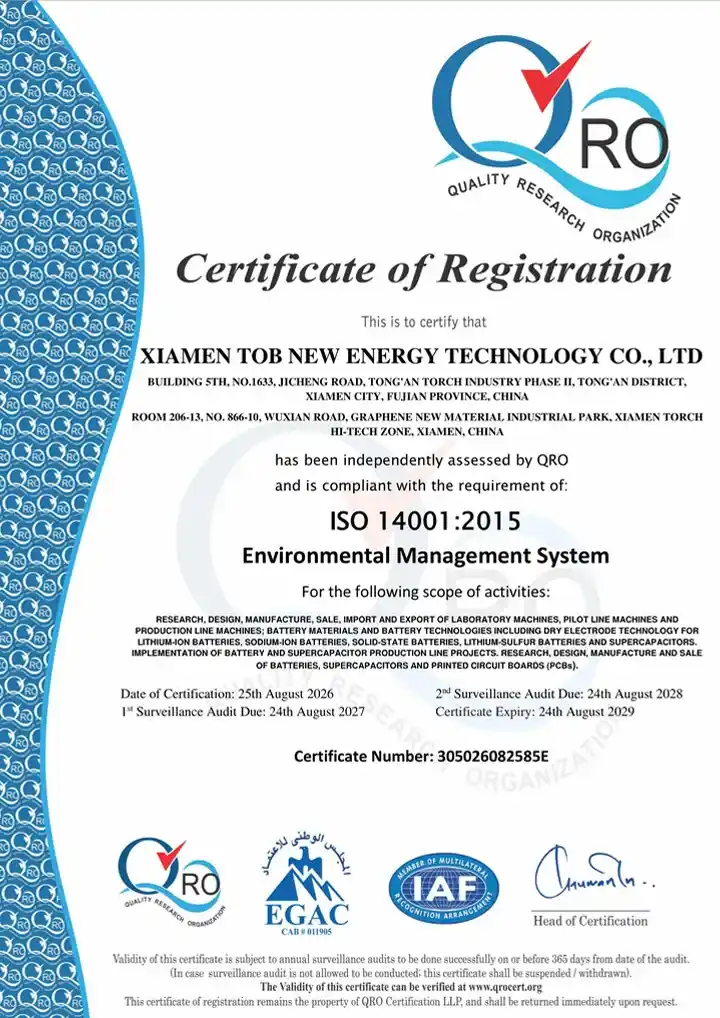
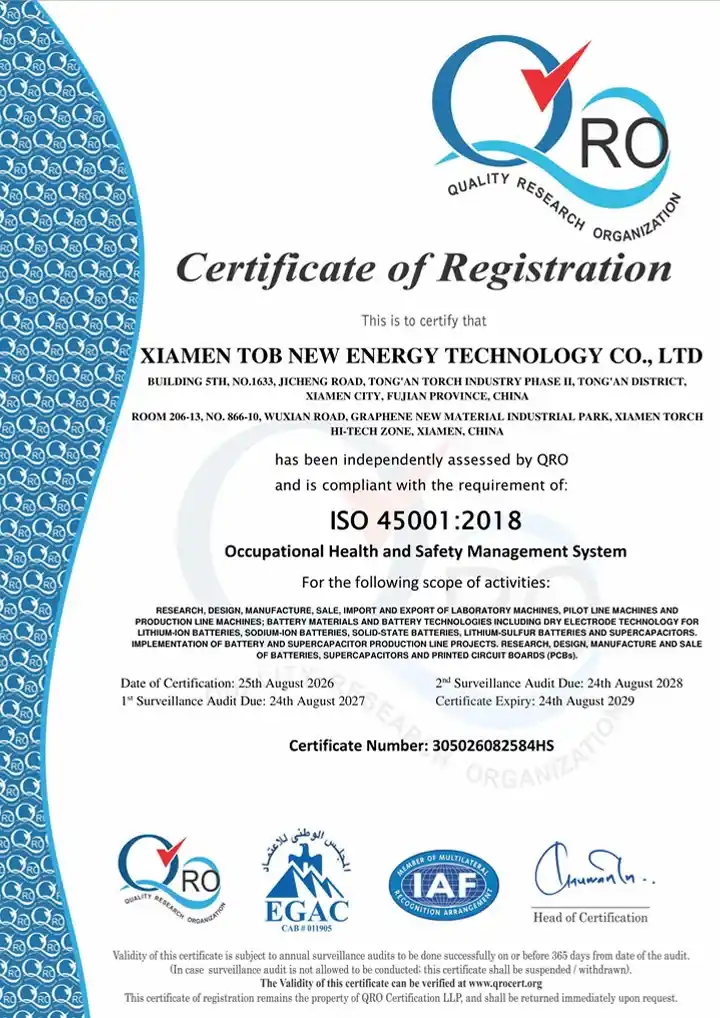
The factory that produces this electrode holds ISO 9001 certification under 3050260408100Q, issued on 8 April 2026 and valid to 7 April 2029, together with ISO 14001 (305026082585E) and ISO 45001 (305026082584HS). The certified scope covers laboratory, pilot line and production line equipment together with battery materials, so the electrode is produced inside a system that also audits the machines used to make electrodes.
|
|
|
CE marking applies to machinery, not to an electrode sheet, so the conformity route for this product is the management system above rather than a CE certificate. If your project needs a document we have not listed, ask before the order and we will say what exists.
2. Patents held by the founder
Dany Huang, Ph.D., who founded TOB NEW ENERGY in 2012 after a decade in pouch, cylindrical and prismatic cell production, holds 55 Chinese patents: 5 granted invention patents, 45 utility model patents and 5 published applications. The subject matter sits on the cell side - structures, formulations, gas handling - rather than on any single machine, so the portfolio is relevant to electrode work without being a claim about this particular sheet.
3. Research record
Our citation index currently holds 707 records that reference TOB equipment or materials; 70 of them name a specific TOB model. The TOB-F182 is not yet named in any of the 70. We give the number rather than leave the section out, because a page that only ever claims citations is a page that cannot be checked. When a paper does name the model, the entry goes here with its title, journal, authors and DOI.
4. Reference projects
Two deliveries show the scale this product is supplied into. Neither is a metal-air project, and we say so: one is a laboratory line build and the other is an electrode production line, which is where the electrode-side experience comes from.
The first is a projects for lithium ion pouch cell lab scale line building in Brazil, delivered as a complete bench line rather than as separate machines, which is the same supply pattern a research group uses when it needs electrodes and equipment on one schedule.

The Brazil lab line: electrode preparation through to cell assembly on one bench, which is the scale a research electrode is usually consumed at.
The second is a dry electrode supercapacitor production line, where the electrode is made without a solvent casting step. That project is the reference for how a laminate behaves when it is pressed rather than coated, which is the closest process analogue to a gas diffusion electrode among our deliveries.

The dry electrode line: pressing rather than slurry casting, the process closest to gas diffusion electrode lamination.
Engineering FAQ
Q1: How is this different from a coated foil electrode?
A coated foil carries one active layer on a metal foil and works in a closed cell where the electrolyte is a liquid in contact with the whole face. An air cathode has to let a gas in and keep a liquid out at the same time, so it needs a gas diffusion layer behind the catalyst and a collector that does not block the gas path. That is why it is a three-layer laminate rather than a coating, and why the uncoated strip and the frame cut matter more than they do on a foil.
Q2: Can I order a size outside the four standard drawings?
Yes. The four drawings are a starting point, not a limit; anything outside them is quoted against your dimension, including the uncoated length. What we need is a drawing with width, coated length, uncoated length and its position, plus the cell format it has to fit, because the uncoated strip is usually what constrains a custom size rather than the coated face.
Q3: Which of the three chemistries does this electrode work with?
Aluminum-air, zinc-air and magnesium-air. The three-layer construction is the same for all of them, but the catalyst system and the current collector are selected per application, because the electrolyte and the reaction products on the air side differ between the three. Tell us the chemistry at enquiry and the quotation is written against it.
Q4: What decides whether an air cathode floods or dries out?
The balance between gas pressure and electrolyte wetting at the catalyst surface, and that balance is set by the gas diffusion layer and by how the cell is clamped. A cathode does not fail in the abstract: it floods at a current where the gas demand exceeds what the diffusion layer can supply, or it dries when the electrolyte cannot keep the catalyst wet. This is why the same sheet can look excellent in one fixture and mediocre in another.
Q5: Can it be used in a secondary, rechargeable metal-air cell?
The construction is specified for the discharge side of a metal-air cell. A rechargeable cell also runs the oxygen evolution reaction on the same electrode during charge, which is a harder duty for the catalyst and the collector, so it should be quoted as its own case rather than assumed from the discharge specification. Tell us the charge regime and it is quoted against that.
Q6: What information do you need to quote a custom size?
Four things: the chemistry, the drawing or the dimensions with the uncoated length, the current the cell will run at, and the quantity. With those we can confirm the catalyst system and the collector, and the quotation carries the drawing you approved rather than a generic description. Delivery country matters for packing and documentation, so include it in the first message.
Q7: Are the two model codes, TOB-F182 and TOB-M24, different products?
Both codes are quoted against the same four drawings in the specification, so the size range and the construction are identical for either. Tell us which code your documentation uses and the quotation follows that code, so the paperwork matches what your system expects.
Send us the cell format, the chemistry, the dimensions you need and the quantity. We will confirm the catalyst system and the collector, then quote against a drawing you can approve.
Email: tob.amy@tobmachine.com | Mobile phone: +86-18120715609
Reviewed by: Science Wang, Six Sigma Black Belt, Battery Lines | Last updated: 2026-11-10
Previous:
MnO₂ Electrode for Zinc-Manganese BatteriesNext:
NMC Cathode Materials NMC811 NMC622 NMC532 NMC111 Powder
If you are interested in our products and want to know more details,please leave a message here,we will reply you as soon as we can.

 subscribe to us