Chinese
 français
 Deutsch
 italiano
 español
 português
 Nederlands
 日本語
 한국의




- Home
- >
- Battery Materials
- >
- Cathode Active Material
- >
- MnO₂ Electrode for Zinc-Manganese Batteries
Categories
Hot Products

Loading...
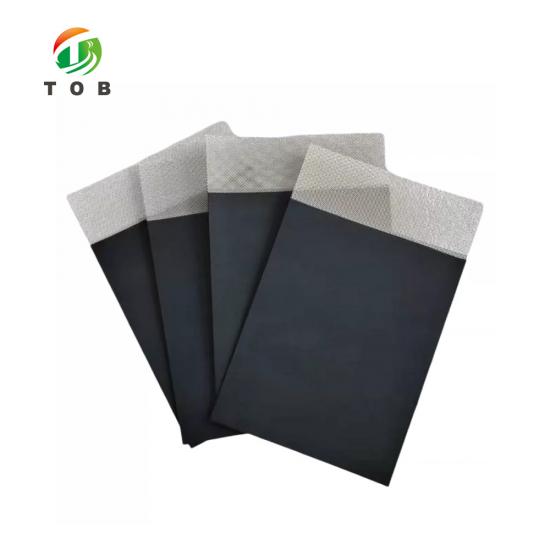
MnO₂ Electrode for Zinc-Manganese Batteries
Brand:
TOB NEW ENERGYitem no.:
TOB-ZM-Corder(moq):
1Payment:
L/C,T/Tproduct origin:
Chinashipping port:
XIAMEN
MnO₂ Electrode for Zinc-Manganese Batteries - TOB-ZM-C
Manganese dioxide on stainless steel mesh, 24 or 48 mg/cm², 220 mAh/g specific capacity, cut to your size
Product Overview and Ideal Applications
A made-to-order manganese dioxide cathode for zinc-manganese and aqueous zinc cells: MnO₂ active material on a stainless steel mesh collector, coated at 24 or 48 mg/cm² and cut to your drawing. On the standard 90 by 76.5 mm sheet the electrode is 0.24 mm thick, carries 1600 mg of active material over 68 cm² and delivers 400 ± 50 mAh at 0.73 mA/cm² discharge, a calculated 220 ± 20 mAh/g.
The mesh is the reason to choose this format over a foil. It keys the coating across its whole area instead of letting it sit on a flat surface, and it leaves a bare metal strip at one edge where a tab is welded rather than pressed onto manganese dioxide. Four-point resistance is 3 ± 0.5 Ω against 50 ± 10 Ω two-point, the difference being probe contact; electrolyte uptake is 0.55 ± 0.05 g/g after 24 hours in 2M ZnSO₄. The same fabrication route runs on other chemistries: LMFP cathode electrode on carbon coated aluminum foil for non-aqueous cells, metal-air battery electrode customization for air cathodes, and customized battery electrode for lithium-ion cell and supercapacitor for lithium and supercapacitor work.
It is the cathode only: no zinc anode, separator or electrolyte is supplied, capacity is quoted at one current density, and any size outside the catalogue is quoted from your drawing rather than stocked.
Ideal for:
- Cathode screening for zinc-manganese and aqueous zinc systems, where the electrode has to be comparable between batches
- Coin cell assembly at 12 or 24 mg/cm² on a disc that drops into a 2032 can without trimming
- Single-side sheets for pouch or bespoke test cells built to your own geometry
- Electrolyte and separator studies, with the electrode chemistry held fixed
- A reference electrode against which a new MnO₂ powder, binder or conductive additive is judged
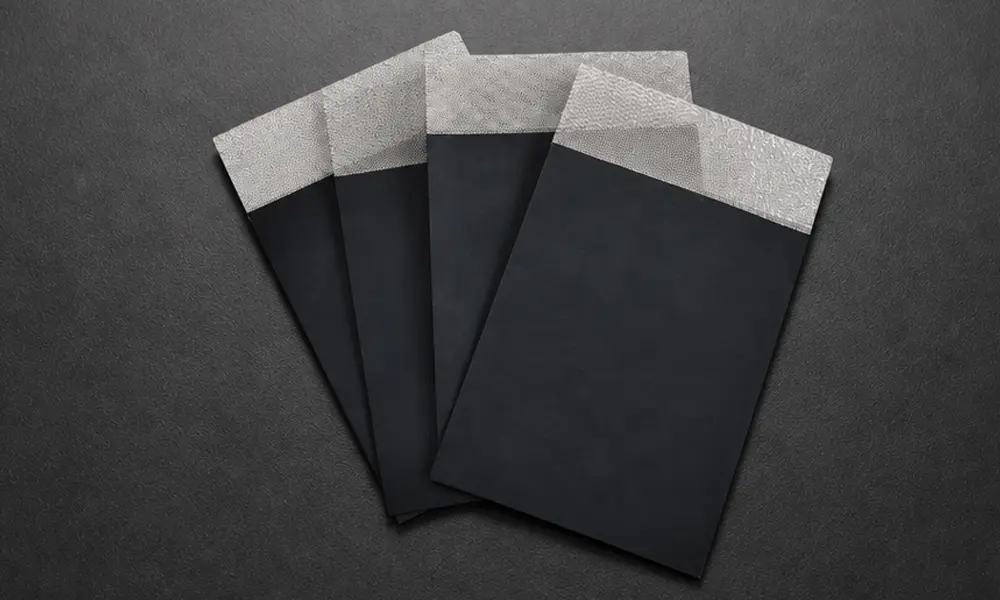
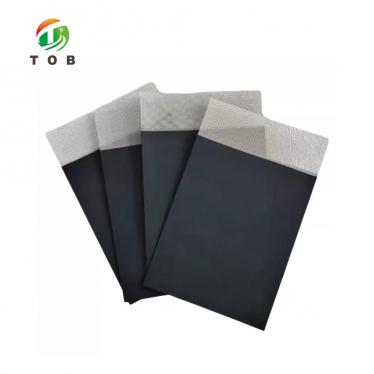
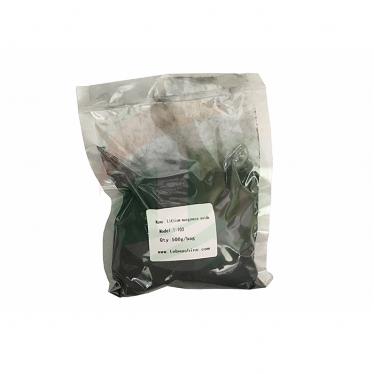
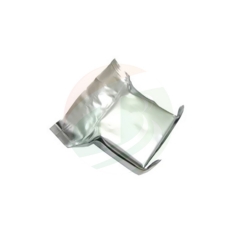
Four sheets with the coated MnO₂ area and the uncoated stainless steel mesh left exposed along one edge, where the tab is welded and where a four-point probe lands.
Tell us your application, required specifications, quantity, and delivery country. Our engineer will confirm the suitable product or configuration.
Complete the inquiry form below and our engineer will review your requirements. Prefer email? Contact tob.amy@tobmachine.com.
Complete Specifications
Two tables follow, and they answer different questions. The first is the measured sheet: every value with a test method beside it, so you can repeat the measurement in your own lab. The second is the catalogue of formats, which is where you find the size and loading you want to order.
1. Electrode Technical Parameters
These are the values for the 90 by 76.5 mm sheet at 24 mg/cm². Each row names the instrument or method used to obtain it, which is what makes the table checkable rather than a claim.
| No. | Item | Unit | Test method | Value |
|---|---|---|---|---|
| 1 | Point resistance, 2-point | Ω | Multimeter | 50 ± 10 |
| 2 | Point resistance, 4-point | Ω | Internal resistance tester | 3 ± 0.5 |
| 3 | Thickness | mm | Thickness gauge | 0.24 ± 0.01 |
| 4 | Electrode weight | g | Electronic balance | 4.5 ± 0.2 |
| 5 | Stainless steel weight | g | Electronic balance | 2.2 ± 0.1 |
| 6 | Coating weight | g | Electronic balance | 2.4 ± 0.1 |
| 7 | Active material weight | mg | Electronic balance | 1600 ± 50 |
| 8 | Area | cm² | Ruler measurement | 68 ± 2 |
| 9 | Areal density | mg/cm² | Calculation | 24 ± 1 |
| 10 | Electrolyte uptake | g/g | Soaked in 2M ZnSO₄ for 24 h | 0.55 ± 0.05 |
| 11 | Capacity | mAh | Assembled cell, 0.73 mA/cm² discharge | 400 ± 50 |
| 12 | Specific capacity | mAh/g | Calculated | 220 ± 20 |
2. Available Sizes and Loadings
The catalogue below is the standard range. A dimension in brackets, as in 25 by (25 + 10) mm, is a coated area plus the bare mesh tab left for contact; the number outside the bracket is the full cut size.
| Type | Specification |
|---|---|
| Sheet | 90 × 76.5 mm / 48 mg/cm² |
| Sheet | 25 × (25 + 10) mm / 48 mg/cm² |
| Sheet | 20 × (20 + 10) mm / 48 mg/cm² |
| Small pieces | 2 pcs / 10 × (10 + 10) mm / 48 mg/cm² |
| Sheet | 90 × 76.5 mm / 24 mg/cm² |
| Sheet | 25 × (25 + 10) mm / 24 mg/cm² |
| Sheet | 20 × (20 + 10) mm / 24 mg/cm² |
| Small pieces | 2 pcs / 10 × (10 + 10) mm / 24 mg/cm² |
| Coin cell type | Single side / 24 mg/cm² / 5 pcs |
| Coin cell type | Single side / 12 mg/cm² / 5 pcs |
| Large sheet | Single side 90 × 76.5 mm / 24 mg/cm² |
| Large sheet | Single side 90 × 76.5 mm / 12 mg/cm² |
Sizes outside this list are quoted from your drawing. When you ask for a custom sheet, give the coated area and the tab allowance separately, because that is how the electrode is cut and how the active material weight is calculated.
Structure and Materials
The electrode is a composite, and the three layers are worth naming separately because each one fails differently. The active material is manganese dioxide. The current collector is a stainless steel mesh, not a foil. The coating is a uniformly distributed MnO₂ slurry, and the word uniformly is doing the work in that sentence: an electrode that measures 24 mg/cm² in total but varies across its face will behave like a worse material than it is.
The masses in the datasheet let you see the composition without a separate analysis. The coating weighs 2.4 g of which 1600 mg is active material, so manganese dioxide is about two thirds of the coating by weight, with the balance being the conductive additive and the binder that hold it together and onto the mesh. That ratio is the usual compromise in an aqueous zinc cathode: more active material means more capacity per gram of electrode, less additive means higher resistance and weaker adhesion.
The mesh itself weighs 2.2 g over the same 68 cm², which at 0.24 mm total thickness leaves the coating in the region of a tenth of a millimetre on each face once the mesh is subtracted. That is thin enough that the ion path through the coating is short and thick enough that the areal loading is worth measuring in tens of milligrams per square centimetre.
What the structure is claimed to deliver follows from those three parts: stable electron transport because the mesh carries current across the whole face rather than from a single tab, good adhesion between active material and collector because the slurry is keyed into the mesh openings rather than sitting on a flat surface, and consistent electrochemical performance because the loading is controlled rather than estimated. Those are the claims; the twelve measured values on this page are what you check them against.
Key Engineering Characteristics
- Measured, not nominal. Twelve parameters, each with the instrument or method beside it: multimeter, internal resistance tester, thickness gauge, electronic balance, ruler. A buyer can repeat every one of them on arrival with equipment a battery lab already owns.
- Two resistances quoted, because one of them is the probe. 50 ± 10 Ω two-point against 3 ± 0.5 Ω four-point. The gap is contact resistance at the probe tip, and the four-point figure is the one that describes the electrode rather than the measurement.
- Mesh collector with a bare tab strip. Stainless steel mesh rather than foil, left uncoated along one edge so a tab can be welded and a probe can land on metal instead of on manganese dioxide.
- Two loadings from one process. 24 and 48 mg/cm², in the same formats, so a rate-versus-capacity comparison can be run without changing anything except the electrode.
- Electrolyte uptake measured in the electrolyte that matters. 0.55 ± 0.05 g/g after 24 hours in 2M ZnSO₄, which is a mild aqueous zinc sulfate rather than water. The number predicts wetting in a real cell rather than in a beaker.
- Capacity quoted at a stated current density. 400 ± 50 mAh per electrode at 0.73 mA/cm² discharge. Without that number a capacity figure means nothing, which is why it is in the same row as the method.
- Fabricated to your drawing. Size, loading and thickness are all open, from 90 by 76.5 mm sheets down to 10 mm pieces and coin cell discs at 12 and 24 mg/cm². The catalogue is a starting point, not a limit.
Why Loading, Mesh and the Four-Point Number Decide the Result
Manganese dioxide is a poor electronic conductor, and the discharge reaction happens only where three things meet: the manganese dioxide, the electrolyte, and a path for electrons. Every design decision in this electrode is a compromise between how much of the first you can pack in and how short you can keep the paths to the other two. That is why the sheet is quoted at two loadings rather than one, and why the resistance is quoted two ways.
Doubling the loading from 24 to 48 mg/cm² doubles the manganese dioxide behind every square centimetre, so it roughly doubles the areal capacity, and it also doubles the distance an ion has to travel to reach the manganese dioxide in the middle of the coating. The capacity per gram therefore falls as the loading rises, and a sheet that looks better on an mAh/cm² basis can look worse on an mAh/g basis. Having both loadings in the same format means you can plot that trade-off with one material and one process, rather than guessing whether a difference came from the powder or from the coating weight.
The mesh is the second compromise. Current has to get from the tab into the coating, and on a foil it does that through a thin sheet of metal under a resistive layer; on a mesh it does it through a grid that is in contact with the coating across its whole face, which spreads the current density and shortens the path in the plane. The bare strip left at one edge is part of the same argument: a tab welded to metal is a joint, while a tab pressed onto coating is a contact resistance that grows with every cycle.
The two resistance figures are worth understanding before you compare suppliers. Two-point measurement pushes current through the probe, the coating and the mesh and reads the whole path, so at 50 ± 10 Ω it is mostly measuring the contact between the probe tip and a rough manganese dioxide surface. Four-point measurement separates the current path from the voltage path, so at 3 ± 0.5 Ω it describes the electrode. A supplier who quotes only the two-point number is quoting something that depends on the probe, and two suppliers quoting two-point numbers cannot be compared unless they used the same tip pressure.
Electrolyte uptake of 0.55 g/g means the coating holds a little over half its own weight in 2M ZnSO₄ after a day of soaking. Practically that is the number you use twice: once as a proxy for the pore volume the coating offers the reaction, and once as a dosing figure when you decide how much electrolyte to put in a coin cell. A cell dosed on the assumption of a dry electrode will be starved, and starvation shows up as a capacity that fades in the first few cycles rather than as a low first-cycle number.
What these numbers do not tell you is how the electrode cycles. Capacity is quoted at one current density, 0.73 mA/cm², on one assembled cell; that is a single point on a rate curve, not a plateau. Cycling stability depends on the zinc anode, the separator, the electrolyte volume and the depth of discharge you choose, none of which are properties of the cathode sheet. The datasheet is built so that the electrode can be held constant while you vary those, which is the only way a comparison between electrolytes means anything.
Incoming Checks, Handling and Storage
1. What to Check on Arrival
The point of quoting twelve measured parameters is that you can check them. These five take about ten minutes and catch almost every problem:
- Thickness, with a gauge, against 0.24 ± 0.01 mm.
- Total weight and coating weight on a balance, against 4.5 ± 0.2 g and 2.4 ± 0.1 g.
- Area with a ruler, against 68 ± 2 cm².
- Areal density, by dividing active material weight by area, against 24 ± 1 mg/cm².
- Four-point resistance with an internal resistance tester, against 3 ± 0.5 Ω.
Compare against the tolerances in the first table rather than against a single reading, because a sheet at 4.4 g and one at 4.6 g are both in specification.
If a batch is going to be used for a comparison against a previous batch, record the five values for both rather than only noting that the new one passed. A drift inside the tolerance band is still a drift, and it is the usual explanation for a capacity difference nobody can account for.
2. Handling, Cutting and Assembly
- Handle the mesh strip, not the coating. The bare strip at the edge is there to be gripped. Fingers on the coated face leave oils that change wetting, and the mark shows up later as a dry spot in the cell.
- Cut without creasing. Scissors, a die or a punch all work; folding does not. A crease in a 0.24 mm mesh-backed coating cracks the coating along the fold, and the crack is where the electrode delaminates.
- Keep a tab allowance. When cutting a custom size, leave the bare mesh strip that the format defines as the bracketed dimension, and keep the same allowance on every sample so that the coated area stays constant across a series.
- Wet before you assemble. A coating that has not taken up electrolyte behaves like a resistive film for the first cycles. The 0.55 g/g uptake figure is measured after 24 hours of soaking; a shorter soak is a different experiment, and if you shorten it, shorten it the same way every time.
- Weigh the cell separately from the electrode. Because the electrode weight is quoted with a tolerance of 0.2 g, and the capacity is normalised per electrode, record the actual weight of each sheet you use rather than the nominal one.
3. Storage and Safety
Store the sheets dry and flat, in a sealed bag, away from solvent vapour. Manganese dioxide itself is stable in air, but the coating is a porous composite with a binder in it, and a coating that has absorbed moisture from the room behaves differently in the first cycle than a dry one. Bring the sheets to the glovebox or dry room before assembly rather than opening the bag at the bench.
Cutting generates manganese dioxide dust, so cut in a ventilated place or a fume hood, wear gloves and a dust mask, and wipe the bench afterwards. The electrolyte used with this electrode is a mild aqueous zinc sulfate rather than a lithium salt in organic solvent, which makes the handling easier than a non-aqueous cell, but zinc sulfate is still a chemical to be handled to its own safety data sheet rather than to habit. The electrode is supplied as a component, not as a certified cell; nothing on this page should be read as a compliance statement for an assembled battery.
Quality System, Technology Provenance and Delivered Projects
Quality System and Certification Status
TOB NEW ENERGY holds ISO 9001 certification under certificate 3050260408100Q, dated 8 April 2026 and valid to 7 April 2029, with ISO 14001 (305026082585E) and ISO 45001 (305026082584HS) in place for environmental and occupational safety management. The certified scope matters more than usual for a product like this one, because it covers battery materials and battery technologies as well as machines: research, design, manufacture, sale, import and export of laboratory, pilot line and production line machines, together with battery materials and battery technologies including dry electrode technology, and the implementation of battery and supercapacitor production line projects. An electrode sheet is a material, and the quality system that governs it is the one that names materials explicitly.
CE marking does not apply to an electrode sheet the way it applies to a machine, and we would rather say that plainly than let a certificate logo imply something about a chemical product. The machines in the range carry CE marking where they have been assessed; this electrode does not, and the compliance question for it is the material documentation in the datasheet, not a directive. Separately, TOB has been assessed on site by SGS (report 19520939_T) and TUV (report 493330274_T) through Alibaba.com supplier verification; those reports attest the factory and its capability, not the conformity of any individual product.

|

|

|
Technology Provenance
Dany Huang, Ph.D., the founder of TOB NEW ENERGY, holds 55 Chinese patents: 5 granted invention patents, 45 utility models and 5 published applications, covering cell structures, cell designs and gas handling. The portfolio is on the cell side of the business, which is the side that decides what an electrode has to do; it is not a portfolio of electrode-coating patents, and none of it should be read as a patent covering this sheet. The register is public and can be read entry by entry: the 55 Chinese patents held by Dany Huang.
Peer-Reviewed Use
TOB NEW ENERGY is named in 707 peer-reviewed papers indexed to date as the supplier of the equipment or materials used in the work, and 70 of those papers name a specific TOB product, the most frequent being the TOB-DF-160 coin cell crimper. None of them names this manganese dioxide electrode yet. What the record supports is that laboratories publishing on cell and electrode work buy TOB materials and equipment and credit them in their methods sections, not that this particular sheet has been characterised in print; when a paper citing it appears, it will be listed here with its DOI.
Delivered Production Lines
TOB builds whole lines, and an electrode sheet is the material those lines are set up to handle. The two projects below are the closest reference for a buyer judging whether a supplier understands electrode fabrication at scale. Client names are withheld under our confidentiality practice; the line type and the region are what can be verified on the project pages.

|

|
| Built as a complete line; the sodium-ion battery lab line project records what was installed. | Built in Brazil; the lithium-ion pouch cell lab scale line records what was installed. |
Engineering FAQ
Q: What is the difference between the 24 and the 48 mg/cm² sheets?
Twice the manganese dioxide per square centimetre, twice the areal capacity, and a longer ion path through the coating. In practice the 24 mg/cm² sheet gives the higher capacity per gram and the 48 mg/cm² sheet gives the higher capacity per square centimetre, which is the choice between a rate study and a loading study. The measured table on this page is for 24 mg/cm²; ask for the 48 mg/cm² figures if that is the format you are comparing.
Q: Are the sheets single side or double side coated?
The catalogue marks the coin cell entries and the large sheets as single side, and does not state a side for the plain sheet entries, so confirm it on the order rather than assuming. For a coin cell the answer is single side by construction; for a pouch or bespoke cell it depends on what you ask for, and the pricing and the active material weight both follow from that choice.
Q: What is the difference between the 12 and the 24 mg/cm² coin cell discs?
The same trade-off in a disc format: 12 mg/cm² wets faster and shows rate behaviour more clearly, 24 mg/cm² carries more active material and looks more like a practical electrode. Both are supplied five pieces to a pack, and running the same experiment on both is the cheapest way to find out which one your electrolyte can actually support.
Q: Can I order a size or a loading that is not in the table?
Yes; the table is the standard range rather than the limit of what can be made. Send the coated area, the tab allowance, the loading and the thickness you want, and the electrode is coated and cut to that drawing. Dimensions outside the list are quoted rather than stocked, so lead time follows the coating run rather than the shelf.
Q: Is the 400 mAh figure per electrode or per gram?
Per electrode, measured on an assembled cell at 0.73 mA/cm² discharge. The per-gram figure is the 220 ± 20 mAh/g specific capacity, calculated from the active material weight. When comparing two suppliers, use the per-gram figure for the material and the per-electrode figure for the cell you are building, and check that both were measured at the same current density.
Q: Does it come with a zinc anode, separator or electrolyte?
No. This is the cathode sheet only. The datasheet names 2M ZnSO₄ because that is the electrolyte the uptake and capacity tests used, not because it is supplied. Zinc foil, separators and electrolyte are separate items, and if you need the whole cell bill of materials quoted together, say so with the order and it can be listed on one quotation.
Send your cell drawing, the loading and the coating side you need, and we will quote the sheet with its active material weight before you order.
Email: tob.amy@tobmachine.com | Mobile phone: +86-18120715609
Reviewed by: Science Wang, Six Sigma Black Belt, Battery Lines | Last updated: 2026-11-09
Previous:
LMFP Cathode Electrode on Carbon Coated Aluminum FoilNext:
Metal-Air Battery Electrode Customization | Aluminum, Zinc, Magnesium Air Battery Cathode
If you are interested in our products and want to know more details,please leave a message here,we will reply you as soon as we can.

 subscribe to us