Chinese
 français
 Deutsch
 italiano
 español
 português
 Nederlands
 日本語
日本語 한국의
한국의




- Home
- >
- Pouch Cell Assembly Equipment
- >
- Pouch Cell Vacuum Sealing Machine
- >
- Vertical Secondary Vacuum Sealing Machine for Pouch Cell Degassing and Final Sealing
Categories
Hot Products
Loading...
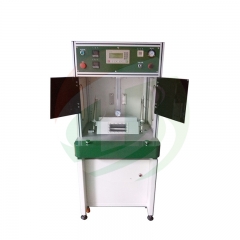
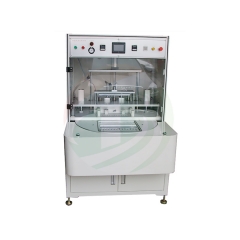
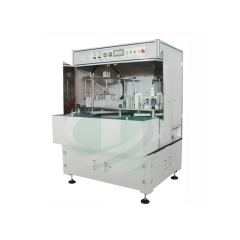
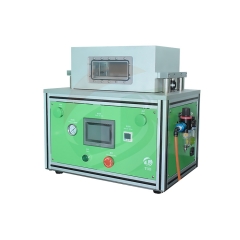
Vertical Secondary Vacuum Sealing Machine for Pouch Cell Degassing and Final Sealing
Brand:
TOB NEW ENERGYitem no.:
TOB-LFVHS-200order(moq):
1setPayment:
L/C,T/Tproduct origin:
Chinashipping port:
XIAMEN
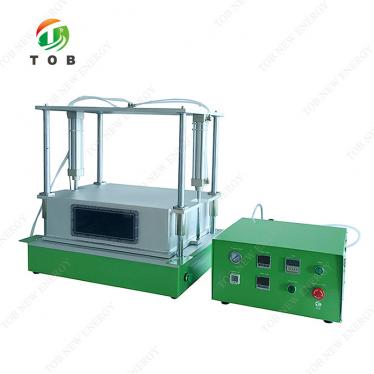
Vertical Secondary Vacuum Sealing Machine for Pouch Cell Degassing and Final Sealing | TOB-LFVHS-200
Product Overview and Ideal Applications
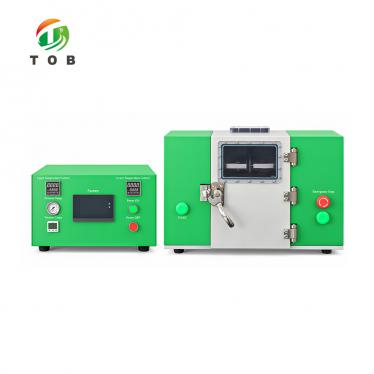
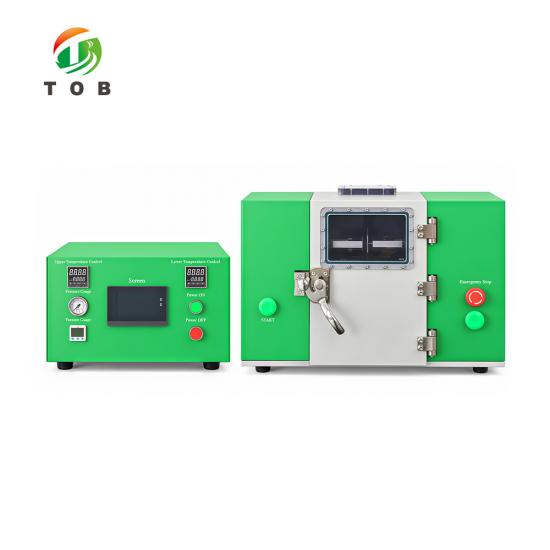
The TOB-LFVHS-200 is a vertical secondary vacuum sealing machine for pouch lithium-ion cells. It performs the secondary vacuum final sealing process - commonly known as degassing and final sealing - in which a pouch cell that has completed formation is placed vertically, pierced to release the gas generated inside the cell, and heat-sealed under vacuum to close the pouch. The process removes the internal gas produced during formation and re-seals the cell, completing the enclosure that protects the cell for the remainder of its life.
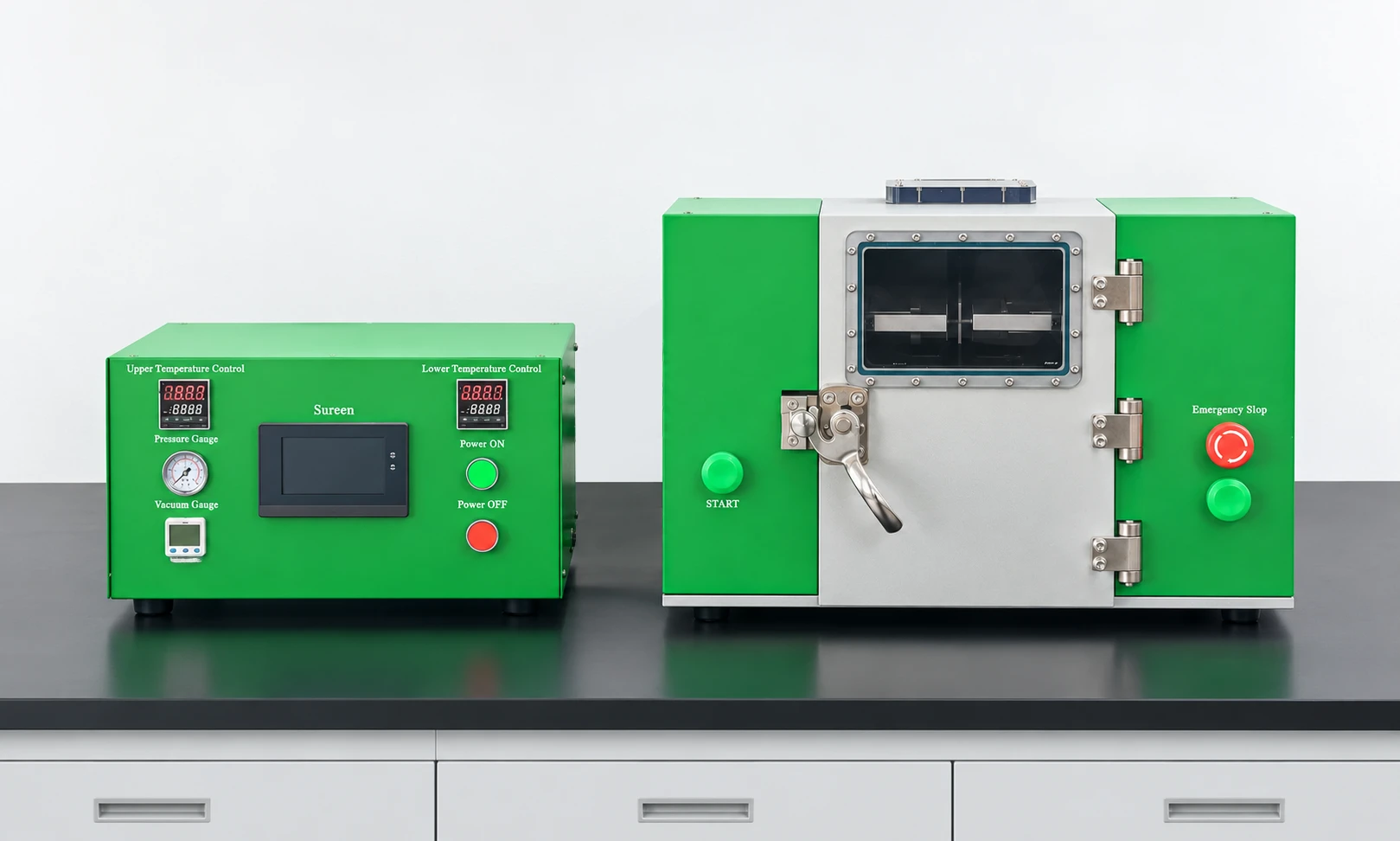
The machine is built around a vacuum chamber that holds the cell during the piercing and sealing cycle. The chamber cover is driven by a cylinder and guided by linear guide bushings, so it closes with flexible, accurate movement and holds the sealing requirement of the chamber. Inside, the left and right sealing heads - made of copper for efficient heat transfer and reduced power consumption - are driven by cylinders guided by two linear guide bushings, which keeps the movement of the heads accurate and preserves the parallelism of the sealed edge after sealing. The pressure of the left and right sealing heads is adjusted independently through pressure regulating valves, allowing the sealing parameters to be tuned for different process requirements.
An automatic piercing function is integrated into the machine, so the gas pocket of the pouch is opened within the same cycle as the sealing operation. The vacuum level reaches ≤ -96 kPa (the vacuum pump is provided by the buyer). The sealing head temperature is adjustable from room temperature up to 250 °C with a temperature control accuracy of ± 1.5 °C, the heat sealing pressure is adjustable from 0 to 7 kg/cm², and the heat sealing time is adjustable from 0 to 99 seconds. The sealing edge width is 5 ± 0.4 mm (per customer requirements), the maximum sealing edge size is 200 mm, and the machine is compatible with pouch cells from 60 to 300 µm in sealing thickness range, with the difference in sealing thickness between any two points held below 15 µm.
The TOB-LFVHS-200 is controlled by a PLC system. The chamber is made of aluminum alloy for corrosion resistance and structural rigidity, and the compact, lightweight construction (95 kg) makes the machine easy to install and to integrate into an existing pouch cell production or pilot line. The machine accommodates different battery specifications, and changing between formats is simple and convenient to adjust.
Ideal for:
- Pouch cell manufacturers carrying out the secondary vacuum final sealing step after formation, on cylindrical-free flat-cell production lines and pilot lines.
- Battery R&D laboratories developing pouch cell designs, where the degassing and final sealing parameters must be tuned and verified.
- Pilot and small-batch producers of pouch cells for consumer, power, or specialty applications who require a compact, standalone sealing station.
- Any production operation that needs to release formation gas from a pouch cell and close the pouch under vacuum with controlled temperature, pressure, and time.
Where Secondary Vacuum Sealing Fits in Pouch Cell Production
In the pouch cell manufacturing sequence, the secondary vacuum sealing step follows formation. The process path is:
- Electrode manufacturing and stacking or winding, producing the electrode assembly.
- Pouch forming and insertion of the electrode stack into the aluminum-laminated film pocket.
- Top-side sealing, closing the pouch around the tabs.
- Electrolyte filling and pre-sealing.
- Formation, during which the first charge-discharge cycles form the SEI layer and generate gas inside the pouch.
- Secondary vacuum sealing: the cell is placed vertically, the gas pocket is pierced under vacuum to release the formation gas, and the pouch is heat-sealed - the step performed by the TOB-LFVHS-200.
- Final trimming, folding and shaping, grading, and testing of the finished cell.
The importance of this step lies in what the gas does to the cell. Gas generated during formation collects in the headspace of the pouch. If it is not removed, the gas reduces the contact between the electrode stack and the electrolyte, creates local dry regions, raises internal resistance, and causes the pouch to swell - all of which degrade capacity and cycle life. The piercing operation creates a controlled opening through which the gas escapes when the chamber is evacuated, and the heat-sealing operation closes the pouch before the cell leaves the chamber. Because the sealing is performed under vacuum, the finished seal is formed free of trapped gas at the sealed edge.
The TOB-LFVHS-200 executes the piercing and sealing functions on one machine, so the cell remains positioned in the chamber throughout the cycle. This reduces handling between two separate operations and keeps the cell's position stable between piercing and sealing points.
How the TOB-LFVHS-200 Operates
The operating sequence of the TOB-LFVHS-200 is organized around the vertical placement of the pouch cell:
- Cell placement: The pouch cell is placed into the machine in the vertical orientation, positioned with the gas pocket and the sealing edge aligned to the piercing and sealing zones.
- Chamber closing: The chamber cover, driven by a cylinder and guided by linear guide bushings, closes over the cell. The guided movement keeps the cover accurate and maintains the sealing requirement of the chamber.
- Vacuum: The chamber is evacuated to ≤ -96 kPa. The vacuum pump is provided by the buyer.
- Piercing: The automatic piercing function opens the gas pocket of the pouch, so that the gas generated during formation is released from the cell under the vacuum condition.
- Heat sealing: The left and right copper sealing heads close onto the sealing edge. The head temperature (room temperature to 250 °C, adjustable), the sealing pressure (0 to 7 kg/cm², adjustable per side through the pressure regulating valves), and the sealing time (0 to 99 s, adjustable) are set according to the pouch film and process requirements. The cylinder-driven heads, guided by two linear guide bushings, preserve the parallelism of the sealed edge.
- Cycle completion: After the sealing time elapses, the heads release, the chamber opens, and the sealed cell is removed. The working speed reaches ≥ 180 times per hour, with an air consumption of approximately 0.2 L of compressed air per sealing cycle.
The control system is a PLC, and the sealing parameters are set for each cell format. Because the sealing edge width is produced per customer requirements (5 ± 0.4 mm in the standard specification) and the machine accommodates cells with a maximum sealing size of 200 mm, adjustment between different pouch formats is straightforward.
Key Engineering Characteristics of the TOB-LFVHS-200
- Copper Sealing Heads for Efficient Heat Transfer - The sealing heads are made of copper, which offers high thermal conductivity. The result is efficient heat transfer to the sealing edge, lower power consumption, and a shorter time to reach the sealing temperature - a design that improves working efficiency and reduces energy consumption compared with sealing heads of lower-conductivity materials.
- Independent Pressure Regulation on Left and Right Heads - The pressure of the left and right sealing heads is regulated through pressure regulating valves, so each side can be set to the process requirements. This independent adjustment supports the different sealing conditions that can exist across a pouch cell's sealing edge.
- Cylinder-Driven Heads with Dual Linear Guide Bushings - Both sealing heads are driven by cylinders and guided by two linear guide bushings. The guided movement is flexible and accurate, which maintains the parallelism of the sealed edge after sealing - a key quality requirement for the final seal, since an uneven edge affects both the seal strength and the appearance of the finished cell.
- Automatic Piercing Function - The machine is equipped with an automatic piercing function, so the gas pocket of the pouch is opened automatically as part of the sealing cycle. Having piercing and sealing integrated on one machine reduces the handling of the cell between two operations.
- Cylinder-Driven Chamber Cover with Guided Movement - The chamber cover is driven by a cylinder and guided by linear guide bushings. The accurate guided movement preserves the sealing requirement of the chamber, which is the basis for reaching and holding the vacuum level during the cycle.
- Compatibility with Different Cell Specifications - The TOB-LFVHS-200 accommodates different battery specifications, and the adjustment for a new format is simple and convenient. Combined with the adjustable sealing temperature, pressure, and time, this makes the machine suitable for multi-format production and development work.
- PLC Control System - The machine is controlled by a PLC, providing the sequence control for the chamber, vacuum, piercing, and sealing operations, and the parameter setting for the sealing process.
- Aluminum Alloy Chamber and Compact Construction - The chamber is made of aluminum alloy, which is corrosion resistant and gives the structure rigidity, protecting the internal components from the process environment. The machine is compact and light in construction - an overall size of L600 mm x W460 mm x H600 mm and a weight of 95 kg - so it can be installed on a production floor or in a laboratory without significant floor-space impact. The TOB-LFVHS-200 is simple to operate and has a clean exterior design.
Main Technical Parameters
| Item | Parameter |
| Chamber | Aluminum alloy, corrosion resistant, robust structure |
| Vacuum level | ≤ -96 kPa (vacuum pump provided by buyer) |
| Sealing head temperature | Room temperature - 250 °C, adjustable |
| Temperature control accuracy | ± 1.5 °C |
| Heat sealing pressure | 0 - 7 kg/cm², adjustable |
| Heat sealing time | 0 - 99 s, adjustable |
| Sealing edge width | 5 ± 0.4 mm (per customer requirements) |
| Maximum sealing edge size | 200 mm |
| Sealing thickness range | 60 - 300 µm |
| Sealing thickness accuracy | Difference in sealing thickness between any two points < 15 µm |
| Air consumption | Approx. 0.2 L compressed air per sealing cycle |
| Compressed air working speed | ≥ 180 times/h |
| Control system | PLC |
| Power | 0.6 kW |
| Power supply | 220 V / 50 Hz |
| Compressed air source | 0.5 - 0.7 MPa |
| Overall dimensions | L600 mm x W460 mm x H600 mm |
| Weight | 95 kg |
| Maximum cell size | As shown in the drawing (1000 x 600) |
Main Electrical and Standard Component Brands
| No. | Item | Brand | Origin |
| 1 | Pneumatic components | Airtac | Taiwan, China |
| 2 | Electrical components | CHINT | China |
| 3 | Relay | Izumi | Japan |
| 4 | Temperature controller | Autonics | Korea |
| 5 | Solid state relay | Yangming | Taiwan, China |
| 6 | PLC + HMI all-in-one | Samkoon | China |
| 7 | Pressure sensor | Panasonic | Japan |
| 8 | Solenoid valve | Airtac | Taiwan, China |
Remark: For reasons of delivery time, the supplier has the right to select components of other brands of equivalent grade according to market supply, without prior notice to the customer.
Practical Operation Recommendations
- Vacuum pump: The machine is specified at a vacuum level of ≤ -96 kPa, and the vacuum pump is provided by the buyer. Select a pump that can reach and hold this level at the chamber volume, and connect it to the machine's vacuum port.
- Compressed air supply: The machine requires compressed air at 0.5 - 0.7 MPa. Keep the supply clean and dry, and verify the pressure before production, since the sealing head pressure and chamber movement are both air-driven.
- Sealing parameter setup: Set the sealing head temperature within the room temperature to 250 °C range and the time within 0 - 99 s according to the pouch film specification. Use the pressure regulating valves to set the pressure of the left and right sealing heads for the process requirement.
- Sealing edge and thickness control: Confirm that the sealing edge width and the sealing thickness range (60 - 300 µm) match the pouch film in use. The finished seal should be checked so that the difference in sealing thickness between any two points remains below 15 µm.
- Cell placement: Place the pouch cell vertically and align the gas pocket and sealing edge to the piercing and sealing zones, so that piercing releases the gas from the pocket and the sealing heads close on the correct edge position.
- Sealing head maintenance: Keep the copper sealing heads clean and free of residue from the pouch film. Inspect the head surfaces periodically, since contamination on the head affects both heat transfer and the flatness of the sealed edge.
- Cycle monitoring: The machine works at ≥ 180 times per hour with approximately 0.2 L of compressed air per sealing cycle. Monitor the air supply and the sealing parameters during production to keep the cycle consistent.
Engineering FAQ
Q1: What is secondary vacuum sealing, and why is it necessary for pouch cells?
Secondary vacuum sealing is the process step in which a pouch cell is pierced to release the gas generated during formation and then heat-sealed under vacuum to close the pouch. Formation generates gas inside the cell; if that gas is not removed, it reduces electrode-to-electrolyte contact, increases internal resistance, and causes the pouch to swell. The TOB-LFVHS-200 performs the piercing and final sealing operations on one machine, so the cell stays in position throughout the cycle.
Q2: Does the machine include the vacuum pump?
No. The TOB-LFVHS-200 reaches a vacuum level of ≤ -96 kPa, and the vacuum pump is provided by the buyer. The pump must be able to reach and hold this level for the chamber volume.
Q3: What pouch cells can the TOB-LFVHS-200 process?
The machine handles pouch cells with a sealing thickness range of 60 - 300 µm, a sealing edge width produced to the customer requirement (5 ± 0.4 mm in the standard specification), and a maximum sealing edge size of 200 mm. The maximum cell size is as shown in the drawing (1000 x 600). The machine accommodates different battery specifications, and switching formats is a simple adjustment.
Q4: How is the sealing quality controlled?
Three parameters are controlled together: sealing head temperature (room temperature to 250 °C, adjustable), heat sealing pressure (0 to 7 kg/cm², adjustable per side), and heat sealing time (0 to 99 s, adjustable). The temperature control accuracy is ± 1.5 °C. The sealing heads are made of copper for efficient heat transfer, and are guided by dual linear guide bushings so the sealed edge keeps its parallelism. The finished seal is verified against the sealing thickness accuracy requirement - a difference of less than 15 µm between any two points.
Q5: What does the automatic piercing function do?
The piercing function opens the gas pocket of the pouch automatically during the sealing cycle. With the chamber evacuated, the gas escapes from the cell, and the pouch is then heat-sealed in the same cycle. Integrating piercing and sealing on one machine reduces handling between the two operations and keeps the cell position stable.
Q6: What utilities and site conditions does the machine require?
The TOB-LFVHS-200 requires a power supply of 220 V / 50 Hz with a power of 0.6 kW, compressed air at 0.5 - 0.7 MPa, and a vacuum pump (provided by the buyer) capable of reaching ≤ -96 kPa. The machine measures L600 mm x W460 mm x H600 mm and weighs 95 kg.
Ready to complete the degassing and final sealing step of your pouch cell line with a machine that combines piercing, vacuum, and heat sealing in one cycle? Request a quotation for the TOB-LFVHS-200 with your pouch cell dimensions, sealing edge width, and pouch film specification. Our pouch cell process engineers can advise on sealing parameters and on matching the machine to your cell format.
tob.amy@tobmachine.com | +86 181 2071 5609
You May Also Need
▶ Semi-Auto Battery Electrode Stacking Machine for Lithium Pouch Cell - The Z-type stacking machine for pouch cell electrode assembly, producing the flat, aligned electrode stack that enters the pouch. Complements the TOB-LFVHS-200 upstream in the pouch cell production sequence.
▶ Vacuum Electrolyte Filling Soaking and Pre-Sealing All-in-One Machine - A combined electrolyte filling, soaking, and pre-sealing machine for pouch cells. Complements the TOB-LFVHS-200 by handling the filling and pre-sealing steps that precede formation and secondary sealing.
▶ Li-Ion Battery Vacuum Diffusion Chamber and Electrolyte Filling All-in-One Machine - A vacuum diffusion and electrolyte filling machine for lithium-ion cells. Complements the TOB-LFVHS-200 upstream, providing the electrolyte filling and diffusion steps that prepare the cell for formation and final sealing.
Previous:
Battery Pouch Vacuum Sealing MachineNext:
Vacuum Pre-sealing, Final Sealing and Electrolyte Diffusion Three-in-One Machine
If you are interested in our products and want to know more details,please leave a message here,we will reply you as soon as we can.

 subscribe to us