Chinese
 français
 Deutsch
 italiano
 español
 português
 Nederlands
 日本語
 한국의




- Home
- >
- Other Equipment
- >
- Prismatic Cell Dummy Model
Categories
Hot Products

Loading...
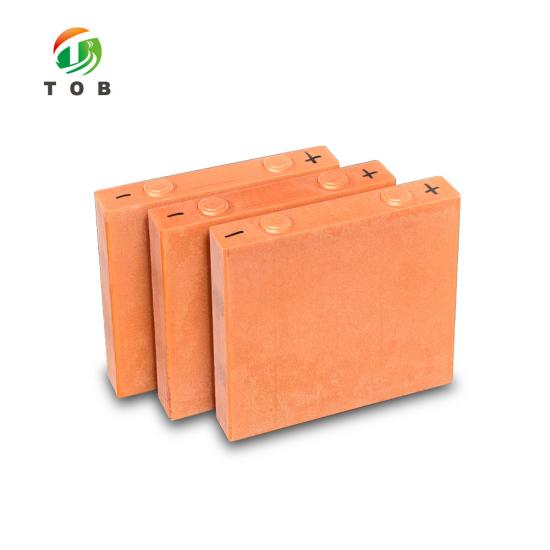

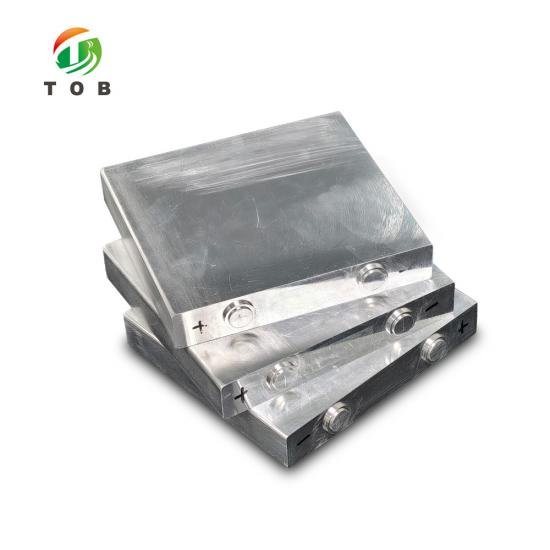
Prismatic Cell Dummy Model
Brand:
TOB NEW ENERGYitem no.:
TOB-DCMXorder(moq):
1Payment:
L/C, T/Tproduct origin:
Chinashipping port:
XIAMEN
Prismatic Cell Dummy Model - TOB-DCMX
Aluminium or Bakelite, made to the cell envelope your machine was built around, with or without a filling port
Product Overview and Ideal Applications
A new assembly line has to be run before it is trusted, and the first hours of running are exactly when grippers clip a corner, a magazine jams, or a clamp closes a millimetre off. Doing that with live cells in the machine means every one of those first collisions happens to a real cell, with electrolyte in it and a formation history attached. A dummy model takes that risk out of the commissioning stage: it has the cell's outside dimensions, its terminals and, where needed, its filling port, but no chemistry inside.
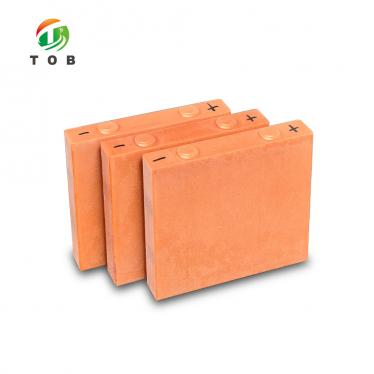
The TOB-DCMX is that dummy. The body is aluminium or Bakelite depending on the station it has to survive, the size is made to your drawing rather than picked from a list, and it can be supplied with or without a filling port. Terminal position, port position and any other feature a gripper, clamp or nozzle touches are taken from the same drawing, which is why this page quotes no fixed dimensions: the model is only useful if it matches the format your machine was built for.
Ideal for:
- Commissioning and buy-off of cell assembly equipment, before a live cell goes anywhere near it
- Winding, case insertion and stacking stations, where the model has to pass a magazine, a gripper and a clamp in sequence
- Electrolyte filling stations, in the port version, where the nozzle needs something to locate and seal against during a dry run
- Welding and tab-handling fixtures, where the top plate and terminal geometry decide whether the fixture locates at all
- Conveyor, sorting and handling lines, to set pitch, gate timing and sensor positions without consuming cells
- Training and operator qualification, where a dropped model costs a phone call instead of a batch
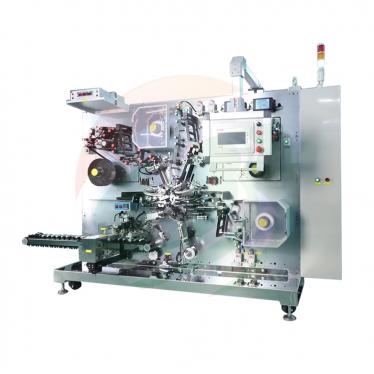
What a dummy cannot do is carry voltage. There is no active chemistry in it, so a station that interlocks on cell voltage, measures open-circuit voltage, or grades on internal resistance will not accept it - those stations need a real cell or an electrical simulator. The dummy proves the mechanics, the fit and the sequence; it does not prove the electrochemistry. Read it that way and it will save you the accidents that happen in the first week; read it as a substitute for a cell and it will disappoint you at the OCV station. If you are commissioning the machines themselves, the auto winding machine for prismatic cell is the kind of equipment this model is normally run through first.
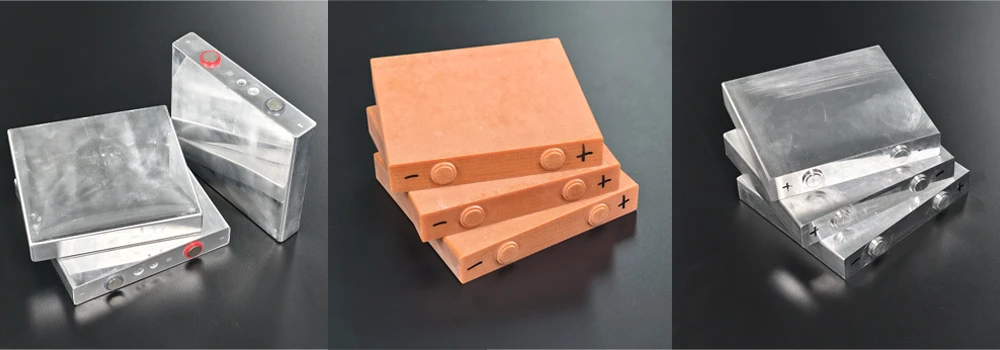
Three variants in one frame, left to right: aluminium with a filling port, Bakelite with moulded terminals, and aluminium with terminal pads only.
Complete Specifications
There is no dimension table on this page, and that is deliberate. A dummy model is only worth having if it matches the cell format the machine was built around, so the numbers have to come from your drawing rather than from ours. What is fixed is the set of choices: the material, the port, and the terminal and feature layout taken from that drawing.
1. Material Options
| Material | Top plate and terminals | Behaviour at the station |
|---|---|---|
| Aluminium | Machined metal top plate with separate terminal studs; a filling port can be machined into the same plate | Metal mass and conduction: suitable where the station clamps hard, where the top plate is welded or pressed against, or where the model has to be picked up by a magnetic or vacuum gripper that expects a rigid face |
| Bakelite (phenolic) | Moulded phenolic top plate with moulded round terminals; no metal studs | Insulating and lighter: suitable where the station is electrically live or where the gripper should not see a conductive body, and cheaper to replace when a commissioning run damages one |
2. Size and What We Need From You
| Item | How it is set |
|---|---|
| Length, width, thickness | From your cell drawing, or from the length, width and thickness of the format the machine was built for |
| Terminal position and size | From the same drawing - the fixture only locates if the studs are where the machine expects them |
| Filling port position | From the drawing, and only on the port version |
| Any other feature the station touches | Point it out on the drawing - a vent shape, a notch, a step in the case. If a gripper closes on it, it has to be on the model |
| Quantity | One per station that holds a cell at the same time, plus spares for the run |
3. Variants Supplied
| Option | What changes |
|---|---|
| Material | Aluminium or Bakelite, as chosen above |
| Filling port | With a port, for filling and nozzle-alignment stations; without, for stations that only grip, clamp or weld |
The port version exists for one reason: a filling or nozzle-alignment station needs a real surface to land on and seal against before electrolyte is anywhere near the line. The port is machined into the same top plate as the terminals, so the nozzle locates against the geometry the machine will see in production.
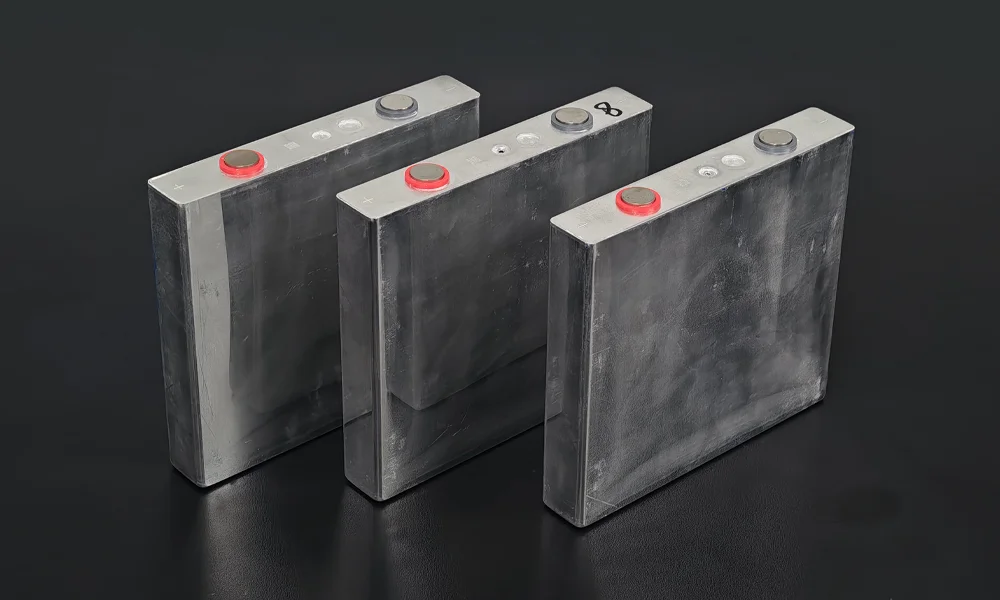
The port version: filling port and terminal studs machined into one top plate, with + and - marked on the plate face.
The plain version drops the port and keeps only the two terminal pads. It is the right choice for stations that grip, clamp or weld but never fill, and it removes an opening that a gripper or a wash step could catch on.
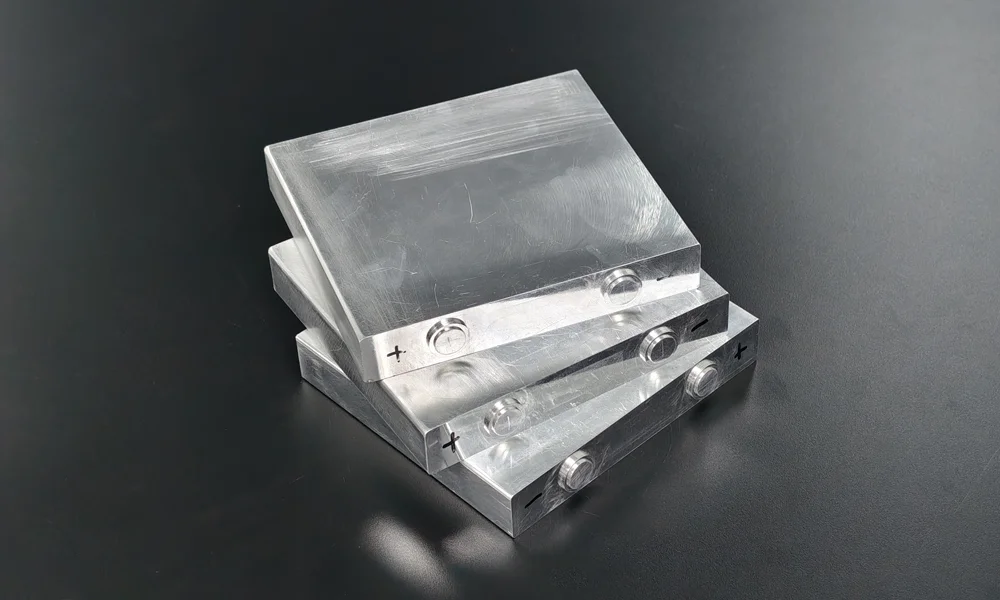
The plain version: two terminal pads only, for stations that grip, clamp or weld but never fill.
Every model is supplied bare: aluminium as machined, Bakelite as moulded, with + and - marked on the plate. There is no film and no wrap on the body, so the surface a gripper or a sensor sees is the material itself. Send a drawing and we will confirm the material, the port and the terminal layout against it before the order is placed.
Choosing Between Aluminium and Bakelite
The choice is usually made by the station, not by preference. Walk the line and ask what touches the model at each stop: a gripper that squeezes, a clamp that presses the top plate, a welding fixture that pushes down on the terminals, a nozzle that lands on the port. Any station that applies force through metal hardware is happier with an aluminium body, because the model then has the mass and the stiffness the fixture was designed around.
Where the station is electrically live - a hipot test, an insulation check, a welding circuit that must not see a short through the workpiece - Bakelite is the safer choice. Phenolic resin does not conduct, so a model resting in the fixture cannot bridge two contacts that were never meant to be bridged. It is also lighter, which matters if the gripper is sized for a real cell and you would rather not add mass to every cycle of a commissioning run.
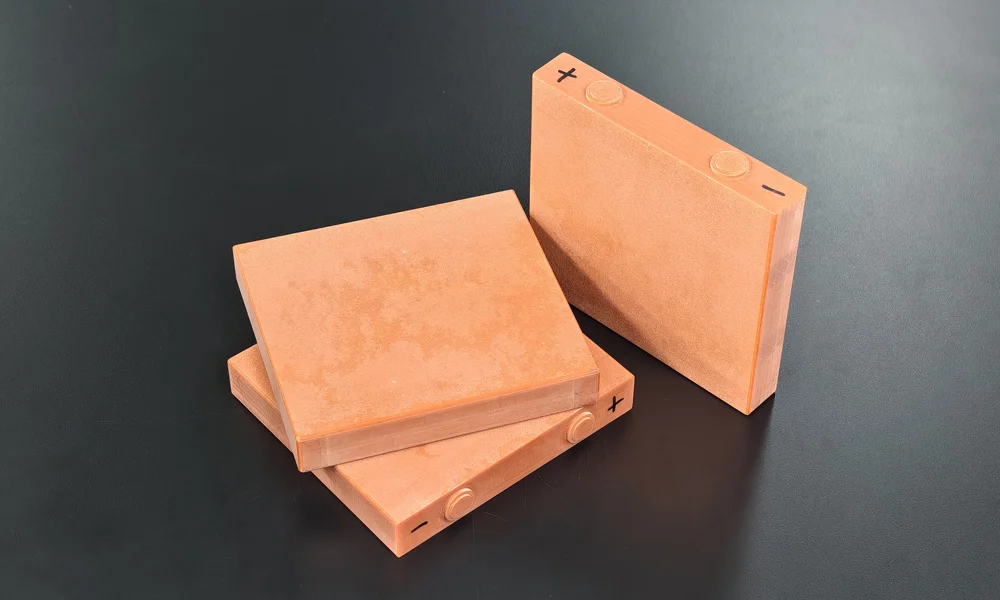
The Bakelite option: moulded phenolic top plate and moulded round terminals, with + and - marked on the plate and the body left bare.
A line that has both kinds of station does not have to choose once. Most commissioning sets we send out are mixed: aluminium models for the clamping and welding stations, Bakelite for the electrical and inspection stops. They are made to the same drawing, so the machine sees the same envelope at every stop and only the material changes.
Why Commission on a Dummy Instead of a Real Cell
Commissioning is the phase when a machine is most likely to damage what it handles. Speeds are being tuned, sensors are being positioned, and the first dozen cycles are run by an engineer watching for the exact moment something catches. Using live cells for that phase means every one of those catches happens to a cell that has already cost you electrolyte, a formation cycle and a disposal path.
A dummy moves the risk to something replaceable. The gripper either opens wide enough or it does not; the magazine either accepts the thickness or it jams; the case insertion station either reaches depth or it stops short. All of that is geometry, and geometry is exactly what a dummy reproduces. A model that has been dropped, scuffed or crushed during a dry run costs a replacement; the same event on a live cell costs a batch, a clean-up and an incident report.
The second reason is repeatability. A dummy has no state: it does not arrive at the station at a different temperature, with a different state of charge, or with a slightly different thickness because the previous process drifted. When you are setting a gap or tuning a sensor, that constancy is what lets you attribute a change to the machine instead of to the workpiece.
The third is documentation. A buy-off run has to be repeatable next year, on a second line, by a different engineer. A dummy with a drawing behind it is a fixed reference; "we ran some cells through it" is not. When the machine is accepted against a model whose dimensions are on paper, the acceptance test can be repeated without arguing about which cells were used.
What the dummy will not do is stand in for the process. It cannot show you that the electrolyte wets the separator, that the formation curve looks right, or that the cell grades where it should. Those are chemistry, and no model has chemistry. Treat the dummy as the instrument that proves the machine is mechanically ready to receive a real cell, and keep the real cells for the stages where the electrochemistry is the thing under test.
Key Engineering Characteristics
- Two materials, one drawing. Aluminium and Bakelite models are made to the same dimensions, so a line that needs both does not have to re-teach its grippers between them.
- Made to your cell format, not to a stock size. Length, width, thickness and feature positions come from your drawing or from the format the machine was built for.
- Filling port optional. The port is machined only where a filling or nozzle-alignment station needs a surface to locate and seal against; the plain version keeps the top plate simple.
- Terminals marked and positioned to the drawing. Studs on the aluminium version, moulded round terminals on the Bakelite version, with + and - marked on the plate so an operator can see polarity at a glance during a run.
- Bare surfaces, nothing to peel. Aluminium models leave the machined top plate and terminal faces exposed, Bakelite models leave the moulded plate exposed; there is no film to wrinkle under a gripper or to trap slurry at the edge.
- Replaceable by design. A model damaged during commissioning is a consumable, not a repair job - which is the whole point of running the dry run on it instead of on a cell.
Handling and Storage
1. Before a dry run
- Count the models against the stations. One per station that holds a cell at the same time, and one spare on the bench so a damaged model does not stop the run.
- Check the surface you are asking the machine to touch. On the port version, confirm the port is clear; on the aluminium version, look for burrs on the terminal faces where a fixture seats.
- Sort by station if the set is mixed. An aluminium model in an insulating station, or the reverse, is the one mistake that makes a commissioning result look like a machine fault.
- Run the first cycle at reduced speed. The first pass is there to find interference, not to prove throughput.
2. Storage and retirement
- Store flat, in the box they arrived in, away from the line. A model that has been used as a doorstop or a paperweight no longer represents the drawing it was made to.
- Wipe the top plate and the terminals after a run. Residue on a terminal face changes how a fixture seats on the next commissioning, which is the opposite of what a reference model is for.
- Retire a model when it has taken a hit. A dinged corner or a bent stud makes it a worse reference than no model at all, because the machine will be tuned to the damage.
A dry run is usually the first half of a longer sequence. Once the model has taken the machine through its motions, the manual prismatic cell case insertion machine and the prismatic cell electrolyte equal pressure filling machine are the two stations where a model with a filling port earns its place before electrolyte is introduced.
Engineering FAQ
Q1: Can a dummy model be run through a filling machine?
Through it, yes - the port version gives the nozzle a surface to locate onto and seal against, which is what a dry run has to prove. What it cannot prove is the dose. The model takes no electrolyte, so weighing, flow calibration and wetting have to be verified with real slurry or by a calibration routine on the pump itself.
Q2: Aluminium or Bakelite for my line?
Follow the force. Stations that clamp, press or weld through hardware get aluminium, because the fixture was designed around a rigid metal body. Stations that are electrically live, or that must not see a conductive body, get Bakelite. A mixed set made to one drawing is the normal answer for a full line.
Q3: What do you need from me to quote a size?
A drawing is best. Failing that, the length, width and thickness of the format, plus where the terminals and the port sit and the positions of anything else a gripper or clamp touches. If the machine already exists, the format it was built for is usually in its acceptance documentation.
Q4: Will the machine's sensors read the dummy as a cell?
Only the mechanical ones. Presence, position, thickness and gripper sensors usually see it; anything that interlocks on cell voltage, open-circuit voltage or internal resistance will not, because the model has no chemistry and no voltage. If your line will not release a cycle without a voltage signal, that station needs a real cell or a simulator alongside the dummy.
Q5: Are the models bare, or coated?
Bare. Aluminium models are machined and left as machined; Bakelite models are moulded and left as moulded. Nothing is wrapped, so the surface a gripper, a vacuum cup or a sensor sees is the material the model is made of. If a station needs a wrap to behave like a finished cell, say so and we will quote it separately.
Q6: How many should I order for a commissioning run?
As many as the number of stations that hold a cell at the same time, plus a spare or two. A line that jams at station four with a single model in hand stops until the model is freed; a spare keeps the run going and the comparison honest.
Send the drawing or the format, tell us the stations, and we will quote the material and the port option that fits your dry run.
Email: tob.amy@tobmachine.com | Phone and WhatsApp: +86 181 2071 5609
Reviewed by: Science Wang, Six Sigma Black Belt, Battery Lines | Last updated: 2026-10-27
If you are interested in our products and want to know more details,please leave a message here,we will reply you as soon as we can.







 subscribe to us