Chinese
 français
 Deutsch
 italiano
 español
 português
 Nederlands
 日本語
 한국의




- Home
- >
- Other Equipment
- >
- Solid Density Tester
Categories
Hot Products
Loading...
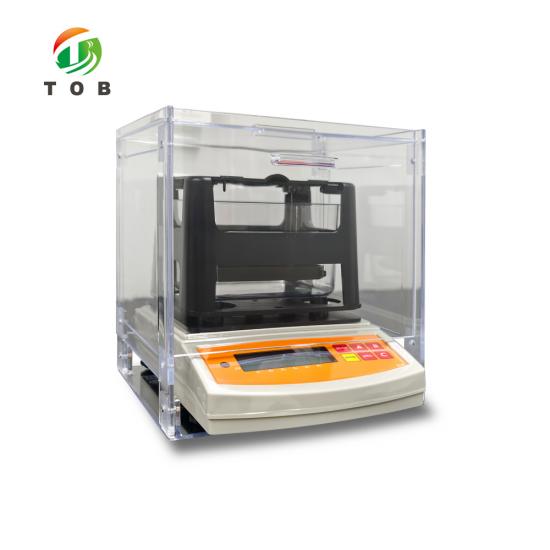
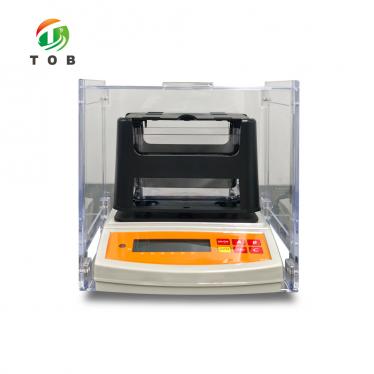
Solid Density Tester
Brand:
TOB NEW ENERGYitem no.:
TOB-AR-600Gorder(moq):
1 setPayment:
L/C, T/Tproduct origin:
Chinashipping port:
XIAMEN
Solid Density Tester - TOB-AR-600G
600 g capacity, 0.01 g weighing and 0.001 g/cm3 density, to ASTM D792, ISO 1183 and GB/T 1033
Product Overview and Ideal Applications
Solid density is one of the few material properties a factory can check in two minutes without sending a sample out. The TOB-AR-600G weighs the sample in air, weighs it again suspended in water, and reports density and volume directly - the buoyancy method behind ASTM D792, ISO 1183 and GB/T 1033. No pycnometer gas, no vacuum cycle, no calibration curve: 600 g of capacity, 0.01 g of weighing resolution and 0.001 g/cm3 of density resolution, in a unit that fits on a bench under its own dust cover.
For battery work the useful part is what it says about incoming material. The density of an electrode sheet, of a current collector foil or a separator film, of the plastics and insulators that go into a module - each of those is a solid sample, and each can be checked on arrival instead of after a cell fails a formation step. The same unit covers the wider list the method was written for: plastics, rubber, cable insulation, composites, packaging, footwear, pipe, electrical parts, sports equipment, tyres, vehicle parts, glass, rock, ore, jewellery, grain and metal.
Ideal for:
- Incoming inspection of electrode sheets, foils and separator films, where density is the cheapest way to catch a substitution before it reaches coating
- Battery material and component suppliers who have to show a batch matches the datasheet density
- Plastics, rubber and cable compound QC, where density identifies a formulation faster than a full mechanical test
- Composite and packaging film checks, including density as a proxy for filler or mineral loading
- Geology, mineral and jewellery work, where the sample usually cannot be destroyed
- Teaching and R&D labs that need a density number without buying a gas pycnometer
It measures solids, and it is worth being precise about that boundary. A powder, a slurry, or a body with open porosity is a different measurement: for powders the number that matters is tap density, and the tap density tester with two testing positions is the instrument for it; for the true, skeletal density of a porous solid, a gas pycnometer measures the volume the solid actually occupies, which is what the true density and porosity analyzer does. Buy this unit when the sample is a solid whose outer volume is the volume you want to divide the mass by.
Complete Specifications
Five tables: what the instrument measures, what the tank and medium allow, what it needs from the wall, which standards the method comes from, and what is in the case. Every figure is the quoted rating.
1. Instrument and Performance
| Item | Specification |
|---|---|
| Model | TOB-AR-600G |
| Maximum capacity | 600 g |
| Weighing resolution | 0.01 g |
| Density resolution | 0.001 g/cm3 |
| Density range | 0.001 to 99.999 g/cm3 |
| Results displayed | Density and volume |
| Measurement types | Density of any solid, in any solid form |
| Density frame | ABS, one-piece injection moulded |
| Parameters set on the unit | Water temperature, and the density of the measuring medium |
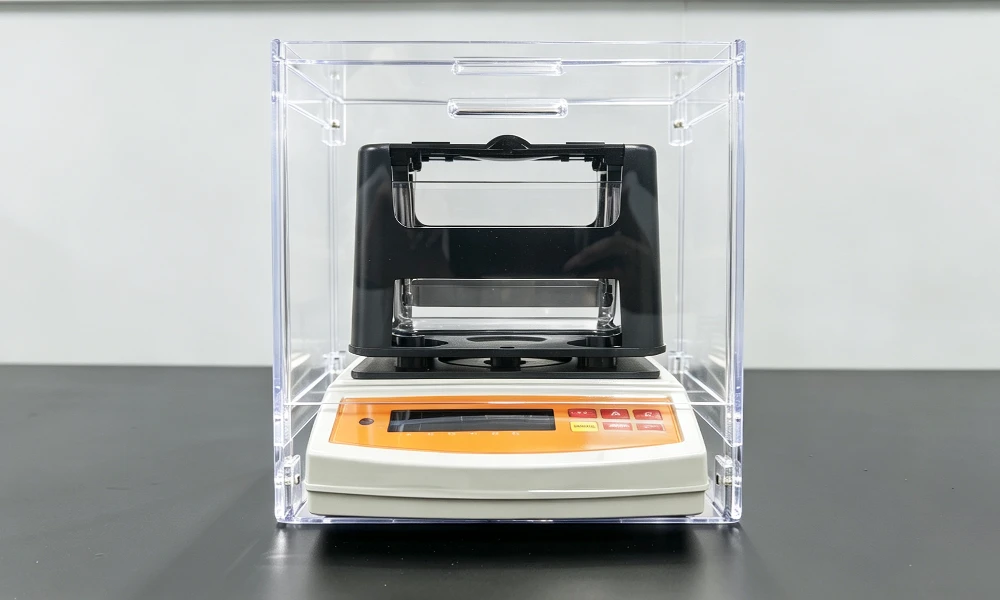
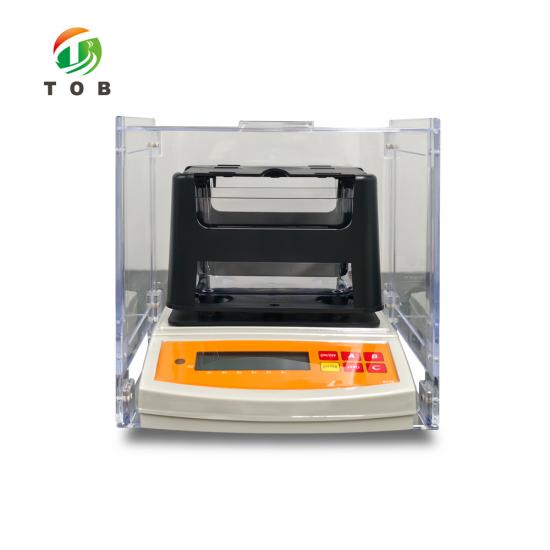
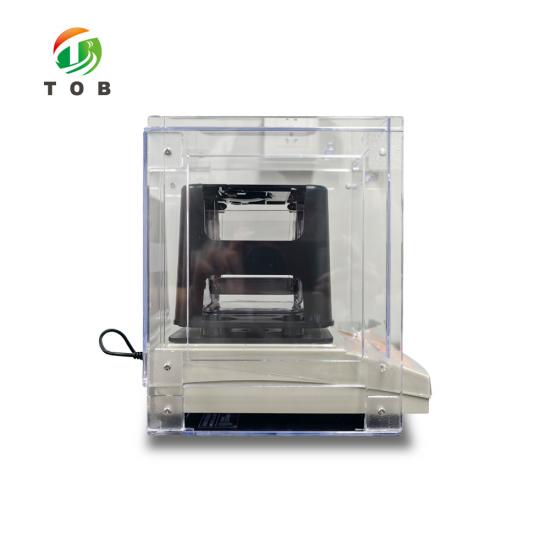
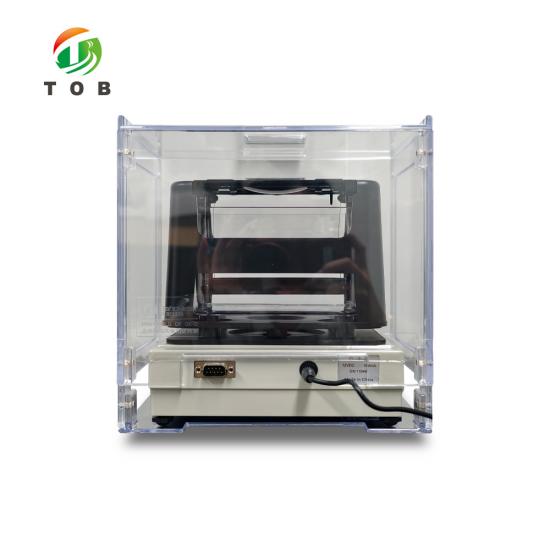
The complete unit as it is used: density frame and tank mounted on the weighing platform, whole assembly under the clear cover. 425 mm wide, 175 mm deep, 325 mm high, 4.5 kg.
2. Measuring Tank and Medium
| Item | Specification |
|---|---|
| Standard tank | High-capacity PC tank, one-piece injection moulded, transparent, 153 mm x 107 mm x 93 mm |
| Custom tank | Made to the size of your sample on request |
| Measuring medium | Water as standard; other liquid media permitted, and the medium density is entered on the unit |
| Temperature compensation | Actual water temperature is entered and applied to the calculation |
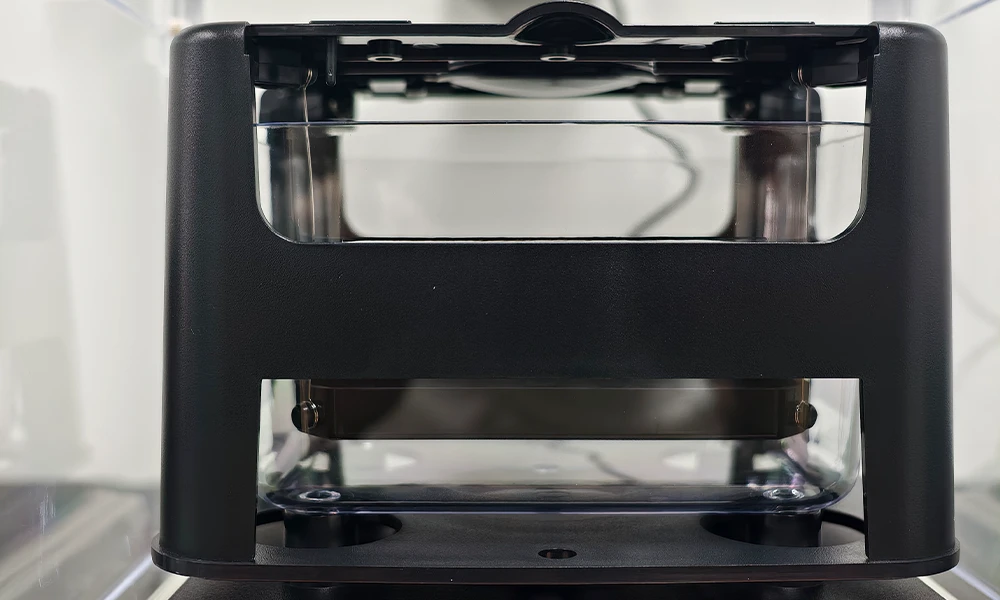
The ABS frame straddles the tank: the sample hangs from the arm above, the tank sits in the opening below, and nothing touches the sides during the weighing in water.
3. Power, Weight and Dimensions
| Item | Specification |
|---|---|
| Power supply | AC 100 to 240 V, 50 Hz / 60 Hz, through an external adapter |
| Plug | EU standard by default, other national standards on request |
| Net weight | 4.5 kg |
| Dimensions | 425 mm x 175 mm x 325 mm (L x W x H) |
4. Standards the Method Comes From
| Standard | Scope |
|---|---|
| ASTM D792 | Density and specific gravity of plastics by displacement |
| ASTM D297 | Rubber products, chemical analysis including density |
| GB/T 1033 | Density and relative density of plastics |
| GB/T 2951 | Test methods for insulation and sheath of cables |
| GB/T 3850 | Density of sintered metal materials and hard metals |
| GB/T 533 | Density of vulcanised rubber |
| HG4-1468 | Density of rubber, chemical industry standard |
| JIS K6268 | Density of vulcanised rubber |
| ISO 2781 | Density of vulcanised rubber |
| ISO 1183 | Density of non-cellular plastics |
The standards share one physical principle - weigh in air, weigh immersed, divide by the displaced volume - and differ in how the sample is prepared and how the result is reported. Tell us which one your certificate has to cite and we will note the conditioning the standard requires.
5. Standard Accessories
| # | Item |
|---|---|
| 1 | Main unit |
| 2 | Measuring tank |
| 3 | Measuring stand |
| 4 | Tweezers |
| 5 | Thermometer |
| 6 | Calibration weight |
| 7 | Wind and dust cover |
| 8 | Particle measuring kit, one set |
| 9 | Floating body kit, one set |
| 10 | Power adapter |
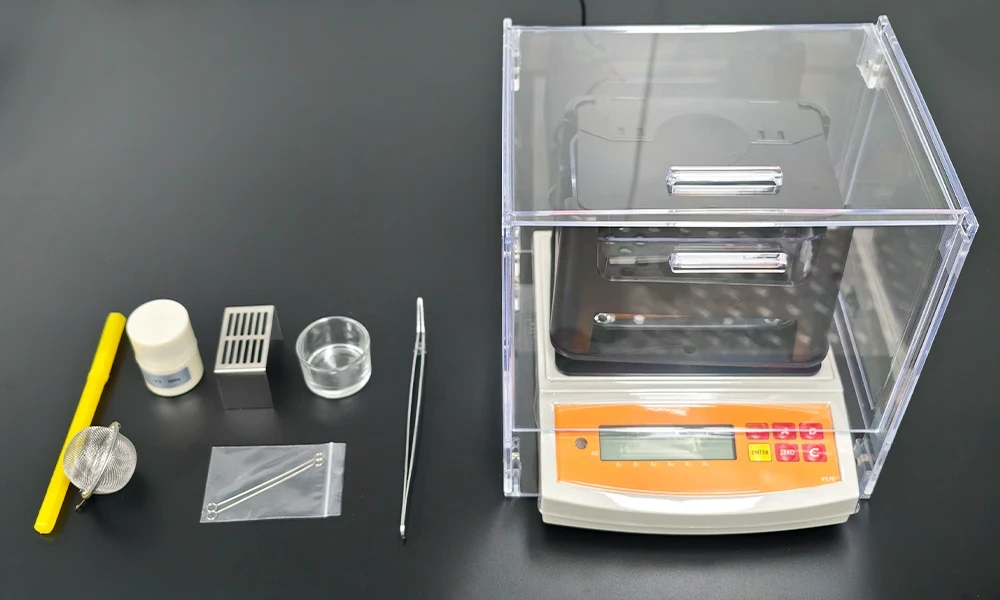
Accessories supplied with the TOB-AR-600G solid density tester
Electrical and Mechanical Components
Six parts decide whether a density reading repeats: the weighing sensor, the frame that carries the load into it, the tank that holds the medium, the electronics that apply the temperature correction, the cover that stops air moving across the pan, and the adapter that keeps the supply steady. All six are listed below by function.
| Component | What it is |
|---|---|
| Weighing sensor and platform | 600 g capacity, 0.01 g resolution, feeding both the dry weight and the immersed weight |
| Density measuring frame | ABS, one-piece injection moulded, straddling the tank so the suspension arm and the cradle stay in one rigid piece |
| Measuring tank | Transparent PC, one-piece injection moulded, high capacity so a large sample displaces water without raising the level onto the frame |
| Display and keypad | LCD showing weight, density and volume; ON/OFF, A, B, ENTER, ZERO and C keys, with S1 to S6 positions marked under the display for the stored parameters |
| Temperature compensation | The water temperature you enter is applied to the calculation, so the result does not drift with the room |
| Wind and dust cover | Clear cover over the whole weighing area, which is what lets the unit be used beside a line and not only in a closed room |
| Power adapter | External, AC 100 to 240 V, 50 Hz / 60 Hz, supplied with the plug standard you specify |
Component brands and model numbers are fixed in the order specification and are not printed here as a catalogue claim. If a brand matters to your procurement, ask for it in writing on the quotation.
Why Density Is a Material Check, Not a Lab Curiosity
Density is the cheapest fingerprint a material has. Two suppliers can deliver a plastic that looks the same, machines the same and passes the same tensile test, and still differ in filler loading - which shows up in density before it shows up anywhere else. That is why density is written into so many product standards as an acceptance criterion rather than a research number.
In battery work the same logic applies at three points. On incoming electrode sheet, density tells you whether the coating was calendered to the same target as the last lot. On foil and separator film, it catches a gauge or formulation change that thickness alone will miss. On the moulded and machined plastics around the module, it catches a resin substitution that would otherwise only appear as a field failure.
The measurement is also the one that survives an argument. Buoyancy is a physical law, not a correlation, so a reading taken on this unit can be repeated on another balance with the same method and the same medium, and the two numbers will agree. There is no curve to re-fit and no lamp to age.
Two things still have to be handled with care, and both are built into the unit rather than left to the operator. The first is water temperature: the density of water falls by roughly a quarter of one per cent between 20 and 30 °C, which on a 2 g/cm3 sample is about 0.005 g/cm3 - five times the display resolution. The second is air movement: 0.01 g is a small number, and a draught across an open pan is enough to move it.
What the resolution does not do is rescue a small sample. 0.001 g/cm3 is what the display resolves; what you can actually distinguish depends on the mass you put on the pan, because the buoyancy force you are measuring is proportional to the sample's volume. Cut the largest sample the tank and the standard allow, and the last digit becomes real rather than decorative.
Key Engineering Characteristics
- Any solid, no shape assumption. Block, sheet, film, pellet, ring, wire section or an irregular fragment - the method only needs the sample to fit in the tank and to sink, so there is no sample geometry to machine.
- Readings that repeat. Two weighings on a 0.01 g sensor, with the draught excluded by the cover and the water temperature entered as a parameter, give a number that another operator can reproduce on the same day and the next.
- Fast enough for incoming inspection. A reading takes the time to weigh twice and dry the sample, which is why the unit belongs at goods-in rather than in a metrology room.
- Water, or another liquid. Water is the default medium; the medium density is a parameter, so alcohol or another liquid can be used where the sample would absorb or react with water.
- Tank sized for real samples. A high-capacity PC tank in one piece, with custom sizes available when the sample is larger than the standard opening.
- Temperature compensation as a setting, not an assumption. The thermometer in the accessory set exists because the correction needs an actual temperature, not room temperature taken from a wall display.
- Built for a workshop bench. The clear cover and the 4.5 kg base let the unit sit beside a line; the same cover keeps dust off the pan in a lab where nobody will think to cover it.
- One year of cover. The unit is supplied with a one-year quality guarantee.
Operating, Medium and Care
The sequence is short, and every step exists to remove one source of error. The keys below are the ones you will actually press.
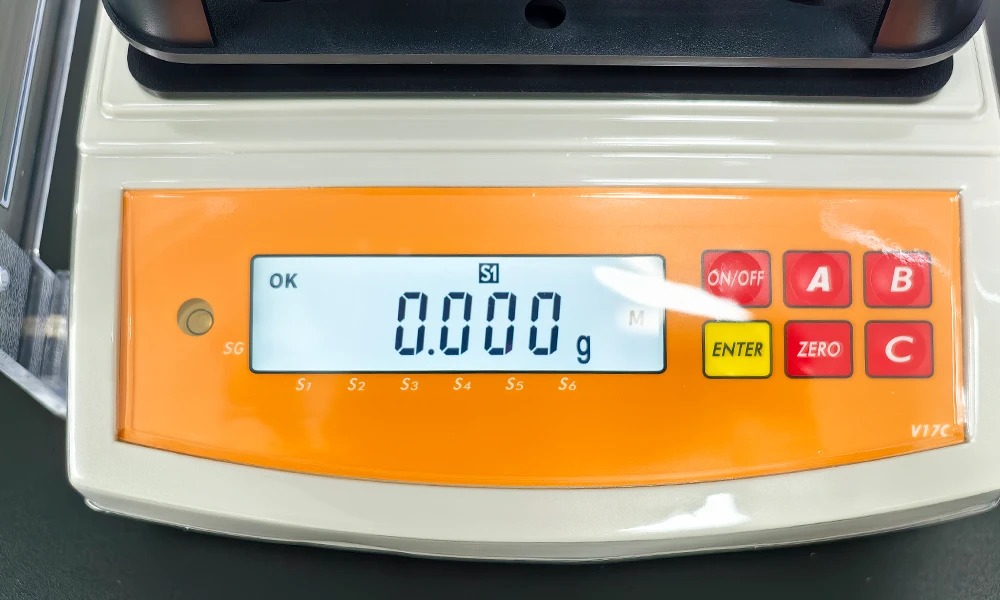
ON/OFF, A, B, ENTER, ZERO and C on the right; weight in grams on the display, with the S1 to S6 positions marked underneath for the stored settings.
1. Sequence of a measurement
- Switch on with the cover closed and let the display settle to zero; press ZERO if it does not.
- Read the water temperature with the thermometer from the set and enter it as a parameter, then enter the density of the medium you are using.
- Weigh the dry sample in air and store the value - this is the mass that goes into the calculation.
- Suspend the sample from the frame so that it hangs free in the medium, clear of the tank walls and fully immersed, and let the reading settle before storing it.
- Read density and volume from the display; repeat on a second piece if the batch matters, because a single fragment may not represent it.
- Dry the sample and the cradle before the next material, so a drop of the previous medium does not follow the sample onto the pan.
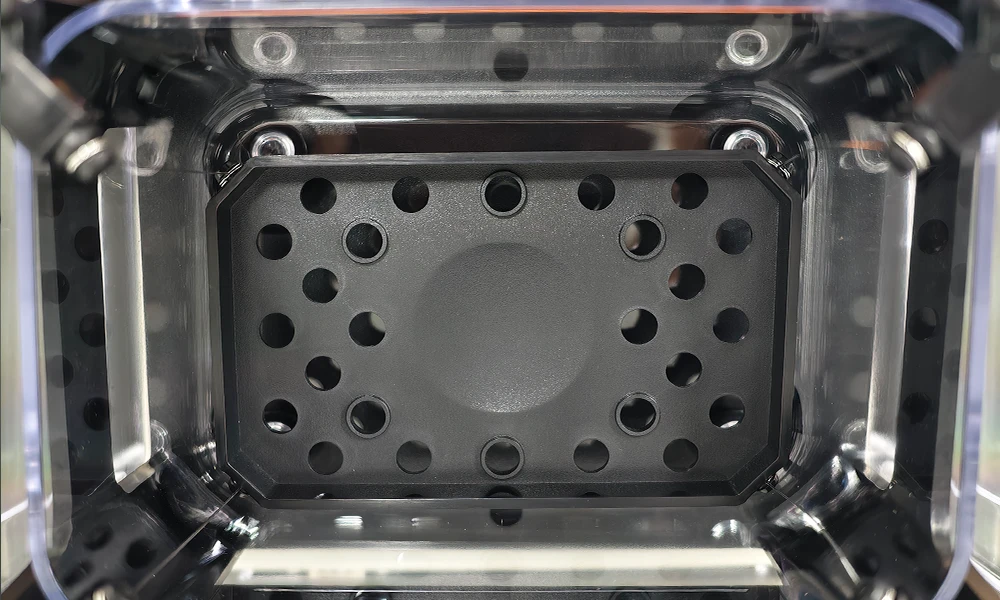
Looking down into the tank: the perforated cradle carries the sample through the medium, and the holes let it drain and let air escape instead of clinging to the underside.
2. Medium, cleaning and storage
- Use clean water, and change it when it is visibly cloudy - suspended dirt changes the medium density you entered.
- If you switch to another liquid, empty and rinse the tank first, then enter the new medium density before measuring.
- Dry the frame, the cradle and the pan after a session; water left on the suspension is weight the next measurement did not intend to include.
- Keep the cover on when the unit is idle, and keep the unit away from a draught, a door or an air-conditioning outlet.
- Store with the tank empty if the unit will not be used for a while, so nothing grows in standing water.
Used alongside it on the same bench: the automatic lithium battery electrode sheet resistance tester for the electrical side of the same incoming check, and the tap density and true density instruments linked in the overview when the sample is a powder or a porous body rather than a solid.
Engineering FAQ
Q1: Can it measure the density of a powder or a slurry?
No, and no buoyancy balance can. A powder does not displace its own envelope in a way the method can use, and a slurry has no fixed outer volume. For powders the number the industry quotes is tap density, measured on a tap density tester; for the skeletal density of a powder or a porous solid, a gas pycnometer is the instrument. This unit is for samples you can hold in one piece.
Q2: The display resolves 0.001 g/cm3 - will my sample actually read that finely?
Only if the sample is large enough. The buoyancy force scales with the sample volume, so the weighing error of 0.01 g translates into a bigger density error on a small piece than on a large one. Cut the largest sample the standard and the tank allow; if your samples are small by nature, treat the last digit as an indicator rather than a measurement.
Q3: Do I have to enter the water temperature every time?
Every time the temperature has moved. Between 20 and 30 °C the density of water changes by about a quarter of one per cent, which is roughly five times the display resolution on a 2 g/cm3 sample, so an out-of-date temperature is larger than the error you are trying to control. A thermometer is in the accessory set for this reason.
Q4: Can I use alcohol or another liquid instead of water?
Yes. The medium density is a parameter you enter, so any liquid that does not attack the sample or the tank can be used. It is the usual answer for materials that absorb water, and for samples whose density is close to water where a denser medium gives a bigger buoyancy signal.
Q5: How do I measure something that floats?
With the floating body kit in the accessory set, which holds the sample under the medium instead of letting it rise. The calculation is unchanged: the immersed weight is simply the force the kit has to apply.
Q6: What about a porous part, or a sample with a hollow inside?
You get the density of the part as the medium sees it, which includes the voids that the medium can enter - often the number you want for a foam or a moulded housing, and not the number you want for a material datasheet. If you need the density of the material itself rather than the part, seal the surface or measure the skeletal density with a gas pycnometer.
Tell us what you need to measure and which standard your certificate cites, and we will send back the configuration, the medium and the accessory kit that fits it.
Email: tob.amy@tobmachine.com | Tel / WhatsApp: +86 181 2071 5609
Reviewed by: Science Wang, Six Sigma Black Belt, Battery Lines | Last updated: 2026-10-28
If you are interested in our products and want to know more details,please leave a message here,we will reply you as soon as we can.

 subscribe to us